Yiddish Storytelling

(This post was written before today’s attack on Israel by Hamas. I have no words, except to say that I’m sending love and prayers to family, friends, teachers and classmates in Israel right now. I will leave it to politicians and journalists to describe what is happening on the ground, but I decided to post this essay, about the joy of teaching Judaism to Jewish children, because that joy is a big part of what keeps me going and I hope it helps others too.)

            This year for my synagogue school elective, I’m teaching Yiddish, sort of. More like I’m teaching the kids some of the Yiddish words that have become popular among American Jews, so they can feel like they are part of the club when people around them are kvetching (complaining, whining) and kibbitzing (chatting, gossiping) and kvelling (expressing great pleasure and pride in someone else’s achievements) over a nosh (a snack) of bagels and lox.

“I like to nosh!”

            The hardest part of planning the class was trying to limit the number of words I would teach them. I mean, you have to do verklempt (choked up with emotion) and schlep (drag something, or drag yourself somewhere) and chutzpah, but how can you leave out farshtunkene (stinking, rotten, contemptible) or bupkes (nothing, literally “goat droppings”)?

            At first, I thought I would use video clips of famous comedy routines or movie scenes to help them get a feel for how the words are said, but most of the clips were way too grown up in content, or so chock full of Yiddish words that the kids would have been overwhelmed. So I decided to go with theme days, and have the kids tell their own stories using Yiddish words on that theme. For Chutzpah Day, I decided to leave it at just the one word, because everyone has chutzpah stories: times when they had the chutzpah to speak up or take action, times when they didn’t have the chutzpah to do something they wanted to do, and plenty of times when someone else had the chutzpah to do something crazy nearby. And for Oy Vey Day, of course, we start with Oy Vey, the classic expression of dismay and then plotz (exploding or fainting with emotion) and shpilkes (restlessness, or “sitting on pins”), which pretty much every child in synagogue school experiences everyday.

Oy Vey.”

            But I started with Kvetch Day, because I knew the kids would have a ton of complaints that they needed to get out, and the chance to vent, while saying funny words that make you spit or cough, is priceless. They go through so much tzuris (troubles, worries, suffering) in their daily lives, and there are so many times when brothers or sisters are nudniks, interfering with games or bothering them endlessly, and of course when your friend gets a new iPhone for Hanukah and you get socks, which is worse than bupkes, it stings.        

“Every day is a Kvetch day.”

My own adventures in Yiddish have been meaningful to me, which is why I wanted to bring it to the kids, at least in a lighthearted way. The language itself is a history of where Jews lived over a thousand years, picking up new words from each new town and city they lived in, a lot from medieval German, but also from Polish and Russian, and plenty from Hebrew itself.

            I wish I knew more about Ladino, the language of Jews from the Iberian Peninsula, who had to leave during and after the Spanish Inquisition. Ladino is based on an old version of Spanish, mixed with Hebrew, and just like Yiddish, picked up words as the people who spoke it traveled to new homes in Amsterdam, and South America and the Ottoman Empire, again with Hebrew laced through it like the blue thread woven through the tzitzit.

            There are so many other Jewish languages, from all the different places where Jews have lived, because the Hebrew from prayer and study bled into the language of the market place automatically as they lived their daily lives.

            We’re living through a period, now, where diversity is celebrated, and it’s ok, with most people, that Jews often maintain their own customs and languages as well as becoming full-fledged members of the communities where they live. But historically, that wasn’t the case. Even when Jewish separateness was enforced by the local governments, keeping Jews out of certain neighborhoods and professions, it still bothered the locals that the Jews had their own ways of living, and their own languages in which to do it, because you never knew what they were saying to each other.

            But right now, when everyone is allowed to celebrate their unique cultures, of food and music and language and fashion, Jews are feeling freer to celebrate it too, and to celebrate all of the different cultures that have been woven through Judaism over the millennia. There are tons of cookbooks for Jewish foods from the Middle East and Eastern Europe and South America and North America, and Jewish families on Long Island are eating foods from Morocco and Jamaica and Russia and Ethiopia at their Passover Seders, as a way to honor the diversity of the Jewish people, and because they’re really yummy.

            What I want most for my students is that they will gradually grow their idea of what it means to be Jewish, so they aren’t limited to what they see in their own communities on Long Island, but can also see that Judaism has existed and transformed over and over again in a million different forms, and therefore there will always be room for them to bring their own unique ideas to the table. And I want them to know that their own stories are just as important as Abraham and Isaac and Jacob’s and Tevye and Herzl and Golda’s. I especially want them to know that the Jewish people have always been complainers, and have grown and changed and lived good and interesting lives as a result of having their say. I want them to know that their voices are to be celebrated and heard, no matter how much phlegm they cough up along the way.

“Nu, we’re listening.”

If you haven’t had a chance yet, please check out my Young Adult novel, Yeshiva Girl, on Amazon. And if you feel called to write a review of the book, on Amazon, or anywhere else, I’d be honored.

            Yeshiva Girl is about a Jewish teenager on Long Island, named Isabel, though her father calls her Jezebel. Her father has been accused of inappropriate sexual behavior with one of his students, which he denies, but Izzy implicitly believes it’s true. As a result of his problems, her father sends her to a co-ed Orthodox yeshiva for tenth grade, out of the blue, and Izzy and her mother can’t figure out how to prevent it. At Yeshiva, though, Izzy finds that religious people are much more complicated than she had expected. Some, like her father, may use religion as a place to hide, but others search for and find comfort, and community, and even enlightenment. The question is, what will Izzy find?

Why Don’t I Wear a Tallit?

            Over the Jewish high holidays I noticed all over again how many women in my congregation wear a tallit, a Jewish prayer shawl. I grew up at a time when it was rare for women to wear a tallit, and rare for women to become rabbis and cantors, though there were some. At summer camp there were one or two women who wore a tallit (and a kippah and tefillin), but they were outliers. I had my Bat Mitzvah at thirteen and led the service and read from the Torah, but I wore a nice dress, blue I think, and no tallit.

“When do I get to have a Bat Mitzvah?”

            A tallit, or Tallit Gadol, is worn over the shoulders at morning prayer services (and one evening service per year, on the eve of Yom Kippur), as opposed to the tallit kattan, worn by boys and men under their clothes. There are fringes at the four corners of the tallit, called tzitzit, each made of eight or so strings held together with four knots, with one blue thread. Most synagogues have extra tallitot (the plural of tallit) and kippot (the plural of kippah, or skullcap), outside the sanctuary for those who don’t have their own.

Tallit Gadol (not my picture)
Tallit Kattan (not my picture)

            In Rabbinic Judaism, women are not obligated to wear a tallit, but Orthodox Judaism actually forbids women from wearing them, and growing up, this prohibition was front and center for me at my orthodox Jewish day school. The rabbis told us that men needed these reminders more than women did, and anyway, women would be too busy taking care of the children to get to synagogue for services on a regular basis. They explained the prohibition against women wearing tallitot as part of the prohibition against women wearing men’s clothes, which they took seriously in our school, where girls were forbidden from wearing pants. Despite my frustration with their patronizing logic, I still never thought of taking on the obligation of wearing a tallit myself.

            The female rabbi at my synagogue today, though, wears a tallit, and many women in our congregation wear not only a tallit but also a kippah, traditionally the men’s head covering. We’ve had generations of Bat Mitzvah girls and adult Bat Mitzvah groups at our congregation now, so that women of all ages have gone through the process of choosing their own tallitot to fit their personalities and feel welcomed as equal members of the Jewish people. I like so many of the women’s tallitot that I’ve seen, in pinks and reds and purples, with beautiful designs and embroidery, and I love the idea that women are seen as just as important as men to the maintenance of the community. I even have my grandfather’s tallit in a cabinet, because it matters to me, but I’ve never worn it, and I’m not sure why.

A Women’s Tallit (not my picture)

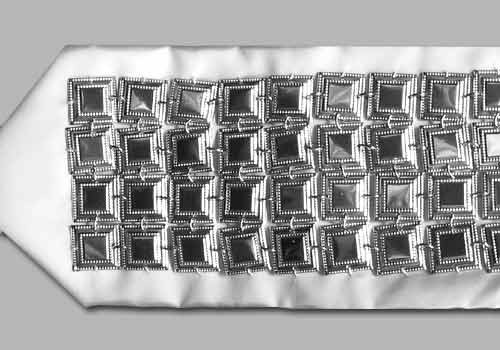
            Maybe it’s just habit, after years of not wearing one; or maybe it’s because of the obligations and commitment it represents, and I’m not ready to take that on; or maybe it’s my father. I loved my father’s tallit. It was the size of a beach towel, with thick black stripes and sterling silver squares covering the atarah, or yoke, of the tallit. It was like a huge tent that could be folded over at the shoulders to give him wings, or spread over his head so he could disappear underneath it into his own personal relationship with God. I think that any tallit I might try to wear, no matter how feminine, or light, would feel like draping the power of my father over my head, and I know in my bones that instead of making me feel safe, it would suffocate me.

A Sterling Silver Atarah (not my picture)

            There are so many things like this, still, in my life, so many relics of the past that I have tried to re-value and scrub clean of their old associations. I have overcome a lot of them, through hard work, but the prevailing notion that anything is possible and all wounds can be healed, just doesn’t ring true for me. Early on in therapy I truly believed I could have a normal life, eventually, if I just put in the work, but now I know that, for me, there are some milestones that will never happen, and some wounds that will never heal, and the scars will be a part of me for the rest of my life. So far, this inability to take on the yoke of Torah, the obligation of daily rituals like wearing a tallit, is one of those unhealed wounds. It’s still possible that, one day, there will be comfort in wearing a tallit of my own, where I can create my own cocoon of time with God, but I’m not there yet.

            But there is comfort in seeing so many women around me embracing their beautiful tallitot, and wearing them with pride and ease. On Yom Kippur, the longest day of the Jewish liturgical year, tallitot are worn starting from Kol Nidre, the evening service, through the next morning and afternoon and on through Neilah, the final service of the long day, at sunset. And multiple times during that long day we sing the Yevarechecha, the priest’s prayer, repurposed as a prayer for community. We drape our arms over the people on either side of us, many using their tallitot to wrap their neighbors and loved ones in a communal tent of peace. And it really is beautiful.

“I should have my own tallit, Mommy.”

If you haven’t had a chance yet, please check out my Young Adult novel, Yeshiva Girl, on Amazon. And if you feel called to write a review of the book, on Amazon, or anywhere else, I’d be honored.

            Yeshiva Girl is about a Jewish teenager on Long Island, named Isabel, though her father calls her Jezebel. Her father has been accused of inappropriate sexual behavior with one of his students, which he denies, but Izzy implicitly believes it’s true. As a result of his problems, her father sends her to a co-ed Orthodox yeshiva for tenth grade, out of the blue, and Izzy and her mother can’t figure out how to prevent it. At Yeshiva, though, Izzy finds that religious people are much more complicated than she had expected. Some, like her father, may use religion as a place to hide, but others search for and find comfort, and community, and even enlightenment. The question is, what will Izzy find?

Rosh Hashanah

            I was dreading Rosh Hashanah. I was already exhausted from the first week back teaching synagogue school, and I hadn’t even tried on my High Holiday clothes from the year before, just crossing my fingers that they still fit. I’d survived the two hour choir rehearsal in the midst of the crazy first week of school, but just barely, and I still had to go to the vet for Cricket’s fluids and Ellie’s heart meds, and do the food shopping, and at the last minute, we had to do three loads of laundry because Cricket had peed on everything, and by the time we were done I had just enough time to take a shower and get dressed in order to get to the synagogue on time.

“All your fault.”

            Almost as soon as I sat down in the choir seats, the senior rabbi came over to tell me I would be doing the second reading – a Mary Oliver poem about her dog. I hadn’t seen the rabbi in person in a while, because I’d been going to services online, so I guess this was his first chance to tell me that he wanted me to read this poem – though I do have email, and a phone. I mentioned that it would be difficult for me to get to the Bima from the choir seats, especially in between songs, and he turned to my mom and complained about how much people like to complain.

I didn’t know exactly when my reading would come up, just that it would be relatively soon. Maybe. And that I couldn’t say no.

The choir was busy for the first part of the service, rarely sitting down. I’d forgotten how much standing was involved in singing with the choir because we were allowed to sit during rehearsals, and then I heard the junior rabbi give the intro for the poem I was going to read, so I put down my music and scooted past Mom and found my way down the aisle and up the stairs to the podium, and I read about Percy, the loving dog who looks up at his person as if she is everything.

            As soon as I was done reading, I had to hurry back to the choir section for the next song, but I felt, in that moment, the reason why I kept saying yes – to singing, to rehearsing, to reading in public, to teaching and exhausting myself – it feels really good to be part of a community, and to be known. Because not only the rabbis, but many of the other people in the room knew why I’d been chosen to read that particular poem. And they knew that I sang with the choir and they knew that I taught in the synagogue school, and they knew my Mom and her photography and quilt work and asked after her when she wasn’t there. They may not all have known how hard it was for me to do all of it, but they saw me, and cared about me, and congratulated me, and it felt good.

            I always dread the high holidays, knowing the work involved and how self-conscious I’ll feel going up on the podium and dressing up and singing into microphones, and all of the extra-long services one after the other after the other. And I always forget how meaningful it is, and how satisfying it is, to be surrounded by so many people sharing the same experience.

            There are, of course, times when I feel like I don’t belong, and when I feel like parts of me are invisible. During the Torah service, for example, our community calls up groups of congregants for the honors instead of calling up individuals, and they’re all in life-cycle related categories: everyone who will be driving a car in the next year; everyone who is newly married or celebrating an important anniversary; everyone with a new baby or grandbaby.

            There are also categories that could apply to me; I’m dreading the time when I can go up for the first Aliyah on Rosh Hashanah, for those who have lost a loved one in the past year. But mostly I feel this otherness, endlessly, because to be a member of the Jewish community often means to focus on the family as the unit of measurement, and I don’t really fit. There’s no Aliyah for people who had to go to more than ten doctors’ appointments in the past year, or people who are pre-emptively grieving the loss of a senior dog, or people who want to do more with their lives, but can’t.

            In a way, I prefer the darkness of Yom Kippur: the focus on what has been difficult and painful over the past year; the focus on what we regret. It’s not that I want to revel in the pain, but there’s relief in knowing that everyone is sitting a second longer than usual with what went wrong, and what was missing, instead of focusing solely on the Instagram-ready celebrations.

            But I made it through the marathon of Rosh Hashanah services, even forcing myself out to Tashlich on the afternoon of the first day of the holiday, when our community has its dog-friendly service out by the water, where we sing and throw away our sins (even the babies seem to revel in throwing their sins, in the shape of bird seed, out to the ducks), and meet all of the canine members of the community who’ve been out of view, but still there with us in spirit, over the past year.

“I don’t mind napping while you go to shul.”

            I pushed myself to go to the outdoor service because I wanted Cricket to be there one more time. She’s never been the most outgoing or friendly dog, and she wasn’t feeling all that well on that day in particular, but I wanted her to know that she was still part of our community, still known and seen and loved.

            And even if it’s hard to live up to the work of being in community, even if sometimes it feels like more than I can do, there are also moments when it all comes together and my sixteen year old dog, and I, know we belong.

If you haven’t had a chance yet, please check out my Young Adult novel, Yeshiva Girl, on Amazon. And if you feel called to write a review of the book, on Amazon, or anywhere else, I’d be honored.

            Yeshiva Girl is about a Jewish teenager on Long Island, named Isabel, though her father calls her Jezebel. Her father has been accused of inappropriate sexual behavior with one of his students, which he denies, but Izzy implicitly believes it’s true. As a result of his problems, her father sends her to a co-ed Orthodox yeshiva for tenth grade, out of the blue, and Izzy and her mother can’t figure out how to prevent it. At Yeshiva, though, Izzy finds that religious people are much more complicated than she had expected. Some, like her father, may use religion as a place to hide, but others search for and find comfort, and community, and even enlightenment. The question is, what will Izzy find?

If I Had the Energy

            If I had the energy, I would go back to Ikea for more bookcases, to line the walls of my room, and the living room, and maybe the hallway and the dining room too, and then I’d fill them all with books.

            If I had the energy, I would go back to school to become a rabbi, or a cantor, or at least a Jewish studies professor.

            If I had the energy I would go for long walks in different places every day, sniffing the smells and breathing the air and listening to all of the sounds, like Cricket and Ellie like to do.

“Walkies?!”

            If I had the energy I would finish writing the novels I’ve started, no matter how many revisions it takes or how much time I’d have to spend fighting my internal demons, and I would keep reminding myself that writing the book is the important thing, even if no one ever reads it.

            If I had the energy I would live on a farm, with horses and sheep and alpacas and one of every kind of dog in the world!

“Other dogs?!”

            If I had the energy, I would go back to ice skating and tennis and learn how to just love what I can do and not always compare my abilities to the people who do these things at the highest levels.

            If I had the energy I would make dinner every night, learning new and complicated recipes for meals that I would love to eat.

            If I had the energy I would travel across Israel, and then across the United States, and then across Europe and then Asia, learning new things and eating new foods and meeting new people.

            If I had the energy, I would go back to school for a PsyD, and train with people I admire, and become a child psychologist so I could help the kids I don’t know how to help now.

            If I had the energy I would write memoirs and mysteries and musicals; I would write down everything I know and every question I have, and then I would read and study and ask and interview until all of my questions were answered, and then I’d start all over again with new questions.

            If I had the energy I would practice guitar and piano every day, and then learn how to play the violin, and the drums.

“That would be loud.”

            If I had the energy I would do the gardening and the landscaping at the co-op so that no one would ever cut one more branch off of one more pawpaw tree.

            But to be fair, if I had all of that energy, I would be overwhelmed, with too much to do and no idea how to decide which of my priorities should go first, and not enough time or money to do it all anyway. Because there are so many versions of me in my imagination, and they all keep competing for what little time and energy and focus I actually have. And even now, when the amount of energy I have in any given day has dwindled down to something incredibly small, I still can’t focus enough to fill that time well and accomplish the things that should be possible, because I spend so much time arguing with myself, unable to stick to one version of me, even for a day, even for an hour.

            So maybe it’s okay that I don’t have the energy to do everything my imagination can come up with, because that would be too much to fit into any one life. And most likely, if I had more energy, I would have an even longer, more unreasonable list of things to do, and the same feeling of failure to live with.

            Maybe the goal is to accept the amount of energy I have today, and hope for more for tomorrow, and be kinder to myself about the limits, to my energy and my focus and my decision making skills,…but I should definitely get over to Ikea to get those bookcases one of these days.

“Bookcases are where you store chicken treats, right?”

If you haven’t had a chance yet, please check out my Young Adult novel, Yeshiva Girl, on Amazon. And if you feel called to write a review of the book, on Amazon, or anywhere else, I’d be honored.

            Yeshiva Girl is about a Jewish teenager on Long Island, named Isabel, though her father calls her Jezebel. Her father has been accused of inappropriate sexual behavior with one of his students, which he denies, but Izzy implicitly believes it’s true. As a result of his problems, her father sends her to a co-ed Orthodox yeshiva for tenth grade, out of the blue, and Izzy and her mother can’t figure out how to prevent it. At Yeshiva, though, Izzy finds that religious people are much more complicated than she had expected. Some, like her father, may use religion as a place to hide, but others search for and find comfort, and community, and even enlightenment. The question is, what will Izzy find?
Missing Choir

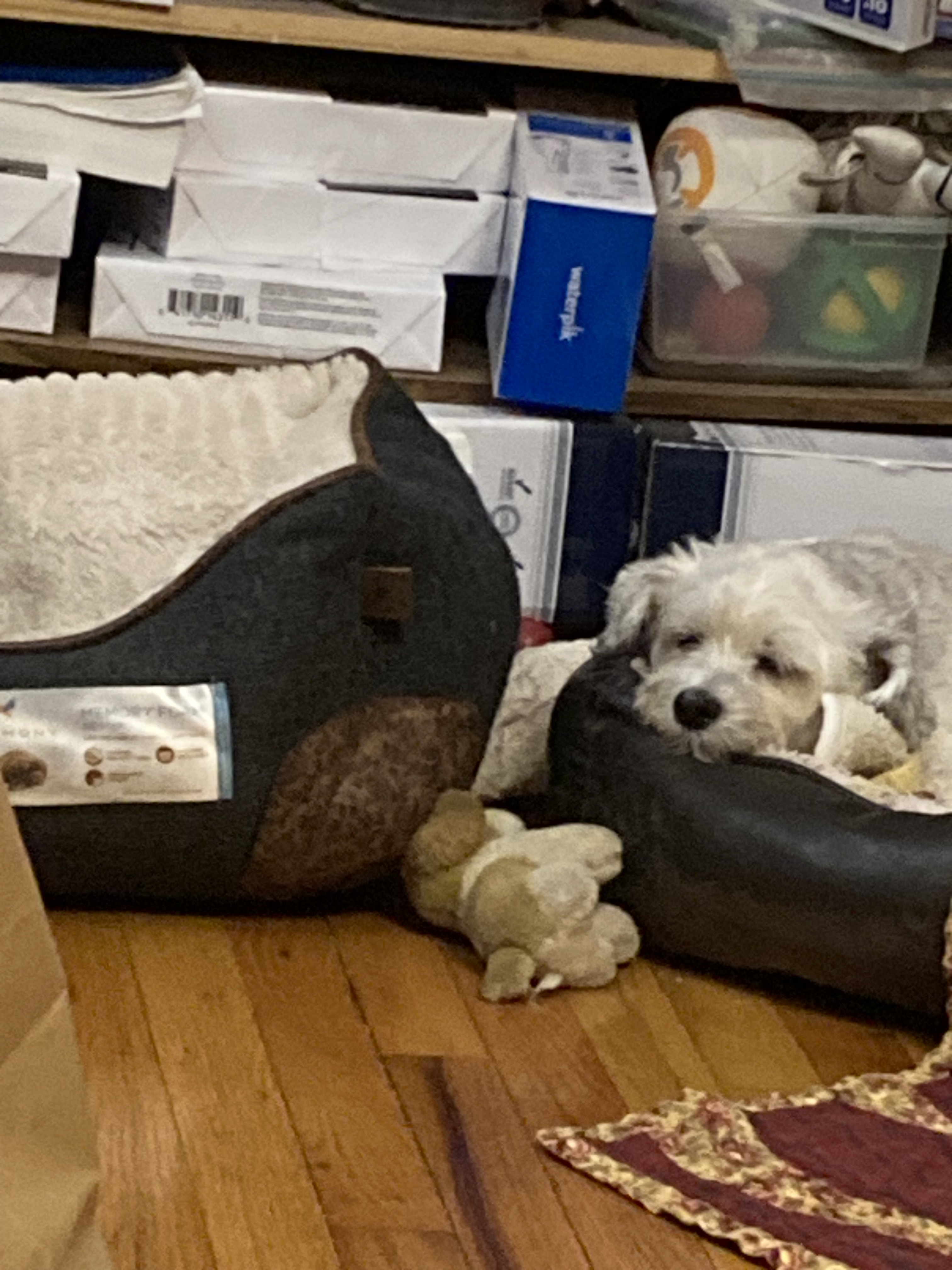
            It’s a summer ritual to have choir rehearsals at the synagogue to prepare for the fall Jewish holidays (Rosh Hashanah and Yom Kippur), but I haven’t been able to get to most of them this year. I went to one rehearsal early in the summer, but then there was surgery and car issues and doggy doctors’ appointments and human doctors’ appointments and on and on. Choir rehearsals are always at eight o’clock at night, so even when I wasn’t sick at home or busy somewhere else, I was just too exhausted to drive out to the synagogue at night, in the heat. I finally got to a rehearsal this week, but the next one will be on the night of my first day back teaching synagogue school, and I don’t know if I’ll be up to it.

“We’re exhausted for you, Mommy.”

            I feel torn. I’ve worked so hard over the years to learn the music, and even harder to teach myself how to sing the alto part while the bases and tenors roar behind me. And being in the choir makes me feel like I’m part of the service instead of just following along. But, of all of the things on my schedule right now, choir is the only one I can realistically let go of; I can’t stop going to doctors’ appointments, or driving Mom or the dogs to their doctors’ appointments, and I can’t give up on teaching, both because it’s my only paying job, and because it’s the way I feel most useful in the world.

            But, I feel like if I drop choir I’ll be letting people down, and separating myself even more from my community. All summer long I was only able to go to Friday night services online, instead of in person, because I just didn’t have the energy to get dressed again and go out. But while everyone else was there in person, I was just watching whatever parts were visible on screen, and I felt the loss.

            My hope is that I’ll be able to get to the rest of the rehearsals, because I don’t want to keep losing things that matter to me, but I also need to be able to give myself a break when things are too hard. I’ve put in so much work to improve my life and my health and I’m hoping it will start to pay off soon. I especially have my fingers crossed that finally getting back into the classroom will bring me enough joy to help me get through everything else.

            With all of the chaos going on, I’ve been trying to focus on the things that are working: like revising my lessons plans and getting excited to teach again; and watching Cricket stubbornly insist on staying alive; and watching Ellie thrive on her new heart meds; and reading books and watching TV and listening to the birds. I’m trying to stop and appreciate every good moment that comes along, and not let the not-so-good moments bully the good ones out of the way. But it’s a battle.

“We’re helping, Mommy.”

If you haven’t had a chance yet, please check out my Young Adult novel, Yeshiva Girl, on Amazon. And if you feel called to write a review of the book, on Amazon, or anywhere else, I’d be honored.

            Yeshiva Girl is about a Jewish teenager on Long Island, named Isabel, though her father calls her Jezebel. Her father has been accused of inappropriate sexual behavior with one of his students, which he denies, but Izzy implicitly believes it’s true. As a result of his problems, her father sends her to a co-ed Orthodox yeshiva for tenth grade, out of the blue, and Izzy and her mother can’t figure out how to prevent it. At Yeshiva, though, Izzy finds that religious people are much more complicated than she had expected. Some, like her father, may use religion as a place to hide, but others search for and find comfort, and community, and even enlightenment. The question is, what will Izzy find?

Ellie’s Belated Return to the Groomer

After months of worrying symptoms and doctor visits and medication, Ellie’s heart failure has stabilized enough so that we finally felt safe taking her to the groomer to deal with her very overgrown mop of hair. It was also Ellie’s first visit to the groomer alone since she’s been with us (four years!), because Cricket doesn’t need much grooming and I didn’t think she would be up to the stress of it anyway.

“I’m perfect just as I am.”

            As we were leaving the apartment, I made sure to give Cricket a Greenie (a green dog treat, shaped like a toothbrush, with questionable teeth cleaning capabilities) to keep her occupied while Ellie had her leash put on, and immediately, Ellie snapped her teeth on the Greenie, already in Cricket’s mouth! They stood there fighting silently over that Greenie with all of their might, and somehow Cricket managed to hold on to it until I could convince Ellie to let go and follow me to the front door.

And I was sort of in shock.

Ellie, my calm, loving, usually submissive sweetie pie, had actually tried to steal food from her grumpy, stubborn, aged sister’s mouth?!

“Who, me?”

            I was laughing out loud as I led Ellie outside, thrilled both that Ellie’s appetite was back in full force, and that Cricket still had the strength to fight for what was hers.

            Once outside, Ellie ran gleefully to the car, seemingly forgetting that she’d missed out on a treat, possibly because she’d finally remembered that she’d had a full breakfast just moments earlier.

            On the drive to the groomer, Mom sat in the backseat with Ellie to keep her company and defuse her car anxiety and the weirdness of not having Cricket there with her. When we dropped Ellie off at the groomer, I started to feel more anxious about leaving her there, out of my sight, for hours. She still coughs every once in a while, even though her medications seem to be managing most of her heart failure symptoms. But I tried to be positive and focused on driving Mom to her Neurologist’s office, where she would hopefully find some relief for the pain in her legs and feet, if not a cure for the numbness that has prevented her from driving lately. And then, while sitting in the waiting room at the doctor’s office, I was preoccupied with worrying about Mom, and worrying about leaving Cricket alone at home for so long, and then worrying about fifteen or twenty other things swirling in my mind, and there wasn’t much room to worry about Ellie, who, at the very least, was not alone.

After the doctor’s appointment we had to stop off at CVS to pick up prescriptions, and to drop off one for Ellie (because one of her medications is only available at the human pharmacy), and then we went to the market that always has chicken livers, unlike our regular supermarket, because when Cricket is refusing to eat anything else she will still eat chicken livers. She’s often not hungry in the morning, but that’s when we need to give her the doggy Xanax to help her calm down enough to receive her subcutaneous fluids to manage her kidney disease. Chicken livers, and cinnamon buns, oddly, seem to be our most reliable treats when the wet dog food isn’t tempting enough.

And then we were back at the groomer to pick up Ellie, who was now less than half the dog she’d been a few hours earlier, and thrilled to be going home.

            Cricket was standing at the door waiting for us when we returned home, and she thoroughly examined her shorn sister, to see what fresh hell she’d been through, but more importantly, to find out if she’d had any secret treats (she had, her groomer loves to give her treats!).

            And then the dogs banded together to beg Grandma for even more treats, eventually running out of steam and deciding to start their favorite afternoon activity, sleep tourism, wherein they proceed to take naps in as many different places throughout the apartment as possible. And then I was able to relax too, knowing we’d all made it through another challenging day. Together.

If you haven’t had a chance yet, please check out my Young Adult novel, Yeshiva Girl, on Amazon. And if you feel called to write a review of the book, on Amazon, or anywhere else, I’d be honored.

            Yeshiva Girl is about a Jewish teenager on Long Island, named Isabel, though her father calls her Jezebel. Her father has been accused of inappropriate sexual behavior with one of his students, which he denies, but Izzy implicitly believes it’s true. As a result of his problems, her father sends her to a co-ed Orthodox yeshiva for tenth grade, out of the blue, and Izzy and her mother can’t figure out how to prevent it. At Yeshiva, though, Izzy finds that religious people are much more complicated than she had expected. Some, like her father, may use religion as a place to hide, but others search for and find comfort, and community, and even enlightenment. The question is, what will Izzy find?
The Ozempic Experiment

Two and a half years ago, I started to work with a nutritionist who specialized in Intuitive Eating. I really wanted to believe that Intuitive Eating would be the answer for me, because I was starting to believe that I would have to be on starvation diets for the rest of my life, and I knew I couldn’t live like that. The nutritionist worked with The Intuitive Eating Workbook, by Evelyn Tribole and Elyse Resch, and had a lot of experience working with people with trauma backgrounds, and autoimmune disorders, and a history of eating disorders, so she seemed like the right person to help me feel safe with food, and feel comfortable in my body, and be able to maintain a healthy weight.

“I can help. Just give me all your food.”

We worked through all of the exercises in the Intuitive Eating Workbook together, charting my hunger and fullness levels, writing down all of my destructive thoughts around food and learning how to reframe them, and overall trying accept that dieting, or restricting food in particular, was not a good long term answer to my problems, given all of the evidence that diets lead to more eventual weight gain. I worked hard at balancing my meals, adding more protein to breakfast, and more vegetables to lunch, and more fat here and there so that I would feel full at the end of each meal. But despite all of my efforts, my weight continued to go up, a little bit at a time, until I’d gained back everything I’d lost on Weight Watchers five years before. The nutritionist said that, given all of my efforts, she was sure I would have been more successful with Intuitive Eating if only I hadn’t been suffering from so many other health problems at the same time, and I tried to believe her, and kept trying.

            And then, a few months ago, I started to get a series of out of range blood test results. First my Adrenal values were high, and the endocrinologist sent me for a CT scan of my abdomen to see if there were nodules on my adrenal glands causing the raised numbers. But my adrenals were clear, and a repeat blood test showed that my Adrenal levels were back to normal, but now my liver values were high. So I was sent to the gastroenterologist, who sent me for an ultrasound of my liver and redid the blood tests, again. The new blood tests said that my liver values were normal, but the ultrasound showed a severe nonalcoholic fatty liver, and both the gastroenterologist and the endocrinologist said that weight loss was the only currently accepted treatment for a fatty liver, and if I didn’t address it now I could end up needing a kidney transplant down the line. But after so many years of trying every diet and non-diet available, I felt hopeless, so they suggested weight loss medication. In the past, the options for weight loss medications were generally too dangerous or unreliable to be recommended by most doctors, but with recent advancements in the field there has been more hope, or at least more things to try. And after all of the doctors’ visits and variable blood test results and finding out about the fatty liver, I was desperate enough to agree to try Ozempic.

            I thought that my nutritionist would be against the whole idea of a weight loss medication, since it goes against the accept-your-body-as-it-is principles of Intuitive Eating, but she was on board immediately, for the sake of my overall health. But I still felt uncomfortable. I’d heard all kinds of the stories about the gastrointestinal side effects of Ozempic and other drugs like it, and there has been so much shame in the air around celebrities taking Ozempic, either because people think that taking a weight loss drug is frivolous or because they think it’s a sign of weak character. I was also worried that my health insurance wouldn’t cover the medication, or that I’d be one of the people who didn’t lose weight on Ozempic, or worse, that taking Ozempic would destroy my ability to enjoy eating, which I rely on heavily to get me through so many other things in my life.

“Puppy kisses help too, right?”

            But my health insurance paid for the Ozempic prescription, and I took that as a sign to move forward with it. I started at a low dose a few weeks ago, and so far there haven’t been any side effects, or any impact at all. I’m okay with taking it slowly, and building up the dose at a pace that my body can handle, but I’m still worried that as the dose goes up so will the side effects, and that even on a higher dose I won’t lose weight, since so many medications that seem to work for other people haven’t worked for me.

            But all I can do now is wait and see what happens, if the Ozempic works for me or not, and if weight loss will return my liver to a healthier state or not. In the meantime, I haven’t given up on Intuitive Eating, because even if it hasn’t changed my body, it has done a lot to change my mind, calming the noise in my head around food and weight and body type, and that relative quiet has left room for more positive thoughts to creep in. And as a result of that realization, I’ve started to adapt some of the Intuitive Eating exercises to see if they can help me create more calm in my mind around writing, where the noise has been even louder than it ever was around food.

Whatever happens, I’m hopeful that progress will continue from all of my efforts, even if I’m not sure what that progress will look like.

“We’re ready.”

If you haven’t had a chance yet, please check out my Young Adult novel, Yeshiva Girl, on Amazon. And if you feel called to write a review of the book, on Amazon, or anywhere else, I’d be honored.

            Yeshiva Girl is about a Jewish teenager on Long Island, named Isabel, though her father calls her Jezebel. Her father has been accused of inappropriate sexual behavior with one of his students, which he denies, but Izzy implicitly believes it’s true. As a result of his problems, her father sends her to a co-ed Orthodox yeshiva for tenth grade, out of the blue, and Izzy and her mother can’t figure out how to prevent it. At Yeshiva, though, Izzy finds that religious people are much more complicated than she had expected. Some, like her father, may use religion as a place to hide, but others search for and find comfort, and community, and even enlightenment. The question is, what will Izzy find?

Cricket and the Wee Wee Pad Path

A couple of weeks ago, when Cricket lost the ability to hold off peeing until she could reach the wee wee pad by the front door, we created a yellow brick road of wee wee pads, from Grandma’s bed to the front door, to help her out. And, either as a result of the Gabapentin and ACE she takes every day (in order to tolerate the subcutaneous fluids for kidney disease), or because of incipient dementia, Cricket has started to pace around the apartment at all hours, peeing along her wee wee pad path, especially in the middle of the night.

            After she’s jumped off Grandma’s bed, to get a drink of water and to pee, Cricket will come to my room, sometime around four o’clock in the morning, and bark at me for the mommy-elevator up onto my bed, where she wanders around and around in search of the perfect sleeping spot, which is often elusive. For some reason, Ellie has decided that instead of staying in my room at night, the way she used to, she prefers the wee wee pads – at least the as yet unused ones – as her favorite place to sleep.

“Are you telling my secrets, Mommy?”

When I accept the inevitable and finally get up, around 7 AM, Cricket and Ellie are ready to go outside, walking down the stairs together if Cricket is up to it. Neither one of them can run and play the way they used to, but Ellie gets a lot of enjoyment just by standing still and listening to the sounds of the neighborhood, while her sister wanders around the yard sniffing all the smells.

When we get back inside it’s time for Ellie’s medication, carefully stuffed into small pieces of chicken or chicken liver, with a few pieces going to Cricket as well. And, if she’s willing, Cricket gets her ACE and Gabapentin in her food too, so we can get her fluids done early and give her time to pee it all out during the day, instead of needing to walk her path so much overnight.

“Give me more fluids and I’ll be swimming down the hallway!”

We’re still in the trial and error phase with all of this, constantly adapting their diets and schedules and adapting our expectations of what they can and can’t do, based on how things are going each day. Ellie is mostly consistent, though she needs new high value treats every few days to help her tolerate all of her pills. Cricket is the wild card. Some days she seems like she could go at any moment, and other days she seems so normal that we almost get complacent. Almost.

We’ve started to get rid of rugs that have been peed on too often, by both of them, and we’re doing a lot of extra laundry, but we love them, so we walk the wee wee pad path, replacing one pad here and there as we go along, trying to keep them happy and comfortable. I wouldn’t have chosen this, but I wouldn’t want to miss a day of having them in my life either, so this is what love looks like right now.

If you haven’t had a chance yet, please check out my Young Adult novel, Yeshiva Girl, on Amazon. And if you feel called to write a review of the book, on Amazon, or anywhere else, I’d be honored.

            Yeshiva Girl is about a Jewish teenager on Long Island, named Isabel, though her father calls her Jezebel. Her father has been accused of inappropriate sexual behavior with one of his students, which he denies, but Izzy implicitly believes it’s true. As a result of his problems, her father sends her to a co-ed Orthodox yeshiva for tenth grade, out of the blue, and Izzy and her mother can’t figure out how to prevent it. At Yeshiva, though, Izzy finds that religious people are much more complicated than she had expected. Some, like her father, may use religion as a place to hide, but others search for and find comfort, and community, and even enlightenment. The question is, what will Izzy find?

The Power of Distraction

            I had to have a virtual colonoscopy recently. The virtual part meant that after all of the awful prep, I went to a lab and they filled my colon with air and took CT scans, instead of putting me under anesthesia and doing a more invasive procedure. The gastroenterologist was being cautious with me because I have Ehler’s Danlos (a genetic disorder that causes thin skin and loose ligaments and can make internal organs more prone to injury), and he couldn’t get a clear enough idea from the geneticist of which type of the disorder I have so he assumed that I was too fragile for the real test. Thank God. The caveat, though, was that if they found anything on the scans that needed to be addressed, I’d have to redo the prep and go back for a traditional colonoscopy, Ehlers Danlos be damned. Honestly, the idea of going through the prep again sounded much more frightening to me than going under anesthesia and risking bleeding out.

            Before I went in for the virtual colonoscopy, the lab sent the instructions telling me how to prepare. First, I had to avoid dairy and high fiber foods three days before the test, and then I had to drink only liquids the day before the test, with no pulp or food coloring, and then at a certain time I had to take two Dulcolax pills and then drink a bottle of Miralax mixed with 64 ounces of Gatorade, and then take two more Dulcolax pills, and then drink two different kinds of unpalatable contrast to make the colon more visible on the scans. The endless trips to the bathroom were nothing compared to the horror of trying to swallow those bitter, chemical-tinged liquids of suspicious density.

“Yucky.”

            The saving grace throughout all of that prep was Netflix. I couldn’t really concentrate, both because my tummy was rumbling and because I was anxious about the results of the test, so I distracted myself with hours and hours of Netflix shows: there was an Australian teenage surfing show called Surviving Summer, and an American show called Sweet Magnolias, but my favorite was a show called Mismatched, set in Jaipur, India, about two teenage techies named Dimple and Rishi who spend the summer at an app development course. It’s romantic and funny and silly and full of teenage drama and even a few Bollywood-style dance numbers, and by the time I’d finished watching the second season the colonoscopy was over and I’d forgotten that I was listening to dialogue in Hindi and reading subtitles.

“I understood every word.”

            Even a few years ago, I would never have thought that I would feel so connected to a show set in India, with teenagers who speak a language I don’t understand, but Netflix has opened up whole new worlds for me. I’ve binged shows in Hindi, and Korean, and Spanish, and Italian, and of course English, that I would never have seen otherwise.

            Don’t get me wrong, I’ve found a lot of duds along the way, and I’ve had to watch the first few minutes of a lot of shows I wish I’d never seen, but the number of wonderful surprises has made it all worth the effort.

.           With the writers’ strike meaning that there are no late night shows on the air, and now the actors’ strike on top of that probably meaning that the fall TV season will be delayed, or replaced with reality shows, it’s a relief to know that I can always find something I’ve never heard of, but will thoroughly enjoy, on Netflix. It’s ironic, though, that the strikes are very much about the compensation problems with the Netflix streaming model, and yet Netflix and other streamers are the ones who are benefiting from the lack of network shows. I feel like I should feel guilty or disloyal for watching Netflix, but instead I’m just happy that I get the chance to discover so many actors and writers from around the world who I would never have seen on network TV in the United States. And maybe the strike will lead to these hard working creators being better compensated for making all of these wonderful shows. I hope so.

            And now that the colonoscopy is over, and I know that I don’t have to have another one for five years, I’ve already found new shows to help me get through all of the vet visits and doctor visits that seem to be my lot this summer. There’s a great show from England called Heartstopper, based on a series of graphic novels about LGBTQ+ high school kids in love, and a Korean show called Extraordinary Attorney Woo, about an Autistic woman who becomes a lawyer, and they are both sweet and quirky and smart and surprisingly insightful and compassionate.

            I wish I didn’t need so many distractions to help me get through each day lately, but I’m grateful that there are such good distractions available, and I’m hoping that, maybe, they will inspire more of my own writing. At the very least, they make me feel more hopeful about the world around me, and that’s no small thing.

If you haven’t had a chance yet, please check out my Young Adult novel, Yeshiva Girl, on Amazon. And if you feel called to write a review of the book, on Amazon, or anywhere else, I’d be honored.

            Yeshiva Girl is about a Jewish teenager on Long Island, named Isabel, though her father calls her Jezebel. Her father has been accused of inappropriate sexual behavior with one of his students, which he denies, but Izzy implicitly believes it’s true. As a result of his problems, her father sends her to a co-ed Orthodox yeshiva for tenth grade, out of the blue, and Izzy and her mother can’t figure out how to prevent it. At Yeshiva, though, Izzy finds that religious people are much more complicated than she had expected. Some, like her father, may use religion as a place to hide, but others search for and find comfort, and community, and even enlightenment. The question is, what will Izzy find?

Three Little Pawpaws

Pawpaw 1

            Before the summer even began, the gardeners (the new ones) decided to prune the Pawpaw tree (AKA, rip off the lower branches without permission), and I was worried we wouldn’t get any fruit this year. I was grateful, though, that at least these gardeners didn’t cut down a whole tree (the way the previous ones did), and it turns out that we do have three small Pawpaws growing on the upper branches of the tree. The new gardeners also seemed to think they should weed Mom’s little fenced-in garden, and so far they’ve pulled up a potato plant and oregano, but no weeds. To be fair, I wouldn’t know the difference either, but that’s why I am not a gardener.

Pawpaw 2
Pawpaw 3

I don’t know how anyone does anything outdoors in the kind of heat we’d had recently, because I can barely breathe in it and certainly can’t think clearly, but Mom has still been working in her garden and we’ve had workmen in and around the Co-op redoing the heating system, and I feel vicarious incipient heat stroke whenever I see them outside.

Mom’s garden

With both dogs not feeling well lately, we’ve been limiting their walks during the day, so I haven’t had the chance to visit the Pawpaw tree as much as usual to see if there are any more Pawpaws hiding in there. But I know the tree is thriving. It’s gotten so tall that there could be plenty more Pawpaws higher up that I’d never see until they fall on my head in September. And the baby trees, about fifty feet away, are getting taller too, though it will probably be quite a few years before they begin to fruit.

            At some point, the weather will have to relent, and the Pawpaws will be ripe and ready to eat, but I don’t know if I will still have both of my dogs by then, so it’s hard to think ahead and wish for the cooler weather.

            I hate that so much love has to come with so much loss, but I haven’t figured out a way to have the one without the other. Yet. If you figure it out first, please let me know.

My puppies

If you haven’t had a chance yet, please check out my Young Adult novel, Yeshiva Girl, on Amazon. And if you feel called to write a review of the book, on Amazon, or anywhere else, I’d be honored.

            Yeshiva Girl is about a Jewish teenager on Long Island, named Isabel, though her father calls her Jezebel. Her father has been accused of inappropriate sexual behavior with one of his students, which he denies, but Izzy implicitly believes it’s true. As a result of his problems, her father sends her to a co-ed Orthodox yeshiva for tenth grade, out of the blue, and Izzy and her mother can’t figure out how to prevent it. At Yeshiva, though, Izzy finds that religious people are much more complicated than she had expected. Some, like her father, may use religion as a place to hide, but others search for and find comfort, and community, and even enlightenment. The question is, what will Izzy find?