Tag Archives: Israel

Oh, But There’s More

            As if things around here haven’t been dramatic enough, Mom finally went to see a new orthopedist in November, to check on the pain in her left leg, and the new doctor confirmed that the left hip is now at the bone on bone stage and needs to be replaced, like, now.

I keep having flashbacks to two summers ago when Mom had her right hip replaced, and ended up needing a second surgery six weeks later to fix the mistakes of the first surgery, and then had to be hospitalized again a few weeks later when fluid filled her lungs as a result of the two anesthesias. I spent that whole summer feeling like the world was crashing down, and now, after losing two dogs in two months and with Mom going in for surgery again, my existential dread is back in the danger zone.

And then came Covid.

The day before Ellie died, Mom and I went for our yearly Covid shots and quickly forgot about them in our grief. Within a week I had what I thought was a cold, and it made sense to me that I would get sick given how awful I felt at losing Ellie, so I didn’t question it. Though I do remember thinking, huh, this is the first cold I’ve had since before the whole Covid thing started.

When I finally had the energy to go out and do my chores I wore a KN95 face mask, thinking I just didn’t want to spread what was left of my cold. I went to the drug store and did some food shopping, and then I went home to take five naps. The symptoms of the cold (sneezing and coughing and nausea and feeling like my limbs were about to fall off) seemed to be over, but I still thought I should wear my mask when I went to teach the kids, just in case.

I’ve been organizing things around the living room, since Ellie’s death, so when I got home from teaching that day and was too tired to move from the couch, my eye caught on a box of Covid home tests across the room and I thought, huh, maybe I should just check. I don’t know why this thought didn’t occur to me before I went out, but it didn’t. Honestly, I’d taken so many tests over the past few years, each time I had a bad allergy day or heard about someone who’d gotten Covid, and the tests had always been negative, so it just seemed like a science experiment, and a way to use up the leftover home tests now that they were a month or two out of date.

I took the test, and it was positive. So I took another test, and it was positive too. Then Mom took a test and she was positive too, and I felt like shit. I wrote to my boss to let her know I had Covid, expecting her to be in a rage that I’d been so stupid to not think of taking the tests before coming to work, but, of course, she was kind and just asked how I was feeling and what she should teach when she subbed for my class.

I have never missed work since I started this job. It’s a very part time job, so that’s probably not as big of an achievement as it seems, but to me it’s a big deal, because I am often very, very tired and I always impress myself when I get up and out and actually manage to drive safely and even teach. I had on my KN95 mask for the two hours I’d been at school with the kids, and most of my symptoms were already gone, so, fingers crossed, I didn’t get anyone sick. But even knowing all of that, I felt like a mass murderer (I’ve been watching the news a lot, and the way the world seems to think every Jew is killing people just by being Jewish has hit me hard. My father made it clear that, as a female, I was the cause of all evil in the world, and now large swaths of the world seem to think that being born Jewish makes me the cause of all evil too, so…I’m feeling it).

I don’t know where I got Covid from, and the fact that I gave it to Mom, who was already suffering with her hip pain, just sucks. But we spent the next few days at home, rescheduling Mom’s pre-op testing appointments, and hoping for the best.

            And now that we’ve both been feeling better, at least Covid-wise, I’m back to grieving for Ellie, and being consumed by the news about Israel, and worrying about all of the doctors’ appointments coming up, and having nightmares about what will happen during the surgery, and after.

            In normal, and even not so normal times, Mom does everything she can to make things easier for me, often too much. But she won’t be able to help with anything for a while – not cooking or cleaning, certainly not errands and laundry and food shopping; and there’s no dog to help lift my spirits and put things in perspective, and it’s so dark and it’s getting cold and the world is such a scary place and…

I know I’m supposed to be an adult, with all kinds of inner resources and strengths to manage things like this, and I’m doing my best, watching as many Christmas movies as possible to distract myself, and taking each challenge one at a time, but I’m not okay. I want Ellie back and I want Mom to be healthy and I want the war to be over. Now.

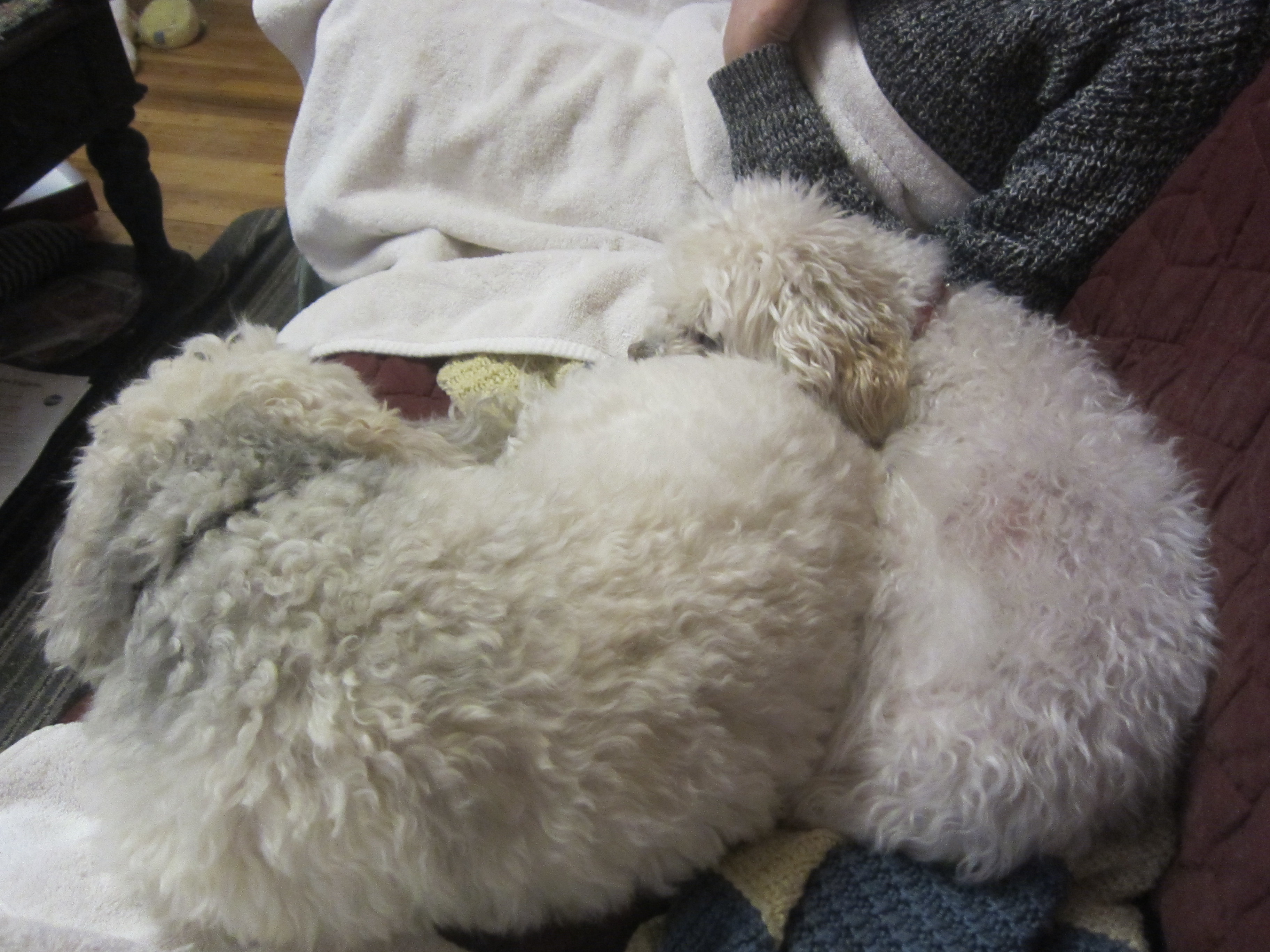
The stuffed animals are keeping the dog beds warm.

If you haven’t had a chance yet, please check out my Young Adult novel, Yeshiva Girl, on Amazon. And if you feel called to write a review of the book, on Amazon, or anywhere else, I’d be honored.

            Yeshiva Girl is about a Jewish teenager on Long Island, named Isabel, though her father calls her Jezebel. Her father has been accused of inappropriate sexual behavior with one of his students, which he denies, but Izzy implicitly believes it’s true. As a result of his problems, her father sends her to a co-ed Orthodox yeshiva for tenth grade, out of the blue, and Izzy and her mother can’t figure out how to prevent it. At Yeshiva, though, Izzy finds that religious people are much more complicated than she had expected. Some, like her father, may use religion as a place to hide, but others search for and find comfort, and community, and even enlightenment. The question is, what will Izzy find?

On the Coverage of the War in Israel and Gaza

            I have been trying to write my thoughts on this for weeks, but I’ve been afraid of getting things wrong, or of bringing down anger from any and all directions. I have a fourteen page draft of a blog post that seems more like a thesis than a personal essay, but I’m not an expert on the history of Israel, or military tactics, or academic jargon, or even anti-Semitism; I care about those things, and am impacted by them, but other people will do a much better job of holding forth on those subjects than I ever could.

“Don’t look at me.”

            What I can write about is how it has felt to watch the news lately, and be on social media, being told by so many people what I should think, or do, or say in the aftermath of the Hamas attack on Israel on October 7th, a day after the fiftieth anniversary of the Yom Kippur war. I don’t believe that Jews, or Israel, should be immune to criticism; I also don’t believe that Hamas is anything but a terrorist group (calling them a liberation group suggests a real misunderstanding both of their mission and of how they have governed Gaza for the past decade and a half). What I know for myself is that hearing about the massacres on October 7th made me worry about family and friends in Israel, but watching the gradually more toxic responses around the world, and especially on American college campuses, has been frightening. I thought for sure that the chants of “from the river to the sea,” which is a demand for the eradication of the State of Israel and its current population of more than eight million Jews, plus two million non-Jews, would convince people that this pro-Hamas reaction is morally wrong, but that hasn’t happened. I thought it was the norm to recognize the difference between Hamas and Palestinians in general, and that everyone knew the difference between Israelis living within the internationally accepted borders of Israel (like the ones who were massacred and kidnapped), and Jewish settlers in the West Bank, but no. In fact, a lot of the terminology being thrown around about Israel (colonialist, apartheid, genocide) has become mainstream in a way I never expected. Social media is powerful in creating false narratives, and even more successful in advancing partial narratives that are misleading.

            An enormous number of Israelis who spent the past year protesting against Benjamin Netanyahu’s far right government and its attempts to peel away layers of democracy are now fighting for their country’s survival, both in the military and in thousands of volunteer efforts to help the survivors from the south, who had to escape Hamas and Islamic Jihad rockets, and evacuees from the north, escaping Hezbollah rockets. I am proud of how quickly Israelis were able to find their way forward, and worried about the choices of the military and the government, and frightened by the lack of critical thinking and journalistic ethics that seem to abound right now when facts would be really helpful. I am proud of the Haredi (ultra-orthodox) Jews in Israel who are joining the army for this war, despite a very contentious law that allows them to avoid military service in favor of study, and I’m angry at some Jewish settlers in the West Bank who think they have a religious right to hurt their Palestinian neighbors.

            But I can’t fix any of those things. I cannot vote in Israel, and I can’t call every reporter who takes Hamas’ word without evidence and remind them that that’s just stupid. I can only be here, living my own little life in New York, and sending prayers to my family and friends who really need it right now.

“I pray all the time, Mommy.”

            At my synagogue, on Long Island, we’ve spent a lot of time talking about how we find comfort right now, since that’s really all we can control. We’ve had speak ups, to share our grief and confused feelings, and vigils, for the survivors and the dead and the missing and all those on the ground who are still in danger. One of the rabbis from my synagogue joined a group of New York rabbis for a short trip to Israel, to show solidarity and to learn more about what’s going on. I think, right now, many American Jews, because we are further away from the danger and, in most cases, experiencing less direct trauma, are wishing for ways to reach peace. But we, I, have no idea what the military realities are, and what it will take to make Israelis safe again. I refuse to tell Israel what they should do, though, of course, I have questions.

            I have a lot of trouble with people who equate the horror of a massacre perpetrated on civilians and a war conducted, or at least trying to be conducted, under the set rules of war.

            My focus has been on finding podcasts and articles that can help me understand more of what it feels like to be in Israel right now, so that I can be more empathetic, and to reassure me that Israel is a real place and not this cardboard cutout of evil that often gets portrayed by Pro-Palestinian activists on American college campuses.

            Israel Story, a great podcast in English that shares stories from all segments of Israeli society, has been posting short interviews with Israelis in different sectors during the current war. In the past, Israel Story has covered many Palestinian stories with empathy and clarity, humanizing and coloring in details of lives we often don’t get to hear about. The archives are full of those stories, but right now the most powerful of the short interviews I’ve heard was with a father who rescued his teenage son from the music festival in the South of Israel after the massacre had begun. www.israelstory.org/episode/sivan-avnery/                I’ve also been listening to podcasts from a school in Jerusalem called the Shalom Hartman Institute which has done a lot of work bringing together religious and secular, American and Israeli, and finding ways to have difficult conversations that are productive and even inspiring. I also watched a webinar interview with Yehuda Kurtzer, the president of the Institute in North America, that addressed what it feels like in Israel right now, and how liberal American Jews are dealing with the current news environment. https://youtu.be/Glia_tSZqmo?si=g3Fr8T4XR_D7Qkwk

            I go to the Forward and the Times of Israel and the Atlantic for articles that help me understand the issues involved. Here are links to two of the many articles that I’ve found helpful: https://blogs.timesofisrael.com/why-is-israel-being-blamed-for-the-hamas-massacre/

            I go to Kveller and Nosher and My Jewish Learning for a break from the news and a chance to remember that there is still Jewish joy and silliness, and comfort food, and so much to learn about being Jewish that has nothing to do with politics or war.

            But most of all I go to music. I have a ridiculously long Israeli music playlist on Spotify filled with music from Ishai Ribo and Hanan Ben Ari and Yuval Dayan and Keren Peles and Jane Bordeaux and Ofra Haza and Arik Einstein and David Broza and Hadag Nachash and Hatikva 6, and I keep finding more musicians and more music to remind me that there is more to Israel than this war.

Hanan Ben Ari – https://youtu.be/z27MZP_4P_U?si=uu7wqn1pEn6cRdd8

Ishai Ribo – https://youtu.be/7mmu6EzLZfM?si=egySHSIHEU0ckn7t

Jane Bordeaux – https://youtu.be/5t59s1sa1oc?si=o2XozKDDdpCiaSFA

Yuval Dayan – https://youtu.be/V4qsi4V-NFY?si=FqlWyWA40AIKhBYA

            So that’s where I’m at right now. I’m still trying to write out my thoughts on the war itself, and the history that led to it, mostly for my own clarification, but the rest of the time I’m taking a lot of deep breaths, and listening to voices across the spectrum, when I’m up to it, and listening to music when I’m not.

            I wish everyone Besorot Tovot, good news to come, and comfort and understanding until that time comes.

“Paws crossed.”

If you haven’t had a chance yet, please check out my Young Adult novel, Yeshiva Girl, on Amazon. And if you feel called to write a review of the book, on Amazon, or anywhere else, I’d be honored.

            Yeshiva Girl is about a Jewish teenager on Long Island, named Isabel, though her father calls her Jezebel. Her father has been accused of inappropriate sexual behavior with one of his students, which he denies, but Izzy implicitly believes it’s true. As a result of his problems, her father sends her to a co-ed Orthodox yeshiva for tenth grade, out of the blue, and Izzy and her mother can’t figure out how to prevent it. At Yeshiva, though, Izzy finds that religious people are much more complicated than she had expected. Some, like her father, may use religion as a place to hide, but others search for and find comfort, and community, and even enlightenment. The question is, what will Izzy find?

Cold Case

            I’ve been re-watching a show called Cold Case on the Roku streaming channel. When I saw it on there a few months ago I remembered feeling safe in the hands of the writers and actors on the show, so when I needed reassurance, with the grief of losing Cricket and watching the recent events unfold in Israel, I started watching the episodes from the beginning, often instead of watching the news.

The magical Cricket

The premise of Cold Case is that this particular Philadelphia homicide squad focuses on cases that have been left unsolved for years, even decades. More often than not, the storylines hold secrets that couldn’t have been told in their own time, either because of the prejudices of the day or the inability of the traumatized people involved to speak up. Music helps to set each episode at a particular place and time, and we see the scenes play out both in the past and the present to bring the story to life, but the real power of the show is in the way the detectives genuinely care about what happened to these people, even so many years later, as if they really believe that every life matters and every story deserves to be told.

            I remember so many times in graduate school, both for writing and for social work, when the lesson was the opposite: that no one life really matters that much. In social work, the focus was on the collective – the family, community, institution, etc. – as opposed to the individual. And in writing workshops it was all about the beauty or cleverness of the writing, or the complexity of the plot or the nuances of the sentence structure or variety of descriptions; there was a lot of active disrespect for people whose telling of their own stories was still raw or full of emotion, and there was even more anger at people who wanted to tell stories that “have all been told before,” which often referred to stories about rape, sexual abuse, domestic violence, and eating disorders, not coincidentally stories that are often told by women.

“What?!”

            But on Cold Case every story matters. It matters what happened to a young woman who dressed as a man during prohibition; and it matters what happened to an autistic boys’ parents, even if he can’t tell his story in words; and it matters who shot a little black girl on the playground, and how a teenage boy who was thought to be a criminal was killed on a rooftop. It matters who loved who, and what went wrong and why. It has been such a relief to sit on the couch with Mom and Ellie and watch this show and feel that our sympathy can be unlimited, and that there are endless stories that can and should be told.

            I don’t think I recognized, when I watched this show the first time around, more than fifteen years ago, that it resonated so deeply with my own story; my childhood has often felt like a cold case, moldering in a file box somewhere. So much of the drama of my adult life has resulted from a crime that never received justice, and I’ve had to fight off the insistence (from others but also from within myself) that my story doesn’t deserve the attention I give to it, and that what happens to me, or people like me, is inconsequential. I still speak up because I know that there is healing in being seen and heard, but the fight has been exhausting. Except, when I watch the detectives connecting with each victim, through their own troubled lives, I feel reassured that they would have cared about what happened to me too. And for a few hours at a time, I don’t have to fight, because I know I matter; I know that we all matter.

“I matter too. Right, Mommy?”

If you haven’t had a chance yet, please check out my Young Adult novel, Yeshiva Girl, on Amazon. And if you feel called to write a review of the book, on Amazon, or anywhere else, I’d be honored.

            Yeshiva Girl is about a Jewish teenager on Long Island, named Isabel, though her father calls her Jezebel. Her father has been accused of inappropriate sexual behavior with one of his students, which he denies, but Izzy implicitly believes it’s true. As a result of his problems, her father sends her to a co-ed Orthodox yeshiva for tenth grade, out of the blue, and Izzy and her mother can’t figure out how to prevent it. At Yeshiva, though, Izzy finds that religious people are much more complicated than she had expected. Some, like her father, may use religion as a place to hide, but others search for and find comfort, and community, and even enlightenment. The question is, what will Izzy find?

Another Summer of Hebrew

            I started a new online Hebrew class for the summer, and my new Hebrew teacher is down to earth and clear and friendly, so I am hopeful that the class will be good and productive. But this is going to be my last Hebrew class for a while, because it’s expensive, and with another oral surgery coming up, and the pause on student loan debt repayment ending in August, I need to keep costs down; but also, I feel like I can’t focus on the classes during the school year anymore. I need more rest days, in order to recover from my work days, or else I won’t be able to work much longer.

“You should just stay home with us all the time.”

            I still love learning Hebrew, and I’m hoping that this last class will give me more confidence to continue learning new vocabulary on my own. Maybe I’ll even start writing in Hebrew and see how my voice translates.

            Writing in Hebrew is one of the few things we haven’t worked on in these classes from Tel Aviv, where the focus is on conversation skills and reading newspapers and watching TV. I think I would write poetry in Hebrew, because the language is so conducive to poetry, with all of the rhyming words and onomatopoeia and the leanness of the language overall. I gave up on writing poetry in English after too many discouraging teachers telling me to write like someone else, but maybe with Hebrew I could start again with a blank slate.

            I still want to become fluent in Hebrew, but I think if I take more classes I’d like to move towards Jewish learning in general, rather than Hebrew in particular. The focus in these classes has been on how Hebrew is spoken in Tel Aviv, with very little discussion of things that are recognizably Jewish, rather than Israeli. For me, Hebrew and Judaism are deeply intertwined, but Modern Hebrew has become a secular language, used for every mundane and profound purpose in daily life in Israel, and it feels like, as a result, some of the meaning has been stripped away.

I still want to learn more vocabulary, but I wonder if the words I really want to understand are the ones in the Hebrew Bible, or in the prayers, so that I don’t have to rely on someone else to tell me what they mean. I don’t want to lose sight of Modern Hebrew, and the way it has embraced so many different cultures and absorbed words from Arabic and English and French and Russian and more, I just want to re-invest in the connection to the past, where it all comes from.

I’m still not sure where all of this learning and exploring will take me, or how, or if, I will make use of it in my writing or my teaching, but sometimes learning is worth the effort just for its own sake, for the way it challenges our perceptions and widens our vision of the world and ourselves.

And maybe next summer, or when/if I start feeling better and have more energy, it will lead me to something more.

“Just make sure you take us with you wherever you go.”

If you haven’t had a chance yet, please check out my Young Adult novel, Yeshiva Girl, on Amazon. And if you feel called to write a review of the book, on Amazon, or anywhere else, I’d be honored.

            Yeshiva Girl is about a Jewish teenager on Long Island, named Isabel, though her father calls her Jezebel. Her father has been accused of inappropriate sexual behavior with one of his students, which he denies, but Izzy implicitly believes it’s true. As a result of his problems, her father sends her to a co-ed Orthodox yeshiva for tenth grade, out of the blue, and Izzy and her mother can’t figure out how to prevent it. At Yeshiva, though, Izzy finds that religious people are much more complicated than she had expected. Some, like her father, may use religion as a place to hide, but others search for and find comfort, and community, and even enlightenment. The question is, what will Izzy find?

Planning My (Eventual) Trip to Israel

            Ever since my High School best friend visited from Israel, back in January, I’ve been thinking about what we’ll do when I finally get to Israel. I think the biggest result of my almost two years of online Hebrew classes from Tel Aviv, and watching so many Israeli TV shows to practice my Hebrew, is that I’m much more interested in visiting smaller neighborhoods and meeting the people than I am in going to the traditional tourist sites. For example, I really don’t want to get up early in the morning to hike Masada, or even take a cable car to the top to watch the sunrise, because I’ve seen more than enough pictures of the view, and because I’m not sure I want to celebrate a place where so many Jews felt like their only option was to commit suicide in order to avoid being captured.

I’m reluctant to go to the Dead Sea (Yam HaMelach in Hebrew), because… bathing suits, and because I usually have one wound or another and the salt stings. But I wouldn’t mind going further south, to Eilat, because there’s supposed to be a spectacular underwater preserve, where you can snorkel or go on a glass bottom boat ride to see fish and coral, and then you can go to the Dolphin Reef to swim with dolphins. But again, bathing suits, or a wet suit, which is just as bad.

Of course, I’ll need to go to Jerusalem for a few days, just to see if I fall under its spell. I’m kind of hoping I will, because it sounds like an incredible high the way people describe it, though I don’t want to get the official version of Jerusalem Syndrome, which includes psychotic breaks and believing you are Moses or Jesus or someone like that. More likely than not, I’ll get to the Wailing Wall, look around, realize I’ve seen it all in pictures and videos already, and then spend the rest of my time at the Mahane Yehuda Market.

“Do they have food?”

            Time of year will make a huge difference in what kind of trip I can take, because if I have to go in the summer I will not be able to spend much time outdoors. I’ll just go from one taxi/bus/train to another, and one hostel to another, carrying buckets of ice to toss over my head in case of emergencies.

            I found an Israeli tour guide on YouTube, named Oren, who does tons of videos: on how to plan trips to Israel in general; and how to manage public transportation, and how to navigate the weather, and the people, and the supermarkets, etc. He’s an opinionated guy, and I don’t always agree with his point of view on politics, but he’s knowledgeable and detailed, and funny, and he really loves Israel.

Some things I’ve learned from Oren: they don’t stamp passports in Israel, because then it would be difficult for people to travel on to Arab countries, so instead you get a paper called an Electronic Gate Pass that you have to keep track of; the New Israeli Shekel, Known as NIS or “Shach,” equals about thirty to thirty five American cents; you need an adapter for any American electronics (hair dryer, electric toothbrush, etc,); you will need an Israeli provider’s sim card for your cellphone in order to have Wi-Fi, outside of a hotel/hostel that provides it for you; March and April are the best time to go to Israel, but any time after October is okay, because the winters are mild; The preflight security interview at El Al can be intimidating and annoying, but you’ll survive; buy traveler’s insurance; keep the Jewish holidays in mind when planning your trip, because there’s no public transport on Shabbat and holidays in most of the country, and flights into the country are more expensive leading up to the big holidays; only go to the Negev in the winter, otherwise you will burn to a crisp; you need a guide of some kind in order to visit the old city of Jerusalem, but there are group tours, apps, and guide books if private tours are too expensive, and keep in mind that Jewish and Christian tours are very different; in an emergency dial 101; don’t be surprised to find yourself standing next to an Israeli soldier carrying an Uzi.

            Recently, I’ve been getting really interested in seeing the north of Israel, because I know so much less about it, and because it is not as hot as the south, but Oren has fewer videos about the north, so far, so I had to go to Wikipedia and other sites for information.

            Haifa is the big city in the north of Israel, and there’s an Israeli saying that goes, “Haifa works, Jerusalem prays, and Tel Aviv plays,” which doesn’t make it sound very exciting, but it has the only underground rapid transit system in Israel, called the Carmelit (Tel Aviv is in the process of building its own). And it’s also one of Israel’s mixed cities, with a significant population of Arabs and Jews living in the same place, with Arab Christians, Arab Muslims, Druze and Bahai communities, plus a lot of immigrants from the former Soviet Union, and even an ultra-orthodox minority. So it seems like it’s worth a visit, and it could be a good jumping off point for visiting other parts of the North. Haifa is also one of the few cities in Israel where buses operate on Shabbat.

I want to see Tsfat (Safed), which is known for art and mysticism; and Akko (Acre), which is an ancient city with remnants from the Hellenistic-Roman period, and the Crusader period, and the Ottoman period; and then there’s Tiberius, which was founded in 20 CE by Herod Antipas, the son of Herod the Great, and became a hub for Jews after the destruction of the second temple (and where the Jerusalem Talmud was put together); and there’s Mount Hermon, bordering Lebanon, which is the one place in Israel that gets enough snow for skiing in the winter (but since I don’t ski I’m not sure why I’d go there, except to cool off); and then there are a lot of Kibbutzim and Moshavim to visit, with fruits and vegetables and cheeses and mushrooms galore.

“I like cheese!”

But it’s all still up in the air, especially when it’s so much easier to watch videos of all of these places on TV. And I’m still dragging my feet about getting my passport renewed, though, partly because of my reluctance to have my picture taken, and partly because it’s one more appointment I’ll have to make and organize and get to. And the thing is, I don’t really want to go to Israel alone, or plan a whole trip by myself, and I can’t expect my friend to abandon her family for weeks at a time just to keep me entertained. My synagogue is planning an Israel trip next year, in the spring I think, but it’s bound to be expensive and involve a lot of walking, and visiting places I don’t particularly want to go, and it would require me to make up my mind far in advance, which I seem incapable of doing.  So, in the meantime, I’m watching Israeli movies and TV shows: on my Kan 11 app, or the Izzy streaming channel, or just on YouTube. At the very least, by the time I get to Israel I’ll know the best places to go for Chummus.

“Have them send all of the food here!”

Some of Oren’s Israel videos:

The 10 Most ISRAELI Things You Don't See On the News (14:33) https://youtu.be/q4lmXwqGDHg
The Israeli Supermarket (11:54) https://youtu.be/OFUximyJ3rI
Running the Dead Sea Marathon (10:14) https://youtu.be/THKJDJQUww4

If you haven’t had a chance yet, please check out my Young Adult novel, Yeshiva Girl, on Amazon. And if you feel called to write a review of the book, on Amazon, or anywhere else, I’d be honored.

            Yeshiva Girl is about a Jewish teenager on Long Island, named Isabel, though her father calls her Jezebel. Her father has been accused of inappropriate sexual behavior with one of his students, which he denies, but Izzy implicitly believes it’s true. As a result of his problems, her father sends her to a co-ed Orthodox yeshiva for tenth grade, out of the blue, and Izzy and her mother can’t figure out how to prevent it. At Yeshiva, though, Izzy finds that religious people are much more complicated than she had expected. Some, like her father, may use religion as a place to hide, but others search for and find comfort, and community, and even enlightenment. The question is, what will Izzy find?

Piece of Hebrew/Piece of French

            I recently found a YouTube channel called Piece of Hebrew and I’m a little bit addicted. I’ve been making YouTube lists for everything lately, for videos about Jewish history and Israel for the teenagers at my synagogue, for guided meditation and exercise videos for me, for Hebrew language shows of all kinds for me (and for any of my students who eventually want to improve their Hebrew). And each time I find one good thing, I find ten more that are sort of on topic, or not really, like videos to add background to my Jews around the World curriculum (there were a ton of virtual tours during Covid), and videos to help people plan trips to Israel (I found a really good Israeli tour guide whose videos are helpful and entertaining), and, of course, as soon as we watch a new show in my online Hebrew class I have to go to YouTube to see if I can find more episodes (there’s a great series about Israeli chefs in cities around the world and a bunch of the episodes are on YouTube, with Hebrew subtitles).

“We’re never going outside again.”

            So, somewhere in there I found the Piece of Hebrew videos, hosted by an Israeli Hebrew teacher named Doron, where he talks about Israeli musicians and TV shows and movies, all in Intermediate level Hebrew with English subtitles. And then I watched some episodes that included Elsa, his live in girlfriend who made Aliyah to Israel four years ago from France and became fluent in Hebrew, and then I found out that she has her own YouTube channel called Piece of French, which is in intermediate and advanced French and all about her life in Israel, and in France, and on vacation, and with her family.

            So now I have five or six pages of links to videos, all of which I want to watch right now. Part of the fun is getting to know the two of them and their dog, Bilhah, and how they met, and how and why they started their channels, and then what their lives are like in Israel on a daily basis: with videos on gardening and shopping and camping and whining about random things, all in French or Hebrew, with English subtitles.

“Does Bilhah bark in Modern or Biblical Hebrew?”

            My current online Hebrew teacher was even mentioned in one of Doron’s videos, listing his five favorite Israeli female singers, which probably encouraged me to watch more videos early on, now that I think about it.

            Of course, now I feel like I’m way too far behind in my French, much farther behind than I thought I was, and I worry that I’m not far enough ahead in Hebrew either, and I should be watching these videos for hours every day to improve. And I’m already overwhelmed with my actual work, and trying to figure out how to get everything done between naps, which is probably why I got so deep into the YouTube videos in the first place, because I could watch them on my phone, lying down.

“We love nap time.”

            It’s so nice that the world has adapted to my chronic exhaustion by providing so much passive entertainment, but I wish I could be well enough to actually go to France and Israel (and Italy and Spain and Japan…) and see everything firsthand. Especially the food. I’d really, really like to taste all of the food for myself.

“Me too!”

If you haven’t had a chance yet, please check out my Young Adult novel, Yeshiva Girl, on Amazon. And if you feel called to write a review of the book, on Amazon, or anywhere else, I’d be honored.

            Yeshiva Girl is about a Jewish teenager on Long Island, named Isabel, though her father calls her Jezebel. Her father has been accused of inappropriate sexual behavior with one of his students, which he denies, but Izzy implicitly believes it’s true. As a result of his problems, her father sends her to a co-ed Orthodox yeshiva for tenth grade, out of the blue, and Izzy and her mother can’t figure out how to prevent it. At Yeshiva, though, Izzy finds that religious people are much more complicated than she had expected. Some, like her father, may use religion as a place to hide, but others search for and find comfort, and community, and even enlightenment. The question is, what will Izzy find?

The New Hebrew Semester

            I’ve been in the same online Hebrew program from Tel Aviv for more than a year now, but each semester feels like a new experience, with new challenges. For the first session of this semester, back in late October, our new teacher spoke quickly and mostly in Hebrew, only clarifying a few words in English here or there, and yet, I was able to follow most of it. A year ago I would have been lost and intimidated and now I’m not. I’m still not fluent, but I’m much closer.

“Mazel Tov.”

            One of the obstacles to overcome each semester is the renewed feeling that I’m the worst student in the class and have the least interesting life and the least impressive resume. My teachers keep telling me that I’m underestimating my fluency, but I’m the one inside my head, grasping around in the dark even for the words I thought I knew well. I do fine with homework and conjugations and vocabulary, but making conversation is hard enough for me in English, with all of my social anxiety, it’s that much harder in Hebrew, with the words endlessly trying to escape from my brain. Generally it takes me a few weeks to remember that everyone in the class is a flawed human being, just like me. I wish I could have mastered this lesson by now, but I guess I should be grateful that it eventually kicks in at all.

I’m still not sure what my goal is in studying Hebrew. Is it about going to Israel for a visit? Or just wanting to learn about Israel in more depth? Is the next step in my journey secular or religious, an activity, or more studying? I just don’t know.

“Don’t go anywhere without me, Mommy.”

This semester we’ve started to read Facebook posts in Hebrew, and other instances of natural Hebrew existing in the wild, to build our reading comprehension, but it has the effect of making me feel like an alien and uncool, now in two different languages.

            One of the new things we’re doing this semester is that instead of watching one TV show from beginning to end, we’re watching single episodes of reality shows (not like “Married at First Sight,” which we watched in a previous class and that I keep trying to wash out of my brain), getting to hear different accents and different vocabularies with each show.

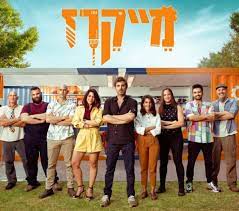
            The first thing we watched was an episode of a show called “Makers,” where a team of creative craftspeople made new hearing aids for a hard of hearing singer, so she wouldn’t have to deal with so much static when she put her headphones on in the studio, and then they created a smart house set up for a pair of born-deaf adult twins who needed help knowing when someone rang the doorbell or when the alarm clock went off. They put light strips in every room, even in the bathroom, and programmed the lights in different colors for each alert: like the phone, or the door, or the sirens telling them to find shelter when rockets came from Gaza. And for one of the sisters who struggled with getting up on time, they attached a light fixture to her alarm clock that gradually grew brighter the longer she ignored it, and then if she was still sleeping, a fan would go on and blow in her face to finally wake her up.

Makers

We also watched an episode of a show called “On the Napkin,” about Israeli chefs, and the episode we watched was about a Japanese cook in Israel, married to an Israeli man for forty years with three adult children, and now she’s serving homestyle Japanese dinners in their dining room/restaurant every night, sourcing tofu and mushrooms and greens from nearby farms.

But the story that really got to me was from a show called “The Recording Studio.” The episode we watched was about a twelve-year-old autistic boy who wanted to record a song for his longtime teacher’s aide. His parents came with him to the studio, but he explained everything himself, telling the host of the show that his aide was so special to him because she’d spent years teaching him how to relate to his non-autistic classmates, teaching him how to speak their language so that he could live in their world and make friends. He said that it would take a degree in psychology to learn the autistic language, so he had to be the one to learn how to understand them. During rehearsals, he not only played piano and sang, he also made sure to communicate as clearly as possible with the host and musicians about what he wanted, and confronted them when they were making assumptions about what he could and couldn’t do, or which truths he could and couldn’t handle.

When his aide finally came into the studio, he hugged her and introduced her to all of the musicians, and then he sang the song with the band, and his teacher and his parents were in tears. It was so clear that she really had set him free from a lonely place, and that she had taught him how to relate to other people and feel connected to them, while still being himself.

Sometimes, out in the real world, I feel like that autistic boy, trying to translate all of my thoughts and feelings into a language other people can understand, and wishing they could speak my language instead, whatever that is. So maybe that’s why I am so drawn to learning languages in the first place, and why I’m working so hard to learn Hebrew in classes full of other people with their own internal languages and stories to share. Hearing about the countries they live in (Israel, Holland, Spain, Belgium, Germany, Italy, Poland, America, Croatia) and the reasons why they want to learn Hebrew (planning to move to Israel, already living in Israel but wanting to speak the language, discovering a Jewish identity, trying to make peace with a Jewish childhood, wanting to talk to Israeli grandchildren, joining an Israeli dance company, or, very often, marrying an Israeli), helps me to feel hopeful that one day I will find the words to say what I mean and, in the meantime, other people will work hard to understand me, just like I work hard to understand them. And the hard work feels worth it, whether I become fluent in Hebrew or not, because the process itself is helping me create connections all over the world, and in my own brain, to help me understand myself.

If you haven’t had a chance yet, please check out my Young Adult novel, Yeshiva Girl, on Amazon. And if you feel called to write a review of the book, on Amazon, or anywhere else, I’d be honored.

            Yeshiva Girl is about a Jewish teenager on Long Island, named Isabel, though her father calls her Jezebel. Her father has been accused of inappropriate sexual behavior with one of his students, which he denies, but Izzy implicitly believes it’s true. As a result of his problems, her father sends her to a co-ed Orthodox yeshiva for tenth grade, out of the blue, and Izzy and her mother can’t figure out how to prevent it. At Yeshiva, though, Izzy finds that religious people are much more complicated than she had expected. Some, like her father, may use religion as a place to hide, but others search for and find comfort, and community, and even enlightenment. The question is, what will Izzy find?

An Israeli Reality Show

            I’m not a huge fan of reality shows. I do watch things like Project Runway and Top Chef, because I like watching what the contestants can create and how they are able to create it, but even the commercials for any of the Real Housewives of Wherever shows or The Bachelor and The Bachelorette make me nauseous. So I wasn’t thrilled when my current Hebrew teacher (in my online language classes from Tel Aviv) said that the Israeli show we’d be watching as a class this semester, to practice our Hebrew listening skills, would be a reality show called Married at First Sight (Chatunah MiMabat Rishon, in Hebrew).

            Oy, God help me.

            The logic behind her choice was that she wanted us to practice listening to how people really speak Hebrew in daily life, with all of the repetitions and slang and run on sentences, as opposed to the scripted Hebrew of the comedy and drama shows I watched (and loved) in previous classes. And I can see her point. But…

            The gimmick of this particular show is that the couples don’t meet until they are under the Chupah (the wedding canopy). There’s a three member team of psychologists who interview the candidates and choose the pairings based on their deep knowledge of humanity, I guess, though they are limited in their choices by who is willing to be on a reality show like this in the first place.

“Are we on a reality show?”

            And then we, as an audience, get to know the future bride and groom and where they work and who their friends and families are, and we watch them trying on wedding dresses and suits and talking to the psychologists, and then the families and friends meet at the wedding venue, and then the bride and groom come out and finally meet each other for the first time under the Chupah.

The wedding ceremony itself is sort of Jewish-wedding-lite, except, they still have the “groom” stomp on a glass (an important symbol meant to remind us of the loss of the first and second temples in Jerusalem, so that even on our happiest days we still remember our saddest days), and even that much feels icky.

            We’re watching the fourth season in class, which means that this show has lasted quite a while, and a lot of people seem to enjoy it. This season was filmed during Covid, so there are face masks here and there, and they probably did a lot of Covid testing behind the scenes, and the only place the couples could go on their honeymoons, outside of Israel, was the Seychelles, for some reason.

“Can we go to the Seychelles? Do they have chicken there?”

            So far, every time one of the brides has been introduced at the wedding, her soon to be groom has been blown away by how beautiful she is, which gets under my skin. The women that are chosen are all thin, of course, and the makeup and hair people are excellent, and the dresses are beautiful too. The guys look a bit more average, though none of them has a beer gut. For me, all of this adds to the ugh-factor, because I am not skinny or perfect, and I don’t have a team of makeup and hair people on call, and I’d still like to believe that someone could fall in love with me, but shows like this keep telling me it’s not possible.

            Following along with the almost-like-a-Jewish-wedding concept, the couple first gets to spend some time “alone” together, with a cameraman, when they go to the Yichud room (the togetherness room) after the ceremony. This is a custom in orthodox, or strictly orthodox, weddings, where the Yichud room is the first time the bride and groom are allowed to be alone together without a chaperone, and therefore finally get a chance to hold hands, or even kiss (there isn’t much time for anything else, but now that they’re married they can do whatever they want). On the show, this really is just a time for the new couple to talk to each other for the first time and exchange small bits of information, like, I have a dog, I have ten tattoos, or I smoke (which, I guess, is still a thing in Israel).

            Then there’s the party, with all of the music and dancing and friends and such, and everyone comments on how wonderful the match is, just to reassure themselves that this whole thing isn’t crazy.

            Then the couple goes to an apartment for the night, to talk and eat and put on their wedding rings and find out where they’re going for their honeymoon (The Seychelles? Oh my God! Who knew!), all filmed by a camera person, or camera people. And then, at some point, the camera people leave and the door is closed for the night. Thankfully.

            So, each week in class, after we’ve watched the week’s episode on our own, we discuss what we liked, didn’t like, didn’t believe, laughed out loud at, wanted to scream about, etc. It’s such a silly show that our conversations about it end up being mostly fun and silly too, though there is quite a lot of backseat diagnosing (because some of the brides and grooms are crazy), and there are always a lot of questions about what the team of psychologists could have been thinking by putting these two people together. Oh, and all of this discussing has to be done in Hebrew.

            Not surprisingly, I can’t relate to most of the people on the show. They are presented to us as the most charming, gorgeous, successful and ambitious people, almost as if they are all the same person, though, clearly, they aren’t. The one thing they do have in common, though, is a willingness to have their intimate relationships recorded and aired in public, which I don’t understand.

I remember how awful it felt when I had to do a sleep study at home, and along with wearing all kinds of monitors I had to keep a video camera aimed at me twenty-four/seven, in case I had some kind of cardiac or neurological event and they needed to see what I was doing when my numbers went wonky. I hated knowing that some stranger might eventually be watching me sleep, eat, or watch TV, though the likelihood that even one person would ever watch a small part of the tape was really low.

“That was a really boring movie.”

            And even if I could tolerate being watched all day and night, I would be deeply suspicious that my “groom” would just be saying that nice/patient/compassionate thing because the cameras were on him and he wanted to look good on TV, and once the cameras stopped the real person would be an asshole and I’d feel like a fool.

            My teacher this semester is a beautiful, young, charming, funny actress/student from just outside of Tel Aviv, so in a way this show fits the energy of the semester overall: lots of silliness and fun, and nothing too deep or serious. She herself, she says, has not been tempted to try out for the show, and prefers making fun of the people who do, which makes her more relatable. She’s always friendly and full of praise for our attempts to speak Hebrew, and never negative or hurtful, but still, part of me worries that this reality show is telling me what real Telavivians are like, and if I go there, which I really want to do, they will rip me apart. Though that could be my old stuff playing up again, from back in elementary school when the beautiful, competitive, well-dressed girls in my class hated my guts.

There’s also the disorienting fact that while this is a reality show taking place in Israel, there is no sense of the politics, or violence, or the social divides between Jews and Arabs and between secular and religious Jews. Even in my lovely, fun, cheery Hebrew class this semester, we still had to talk about the terrorist attack that happened in Tel Aviv recently, where sirens and ambulances and death took over the city for a while. But those things don’t come up on the show, or at least, they haven’t so far.

Hopefully, as the season goes on, there will be a little bit more reality in this reality show, and maybe one or two people I wouldn’t mind meeting in real life. But even if nothing improves on the show, I’m definitely improving my Hebrew listening skills, and learning more about how real Israelis talk when they don’t have a script; which has been reassuring, actually. Clearly I’m not the only one who struggles to find the right words.

“Don’t worry, Mommy. I have trouble with words too.”

If you haven’t had a chance yet, please check out my Young Adult novel, Yeshiva Girl, on Amazon. And if you feel called to write a review of the book, on Amazon, or anywhere else, I’d be honored.

            Yeshiva Girl is about a Jewish teenager on Long Island, named Isabel, though her father calls her Jezebel. Her father has been accused of inappropriate sexual behavior with one of his students, which he denies, but Izzy implicitly believes it’s true. As a result of his problems, her father sends her to a co-ed Orthodox yeshiva for tenth grade, out of the blue, and Izzy and her mother can’t figure out how to prevent it. At Yeshiva, though, Izzy finds that religious people are much more complicated than she had expected. Some, like her father, may use religion as a place to hide, but others search for and find comfort, and community, and even enlightenment. The question is, what will Izzy find?
Disappointment

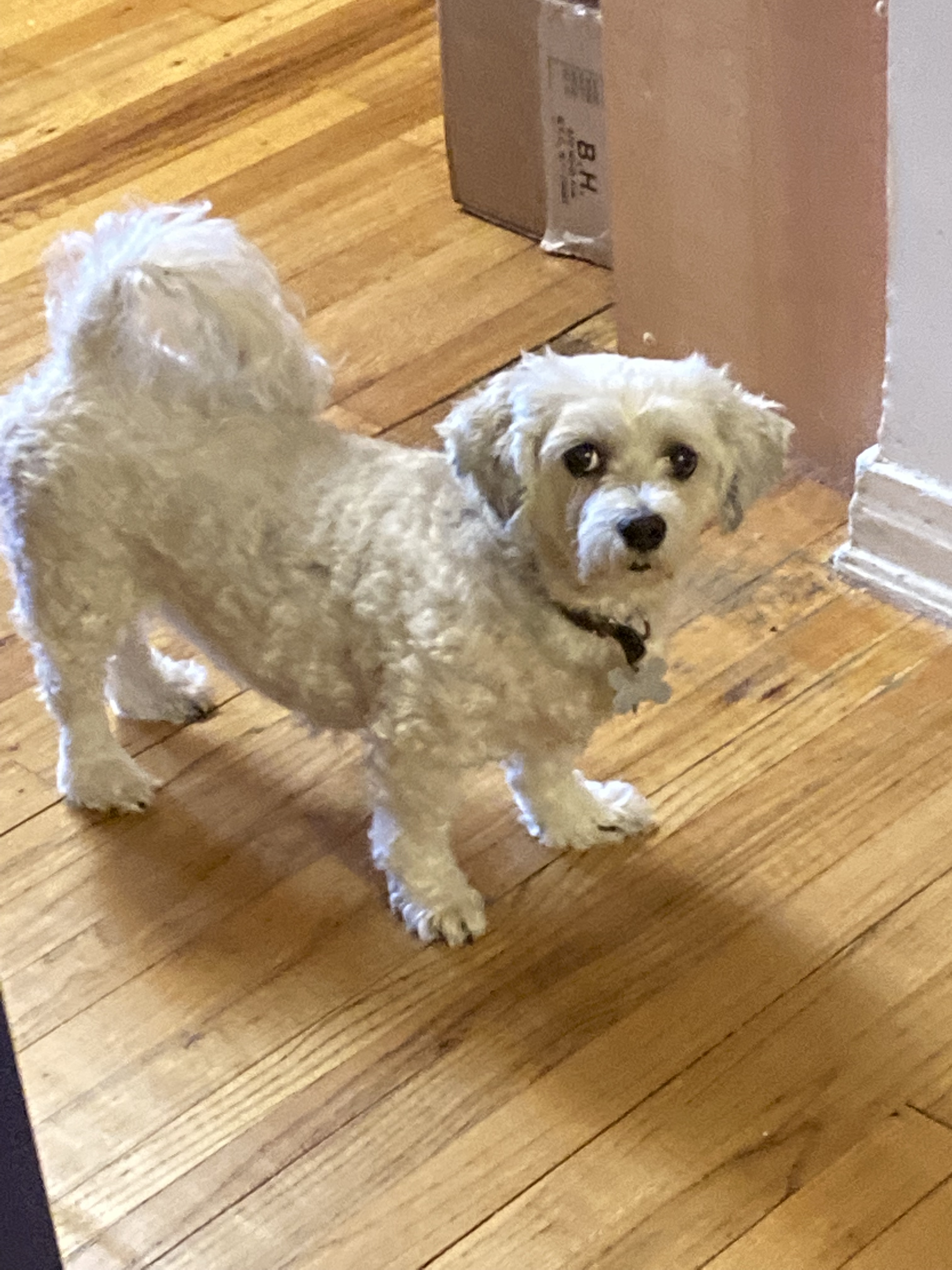
            I applied for a fellowship related to my teaching gig at the synagogue, which would have included a free trip to Israel this summer, but I didn’t get it. It was a long shot, because I didn’t have all of the prerequisites, but I applied anyway, because my boss recommended me for it, and because I wanted to go to Israel. It was a big reach, though, and I pushed myself to fight for it, and pushed myself to imagine that I could handle the trip to Israel in the heat of the summer, and I got as far as being wait-listed, which isn’t bad. I know I can apply again next year, and, really, three weeks in the heat of the summer in Jerusalem was probably more than my body could have handled, but…rejection is rejection.

“You were going to go to Israel without us?!”

            It was painful to feel all of that wanting again, too. I’ve almost gotten numbed to all of the hope and rejection around my writing, but this was a new kind of thing and the anxiety and pressure and hope of it didn’t sit well in my particular nervous system. It’s easier just to not think anything big or new is possible, because then I can go along day by day, living in the present, and managing my small amounts of energy while working on long term goals one step at a time. But hope and excitement and possibility revved me up again, and got me thinking about the future, and all of the things I want (and don’t have yet), and all of the things I can’t have and can’t do.

            It’s as if there’s a certain amount of hope my body can tolerate and anything bigger than that is overwhelming and sets up a roller-coaster ride I don’t want to be on. And I’m realizing that I’ve been actively stopping myself from trying a lot of different things, for fear of getting on the hope-and-rejection-rollercoaster. And that’s not good.

“Would I like rollercoasters?”

            I envy people who can tolerate more anxiety than I can, because they can take more risks in life without worrying as much about the mental health consequences if they fail. I want to become one of those people.

            The sadness I’m feeling now, for the most part, is that I don’t have a plan for how to get to Israel yet, and I really want to go. But this opportunity came up out of nowhere, so maybe others will too. And in the meantime I can continue working on my Hebrew, and saving money to pay for the eventual trip, and most of all working hard to build up my tolerance for the hope-and-rejection-rollercoaster, so I’ll be ready to take the risk when the next opportunity arrives.

“I’ll just rest here while we wait.”

If you haven’t had a chance yet, please check out my Young Adult novel, Yeshiva Girl, on Amazon. And if you feel called to write a review of the book, on Amazon, or anywhere else, I’d be honored.

            Yeshiva Girl is about a Jewish teenager on Long Island, named Isabel, though her father calls her Jezebel. Her father has been accused of inappropriate sexual behavior with one of his students, which he denies, but Izzy implicitly believes it’s true. As a result of his problems, her father sends her to a co-ed Orthodox yeshiva for tenth grade, out of the blue, and Izzy and her mother can’t figure out how to prevent it. At Yeshiva, though, Izzy finds that religious people are much more complicated than she had expected. Some, like her father, may use religion as a place to hide, but others search for and find comfort, and community, and even enlightenment. The question is, what will Izzy find?

Speaking Hebrew

            I’m in my third semester of Hebrew classes with the school in Tel Aviv (online), and I’m still loving it. Each semester is ten weeks long, with about a month off in between, and it’s work, but their method lowers the stress level from where it would be in a regular academic class (no tests, short lessons, lots of repetition and variety). And I love that I’m meeting so many different people: from Italy, and Germany, and South Africa, and France, and India, and Australia, and, of course, the United States and Canada. It surprised me, at first, that aside from the fact that we’re speaking Hebrew, and we don’t have class on the Jewish holidays, there’s almost no Jewish content to the class. I don’t even know if all of my classmates are Jewish, because it never comes up. Sometimes I miss the Jewishness I was expecting, but this way I’m getting a real sense of what it must be like to be in a country where Jewishness is so much in the background, and so taken for granted, that it doesn’t need to be discussed.

            My original goal in taking these classes was to overcome my fear of speaking Hebrew, and especially of making mistakes, and I still feel a pinch when I get something wrong in class, or forget something I should have remembered, or lose focus for a second and have to ask for instructions again – but the pinch is so much smaller than it used to be. The accepting, non-judgmental style of the classes seems to be helping to change the wiring in my brain in a way that will, hopefully, translate into the rest of my life as well.

            I keep trying to figure out why I like these classes so much, despite the amount of time and money I’m spending on it that I should be spending on more practical things. I think part of it is that I like getting a chance to meet new people in a controlled environment, where I know what’s expected of me and where the boundaries are. But I’m not sure that that would be enough to push me to take a French or Spanish class, even in the exact same format. There’s a little girl inside of me who fell in love with Hebrew early in life, and she’s reveling in this chance to speak her language.

“Shalom!”

            But maybe my favorite thing about these zoom classes, especially since in-person gatherings have required face masks for so long now, is that my facial expressions are visible. There’s so much of who I am that comes through on my face and it’s been such a relief to be  seen again and to have people say – oh, Rachel doesn’t like that – without my having to say a word!

“Hmm.”

            I’m still – three semesters later – finding stores of vocabulary and grammar that I haven’t accessed in decades. The more I practice, the less time I have to spend rifling through the dusty attic of my brain, with its sticky closets and creaky drawers, for each word I want to say. But I still get anxious when I first log onto the zoom class and the teacher asks each of us how we’re doing and I have to think of a simple, polite answer to the question, in Hebrew. Even in English I would struggle to eke out an everything’s fine, but in Hebrew I feel even more tongue tied.

And yet, given how awkward these opening conversations are for me, it’s ironic, or perfectly reasonable, that I decided to teach my synagogue school students how to have a simple opening conversation in Hebrew. Person one: Hi, how are you. Person two: choose from everything’s fine, very good, and terrible. The kids love saying Al HaPanim (I feel terrible) so that’s been a hit. I love that the kids giggle and smirk when they say it, because that means it will stick with them. And I know from my own experience that there’s such relief in being allowed to say, “I feel terrible,” if only because we are usually expected to say we’re fine when someone asks. And when I explained to them that the literal translation of Al HaPanim is “on the face,” as in “I’m falling on my face,” or “I’m covering my face with my hands because it’s so bad,” they loved it even more. For me, just saying, “it’s on my face,” when my emotions often are right on my face, resonates.

            We’ve also started watching Israeli TV shows for homework between Zoom classes, and it’s exciting to see how much I’ve been able to understand (because even the subtitles are in Hebrew!). The first show we watched was a romantic comedy about the fashion business, and now we’re watching a drama about a group of army buddies with PTSD getting back together to solve a mystery. The TV shows are much more my speed than a lot of the Israeli movies I’ve been able to find, and it’s giving me a better sense of what Israelis themselves might choose to watch.

She has it/The Stylist
When Heroes Fly

            And, as a result, it’s getting more real to me that I may, eventually, be able to visit Israel. Even a few years ago it felt like a dream, or something for my bucket list, but now it feels inevitable. I feel like these classes are giving me the solid ground under my feet that I will need on the trip, in order to really appreciate the experience and not feel unmoored and overwhelmed. I still worry that Israelis won’t like me, because I am too soft, too American, but I’m learning more and more with each class about how Israelis, at least in Tel Aviv, think and speak in real life, and I’m finding that, just like Americans, they are all different, almost like real people.

            In the meantime, I keep practicing my Hebrew, reading slowly through My Hebrew copy of Harry Potter, watching Israeli TV shows and movies, and speaking Hebrew at home, at least with the dogs. They really seem to understand what I’m saying, though they might just be humoring me. It’s hard to tell. They can be especially inscrutable when they’re overdue for a visit to the groomer.

“We don’t need haircuts, and we understand every word you say.

If you haven’t had a chance yet, please check out my Young Adult novel, Yeshiva Girl, on Amazon. And if you feel called to write a review of the book, on Amazon, or anywhere else, I’d be honored.

            Yeshiva Girl is about a Jewish teenager on Long Island, named Isabel, though her father calls her Jezebel. Her father has been accused of inappropriate sexual behavior with one of his students, which he denies, but Izzy implicitly believes it’s true. As a result of his problems, her father sends her to a co-ed Orthodox yeshiva for tenth grade, out of the blue, and Izzy and her mother can’t figure out how to prevent it. At Yeshiva, though, Izzy finds that religious people are much more complicated than she had expected. Some, like her father, may use religion as a place to hide, but others search for and find comfort, and community, and even enlightenment. The question is, what will Izzy find?