Tag Archives: Jewish

Sacred Space


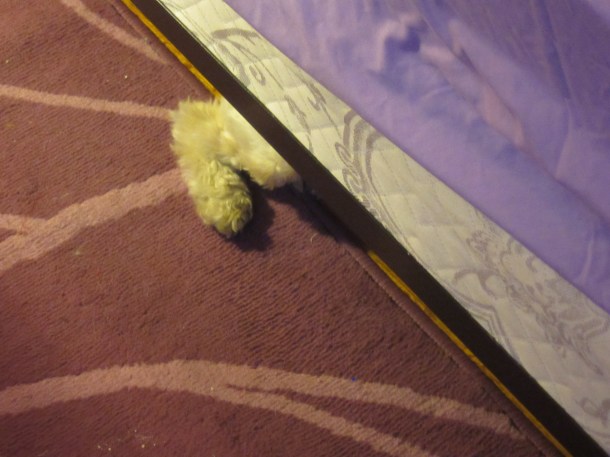
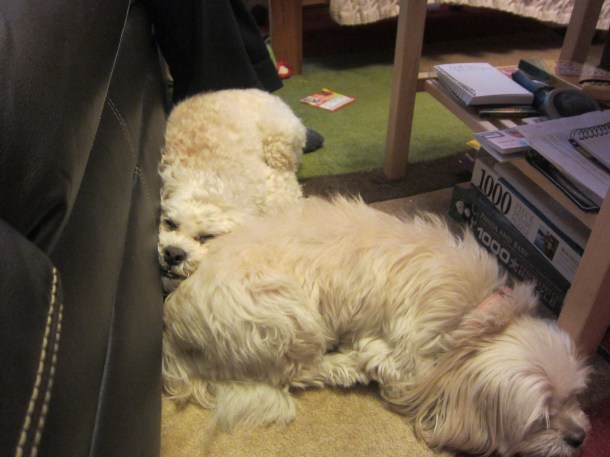
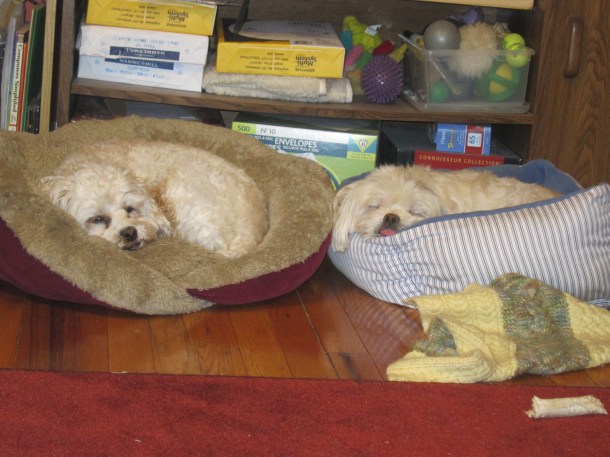
The Cantor at my synagogue has taken up a new topic to study this year: the technology of prayer. I can’t say that I understand what he means by that yet, but the first lesson was about sacred space, and how we arrange it. Butterfly is very often in sacred space, because she listens to the sounds around her and stands still and lets them encompass her. Cricket prefers hidey-holes as her sacred spaces. She feels safe and solemn in those small, enclosed spaces, and it allows her to rest and reemerge more whole.

puppy-in-november-007

“You can’t see me!”

img_0055

“I hear everything, Mommy.”

But, I am not good at interior design. When I decorate, I basically put things where they’ll fit, no Feng Shui or harmony involved, so the idea of contemplating the use of space made me whimper with anticipated boredom. The cantor talked about how most sanctuaries, Jewish and Christian at least, are set up with the congregation in rows of seats, all facing one way, with the clergy up on a riser, and the congregation a step down, like an audience watching actors on a stage. Then he showed us pictures of Jewish synagogues that were set up differently, with the congregation on two opposing sides, or even three sides of the sanctuary, and the clergy in the middle. The idea being to focus attention on the community, rather than on the clergy, who are there to lead the congregation, rather than to be the show itself.

The Cantor’s class on sacred space happened the night before Slichot, which is a service that takes place a week before the Jewish New Year, late at night. It is a preview of all of the themes of the high holidays, with all of the atonement, forgiveness, and cleaning of old forgotten laundry intended for this time of year. But for this one service of the year, the clergy members placed themselves with us in the congregation, and some of the ideas from the previous night’s class must have stuck with me, because as soon as the Cantor began to sing from his seat among us, I felt the change in the shape of the space. I got it. He became one of us instead of separate, and he became a voice only, rather than a performer to be watched. It was a small group the night of Slichot (not a lot of people come out a week before the high holidays, at ten o’clock on a Saturday night, to pray), which meant that the Cantor didn’t need a microphone to be heard, so that his unamplified voice, so intertwined with our own, made him seem even more a part of us.
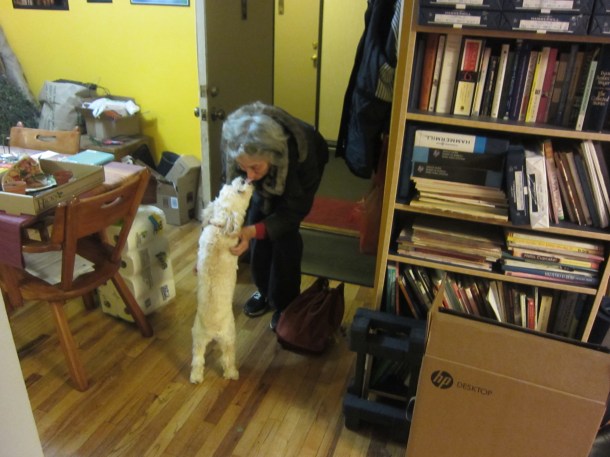
Over the summers, at our synagogue, we move from the formal sanctuary to the small sanctuary for Friday night services. It saves on electricity, especially for the air-conditioning of the sanctuary and the social hall, and it saves us from seeing all of the empty seats from the families who go away on vacation, or just don’t feel especially religious in the heat. But the side effect of moving to the smaller, less formal room, is that our whole tone changes. The clergy stands at our level, and not above. We sit closer together, instead of spread out across the room. We can hear each other sing, and breathe. The space itself, usually just an ordinary room, becomes sacred space because of how we live within it.

Maybe sacred space actually changes from person to person and moment to moment. A lot of the time, I think a space feels sacred because of the people who are in it with you. That’s why I wish that the dogs could join me at synagogue, especially when we are at our most informal and communal. Cricket could sit in my lap, or hide under my chair, and Butterfly could wander around the room and listen to all of the voices around her. That would be my ideal of a sacred space.
001

That’s Cricket’s foot.

015

Cricket in her sacred space.


img_0418

Butterfly’s not allowed in, but she makes do.

A Prayer for Healing


I have been very anxious lately, about the start of my social work internship and my research class, both of which I’ve been dreading since before I applied to graduate school. I haven’t found much that helps with the anxiety. Anti-anxiety meds like Xanax and Valium just wipe me out, meditation makes me more anxious, exercise is good, but leaves me exhausted. I’ve gotten better at asking for help from the people around me, but there’s just so much they can do. When you have no control, what can you do but pray?

Part of me really does believe that prayers sent out to God do reach some energy in the universe. It’s an imperfect system, like tweeting out to the world at large and hoping that the right person, who may not even be on twitter, hears you. But there’s a chance, and it’s better than not sending the message at all. I don’t believe that God puts my request on a list and then decides whether or not I deserve the help I want. I believe that somehow my message ping pongs around the universe, and if I’m lucky, it snowballs and connects with other energies and comes back to me in some form, hopefully something helpful.

I pray for my dogs all the time. I used to pray for Cricket to find comfort and calm. I would put my prayers into her scratching sessions, hoping that the practical behaviors I could do for her would be transformed into something more. And I am always praying for Butterfly – that she will have a good life, that her heart will last a bit longer – and I believe that my prayers work for her. Butterfly is a very good vessel for prayer, because she absorbs energy into her body and spirit without much of a defense system, whereas Cricket is more circumspect and “rational.” It is harder for Cricket to hear the prayers said for her, and to absorb the love sent her way, because there is so much interference – so much static in her system. But she still needs the good energy to be sent her way, even if only one prayer out of a thousand gets through her tough hide.

IMG_1249

“Do prayers come with chicken treats?”

IMG_0237

“I refuse to be healed. Deal with it.”

The cantor at my synagogue was ill this summer (don’t worry, he’s better now) and had to take months off from work. He spent a great deal of time alone, but, he said, because of all of the people in the congregation who reached out to him, and all of the people he knew were thinking of him and praying for him, he never felt like he was alone. This is what prayer can do. Just knowing that someone is praying for you on a regular basis can be healing, and make you feel cared for and safe.

And reaching out to God ourselves can make us feel less alone, even when we are physically alone. It reminds us of the human beings who wrote the prayers, of the people who taught us those prayers, of the times we have prayed together, and of all of the people who may be saying those same prayers at the same time all around the world. There’s a humility to prayer, a recognition that we can’t solve everything on our own, and are not expected to. Reminding ourselves of that on a regular basis can be healing in itself.

I think dogs pray too. First they ask directly for what they want: a walk, a treat, attention. But when the request is denied, or when they are left alone – when they feel powerless – I think they must pray the way we do. Like Butterfly picking up one of my socks when I was a way at the hospital, and carrying it in her mouth. The sock could be seen as a transitional object, as a way for her to hold onto me and feel close to me – or it could be seen as a prayer, that she would soon see me again.

IMG_0972

“Where’s Mommy?”

Cricket talks to God all the time with her barking. She isn’t so much telling me, or Mom, that danger is at the door, she is calling on God to protect her family. And most of the time, God seems to come through for her, so, it works!

030

“Of course God listens to me. I am Cricket, and I am always right.”

Music is the best delivery system for prayer, because it reaches our hearts so much more quickly than words alone. It works especially well when we pray in groups, because it brings all of those heartbeats into the same rhythm, the same space, so that not only can you hear the words being spoken to you, you can feel everyone in the room coming together.

Ever since the cantor’s illness this summer, and the string of national and international disasters that have been overwhelming everyone, my synagogue has returned to the practice of singing a healing prayer at the end of Friday night services. People have found great comfort in singing it together, and saying the names of loved ones in need of healing, out loud or silently. I want it to work for me, but it doesn’t. Maybe the problem is that I don’t believe that my anxiety is worthy of a healing prayer, or maybe my hide is just as tough as Cricket’s and it will take a lot more prayer to get through. We are related, after all.


010

“Is that supposed to be a compliment?”

Yoga Shabbat


The junior Rabbi at my synagogue has been developing a yoga class for Saturday (Shabbat) mornings. She did her yoga teacher training last summer, and started the monthly classes last October. I was curious about what the class would be like, because I’d always been bothered by the feeling that, even in the most secular versions of yoga, there are remnants of the religious culture it comes from. The history of Jews being forced to convert or conform to the dominant religion of given societies is a big part of my discomfort. I see a lot to like in every other religion I’ve ever come across, but participating in another religion is a completely different thing. It feels like a co-opting of my Jewish soul, but more than that it feels disloyal, like you would feel if you were in love with one man and yet kissed someone else. Prayer, and yoga poses, are not just thoughts or feelings, they are actions, and they count.

My hope was that the rabbi had found a way to make yoga feel a little bit more at home with Judaism, or at least less at odds with it. But I put off going all year long. I told myself that the classes were too early in the morning, or that I would have to rush to get to therapy afterwards, or I just had too much school work to do. But really, the idea of sweating and stretching into strange positions in front of my fellow congregants brought up a lot of old fears. When I finally decided, no excuses, that I would go to the last session of the year, I spent the two days leading up to the class flooded with awful memories of gym class in elementary school, and ballet classes, in my ill-fitting gym clothes or mismatched leotard and tights.

But I fought through the anxiety, and went to the class anyway. I took a spot near the back of the room, up against a brick pillar, both to hide, if necessary, and to have a stable wall to lean against, just in case. I brought my own Pilates mat, which is a little bit more cushioned than a yoga mat, and has a few holes in it from the dogs. At home, yoga means trying to stretch while scratching Butterfly with my arm twisted behind my back, and tossing a tug toy for Cricket, while trying not to lose my balance. But at least they haven’t peed on the mat, recently.

IMG_1251

“This is my idea of good yoga, Mommy.”

IMG_1233

Cricket can’t talk here, but she agrees with Butterfly.

The rabbi started the session by summarizing the weekly Torah portion, and then she turned on her iPhone, attached it to a speaker, and played variations of the Saturday morning prayers as the background music for the class. She started us off with “Shalom breaths,” and then we did a lot of Sun Salutations and Downward Facing Dogs, with more advanced poses in the middle of each flow. I pushed myself a little too hard to keep up, because I’m not really up to an hour and fifteen minute yoga class, but I didn’t want to seem weak or lazy. I had to skip a bunch of the advanced poses, and come out of others early, and I ended up resting in child’s pose a lot of the time (though it still took me four days to recover from overdoing it). I missed having the dogs with me. Focusing on them takes some of the pressure off of the need to achieve something beyond my abilities. Having Butterfly with me, sniffing my hair or licking my arm, would have reminded me that it’s okay that I can only do what I can do.

IMG_0055

“Om, Om, I mean, Shalom, Shalom.”

But most importantly, the feeling that I was doing something wrong just by being in a Yoga class on Shabbat was still there. There is a school of thought among Orthodox Jews that yoga is avodah zarah, worship of foreign gods, which would be a big no-no. Some people say that if you avoid the mantras, and chanting, and skip the Sanskrit names for the poses, and maybe skip prayer pose entirely, that would make it okay. But the rabbi kept the Sanskrit names for the poses, and used prayer pose, which upset me. Child’s pose doesn’t bother me, even though it looks very much like a Muslim prayer pose, because I think of it so completely as a child’s protective pose, making myself safe like a turtle in a shell. But yoga’s prayer pose, palms together at chest level, feels so clearly like what it says it is; it forces you to breathe differently and focus your attention in a specific way and it is a very good physical representation of open-hearted supplication.

A lot of yoga is meant to put your body in a position to teach your mind something. Warrior pose is meant to activate not just physical strength, but emotional strength and resolve. Child’s pose is not only a rest from exercise, it is a self-protective break from being confident and open and visible. These emotional and physical experiences are meaningful to me and make sense to me, but I cannot find a reason other than prayerfulness and supplication for me to be in prayer pose, and that feels too much like praying to a foreign god, and being disloyal to my Jewishness.

There’s a lot of talk, both in yoga and in liberal Judaism, about “intention.” You need to be aware of your intention when you say a certain prayer, take a certain action, or do a particular pose, in order to make it meaningful. The assumption then, is that your intention is all that matters, rather than the intention of the original creators of the prayer, or pose, or series of rituals. But, if yoga is part of someone else’s religious culture, what right do I have to take it for myself and strip it of its history? Is it really okay to take yoga poses and imbue them with your own intentions, like flavoring your ice cream base with vanilla or chocolate or salted caramel? Religion, to me, is cultural history, communal ties, rituals and behaviors, and the stories of my people. If Yoga comes from Buddhism and Hinduism, is it fair to take it out of that context and try to imbue it with Jewish feeling? Is it even possible?

Maybe I should just ask Cricket and Butterfly to create some fresh poses for me, like: Begging-for-treats pose, which really strengthens your core; and Barking-at-strangers pose, which gets your anger flowing and makes you feel at least three times your original size.

021

Begging-for-treats-pose.

IMG_0510

Barking-at-strangers pose.

That could work.

009

Butterfly’s idea of a resting pose.

IMG_0876

Cricket’s version, on Grandma’s lap.

Talking in Circles


As a child, I was taught in my Jewish school that we are not allowed to write the name of God (G-d) full out, or else we are taking God’s name in vain. You can’t even spell the Hebrew version of Yahweh out loud; you have to replace some of the letters with safer letters. Often, orthodox Jews will replace any name of God with “Hashem,” which means “The Name.” It’s similar to the He-who-must-not-be-named business in the Harry Potter books, except that we were avoiding saying the name of the ultimate good rather than the ultimate evil. Part of it is an attempt to retain the power, the specialness, of the name of God. Just like in Harry Potter, the fear is that if you say the name of He-who-must-not-be-named (Voldemort, ahem) too frequently, you’ll forget to be afraid of him.

All of this makes me think about how hard it is for humans to say what we mean. In our intention to avoid hurting someone else’s feelings, or to avoid criticism, we often end up being polite, or vague, and therefore, being misunderstood. I love that dogs are direct. I may not always like what they have to say (or when they choose to say it), but at least I know what’s going on with them. Cricket is very clear when she is angry at me for withholding the extra treats she demands. Butterfly is also very direct, and never uses big words. If she barks, it either means she wants to eat what you are eating (and is convinced that Cricket, because she can jump up onto the couch, will have first dibs), or she needs to go outside. If she flattens herself on the ground, she wants to be picked up. If she smiles, it’s because she is actually happy (most likely because food is anticipated). If she licks your hand, she wants to be scratched. If she’s wary, she backs away. If she’s really scared, she shivers (at the vet’s office or during a storm, usually). She’s not vague, or blurry, or sly. And because she’s so clear, her needs are easy to meet.

IMG_1248

Butterfly wants scratchies!

IMG_0724

Cricket is grumpy.

IMG_0418

Those are my shoes Butterfly is sitting on. I can’t imagine what she’s trying to say.

IMG_0313

“Feed me!”

A lot of the time, though, people are vague because they really don’t know what they are feeling, or how to express it clearly. I find myself asking question after question of people who think they’ve been clear and clearly were not. I’m often in the position of wanting to scream, “What the @#$% are you trying to say?!” But I rein myself in. Mostly. I will try to ask a question or two, or ten, to help them get to their point. Sometimes they do not realize that they are wandering, or being unclear. Sometimes they are as frustrated as I am, and believe that I should just understand them without their help. Sometimes they know exactly what they mean, but English is their second language, behind the jargon of their profession, and we both remain un-elucidated.

My rabbi, at times, throws in a word that he assumes everyone knows, like Hapax legamenon – which means, a word that appears only once in a text, like the Bible. He momentarily forgets that we were not all in rabbinical school with him, where that word came up all the time and was so useful! I have an automatic allergy to words like that, because I hated sitting at the dinner table as a kid and being the only one who didn’t understand what was being said, especially after my brother started to study vocabulary words for the SATs. But my rabbi thinks each one of these words is like a jewel, a gift! And he tosses them into conversation with glee. I am considering preparing a glossary for new members of the synagogue with words he uses often, like: prolegomenon, apotropaic, apocopation, merism, inclusio, and, of course, hapax legamenon. He is, in most ways, exceedingly down to earth, but those particular words of his profession just make him delusionally happy.

But, some people use jargon intentionally to keep others out of the club. In certain professions (academics, medicine, and law come to mind), you spend a great deal of your time learning the language of the profession before you can ever be trusted to think your own thoughts. This bothers me. I mean, sure, it’s good to be precise, and when you go into more depth on a particular subject it helps to have vocabulary with you to light up the dark, but does it have to be so alienating to outsiders? To what end?

Cricket understands every word I say, or do not say. She has especially become a master of the ellipsis, so that I can’t even leave the important words unsaid, because she knows I was going to say them anyway. I wonder what she would do with the rabbi’s rabbinical school jargon. She probably wouldn’t let him off the hook, the way the humans do. She would have at least a few more questions for him. He says that dogs can’t come to Bible Study because some congregants may have allergies, or deep-seated fears of canines, but I wonder. Maybe he’s just afraid that Cricket will stand on the table, barking insistently, “but why?!” And he won’t have a handy dandy hapax legamenon with which to answer her.


IMG_0510

“But why?”


Sitting Shiva


In seventh grade, when I was still new to Orthodox Judaism, the general studies principal at my school lost his mother, and the students were bused, grade by grade, to visit him at his home, where he was sitting Shiva. After the funeral, in Jewish tradition, comes Shiva. Shiva means seven, and the idea is that, for seven days, the mourners remain at home and visitors come to them. Maybe seven days was the limit people could consider taking off from work. Maybe seven days was the limit before people became restless and overwhelmed. If you are very observant, there are countless rules to abide by during Shiva – no shaving, always wear a torn piece of clothing, cover mirrors, sit on lowered seats (boxes are specially made for this purpose), etc. Visitors come at pre-set times, to help make a minyan (ten people) for communal prayer.

It was frightening to imagine that we were supposed to offer comfort to the principal of the school, someone so much more grown up than we would ever be. It was scary just to think of him as someone who might need comfort. And yet, my memory of that day isn’t full of fear and darkness. Somehow, the ritual of the visit, the way we each wished him well as he sat on his low chair and he let us see him be sad, and crying, and smiling too, made the day feel full of light, though it could just be that we happened to be there at the right time of day, so that sunlight was shining in through the windows.

I’ve had to go to a number of funerals and Shiva visits in the past few years, as I’ve become more active in my synagogue and gotten to know the older members. When you make friends with 90-year-olds, funerals become more common occurrences.

A friend of mine lost her father over Passover. His death had been a long process, and in large part she had done her grieving and letting go over the last few years of his life, as she lost pieces of him to illness. The last thing to go was his conviction that he had to stay in order to take care of his wife; that commitment outlasted hunger, even the ability to swallow, by months.

Shiva had to be delayed until after Passover, and then only lasted one day because an unofficial mourning period had already been going on, with friends calling from all over the country for a week. There were so many people at her house that I didn’t know, and I felt out of place and uncool. But then, before the Mourner’s Kaddish, my friend read the eulogy she’d written for the funeral, and as she read it I felt like she was conjuring her father into the room. I could almost see him in the corner, with a bemused expression on his face, wearing his white doctor’s coat and his college tie, and complaining about the driver who cut in front of him on the expressway.

I think that the value of a ritual like Shiva is that it forces you to ask for the things you really need, but maybe don’t think you deserve. When I’m depressed, I lose most of my social skills. But for those seven days, the idea is, your rabbi and friends and family and neighbors are given a schedule for when they can interrupt your isolation. They have a clear mandate to visit you, and bring you food, and pray with you. This is one of the benefits of belonging to a synagogue; there are set practices and communication paths to go by, for everything related to a death in the family, if someone calls and asks what you need, you can tell them. I wish there were more of this for other life events.

There’s a rule that you can’t sit Shiva on Shabbat. If you are three days into Shiva and Friday night comes along, you change out of your mourning clothes and wash and dress and go to the synagogue to say the Mourner’s Kaddish with your community. Maybe the message is that happiness and community will be there waiting for you when you are ready for them, or maybe it’s to remind you that the grief will not last forever, because all around you are people who were in mourning at one time, and now they are singing the prayers and smiling at friends, and one day that will be you too. But I’m not sure if I could bear it, seeing other people’s lives going on all around me, seeing happiness.

Ideally I’d have a sleep over starting from the moment of loss. I’d have people in sleeping bags in every corner of the apartment to help me through every moment. But then I think, if my mom actually died, I wouldn’t be able to host people at all. I’d be curled up in a ball, with Cricket, under the couch. Butterfly would have to take care of both of us.

IMG_0136

Cricket hides under the couch, a lot.


IMG_0707

Butterfly is very good at offering comfort.

008

But paperwork might be too much for her.

Just like there is no sanctioned way to do a Jewish funeral for a dog, or to say the Mourner’s Kaddish for a dog, there is certainly no Shiva for dogs. Right after my last dog, Dina, died, my mother had a long-scheduled trip and had to leave town for two weeks, so I was home alone with the death, in silence. I cleaned obsessively, and having that mindless physical task to do was helpful, but I think I would have liked it if my friends with dogs could have come over and filled the house with their voices, and their dogs’ voices. Maybe I could have offered up the last of Dina’s dog food as a ceremony, or given away the leftover pee pads. But, in the event, I didn’t know how to ask for company, or accept help when it was offered. Maybe if there’d been a set ritual to follow, I could have forced myself to follow it. It would have been such a relief, to tell my Dina stories, and share my grief, and have people all around me who cared that I had lost someone so important to me.


dina smiles

My Dina

DSCF0318

Grandma’s pretty good at offering comfort too.

The Shul Rat


I grew up going to synagogue (Shul is the Yiddish word for synagogue) every week, starting when I was four years old. Mom would drop me and my brother off at junior congregation on Saturday mornings, and then pick us up an hour later to take us to our afternoon activities (gymnastics for me and computers for him). I liked that the service for the kids was only an hour and in a small sanctuary, and that the leader of the services was kind of a kid himself, in his early twenties and doing bible trivia with us and giving out candy for correct answers. There was something special about being there with only my brother and no parents around. It gave us a chance to take ownership of our Judaism, and our synagogue, and not have it be filtered through anyone else, or through a sense of duty.

I also liked that after services we could wander around the synagogue, until Mom got there, and it was like wandering through the White House without supervision. We’d sneak around and make it feel really mysterious and dramatic. The ceilings were high, and the setting was so formal, and everyone was quiet so as not to disturb the goings on in the main sanctuary. There was also something wonderful about having a community outside of my family, and a building to explore. My extended family was not next door, or down the block; we didn’t even have big family dinners more than once or twice a year, so the synagogue was my sense of family.

I liked the older people at shul. They weren’t always warm, but they paid attention and looked me in the eye. I felt like my best self there. At school I was a good student, but got teased constantly. At dance and gymnastics classes, I was barely keeping up and certainly not a star. At home…eh. But at shul, I mattered.

When I was seven, my father started to go to Saturday morning services regularly, and not long after that, my brother and I stopped going to afternoon activities and just stayed for the rest of the adult services with our father. The main sanctuary was a big deal. There was a high ceiling and stained glass windows, and tapestries on the walls, representing the twelve tribes of Israel. I liked the smell of the prayer books, and the hard covers, and the golden type on the cover. I liked that I knew who was a regular and who was new. I liked having a set seat that I went to every time. I loved when the Torah reader, the mother of one of my brother’s good friends, would sing harmonies, and I could sing along with her, and learn from her.


USAKamSyn

My synagogue was not quite this grand, but I can dream.

For special occasions, like an engagement, bags of candy were made up and thrown onto the bima, and the kids ran up to get as much candy as they could reach. I never see this at my current synagogue. Maybe it’s been outlawed because someone could get hit, or someone could miss out on candy. Better to just have a table full of candy to choose from after the service, they think. Phooey.

bags of candy

Bags of candy! (not my picture)

After my father got involved in the synagogue, we started to go to Friday night services, which were a formal affair. Kids came with their parents, and the cantor sang his complex loops of song, and everyone dressed up.  After the service there was a sit down oneg (dessert and talk) in the social hall. Tables were set up in a u-shape, and tea and desserts were set out. There were always non-dairy brownies with chocolate frosting, and I always ate off the frosting and left the brownies behind. Then the rabbi would hit his teacup with his spoon to start the discussion, and the kids would rush out just in the nick of time. The rabbi resented this, and forced his own children to stay put, but the other adults seemed to understand that kids could not sit through a long and boring discussion so late at night, when there was a whole building to explore.

Sometimes we’d end up sitting in the dark, in the far reaches of the building, looking through the toys left out by the preschoolers, or telling ghost stories. Other times, we made up elaborate games that required running through the building, and hiding under benches in the small sanctuary, and even sneaking up onto the bima in the main sanctuary to see what the rabbi kept in his lectern.

033

“Are there toys at shul?”

010

“Or pizza?”

I would have loved to bring Cricket and Butterfly to shul with me, to run through the halls of the building and play tag and have an excuse to laugh and jump and not be so self-conscious. But I never struggled to feel “spiritual” at shul, it was just there, in the building, in the occasion, in me. I wish every kid had a place like that, where God is infused into the walls of the building and doesn’t have to be spelled out; where history is just there all around you, waiting to be discovered.

Cricket would be more interested in searching for the left over bags of candy, but then I’m pretty sure God is in the candy too.

007

“Candy?”

010

“Candy!”

The Tango Lesson


More than ten years ago now, I went to a group dance lesson at the Brooklyn Museum of Art, because I had to do an attempt at literary reporting for my creative non-fiction class. I was not ready to write non-fiction at that point, and anything that smelled like journalism made me hyperventilate. But I’m a follow-the-rules kind of girl, so I did the assignment.

The first Saturday of each month, the museum opened its doors, free of charge. You could view the exhibits, or watch a movie, but most of us were there for the dance lesson. This week’s dance was the Argentine Tango.

taste4tango.net

picture from taste4tango.net

A crowd had already gathered on the third floor when we arrived. The willing dancers gathered in the center of the floor, around the small circular stage. There was a woman in a conservative black skirt suit, with stiff white wings on her back, and children running through the maze of casually dressed adults. Another group, the circumspect, sat on the steps at the edges of the floor, holding pocketbooks, legs crossed. The last group, the voyeurs, mostly well-dressed twenty and thirty-somethings, leaned over the railings on the floor above.

In the center of the room, the four dance instructors stood on the podium, each facing a corner of the room. The two men wore black suits, one wearing a microphone headset. He welcomed us in a broken stream of words until the microphone was adjusted. The two women wore low cut black dresses and chunky heeled black dance shoes.

“Everyone step to your right,” the man with the microphone said. “Feet should be together – is that true for you?” he asked, and many people looked down at their feet to check. “Step to the left.” Everyone moved in the same direction at the same time, like a dial clicking one notch at a time.

The instructors demonstrated the next steps forward, hugging in the center of the stage as the rest of us tripped over each other trying to imitate them. The next part of the lesson: arm position. “This is the dance of passion,” the instructor said. “So whoever you’re pretending to hold, pretend to hold them in a passionate way.” He paused, then added, “For you youngsters – just hold your arms up.”

The music started. The main instructor, with an eyebrow raised, asked the single dancers to partner up. Two teenage girls with long blond hair and various piercings held onto each other and giggled. A grey haired couple stood side by side, wearing sensible rubber-soled shoes.

A mother danced with her young daughter. An older white man was paired with a little black girl looking for a partner. A little girl danced with her cabbage patch doll.

“The Tango is all about getting to know someone,” the instructor said. A teenage girl in a black dress and high heels pointed to her arm position and said to her boyfriend, in his jeans and ratty t-shirt, “This is my dance space, this is your dance space,” a line from the movie Dirty Dancing. He seemed to know the reference, because the next thing he did was to lean in to her dance space and kiss her.

dirtydancing

from Dirty Dancing

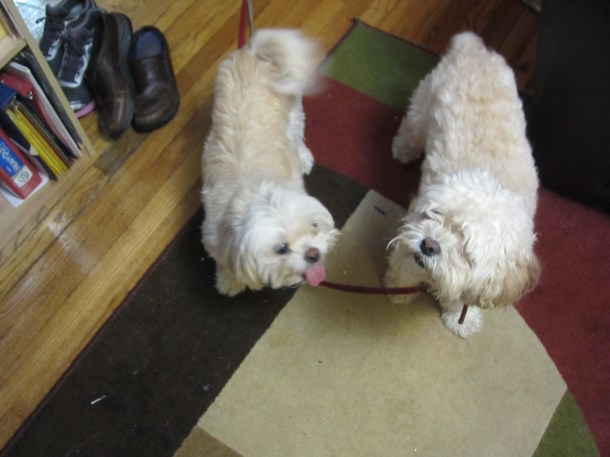
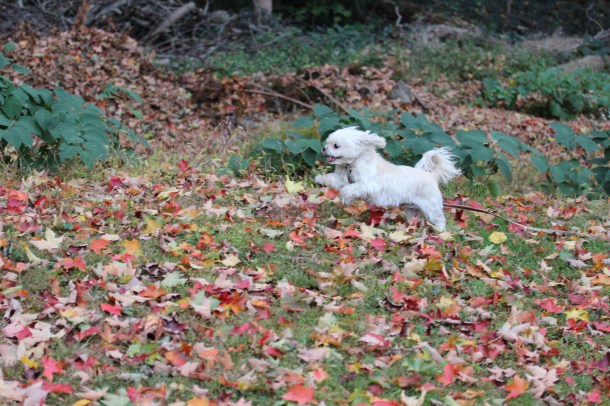
My dogs would never be able to make sense of a Tango, with its sidelong glances and quick flicks and tension. They’re much too straightforward for that, but they have created their own dance forms. Cricket has a “Grandma’s home!” dance that involves a lot of hopping on her two back paws and reaching up into the air with her front paws. Butterfly has an outdoor dance with a lot of skipping and hopping and galloping, before she finally stops to poop. They also have a few partner dances, where they cross leashes and sniff each other and run side by side and then pull apart.

025

Dance with Grandma!

pix from eos 042.jpg

Dance in the leaves!

IMG_1861

Dance in the snow!

IMG_1576

Dance together!

The dance floor at the museum began to look like an oversized game of Twister after a while, with a widening gap between the serious dancing couples and everyone else just playing around, snapping fingers, running instead of dancing, shimmying when that was not what the instructor called for.

A man in a long black coat, black hat, and beard, danced with a woman in a modest red dress on the outskirts of the crowd. He leaned down after a complicated step, and she reached up, to kiss him on the lips. Their teenage son, in the same kind of plain black suit, with fringes dangling out of the corners of his white shirt, wandered through the couples, wind-milling his arms, dancing on his own, twirling his coat like a black dancing skirt.

His parents watched him, but let him be. I noticed the couple because they were obviously Jewish and therefore familiar, but even more than that because they looked so comfortable in their bodies. You could see their relationship in every move they made: the private jokes, the comfortable fit of one hand in another, the playful kiss on the cheek. When I watch Dancing with the Stars, or So You Think You Can Dance, they’re always emphasizing the sexuality and formality of dance, but this was something more real and down to earth; this was like watching a long-married couple do dishes together, or listening in on a gentle disagreement about the color of the curtains.

This is what I love about watching Cricket and Butterfly dance, every move they make is real and expresses something they actually feel in the moment. It’s not formal or theoretical, it’s down to earth and full of life. If I could ever create a dance for myself, that’s what I’d want it to be like, especially if I could include a swirling dance skirt, and a few puppies for good measure.

IMG_0454

And then rest.

My Voice

My Voice

When I was little, I used to sing stories to myself. I would walk to the library, make up a story, and revise it over and over, all to some endless tune in my head. My mother loved that I would sing around the house, and she wanted me to sing more. It was her idea to find me a voice teacher when I was in eighth grade. She wanted me to know that my voice was worth taking seriously.

I was always singing, or shouting, it's hard to tell.

I was always singing, or shouting, it’s hard to tell.

My first voice teacher had an opera background, but she spent most of my lessons on vocal exercises and breathing exercises, teaching me how to breathe from my diaphragm, and stand up straight, and relax my shoulders. I’d never much liked practicing scales on the piano, but vocal exercises made more sense to me. She taught me to sing through the mask of my face, like a raccoon, and to change the shape of my mouth to make the consonants clear and the vowels more open.

My father insisted that we sing songs together after Friday night dinner, as a family. But, he didn’t believe in normal limitations, like that a baritone might struggle to hit a glass-shattering high note. He refused to choose a key that everyone, including him, would be comfortable with, and he didn’t care about the quality of the note when he was done with it. He could rip it and strangle it, and drown the note in coughing, but if he hit that note, even for a second, he’d won.

And he did not like competition. He didn’t want me to practice singing between voice lessons. He would complain that I was “caterwauling,” even if I practiced in my room with the door closed. He’d complain about the money Mom was spending on my lessons. And eventually, he made it clear that he believed in the ban on kol isha – the voice of a woman – that we’d learned at school. I could sing at home, but it would be unacceptable to allow my voice to be heard by men outside of the family. He believed that singing, for a woman, is a salacious, sexually provocative act, and if I do it, I am a whore.

Unfortunately, around the same time as I was getting used to my voice lessons, we had a guest speaker at my orthodox Jewish school. Only the girls were invited to the gym to listen to her. She performed for us first, doing her own version of beat boxing, using her mouth like a drum and her hands as tambourines. The things she could do, the sounds she could create with no musical instruments to back her up, were incredible. There was something like bird song about her voice, as if she was born with these songs in her body and she just had to release them. She wasn’t just hitting notes, she was putting spin on them, like a tennis player, top spin and back spin, hollow sounds and full sounds, cold and warm, shivery and strident, all from one voice. I wanted her to be my teacher.

After her performance, she told us that she’d been a voice student at a prestigious conservatory, training for a professional music career, when she started to visit Chabad (a Chasidic Jewish outreach group) on the weekends. She gradually became more and more religious, until it became clear that as a religious Jewish woman she could never sing in front of men. She’d pieced together a career as a speaker, and sold her music to strictly female audiences. Her message was clear: being religious comes first, before anything else you might want, or love, or need in life.

Her visit haunted me. I didn’t stop singing altogether, but I felt her hand tightening around my throat.

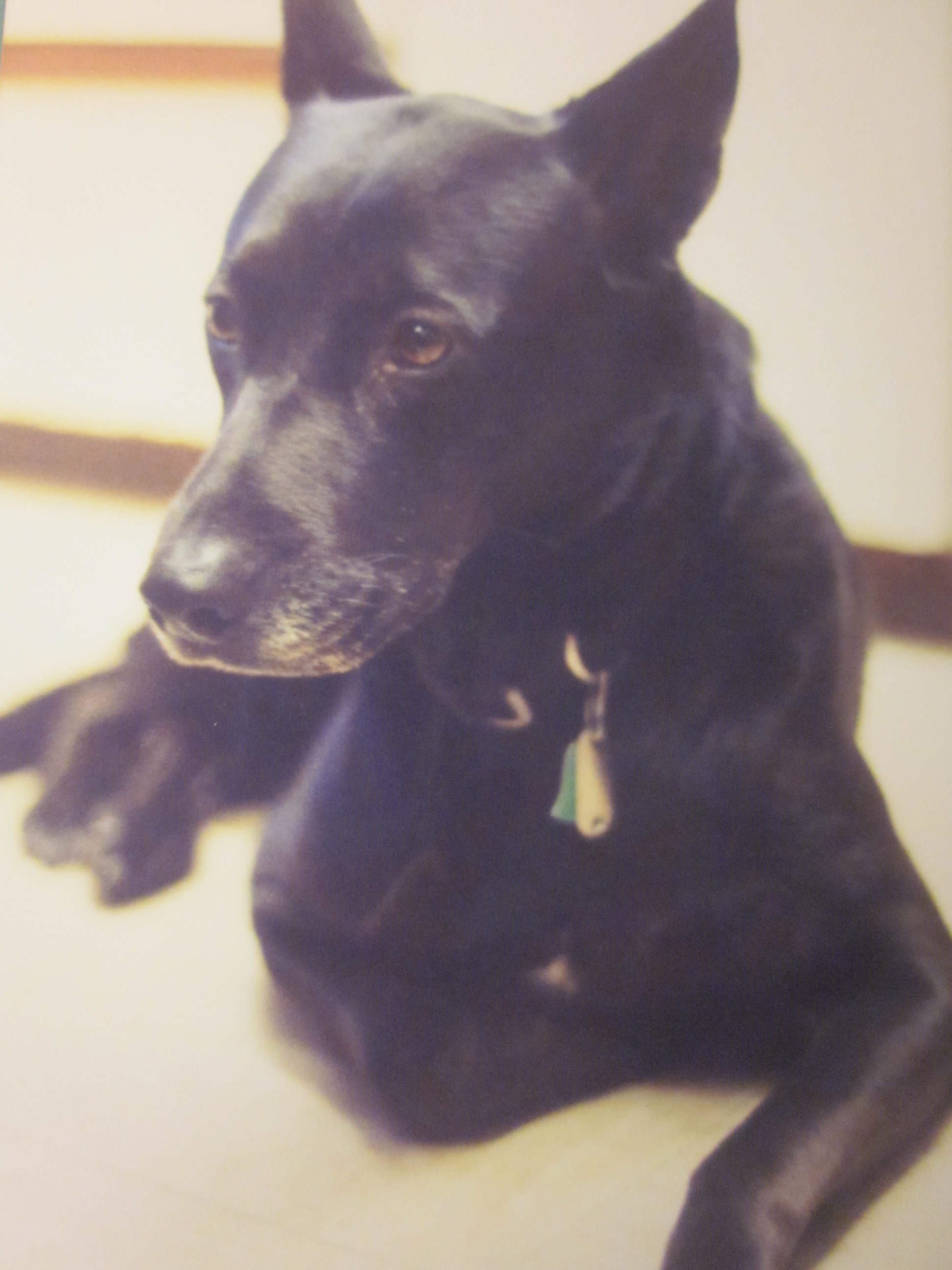
My black lab mix, Dina, came along when I was sixteen years old, and she was a singer too. You had to hit a certain note, something in the howl-range, and that would set her off. Her pitch was pretty good and she could sing a nice clear note or series of notes, but she didn’t seem to enjoy it. She seemed like a button had been pressed in her brain and she had to sing, and had no control over it, and no choice. She seemed relieved when the singing stopped, as if it had taken so much out of her and now she could rest in silence.

Dina as a puppy.

Dina as a puppy.

I took a few years off from trying to sing, until my last semester of college, when I had two credits to kill. I’d been feeling like a robot, detached from myself and my voice, and I hoped voice lessons would help unlock something. I didn’t have to perform in public; my lessons would be in a safe, partially soundproof room. I still couldn’t practice at home, though, so I’d sing in the car on the way to and from school.

This was my first male voice teacher, and he was closer to my age, and friendly, and an opera singer. Whenever he actually sang something I sort of cringed, though. I’m not an opera fan. The vocal quality they strive for is bombastic and brassy and kind of hurts my ears, but he was very nice. He had me singing from an opera workbook, in Italian. There was something freeing about singing in a language I didn’t understand.

I sang to Dina at home, but not too loud, and never in full voice, and gradually, the hand around my throat grew tighter and tighter, telling me to stop singing, and I did.

Dina had a lot to think about.

Dina was a very good listener.

When I think back to that girl singer, though, telling us that she had to give up her dreams in order to be a good girl, I wonder if I ignored something important. With her words, yes, she told us to hide ourselves from the world, but her body carried a different message. Her voice seemed to be saying that, if you have a bird trapped in your chest, flapping its wings and trying to sing its song, you have to let it sing, or it will die.

birdie

My Life as a Jewish Woman

One of my blogging friends suggested that I write about my life as a Jewish woman, and it scared me, because writing about being Jewish always scares me, just like writing about anything else people might judge me for scares me. I worry about anti-Semitism; I worry about people feeling alienated from me for being different; I worry about being rejected, and looked down on most of all. The image of the Jew as vermin has always stuck with me. I was born long after the holocaust, but it has never felt that far away.

“What are you talking about, Mommy?”

I grew up in Jewish environments, getting a Jewish education (or a few different Jewish educations), so being Jewish always felt normal to me. It was only when I went to college that being Jewish became an issue. Most of the higher educational world, no matter how many students at a school are Jewish, is based on a Christian world view. It is assumed that when you mention the bible, and you will, you mean the King James Version, including the New Testament. In a discussion about history or biology, or, god forbid, art history, teachers would reference books of the bible I’d never heard of, and I felt like I needed Google and Wikipedia, before such things existed.

“Ask me, Mommy. I know everything!”

It wasn’t just factual references that I missed and had to look up, there were world view things I couldn’t relate to. So much talk of heaven and hell, and turning the other cheek, had never come up in my childhood. I felt like I’d need a PhD in Christianity before I could understand much of anything. So I did my honors thesis on comparative religions, and read the King James Bible, and the New Testament, and the Koran, and forty other books on various religions around the world. I can’t pinpoint what I did with all of that information, and I didn’t feel like an expert when I was done, but I did feel more grounded. I felt like I knew enough to get by.

Despite the adjustment period, there was something freeing about not being in a Jewish environment anymore. I stopped feeling like someone was looking over my shoulder all the time, giving me demerits for each non-orthodox behavior. No one cared if the sandwich I ate for lunch was kosher. No one cared that I wore pants. If I went to school on a Jewish holiday, no one even noticed. It didn’t matter to anyone how religious I was, or wasn’t. They noticed that I was a good, and maybe compulsive, student. They noticed that I talked back to teachers (sometimes too much, sometimes just the right amount).

Being outside of a Jewish point of view allowed me to see how many different world views there really were. I started to see that even the Jewish world was not as unitary as it had seemed. Not all Jews are orthodox and steeped in the Talmud, not all Jews were red diaper babies raised by union activists, all Jews are not from Eastern European shtetls, all Jews are not “New York liberals,” or Pro-Israel, or Pro-peace, or well educated, or small minded, or wealthy, or clever, etc., etc.

The only really Jewish thing about my life now is the fact that I go to synagogue on Friday nights. I don’t keep kosher (sorry, God), and I don’t take out a prayer book three times a day, and I don’t wear a Star of David necklace. I do have a mezuzah on my door, but I never remember to kiss it.

My life isn’t especially Jewish, but I am. It is a big part of my identity, probably as big as being female, or American, or a writer. Being Jewish is essential to how I view the world around me, how I watch the news, how I meet new people. I am probably more skittish about traveling to, say, Germany than the average American woman. I am probably more sensitive about how Israel is portrayed in the news (though some evangelical Christians have me beat on that one).

The fact is, though, that I felt like just as much of a Jewish woman during the fifteen years when I did not belong to a synagogue as I do now. The rituals, and the belonging, while comforting and satisfying, are not the source of the identity for me. I know people who were raised without much involvement in Jewish community life, and they too feel their Jewishness strongly. There’s a mix of pride in the heritage, and fear of being targeted, and shame at being different, that we all share.

My dogs remind me, though, that my Jewish identity isn’t all of who I am. They are deeply connected to the energy of the universe, and they could care less if I am Jewish or Muslim or Christian or agnostic. The dogs represent the connection I have to everyone, not just to one small group.

“Hi Mommy!”

“If you’re Jewish, are we Dogish?”

I went to the supermarket one day, and some kid with weird hair was standing outside. Normally, I wouldn’t ever think of stopping to talk to a strange teenage boy, but he had a bulldog puppy with him and that changed everything. I met the dog, I got kisses, I talked to the boy on the other end of the leash, and he was friendly and talkative, and grateful that I liked his dog, and we parted as friends, feeling better about the world and the other people in it. Dogs do this!

Who could walk past a bulldog puppy! (not my picture)

Who could walk past a bulldog puppy! (not my picture)

So yes, I am a Jewish woman, and an American, and a writer, but before all of that, I am a dog person. It’s not an identity, it’s just what’s there, under all of the layers of identity, and my dogs think it is the most obvious thing about me.

Me and baby Cricket

Me and baby Cricket

My Mezuzah


A mezuzah is a totem, a sort of anti-goblin device slash symbol of Jewish identity that Jewish people are supposed to place on our doorways. The mezuzah itself is a rolled up parchment inside of a decorative case and the parchment comes from the bible and basically reminds us to love God, and believe in God, and keep the commandments, and pass it all on to our children.

It's pink!

It’s pink!

You’re supposed to kiss the mezuzah – or kiss your fingers and then touch the mezuzah – every time you enter or leave the room, but I don’t have the patience for that. I have my one mezuzah at the front door, and I notice it when I walk in, and it gives me a feeling of familiarity. I happen to think my mezuzah is pretty.

The only other thing we have in front of the apartment door is a red welcome mat that almost always has a few pieces of kibble on it. So, welcome, dogs live here. We also have a table out in the hall with plants on it, and there are plants outside the front door of our building, and a turtle made of painted rocks. So we have a few things that announce who we are – Jewish dog people with lots of plants and an interest in turtles.

Turtle guards the garden.

Turtle guards the garden.

When my brother’s family came to visit, my niece Lilah, the black lab, who had only been here once before, raced up the stairs and went straight to our door without anyone reminding her where to go. She knew which apartment smelled right. Eau de kibble sends the message.

Lilah!

Lilah!

Lilah in the snow.

Lilah chasing Cricket in the snow.

But a mezuzah shouldn’t just be a sign to other Jews, as if only Jews should feel welcome in my home. I feel more like the mezuzah announces who I am, so that you will feel more comfortable telling me who you are.

I like symbols. An idea is elusive, but a physical symbol is visceral and concrete, and makes things easier to remember. I’ve considered dog related symbols for our front door too. The shelter where we adopted Butterfly gives out huge paw magnets that you can put on your fridge, and car stickers, and sweatshirts, and blankets, and on and on. But, by the time you get close enough to my door to see a sticker, you will have heard Cricket barking at you from inside, so the sticker would be kind of irrelevant.

I’m not comfortable wearing a star of David necklace. I had one, but I kept yanking at the chain until the chain broke, two or three times. Maybe the necklace felt too reminiscent of the yellow stars Jews had to wear during the holocaust, or maybe it’s just that the necklace I had came from my father’s mother, and she grossed me out.

I wear my Koru instead. It’s a New Zealand/Maori symbol of new birth – an unfurling fern – and I wear it to try to remind myself that I can start again every day. I don’t have to be stuck in the past, even if the past is the bad day I had yesterday. It’s not a religious or spiritual symbol for me, it’s a reminder, like a rubber band on your wrist (I tried the rubber band idea first, but it hurt too much).

Koru and hair.

My Koru, and hair.

I’m afraid to post this now, given the current situation in Israel. I feel vulnerable when I watch the news. When I heard about mass protests against Israel in Europe, and anti-Semitic slurs on college campuses, I couldn’t help but feel frightened.

To me, having a mezuzah on my door means that I feel safe telling people that I am Jewish and I don’t live in a place where being Jewish makes me a target. Putting a mezuzah on my door, or writing about being Jewish in a blog that is largely about dogs, is my way of saying that I know I’m safe and I don’t have to hide who I am in order to reach out to new people.

My girls, and Ducky too.

My girls, and Ducky too.