Tag Archives: Jewish

The Slow Fast Day


The summer when I was ten years old I lived in the bunk behind the bunk, at my sleepaway camp. My bunk was added on behind the popular girls’ bunk for our age group; they had a lot of light and windows and a porch facing the public, and we were hidden in back, invisible. There was a thin wall separating the two bunks, and we had to listen to the soundtrack of Footloose all summer long through that wall.

There was a girl in my bunk who was sort of my friend, but mostly not. She was the one I’d made fun of the summer before, in my aborted attempt to fit in with the popular girls, and our friendship was on a teeter totter. She was pretty, but strange, and from different evidence over the years – promiscuous behavior at a young age, severe memory lapses, a changeable personality – I realized later that she was a sexual abuse victim, like me. That could explain why I was drawn to her, even though she was often mean to me. She could say awful things, or ignore me for large swaths of time, despite the itsy bitsy size of the bunk we lived in together, and I still accepted her friendship when it was offered.

180

“I understand.”

And then came Tisha B’Av. The Ninth day of the month of Av, on the Jewish calendar, commemorates the destruction of the first and second temples in Jerusalem, in 586 BCE and 70 CE. Over time the fast day has come to represent a long list of catastrophes in Jewish history, maybe because we need more relatable grief to hold onto, like method actors, in order to effectively mourn the loss of two temples we’d never seen, and a kind of life that none of us had ever experienced, with high priests, and animal sacrifices, and all Jews living in one place.

Tisha B’Av is regarded as the saddest day on the Jewish calendar, but generally goes unnoticed in the liberal Jewish world, except in Jewish summer camps, like the one I went to for five summers as a kid. For one full day, from sunset to sunset, we were prohibited from eating or drinking, washing or bathing (aka, no swimming). Fasting is a tool used by all kinds of religious and spiritual practitioners, because it works; depriving the body of food starves the brain of needed Serotonin, creating a neurochemically induced state of depression. Kids under thirteen are supposed to be excused from fasting, but most of us did it anyway.

The summer when I was ten years old, we trekked to the other side of camp and to sit on the basketball court in the dark when Tisha B’Av began. We sat on the ground, by bunk, with a single candle in the middle of each circle, and we listened to the older kids chanting the book of Aicha (Lamentations) in Hebrew. It was haunting, and sad, even though no translation of the text was offered. The next morning we went to services again, all together as a camp for the only time all summer, but then the rest of the day stretched out before us with no distractions, no food to eat, and no activities to keep us busy. Our counselors were felled by the fasting and most likely by the lack of caffeine, because no food or drink also means no coffee, and they didn’t have the energy to sit with us and talk with us and offer comfort.

That year we were all hanging out in our tiny bunk, to escape the heat, bored to death. All of our negative feelings were let loose in the bunk with no safe place to lock them away, and we just lived in the undifferentiated soup of our emotions for hours. Maybe that darkness, and the desperate desire to do something to disperse it, explains what happened next.

I don’t know where our counselors were, but the girl in my bunk who was sort of my friend and sort of not, decided that I needed a haircut. That was the summer when one of the girls had brought Judy Blume’s Forever to camp, and let everyone borrow it. It was the first book we’d ever read with a sex scene in it, and people were reading it in hushed voices, after dark, with flashlights. The brink-of-puberty thing left me open to a lot of criticism: for my bland clothes, my plain brown hair, my lack of makeup, etc. For some reason, this girl focused all of her frustration on me that afternoon, and offered to cut my hair, to make me look presentable. I don’t know if it was hunger, fatigue, or humiliation, but I agreed to stand over the sink in the bathroom while she parted my hair into bunches and started chopping inches off from the bottom.

IMG_1323

“Eeeek!!!!!!”

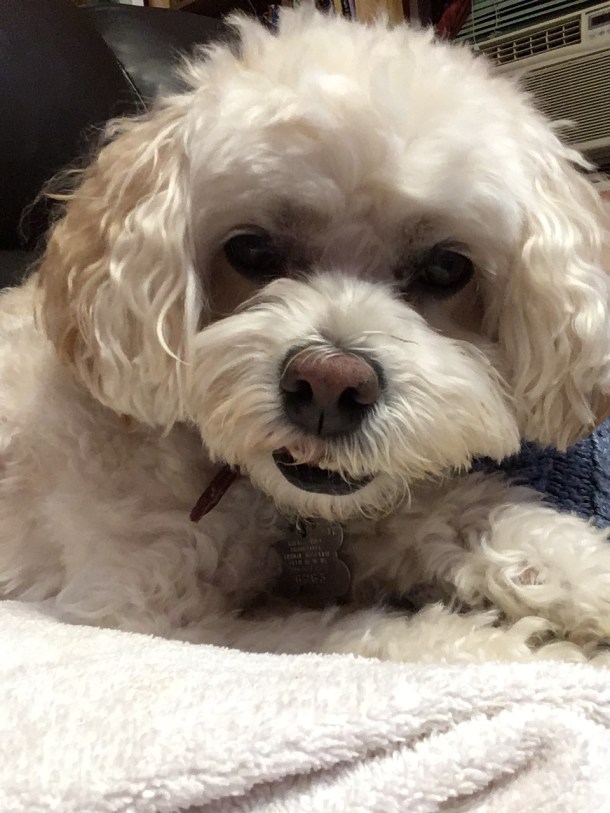
Our senior counselor appeared at the entrance to the bathroom when only one bunch was finished. She screamed at both of us, outraged that we would do such a thing on a holy day. Haircut Girl dropped the scissors and walked out of the bunk with a shrug. I stood still, looking in the mirror, feeling guilty for not knowing all of the rules for Tisha B’Av, and guilty for going along with something I didn’t want to do, and guilty for accepting Haircut Girl’s assessment of me as so far below her. Guilty and ashamed and lonely and depressed; it all seemed to resonate with the character of the fast day, and the shame and guilt of the Jewish people for so upsetting God that he would have to destroy our Temple, twice.

My counselor sat me at the picnic table outside of our bunk and put my uneven hair into a French braid to hide the damage, somewhat, until she could finish the haircut herself after sunset. She had to have known that there was an element of bullying in the haircut, but I think she was also confused that I’d gone along with it. She didn’t understand why I’d say yes to such a thing, and I couldn’t explain it without humiliating myself even further. It matters that the girl cutting my hair was the one I’d made fun of the previous summer, mimicking her in front of the popular girls before I realized I never wanted to do that again. Maybe I felt like I owed her the chance to humiliate me in return, except that she didn’t seem to remember any of it. She barely remembered that we’d lived in the same bunk the previous summer. Or at least that’s what she said.

Towards the end of that summer our age group had a talent show, and Haircut Girl asked me to do a dance routine with her. I’m pretty sure I was a last minute replacement when her preferred dance partner dropped out. She would have looked around our tiny bunk and reluctantly accepted that I was the one most likely to agree to do it, because I loved dancing. I would have gone to dance classes every day in camp, if they’d given any dance classes at my camp. I danced unconsciously most of the time, instead of walking, and it’s possible that that played a role in my less-than-cool reputation.

We did our dance routine to “Let’s Hear It for the Boy,” from Footloose, since we’d been listening to the soundtrack all summer. I don’t remember the performance itself, but I do remember the magic of being able to match my steps to her steps as we rehearsed next to our bunk. Did we sing out loud? Or lip sync during the performance? I don’t remember. Were we better friends when it was over? Nope. But for a couple of days we were dancing to the same music, and even smiling at the same time, though probably not at each other.

And yet, I prefer to remember the fast day, despite all of the pain involved. For that one day, each summer, everyone was more real, with all of their light and all of their darkness visible. It wasn’t comfortable, or fun, but it was cathartic. If a fast day hadn’t already existed in the middle of the summer, we’d have had to create something like it ourselves, just to relieve the pressure of keeping up appearances, if only for a moment.

295

“Phew.”

If you haven’t had a chance yet, please check out my Amazon page and consider ordering the Kindle or Paperback version (or both!) of Yeshiva Girl. And if you feel called to write a review of the book on Amazon, or anywhere else, I’d be honored.

Yeshiva Girl is about a Jewish girl on Long Island named Izzy. Her father has been accused of inappropriate sexual behavior with one of his students, which he denies, but Izzy implicitly believes is true. Izzy’s father decides to send her to a co-ed Orthodox yeshiva for tenth grade, out of the blue, as if she’s the one who needs to be fixed. Izzy, in pain and looking for people she can trust, finds that religious people are much more complicated than she had expected. Some, like her father, may use religion as a place to hide, but others search for and find comfort, and community, and even enlightenment. The question is, what will Izzy find?


Writing Our Own Blessings


There’s a long list of blessings in the Jewish tradition, most of which are over food. The official purpose of saying blessings in Judaism, according to Wikipedia, is to acknowledge God as the source of all blessings, and to transform everyday actions and occurrences into religious experiences. There are blessings on giving charity, and hearing thunder and seeing lightning, on smelling a fragrance, or seeing a rainbow (though that last one is focused on blessing the memory of the covenant between God and the Jewish People, which isn’t really what’s exciting about rainbows). There are blessings for seeing the ocean, or the blossoming of trees, or undergoing a medical procedure, or crossing an ocean, or being released from prison. There are blessings you’re supposed to say each morning, to thank God for straightening the bent, and releasing the bound, and opening the eyes of the blind, and “making me a man.” There is an alternate blessing for women to say, but, spoiler alert, it’s not equivalent to the blessing for men. There are blessings on seeing a miracle, and on receiving good or bad news, and then there’s the blessing thanking God for not making me a Goy (non-Jew), which I just refuse to say.

puppy in November 005

“Hey, what’s that about?”

My question is: are these existing blessings sufficient to fill our needs? Every blessing in the canon was written by a human being, at a certain time and for a certain purpose. If the blessings we say throughout the day impact how we feel about our lives, it only seems fair that we should have some control over what they will be. I want to feel empowered to say the blessings that mean something to me, today, and not be stuck repeating what generations of men have seen as worthy of gratitude.

First of all, I want to be able to alter existing blessings when they don’t work for me. For example, I would change the blessing over rainbows so that it focuses on the beauty of a rainbow, or on the hope that leprechauns and gold coins will appear at the end of it. And since I can’t say the thank-god-I’m-a-man blessing and I refuse to say the thank-god-I’m-not-a-Goy blessing, I need to find alternatives. Maybe, thank God people are all different so we don’t get bored with all of the sameness, or, thank God I am the specific person I am, whoever that may be.

puppy-in-october-017.jpg

“That sounds much better.”

I like the idea of spontaneously expressing gratitude when good things happen, even if those good things don’t fit into some universal pattern. Ellie might say Thank you God for giving me a mommy who knows that I want chicken right now. And Mom might say, Thank you, universe, for this little bird who landed on my window sill to eat the leftover matzah from Passover that the other birds ignored. And for me, Thank God I have enough pens and yellow narrow-ruled legal pads to write down all of my random thoughts.

157

“Did you say chicken?”

            I feel strongly, though, that we should be allowed to acknowledge that life is complicated, and that I can feel more than one thing at a time, without cancelling out the gratitude. I’d call these the “Thank you, but…” blessings, as in, Thank you, God, that I can still walk, even though my hips ache on rainy days, and I have to take pain killers and wear orthotics in all of my shoes; thank you for helping me tolerate people who disagree with me, even though they are still, clearly, wrong; thank you for giving me a nervous system that is extra sensitive to smells and sounds and feelings of all kinds, even though it makes me feel awful half the time; thank you for the joy I feel when I hear a bird singing outside my window, but, you know, it’s five o’clock in the morning and I’d rather be sleeping. And of course, thank you, God, for this piece of chocolate, but next time could you make it Godiva?

            I also want blessings that can acknowledge pain as part of my life: Thank you God for seeing me in my pain, accepting me as I am, and knowing that I am doing my best; thank you God for making it rain on a day when I feel like crying; thank you God for sitting next to me in the muck and not being in such a hurry to leave; Thank you for hearing me when I’m angry and sad and confused, as much as when I’m happy and inspired; Thank you God for teaching me the power of kvetching; blessed art thou, oh lord, our god, ruler of the universe, for not giving a f**k that my hair is a mess today.

003

“Stop talking about my hair!”

            And I need some aspirational blessings, to help me imagine that things can improve: may we, one day, remember what it’s like to wake up to actual birds chirping instead of to twitter alerts; may God, or the force, be with me during my exam so that I don’t forget everything I learned in a fog of anxiety; may we all learn to hear one another with empathy and compassion, even when we do not understand.

            And last but not least, because it’s the category we usually think of when we think of blessings, I need some more blessings that celebrate wonder and gratitude, like: a blessing for every time I see a new tree or bird or flower; a blessing on making a new friend, or having an “aha” moment. A blessing for pushing myself one centimeter further into a stretch, or being able to stand up again after sitting on a low chair, or having enough tissues during allergy season. A blessing for practicing a musical instrument, or taking medication that actually works, or reading a good book, or having a nice phone call, or receiving a kind email. A blessing for the ability to think for myself, and a blessing for the miracle that is chocolate mousse.

But I still have a lot of questions about blessings, and the role they play in our lives. Why do some people find deep meaning in saying blessings all day long, and others find it tedious? Is there still value in saying blessings even if you don’t believe in God? Is there a right way or a wrong way to say a blessing, and if I say the “wrong” blessing will it make me feel worse?

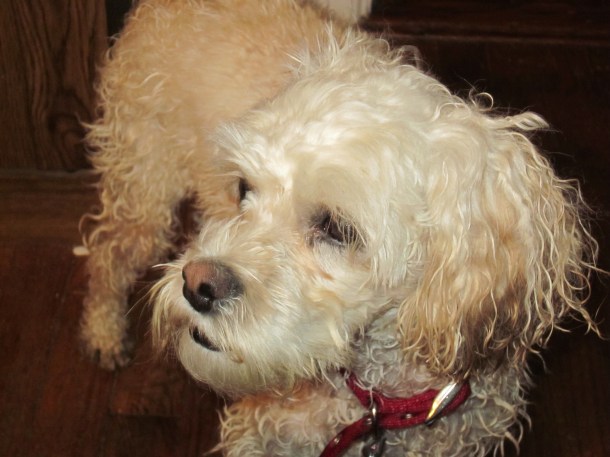
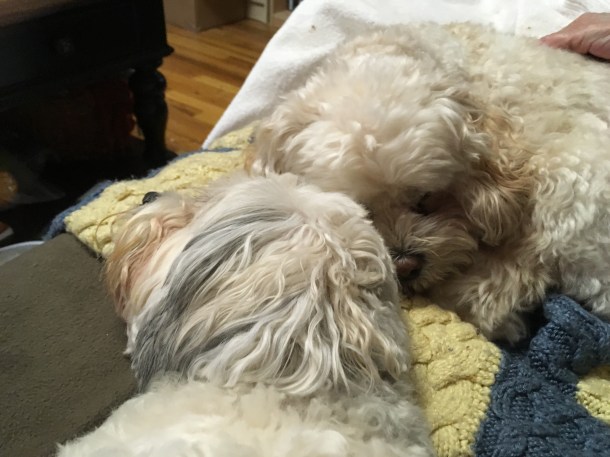
The dogs seem to say blessings throughout their day, like when Cricket sighs a deep sigh as she stretches herself out across Grandma’s lap, or when Ellie flies off the steps to chase a squirrel. They haven’t told me who they say their blessings to, or if they believe in God or some other universal force, and I have no idea if there are words attached to the blessings they mutter to themselves all day long, but it makes them happy. I can see how meaningful it is to them, to acknowledge, with a sound or a smile or a stretch, how wonderful they feel when they smell chicken in the air, or when they scratch their backs on the rug. They are fully present in the moment and acknowledge their gratitude, but also their disappointment and grief, all at the same time. Taking that extra second to acknowledge it all seems to really work for them.

272

“Aahhh.”

284

Some blessings don’t need words.


I wonder if there is a collection of blessings that dogs have access to that helps them find the exact right thing to bless, because I could use something like that. But, unfortunately, I’m pretty sure they didn’t find any of their blessings in a prayer book. They just know what they are feeling, and feel free to say it to whoever might be listening. That seems like a good place to start.


If you haven’t had a chance yet, please check out my Amazon page and consider ordering the Kindle or Paperback version (or both!) of Yeshiva Girl. And if you feel called to write a review of the book on Amazon, or anywhere else, I’d be honored.

Yeshiva Girl is about a Jewish girl on Long Island named Izzy. Her father has been accused of inappropriate sexual behavior with one of his students, which he denies, but Izzy implicitly believes is true. Izzy’s father decides to send her to a co-ed Orthodox yeshiva for tenth grade, out of the blue, as if she’s the one who needs to be fixed. Izzy, in pain and looking for people she can trust, finds that religious people are much more complicated than she had expected. Some, like her father, may use religion as a place to hide, but others search for and find comfort, and community, and even enlightenment. The question is, what will Izzy find?


Yom Daled


On Wednesdays at my Jewish sleepaway camp, when most of the kitchen staff took the day off, we made our own sandwiches, right after breakfast (egg salad, tuna, peanut butter and jelly), and tossed them, and some pieces of fruit, into a black garbage bag to be kept in the fridge for later. The scary part was that we had to tell our counselor what kind and how many sandwiches we wanted, so that two delegates could stay late with her and make the sandwiches. And then during lunch I had to sit there with everyone in my bunk knowing that I’d asked for two peanut butter and jelly, plus an egg salad sandwich. I wanted more sandwiches than a pre-teen girl was supposed to want. I was always hungrier than I was supposed to be. I could eat three bowls of cereal at breakfast, but at least no one was announcing it to the whole room. It’s possible that the other girls ate as much as I did, but they hid it better.

IMG_1035

“Did you say sandwiches?”

Wednesdays were called Yom Daled, or day four, because everything had to have a Hebrew name in camp. I’m not sure why it was Yom Daled, which is the fourth letter of the Hebrew Alphabet, instead of Yom Revi’i, which literally means “the fourth day” in Hebrew. This is a mystery I may never unravel. The other days of the week weren’t named after Hebrew letters, though. In fact, I think we just called them Sunday, Monday, and Tuesday, like everyone else.

Anyway, Yom Daled was meant to be a break from our regular schedule of sports and arts & crafts and swimming and Hebrew classes. We went on day trips, off campus, a couple of times each summer, but otherwise it was up to our counselors to create an “experience.” Like the time they set up a trip to Russia, in the auditorium, and taught us about the Refuseniks (Russian Jews who weren’t allowed to leave Russia). I remember waiting on a long line to get my imaginary passport, and then having it ripped out of my hands (paper cut!) on another line. And I remember feeling like I was wearing a tattered woolen coat, and still shivering, even though in real life I was in a t-shirt and shorts, and sweating to death.

We learned a song that day called “Leaving Mother Russia,” written by a group called Safam, and inspired by Natan Sharansky. I don’t remember singing the song at any other time, but the chorus has stuck with me for thirty years: we are leaving mother Russia, we have waited far too long, we are leaving Mother Russia, when they come for us, we’ll be gone.

Another time, they set up the whole camp as if it were the State of Israel, and we visited a shuk (a marketplace), and had to haggle over prices, in Hebrew, and then we made pitas on a hot stone, and, of course, we had hummus and falafel and Israeli salad for lunch.

010

“I’m sure I like falafel, Mommy.”

On another day, in a different summer, we learned about terrorism. Our counselors lined us up in chairs and had us pretend to be on a plane hijacked by Palestinian terrorists. It was an interesting thing to see our counselors interpret their roles as terrorists; some tried to make us understand the sorrow and pain of losing their land, and the hopelessness of being refugees under the control of strangers; others played their roles with anger and violence and scared the crap out of us.

We also spent a day learning about cults, because it was a hot topic on college campuses that year, and our counselors wanted to prepare us for being tempted to give up our individuality and free will, or something. They didn’t do a very god job of explaining how cults were different from religion or camp, though. I was used to being brainwashed in each new environment I went into, having to buy in to a new set of beliefs, and having to give up things that mattered to me just to fit in. I wasn’t sure how different a cult would be, maybe just in intensity rather than in spirit.

We went on hikes at least once per summer, and it was always exhausting and too hot, but we couldn’t opt out. By the end of each hike dozens of kids were claiming health issues and trying to cadge lifts back to camp with the counselors who had driven to the lunch spot, bringing the food and supplies. I never bothered to beg for a ride, for some reason, even though I hated every second of the steaming walk back to camp.

132

“That sounds exhausting, Mommy.”

I don’t remember a lot of our day trips off campus, though there was one memorable trip to New York City. We went to an art museum (I have no idea which one) and to something called The New York Experience, where we sat in seats that shifted around as if we were on the subway, and then fog blew in our faces. Once we were back outside on the street, I realized that I was closer to home than I was to camp, and all I’d have to do was get to Penn Station, and then catch a train home. Except, I had no cash, and I wasn’t really sure I wanted to go home, though I did wish I’d known ahead of time that we’d be in the city, so I could have called my mother and asked her to meet me.

Another day trip was to Mystic Seaport, where we went on a ferry ride and saw a shipping museum, where they showed us a lot of boats-inside-glass-bottles. But then it started to rain and we couldn’t do the rest of the outdoor stuff, so they took us to see a movie. The choice was between Bull Durham and Who Framed Roger Rabbit, and since Bull Durham was R-rated, they chose to make us watch a movie about an animated rabbit, and his animated, non-rabbit, cheating wife, and murder, lots of murder.

For dinner on Yom Daled, the few kitchen staff who stayed on campus would do a barbecue, setting out piles of hamburgers and hotdogs, and watermelon and chips, for us to eat outside. I don’t remember any vegetables, but there may have been pickles. The barbecues were for whoever was on campus in time, and we could start and finish whenever we wanted and sit wherever we wanted, instead of at our assigned tables. We held our paper plates on our laps, and ate with plastic utensils, surrounded by bugs, but I couldn’t always find someone to sit with, and it reminded me of eating lunch at school, just hoping someone would be willing to sit next to me.

IMG_0913

“I’d sit next to you for a burger.”

You know, there’s something to be said for returning to routine, and schedules, and assigned seating, where you know what’s expected of you, and you’re not tempted to hop a train home, and know you won’t have to eat by yourself.

yeshiva girl with dogs

If you haven’t had a chance yet, please check out my Amazon page and consider ordering the Kindle or Paperback version (or both!) of Yeshiva Girl. And if you feel called to write a review of the book on Amazon, or anywhere else, I’d be honored.

Yeshiva Girl is about a Jewish girl on Long Island named Izzy. Her father has been accused of inappropriate sexual behavior with one of his students, which he denies, but Izzy implicitly believes is true. Izzy’s father decides to send her to a co-ed Orthodox yeshiva for tenth grade, out of the blue, as if she’s the one who needs to be fixed. Izzy, in pain and looking for people she can trust, finds that religious people are much more complicated than she had expected. Some, like her father, may use religion as a place to hide, but others search for and find comfort, and community, and even enlightenment. The question is, what will Izzy find?
Musicals at Camp


My brother was recently in a community theater production of HMS Pinafore (by Gilbert and Sullivan), singing his heart out, playing for laughs, and even doing choreography! It was awesome! But watching him have so much fun on stage reminded me of how bad my stage fright turned out to be – worse and worse as I got older, instead of better and better.

IMG_0679

“Food always helps me when I’m anxious.”

At my Jewish sleepaway camp we did a musical every summer. My first year in camp we did Cats, in Hebrew (someone had the job of translating all of these musicals into Hebrew for us, which sounded like hard work at the time, but now sounds like a lot of fun). I think our bunk did a small dance number, in cat costumes. The next year we did You’re a Good Man, Charlie Brown, and I had a duet with a boy. I was Lucy, standing in my psychologist-is-in stand (foreshadowing my future), but my duet partner couldn’t remember his lyrics, so I did most of the duet myself, either whispering his lines to him, or singing them out loud myself when he whispered back, “huh?” I don’t remember being scared, even with the whole camp watching and listening to me in my blue booth. It was something of an out-of-body experience, though, because I don’t remember the rest of the show, or the rehearsals, just that moment in my booth, singing out to the crowd.

The next year we did The Sound of Music, but just as separate songs, not the whole show. I had solos in two songs that year. We learned our second song the morning of the show – So Long, Farewell – but from this one I only remember the rehearsals and nothing from the show itself.

I don’t think we had auditions for any of those early shows. Maybe my facility with Hebrew got me those roles, now that I think about it, though I’d like to believe it was because of my voice, or at least my memory for lyrics.

It was when I was twelve years old, my fourth summer at camp, that I balked. I went up onstage for the audition and I couldn’t make any words come out of my mouth. It was horrifying. I’d been taking voice lessons at home, and I’d been in an after school acting club, and those three musicals at camp already, but on that day I almost threw up on stage from nerves instead of singing, and then I ran out of the auditorium. They cast me in the chorus with a bunch of other kids who didn’t really want to be in the show, and we sang a couple of songs from the fifties, behind the soloists, as part of a musical revue.

IMG_0523

“Run!!!!!!”

I didn’t even bother to audition the following summer, when our age group did Grease, though I do remember being very jealous of the new girl who came in and snagged the lead role her first summer. She had a smoky alto, and a lot of confidence, and actually had chemistry with our male lead (who was the lead every year, if I’m remembering correctly, because he had a pure tenor and everyone liked him).

It was much more fun to go to the shows the other age groups put on, than to be in one myself, which should have been a clue that I didn’t really want to be an actress, but I didn’t take the hint. I even went to an Artsy day camp the next summer, dancing and singing and acting all day, every day, for two months. I kept expecting my fear to go away, but it refused to budge. And then I went to summer acting classes, when I was sixteen, and even signed up for The Actor’s Studio in the city, after dropping out of college that fall, but I had a severe panic attack on the first day and ended up in the bathroom, hyperventilating and crying, before the end of the first class. That was the final death knell for my career on stage.

It’s a big deal that I joined the choir at my synagogue this year, and have performed in public twice already. It’s a small step forward, but a good one. I don’t see myself doing community theatre any time soon, given the flashbacks of terror I felt while my brother was on stage, even though he himself was having a great time. But at least I’m not throwing up anymore. That’s progress.

IMG_1068

“I want to be on stage, Mommy! I’d be great!!!!”

If you haven’t had a chance yet, please check out my Amazon page and consider ordering the Kindle or Paperback version (or both!) of Yeshiva Girl. And if you feel called to write a review of the book on Amazon, or anywhere else, I’d be honored.

Yeshiva Girl is about a Jewish girl on Long Island named Izzy. Her father has been accused of inappropriate sexual behavior with one of his students, which he denies, but Izzy implicitly believes is true. Izzy’s father decides to send her to a co-ed Orthodox yeshiva for tenth grade, out of the blue, as if she’s the one who needs to be fixed. Izzy, in pain and looking for people she can trust, finds that religious people are much more complicated than she had expected. Some, like her father, may use religion as a place to hide, but others search for and find comfort, and community, and even enlightenment. The question is, what will Izzy find?

yeshiva girl with dogs


Going to sleepaway camp


Each summer, for five years in a row, starting when I was nine-years-old, I went away to a Jewish sleepaway camp for eight weeks. Me and Mom and my brother spent weeks ahead of time buying everything on the camp list: collapsible drinking cup, soap dish, seven pairs of shorts and shirts and underwear and so on, flashlight, bathing suits, flip flops, beach towel. And a trunk. We only had to buy those once, for the first summer, and then store them in the attic during the school year: a huge treasure chest-like box to fill with all of our stuff. Oh, and labels, everything we owned needed a name tag.

A few days after school ended for the year, in the last week of June, Mom drove me and my brother, and our trunks, to a nearby synagogue to catch the bus to camp. The bus ride itself was an orientation. First there was the sharp pain of watching Mommy stand in the parking lot, waving, as we drove further and further away. Then there were the bus songs – 99 bottles of beer on the wall, If I had a hammer, etc. We had counselors on our bus with us, to keep order and manage any traumas along the way, and I met my first new friend on the bus up to camp. She was blond and pretty and bossy, just like my best friend from home, and she started to talk to me right away and asked me to sit next to her on the bus. My brother proceeded to ignore me, almost entirely, as he would continue to do for the next eight weeks.

When we reached camp, we met up with our own counselors, and walked across campus to our bunks, while the maintenance men loaded our trunks and dropped them off on the porch of each bunk (after unloading each trunk we stowed them under the bunk for the summer). The counselors had to come out and meet each bus, and car, when their campers arrived, so back at the bunk we either had a junior counselor or our peers for company, which was not quite enough. I wasn’t really prepared to be away from my Mom, or to manage so many new relationships at once. The saving grace would be the daily schedule, there was almost always something we were supposed to be doing, just not on day one. We also had no TV and very few books, and this was long before smartphones, so socializing was our entertainment.

The blond girl from the bus turned out to be the most popular girl in our age group, and we were in the same bunk, so I was sort of initiated into the popular group right away. I had no idea what to make of that. They were sort of a girl posse, and one of the other new recruits was a nine-year-old outlaw, planning all kinds of trouble for the posse to get into. I was still me, though, and it became clear that I didn’t quite fit in with my new friends. I didn’t have the right clothes, or the attraction to danger, and I didn’t know how to flirt with boys. At first it was exhilarating to be with them, because finally I wasn’t the outcast, the way I was at school, and I wasn’t picked on (too badly). But then they started expecting me to be mean, to make fun of other girls and not just behind their backs, but to their faces.

IMG_0917

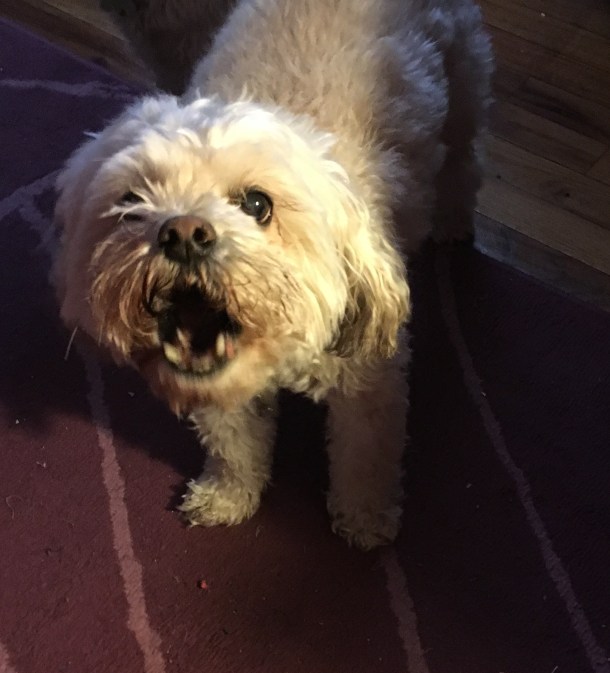
“Harrumph.”

I did it once, without realizing how awful it would feel until I was in it up to my knees. I was a good mimic (I still am, just ask Cricket), and they liked to have me play this and that character, like the male counselor with silly dance moves, or one of the boys who wiped his nose with the hem of his shirt, constantly. I loved the attention! I loved getting the laughs! And then they asked me to do an impression of one of the other girls who was sort of on the outs with the group at that moment. And I did it, because she had such obvious body language and her vocabulary was so specific and I could see the whole performance in my imagination without even trying. I felt like a super star, until I realized that she was suddenly there too, and instead of laughing with me, the other girls were sneering at her and using me as a weapon against her.

I stopped, but it was too late. I tried to apologize, but all that accomplished was getting me kicked out of the cool group; the other girl certainly didn’t forgive me.

I was alone for a few days, but then some new kids came for the second month (in the early years of camp we could choose to come for both months, first month, or second month), and I made some new friends. They were nicer and quieter and preferred playing jacks to getting into trouble. I got a few splinters because the floors of the bunks weren’t perfectly sanded, but there was something reassuring and satisfying about playing jacks. If you played fair and didn’t cheat and didn’t show off just because you were a better player, people stuck around.

img_0987.jpg

Friendship is a good thing.

I went to camp for four more years, but I was never put in the same bunk with the cool girls again, and they barely even looked at me, except for the blond girl from the bus. Every once in a while she’d look over at me with something like regret, but then she’d look back at her friends and shake it off and go back to her popular life.

And yet, I liked being at camp. I liked my less than popular friends. I liked always having something to do and someone to talk to. And if there was also loneliness and conflict and disappointment, well, I had that at home too, and at least at camp I felt normal. I had the same problems as everyone else: sunburn, sand in my shoes, friendship drama, cardboard pizza, too many chores, and homesickness. I think, if we could have had a bunk dog, and if my Mom could have visited every weekend, I’d have wanted to stay all year long.

img_1068.jpg

“I could be the camp dog!”

If you haven’t had a chance yet, please check out my Amazon page and consider ordering the Kindle or Paperback version (or both!) of Yeshiva Girl. And if you feel called to write a review of the book on Amazon, or anywhere else, I’d be honored.

Yeshiva Girl is about a Jewish girl on Long Island named Izzy. Her father has been accused of inappropriate sexual behavior with one of his students, which he denies, but Izzy implicitly believes is true. Izzy’s father decides to send her to a co-ed Orthodox yeshiva for tenth grade, out of the blue, as if she’s the one who needs to be fixed. Izzy, in pain and looking for people she can trust, finds that religious people are much more complicated than she had expected. Some, like her father, may use religion as a place to hide, but others search for and find comfort, and community, and even enlightenment. The question is, what will Izzy find?


The Opioid Epidemic


Recently, the media has been filled with glee around the guilt of the Sackler family (Purdue Pharma) in the origins of the Opioid Epidemic. I have no interest in arguing on their behalf, because the avarice and lack of compassion in their decisions is obvious and really not up for debate. But it interested me that they were singled out, and that the media was willing to simplify the whole epidemic down to the choices of one, rich, Jewish family. I am sensitive to the specter of anti-Semitism, because of the endless role it has played in history, and this struck me as worth examining.

E pre groom

“Are you sure we need to discuss this?”

The Sackler family is responsible for OxyContin, one of the opiates that flooded the market in the nineties, and they attempted to downplay the risks of addiction in their marketing campaigns and ignored misuses of their drugs in favor of making an enormous amount of money, but they could have accomplished none of this on their own. Doctors, who knew that opiates were addictive (Morphine has been around for a long time, Opium for much longer), over-prescribed these medications, and some even made an illegal business out of the underground market for opiates (though most did not). Pharmacies and distributors bought larger amounts of opiates than could ever be used responsibly, knowing they were feeding addiction and illegal markets and doing it anyway. We, as a society, defunded and underfunded addiction treatment, ignoring and demonizing substance abusers so that they could not find a way out, even if they’d wanted to. Families ignored, friends ignored, schools ignored, government ignored, and the FDA approved more and more variations of opiates for the marketplace.

It’s also important to recognize that the Opioid Epidemic has become national and world news in the last few years largely because of the rise of Fentanyl, and then Carfentanyl, both of which are more lethal than Heroin, and have led to many overdose deaths. And Fentanyl has nothing to do with the Sacklers. It’s also important to see that when people of color were losing the war against drugs we didn’t call it an epidemic, instead we blamed the addicts themselves for their problems. This time it is young white people who have been dying, and that seems to have made a difference in the coverage.

Another big difference for the current epidemic is the growth of social media, and technology in general. In the past, a teenager might have had to drive forty minutes to the bad side of town to buy drugs. Now, with a text, you can have anything brought to you in ten minutes. Anything. You don’t have to go to the bad part of town, or spend a lot of money; sometimes all you have to do is open the medicine cabinet in your friend’s house. If we are having an opioid epidemic, then we are having a Benzodiazepine and Marijuana Tsunami, with an alcohol chaser. Vapes, which are everywhere now, can easily be adapted for use with all kinds of different, hard, drugs, and used out in the open. In middle school.

IMG_0930

“You can’t take my Benzos!”

The question is, why did this happen? Why were we so eager to believe the lie that opiates could be made non-addictive? Or that addiction is a small price to pay for pain relief? Or that the market can be trusted to make moral decisions?

This is our culture. American culture. The Sacklers were certainly not acting on Jewish law and morality in their decision making; they were, actually, following the prevailing American value that money is good, and drugs are good, and let’s not think too hard about the downsides, or address the complexities, or look at the people who are struggling, because, really, it’s their own fault if they can’t pull themselves up by their bootstraps.

There are reasons other than Anti-Semitism to explain the hatred and blame of the Sackler family in particular. One, there was a recent document release from their trial, and the information in it was really juicy and obnoxious and therefore caught people’s attention. Even more important, a lot of Americans recognized in the Sacklers a stand-in for the Trumps, and there is great satisfaction in seeing a similarly rich, and corrupt, family being brought down.

But their Jewishness made me nervous. It’s always scary for me to see a Jewish person in the news for criminal, immoral, or unjust behavior – not just because what they did is upsetting, but also because of my fear that their crimes will be used against the whole of the Jewish people. The Holocaust is not as far in the past as some people would like to believe, and we’re seeing an upsurge in anti-Semitism everywhere.

I still don’t know if anti-Semitism played any role in the coverage of this. The origins of the Opioid Epidemic are complex and interwoven and need to be addressed from multiple directions. Simplifying it all down to the greed of one company, and one family, felt good for a moment, because it made us feel like we finally had a handle on what happened. But the epidemic is still happening. We still have a lot of work ahead of us to change our laws and policies and culture, in order to prevent more overdose deaths and lives lost to addiction in all kinds of ways. We want to blame someone, like the Sacklers, or Central American migrants, or corrupt doctors, because we want it to be someone else’s fault, and therefore someone else’s responsibility to fix. But that won’t work. This is our problem, and it belongs to all of us.

012

“Is she serious, Ellie? This is so not my fault.”

011

“Just pretend to be sleeping, Cricket. It always works for me.”

If you haven’t had a chance yet, please check out my Amazon page and consider ordering the Kindle or Paperback version (or both!) of Yeshiva Girl. And if you feel called to write a review of the book on Amazon, or anywhere else, I’d be honored.

Yeshiva Girl is about a Jewish girl on Long Island named Izzy. Her father has been accused of inappropriate sexual behavior with one of his students, which he denies, but Izzy implicitly believes is true. Izzy’s father decides to send her to a co-ed Orthodox yeshiva for tenth grade, out of the blue, as if she’s the one who needs to be fixed. Izzy, in pain and looking for people she can trust, finds that religious people are much more complicated than she had expected. Some, like her father, may use religion as a place to hide, but others search for and find comfort, and community, and even enlightenment. The question is, what will Izzy find?

The Book is Ready


51wewbfuz5l-_ac_us218_-e1543031950131.jpg


I’ve spent many years trying to publish my first novel, Yeshiva Girl, through the traditional publishing route: sending it out to agents, and then watching as my agent collected rejections for me, and then sent it out again, and again. I had hoped that the #MeToo movement would be a sign that the world was ready for Izzy, but the rejections kept rolling in. Izzy has a story to tell that I think a lot of people can relate to, in one way or another. And, fundamentally, I didn’t want her to be alone on a shelf anymore, I want her to be out in the world, so I decided to self-publish on Amazon.

Yeshiva Girl is about a Jewish girl on Long Island named Izzy (short for Isabel). Her father has been accused of inappropriate sexual behavior with one of his students, which he denies, but Izzy implicitly believes that it’s true. Izzy’s father decides to send her to an Orthodox yeshiva for tenth grade, out of the blue, as if she’s the one who needs to be fixed. Izzy, in pain, smart, funny, and looking for people she can trust, finds that religious people are much more complicated than she had expected. Some, like her father, may use religion as a place to hide, but others search for and find comfort, and community, and even enlightenment.

I want to thank my brilliant and talented Mom, Naomi Mankowitz, for the beautiful cover design and page layout for the book, and for every day of love and support throughout my life. And, of course, I need to thank every dog who has passed through my life and taught me about unconditional love and healing. And thank you to all of you, for your support and encouragement for me through the blog, and for inspiring me to take the leap into self-publishing!

me and the girls

We’re sort of ready for the leap.


Please check out my Amazon page and consider ordering the Kindle or Paperback version (or both!) of Yeshiva Girl And if anyone feels called to write a review of the book on Amazon, I’d be honored.


The Interfaith Bible Seminar


Leading up to our yearly ecumenical Thanksgiving service, the local clergy decided to try out an interfaith bible seminar, including two liberal synagogues (one being mine) and a Methodist church. It’s a trial run, to see how we all do, and then maybe more churches and synagogues will be willing to join the group for next year.

I had a lot of questions. Are we all reading the same translations? No, but they are surprisingly similar. Do we read the books in the same order? Nope. The Methodists read from the Old Testament, but also from other books, and on a three year cycle that excerpts pieces out of order. Jews, in general, read the first five books of the Bible, chapter by chapter, in order, throughout each year (though we may excerpt different parts of those chapters, for speed, and then there’s the prophets and the writings, but I won’t overwhelm you with that here.). Do we get the same messages from these stories? No, but no one does. We all see the words through our own kaleidoscope of different life experiences, as it should be.

I was excited to see how the whole trial run would go, because my rabbi has an unorthodox style of Bible study to begin with, pulling in references from Ancient Near Eastern mythology, Orthodox, Reconstructionist, and Reform Bible commentators, and Christian Bible scholars as well. But there’s plenty he doesn’t know about Christian philosophy and how different denominations respond to the Bible (clearly five years of rabbinical school was not enough).

I don’t know if Methodists in general are as laid back as this particular Methodist pastor, but ours was very friendly, and interested in all of our similarities and differences, especially because our congregations are, in terms of American politics in particular, very similar in our beliefs. He liked to connect the bible stories we were reading with current events, though we were all careful to keep the word “Trump” unspoken in our sacred spaces.

The books chosen for study were: Daniel, Esther, Ruth, and Ezra, though I’m not sure why. They do offer a lot of meaty discussion topics, though, including a lot of strangers-in-a-strange-land references, and conversion, and monotheism versus polytheism. In Daniel, there was a lot of My-God-is-Stronger-than-Your-God stuff, but luckily that’s not a bone of contention between Jews and Christians, since we’re talking about the same God, for the most part.

I tend not to read the Bible as a how-to book on life, more like a learn-from-our-mistakes sort of book. But, the books are written in a very understated style, which leaves plenty of room for interpretation, so that what I see as a mistake never to be repeated, someone else may see as a model for how to live a righteous life.

I feel like I could read through these books another hundred times and still find new things, which, as a reader, I love. And I like the feeling of being taken back in time, as if I am living in the desert with Abraham and Isaac and Jacob. It’s a form of time travel, and visiting my ancestors, that allows me to take a few deep breaths outside of my daily life.

We didn’t read through each book line by line in this seminar, the way we usually do, because we only had an hour and a half per book, so we just touched down in the text every once in a while, ready to hop away from any topic that seemed too heated, if necessary. I’m sure we would have been getting into a lot more tricky conversations if we’d been trying to read from the New Testament, though a lot of my fellow congregants would have enjoyed that, especially because they could bring up the Jesus-was-a-nice-Jewish-boy line of argument. We did hear a little bit about which readings from the Gospels were paired with the readings from the Old Testament, which was interesting, but not especially controversial.

I’m not sure what I’ve learned from this interfaith adventure so far, except that I want it to continue. Whether we study in Hebrew, or Latin, or English, and read the New Testament or the Koran, or the Bhagavad Gita, we are all searching for the same things – each other, and how to be the best versions of ourselves.

The fourth and final session of the Bible seminar was snowed out this past Thursday, so instead of reading Ezra, I was outside in the snow with Cricket and Ellie. And it was perfect, because I realized that snow is, just like the Bible, one more thing we see differently depending on who we are and how we feel at that moment. Cricket was in heaven, catching snowballs and digging tunnels and racing around, and Ellie was more circumspect, especially when she realized that her paws were cold, and getting colder. She ended up waiting on the porch for us, where it was dry and warm(er). Some people hear the word snow and feel oppressed by the amount of snow they will have to shovel, or the slippery commute home, and the layers of clothing they will have to pile on. Others think of hot cocoa and cozy family time indoors, and snowsuits and sleds. And everyone is right.

036

Cricket, wondering where Ellie went.

028

Ellie, hiding from the snow.

Except, Cricket is more right, because I agree with her. Snowball fight!

Cricket in snow 2


Healer of the Broken Hearted


We had a solidarity service at my synagogue last Sunday, in the aftermath of the shootings at the Tree of Life synagogue in Pittsburgh. Four synagogues came together in one building, and by the time Mom and I arrived, twenty minutes before the service started, there was no parking left. People had to stand along the sides of the sanctuary after all of the seats had been filled. The clergy of all four synagogues led the service, with readings by the rabbis and songs by the cantors. There was an enormous amount of crying, but I couldn’t cry. The music was beautiful. The presence of clergy from all of the local Christian denominations was meaningful (the local mosque was planning another service for the following day). But the words didn’t reach me. I just wanted to find comfort, and to feel something, but I couldn’t feel anything.

Maybe if I could have brought Cricket and Ellie with me, things would have been different; maybe if we didn’t have to feel such a sense of relief at seeing the police officers lined up in front of the synagogue to protect us; maybe if it were just small service, with my fellow congregants, on a Friday night. I don’t know. Maybe if there hadn’t been so much violence leading up to the shootings, with two black shoppers targeted in a supermarket, and pipe bombs in the mail, and church shootings, and terrorist attacks in other countries and in our own. We can barely breathe between horrific events, let alone mourn.

IMG_0570

We’re all exhausted.

I keep swinging between anger, disbelief, fear, and confusion. At the solidarity service at my synagogue, the focus was on taking action against guns, which of course I agree with, but I can’t see that going anywhere now, any more than it has every single time this issue has come up after mass shootings in the past few years. More than a few years now. We can vote, certainly. We can stand in solidarity with the other victims of mass shootings, and against racist and anti-Semitic violence. But then what?

It turns out that one of the three congregations housed in the Tree of Life synagogue was also a Reconstructionist group, and they had celebrated Refugee Shabbat, as we did in my own synagogue, a few weeks ago. The shooter had found a list of the synagogues that participated in Refugee Shabbat, including my own, and that’s where he got the address for the Tree of Life synagogue, and that was the final straw in deciding which Jews to kill.

The subject of HIAS, the Hebrew Immigrant Aid Society, has come up a number of times lately at my synagogue. There was actually an educational seminar about HIAS planned for Sunday. And then Saturday came, and a man decided to kill Jews at prayer, supposedly because Jews, through HIAS, are to blame for inviting refugees to “invade” our country. To be clear, HIAS does not choose who comes into the country, it works with the state department, along with many other organizations, to help new immigrants integrate into their new communities. If I had to leave my own country and seek safety elsewhere, I would like to believe that there would be an organization like HIAS there, to help me settle in and feel welcome.

One of the songs from the Solidarity Service on Sunday at my synagogue was “Healer of the Broken Hearted,” or in Hebrew, Harofei lishvurei lev. According to my rabbi, the image of a doctor in the Hebrew Bible always refers to God, mostly because every heroic role in the Hebrew Bible belongs to God, the ultimate multiple personality. But this is the image of God that I like best: the comforter, the healer, the one who sees that we are suffering and takes our pain seriously.

Healer of the broken hearted

            Binder of our wounds

            Counter of uncountable stars

            You know who we are

            Hallelujah.”


This week has felt strange: fragmented and confusing. I wanted to be at Synagogue, and I wanted to hide away at home. I needed to watch the news, and I hated to watch the news. And then there was a hashtag encouraging everyone, Jews and non-Jews, to come to Shabbat services. This week’s Friday night service at my synagogue was going to be a Family Service (kid-friendly, loud, and short), but I decided to go anyway. The sanctuary was packed again, and the music was great again, and the neighboring churches sent their clergy to add their words of support again, but it was more than that.

Maybe it was because a few more days had passed since the shootings, or because all of the children in the room changed the atmosphere in the room to something like joy. There was one little girl doing interpretive dance (including cartwheels and high kicks) down the far left aisle, and the five member kids’ choir remembered most of their songs, and the Bat Mitzvah girl ignored the tragedy in the air to celebrate her special day with her family. It didn’t hurt that there was cake after the service, with pink cupcakes and chocolate covered pretzels and an enormous amount of chocolate frosting.

IMG_0554

“Frosting?”


But, in the end, it’s always the music. On Friday nights at my synagogue we often exchange one of the traditional prayers (Ahavat Olam) for an alternative version, written by Rami Shapiro:

We are loved by an unending love.
We are embraced by arms that find us
even when we are hidden from ourselves.

We are touched by fingers that soothe us
even when we are too proud for soothing.
We are counseled by voices that guide us
even when we are too embittered to hear.
We are loved by an unending love.

We are supported by hands that uplift us
even in the midst of a fall.
We are urged on by eyes that meet us
even when we are too weak for meeting.
We are loved by an unending love.

Embraced, touched, soothed, and counseled

ours are the arms, the fingers, the voices;
ours are the hands, the eyes, the smiles;
We are loved by an unending love.

Even if we can’t envision God as the healer of our wounds, we have something more

concrete to rely on: community. We have the power to see each other, and heal each other. Among all of the roles we can play in each other’s lives, this is one of my favorites.

Hallelujah.


001


The Buddy Call

When I went to sleep away camp for the first time, at age nine, everything was new to me. Living in a bunk with other girls, sharing sinks and toilets and showers and such a small space, when I was used to having my own room, and my own door to close out the world. But one of the biggest changes was the lake. At day camps on Long Island I’d been swimming in pools, with see-through water and the burn of chlorine up my nose. At sleepaway camp we swam in a lake, with murky depths, and floating docks that moved with the water.

IMG_1754.JPG

Cricket is not sure about this whole swimming thing.

I didn’t do very well on my first swim test, on the first full day of camp, but that was okay with me, because it meant that my advanced beginner swim classes would be held in the shallow water by the shore, where I could touch the ground under my feet. I was willing to learn surface dives and summersaults and treading water, and basic swim strokes, as long as I could reach out and find the ground when I needed to.

We had swim classes every morning, five days a week, and in the afternoons we had free swim. For my first three summers at camp “free” swim was required, and we needed to have a buddy. The social anxiety of, every day, having to ask someone to go swimming with me, and be tied to me, metaphorically, for forty five minutes, was brutal. I did have friends at camp, in a way I didn’t during the school year, but even so, every day the specter of rejection hovered over me. “Will you be my buddy?” is as excruciating a question to ask as you might think it is, even when I was only asking for temporary friendship.

The buddy rule was to make sure that if one person started to drown, their buddy would notice and call for the life guards on the dock. And to make sure we were all still alive, at some point during each free swim period, we had to go through the torment of the buddy call.

So, some background. Depending on our swimming ability we received a buddy tag corresponding to the shallow water (red), deeper water (yellow), and deepest water (green). I had a red tag, so I could only go for free swim in the shallow water. Someone with a yellow tag could go into deeper water, still surrounded on three sides by contiguous docks, with life guards standing at regular intervals. A green tag meant you could go into the deepest water, which was outlined in stand-alone docks connected by buoy ropes. There was only one lifeguard on each of the scattered docks, so you were mostly on your own out there.

I never wanted a green tag. I was happy to be trapped in red water, even though it meant that friends with higher level tags wouldn’t want to be my buddy, because they’d be restricted to shallow water with me. We lined up at the buddy board, and each pair of swimmers would be assigned a number, in Hebrew, in red, yellow, or green water. Our tags would be placed on the board, under our assigned number, so that if, god forbid, we failed to respond to the buddy call, they would know whose body to search for.

I’d been studying Hebrew since kindergarten, but even I found it stressful to have to remember my number in Hebrew, under stress. The problem is that the number fifteen, using Hebrew letters as numbers, spells one of the names of God, and therefore can’t be said out loud. So instead of using the letters for ten and five, we had to use the letters for nine and six to make fifteen, I think. Just trying to think this through again is bringing up long buried panic.

Anyway. You’d be swimming along, splashing your neighbors (red water was always crowded, because I wasn’t the only one happy to stay in the shallow water), and then the whistles would blow, and you had to stay still throughout the buddy call. If you were in yellow or green water, and more than an arm’s length from the dock when the whistles blew, you’d have to tread water the whole time. I would stand in red water and listen for my number, reminding my usually non-Hebrew speaking friend where our number would be in the order, worried the whole time that I was remembering or counting wrong.

I always needed a nap after free swim because of the stress of it all.

002

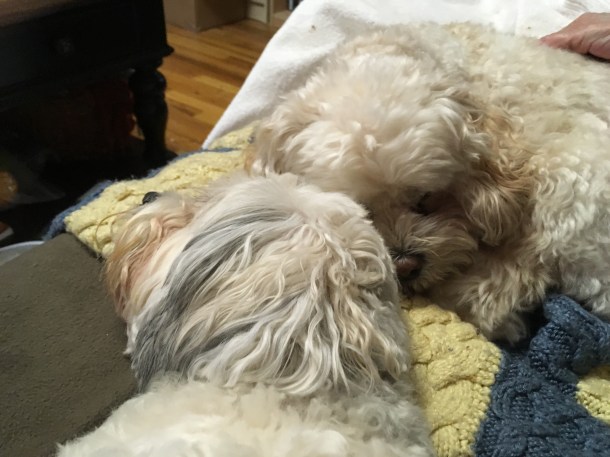
“Cricket, are you sleeping?” “Not anymore.”

Even now, I feel like I’ve spent my whole life dreading the buddy call, but now it’s the “Are you married?” “Do you have kids?” “Where do you work?” questions. The questions that really seem to be asking if I have proven myself worthy of being chosen. And if I haven’t? It kind of feels like I’m not allowed into the pool, or the lake, of life.

Cricket thinks it’s nonsense, of course. I mean, really, who wants to swim in a lake anyway? She also believes in the reject-them-before-they-can-reject-you philosophy, with lots of barking added.


IMG_0238.JPG

“I don’t always bark, but when I do there’s a very good reason, Mommy.”

I’m not sure where Ellie stands on these issues yet. We’ll just have to wait and see.

ellie relaxed.JPG

When she wakes up from her nap.