Tag Archives: synagogue

Friday Night Services

            For a long time now, I’ve attended most of the Friday night services at my synagogue online. At least last year I had to go in person once a month to teach, but our program changed and I no longer teach on Friday nights, so even those services have been lost. Part of the change is physical: I’m just so tired by the end of the day, and at the beginning, and in the middle. One small trip to the grocery store wipes me out so much that I need a three-hour nap just to recover. After that, I can’t even fathom taking a shower and getting dressed to go to synagogue, not even when one of my former students is marking their b’nei mitzvah, despite the promise I made to myself that I would go to every Friday night service for every student who’d ever been in my class.

            I’ve always been tired, and I’ve always been in pain, but still, something has shifted.

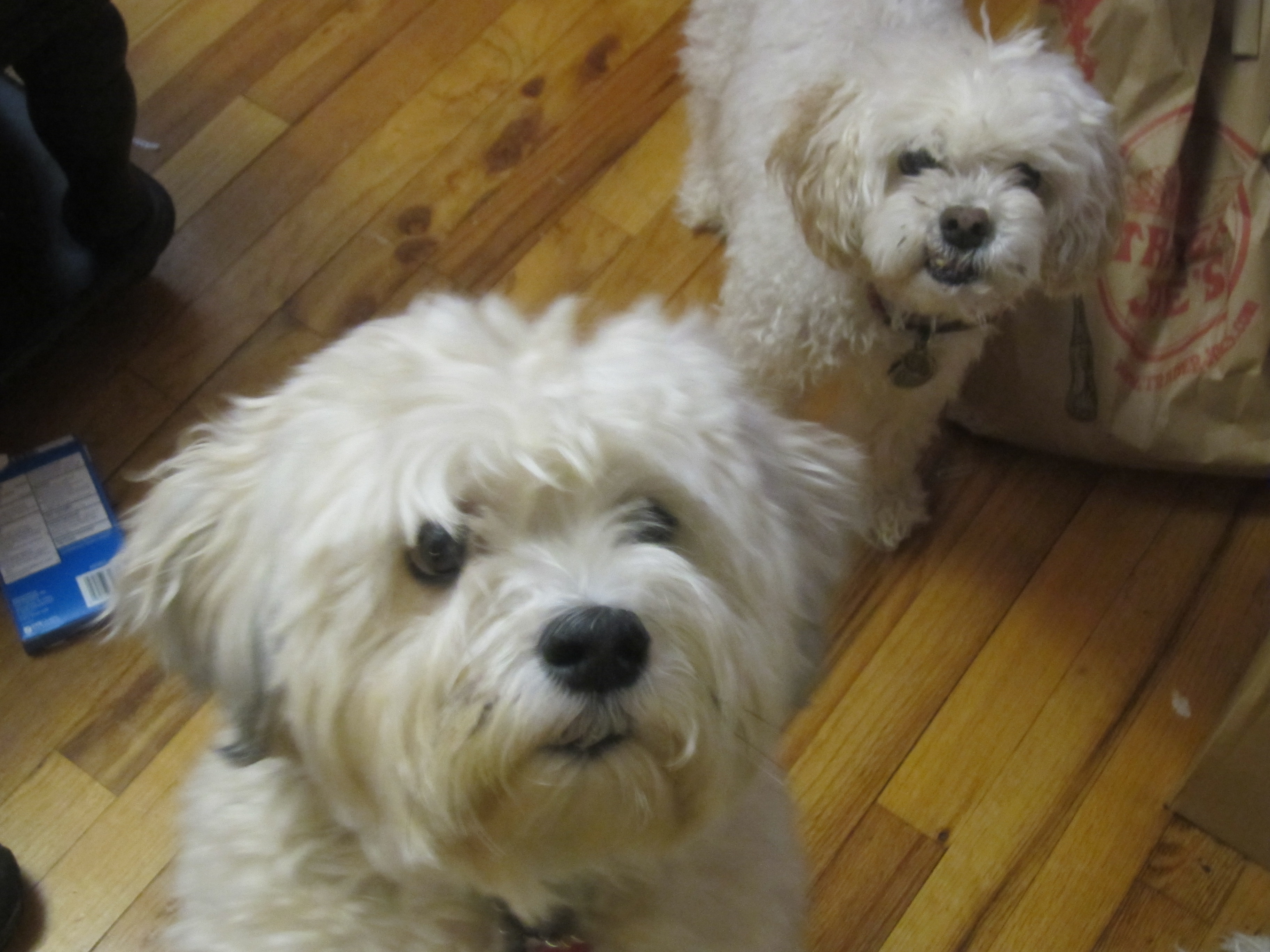
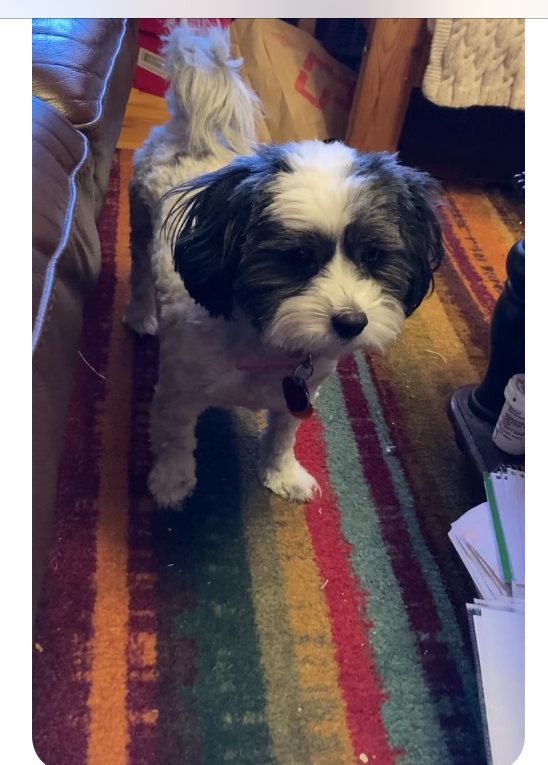
Tzippy can relate.

            Maybe it happened when our senior rabbi cut down to a quarter time, and started to show signs of age, so that even when he’s there and vibrant and funny and inspiring, there’s still this underlying sense of doom and grief, as if a clock is ticking in the background.

            Maybe it happened when I started taking weight loss medication, and something in the mechanism that cuts my appetite also cut into my ability to enjoy the rest of my life.

            Maybe all of the antisemitism that’s been unleashed since October 7th has finally pulled me under, because it doesn’t feel temporary anymore. After the ceasefire, it doesn’t feel like something with a cause and effect anymore. It feels endemic.

            Maybe it’s all of the rejection, after sending my writing out for so many years, with no idea why I’m not what anyone’s looking for.

            I still had some sense of energy last spring – I can vaguely remember what it felt like – when I started to plan the Israel trip, and started researching agents for the new book. I even felt hopeful, and brave, and willing to push through the hard tasks and difficult feelings to get to the good stuff on the other side.

            My hope is that the current malaise is a side effect of my travel anxiety, and once I get to Israel and the anxiety can disperse, I’ll find the rest of my feelings, and I will feel brave again. But I miss the feeling of hope that pushed me to start going to Friday night services in person way back when, and to make the effort to talk to new people and to sing and to speak up. I miss the feeling that I was building up to something, creating something that would continue to grow and bring me joy and comfort.

            Maybe I just need to recommit to the practice of going to services on Friday nights, forcing myself out of the house no matter how tired I am, the way I used to do before zoom services were a thing. I don’t know. Maybe spending a shabbat in Israel will wake something up in me that has been on pause for a while, and I’ll be ready to make more of an effort once I get back home. That would be something to look forward to.

“I’m ready.”

            (I’ll be away from the blog for the next couple of weeks, but hopefully I will have a lot to share when I return. Fingers crossed!)

If you haven’t had a chance yet, please check out my novel, Yeshiva Girl, on Amazon. And if you feel called to write a review of the book, on Amazon, or anywhere else, I’d be honored.

            Yeshiva Girl is about a Jewish teenager on Long Island, named Isabel, though her father calls her Jezebel. Her father has been accused of inappropriate sexual behavior with one of his students, which he denies, but Izzy implicitly believes it’s true. As a result of his problems, her father sends her to a co-ed Orthodox yeshiva for tenth grade, out of the blue, and Izzy and her mother can’t figure out how to prevent it. At Yeshiva, though, Izzy finds that religious people are much more complicated than she had expected. Some, like her father, may use religion as a place to hide, but others search for and find comfort, and community, and even enlightenment. The question is, what will Izzy find?
Our Imperfect Canopy of Peace

            After Rosh Hashanah and Yom Kippur – the big Jewish holidays where even unaffiliated Jews go to synagogue, or fast for a day, or at least eat brisket in a nod to tradition – comes Sukkot, the holiday where Jews build huts in their yards and eat under the stars for a week. This used to be the biggest Jewish holiday of the year, back in ancient Israel. It was a celebration of the harvest, with everyone traipsing to Jerusalem to see and be seen. Today, among liberal Jews in America, Sukkot doesn’t get much attention, coming as it does four days after Yom Kippur, when everyone is sick of being Jewish, or at least of going to synagogue. And that’s unfortunate, because Sukkot is meant to be a happy holiday, with Sukkah Hops (visiting everyone else’s sukkot/huts to eat cake and cookies and just hang out and gossip), and waving palm fronds, and sniffing citrons (etrogim), and all kinds of weird traditions that keep things interesting and happily silly.

            But a year after the October 7th Hamas attack on Israel, which took place during the later days of the holiday of Sukkot, celebrations of the holiday are more complicated. It’s hard to celebrate when Israel is at war (with Hamas, Hezbollah, the Houthis, and, ultimately, of course, with Iran), 101 hostages are still being held in Gaza, and antisemitism is rising around the world. But celebrating Sukkot is an obligation, and one of the other names for this holiday is Zman Simchateinu (the time of our happiness), so we are obligated not only to go through the motions of erecting a sukkah and saying the blessings over the Lulav and Etrog, but to find moments of true joy as well.

Lulav and etrog

            At my synagogue, we build a sukkah each year (well, someone builds it), and we try to have as many services and events and classes as possible in the sukkah, in order to give everyone a taste of the holiday, since most of us aren’t building our own sukkot at home. And at the synagogue school, we try to make a big deal out of the sukkah in the courtyard, and to engage the students in seeing the holiday through different perspectives. This year’s theme is looking at the connection between the sukkah we build for the holiday of Sukkot, and the more figurative Sukkat Shalom, or Canopy of Peace, that we sing about each week in the Hashkivenu prayer at Friday night services.   The most obvious connection is the word “sukkah,” which can be translated to mean booth or hut, as it is for the holiday of Sukkot, or canopy, as it is in the Hashkivenu prayer, where we ask God to cover us with a canopy of peace; but even more so this year, we are looking for a connection, or hoping for a connection, between these days of Sukkot and peace.

In Leviticus 23:41-43, we are told that living in a sukkah for a week each year is a reminder of the Exodus from Egypt, and the forty years our ancestors spent in the desert afterwards before entering the promised land. But, given that we remember the splitting of the Sea of Reeds in our daily prayers, and spend the whole week of Passover remembering the Exodus from Egypt, the fact that Sukkot is also a time for remembering the Exodus is often forgotten, in favor of the lulav and the etrog and the sukkah and all of the food. But this is a Jewish holiday, and there is no such thing as a simple Jewish holiday; even at a Jewish wedding we manage to remind ourselves of tragedy (stepping on the glass to remember the destruction of the temple in Jerusalem, and/or to scare away evil spirits). So, it’s not surprising that even during this holiday of happiness, even during a year when we’re not in mourning, we are still called to reexperience suffering.

The sukkah, which really looks ridiculous if you think about it, with its open door and barely covered roof, is a representation of the fragility of life and our imperfect safety in the world, and in both of those ways it is meant to remind us of our dependance on God. And yet, we are commanded to enjoy life in this sukkah, and invite friends and strangers inside to eat with us. We are called to practice creating joy even in the midst of difficulty, because that’s a time when it feels unnatural but is essential to remember that joy is possible.

a sukkah

And I think that may also be the lesson with our Sukkat Shalom, our figurative canopy of peace: that even with God’s protection our lives will be imperfect, and our experience of peace will be imperfect, and temporary.

            And that sucks. I have always wanted to believe in a future filled with an idyllic peace – a world full of comfort and kindness and all of our needs being met – despite never actually experiencing such a thing; even the hope of such peace in the future has been enough to keep me going. But what if this imperfect peace, filled with moments of suffering and fear and open doors and leaky roofs, is the only kind of peace that’s really possible? What if our prayers for peace have already been answered, but because we were looking for something more perfect we can’t recognize it?

We tend to think of peace as an absolute: we are either at peace or at war. But what if peace is complicated, or exists along a spectrum? American Jews are facing a dramatic rise in antisemitism, and grief and confusion and anger over what’s happening in Israel, but even before October 7th peace in Israel and for American Jews was never perfect (Israel was in the middle of yet another ceasefire with Hamas when the attack occurred, after all, and the past few years in America have not been free of antisemitic acts by any means). There is no time in history free of all difficulty. And maybe these holidays, which we are obliged to celebrate every year no matter what circumstances we are living through, are not about keeping us on our guard, or depressed about our lack of safety, but to teach us that even in an imperfect world we can, and must, live our lives as joyfully as possible, as fully as possible.

            It’s a hard lesson to learn, and even harder to teach, honestly. But Sukkot gives us a yearly opportunity to practice living in and appreciating an imperfect peace. We can sit in our fragile shelter and feel the chill in the air and watch our napkins fly off the table, and still eat good food and laugh with our friends and sing together, feeling gratitude for what we have, and grief for what we don’t have, at the same time.

Feeling multiple things at once isn’t the only lesson of Sukkot, but it might be the most useful one for this particular moment in Jewish history. And, it may actually be the key to all of the other life lessons we want our students to learn. We often think of resilience and mental health as the ability to focus only on the positive, but in reality, resilience is the ability to accept life as it is, and continue on. Like it says in Ecclesiastes, there’s a time for everything, a time to plant and time to uproot, a time to mourn and a time to dance, a time for peace and a time for war. We are meant to live in all of it, eyes open, taking it in and seeing it for what it is. And even, or most importantly, saying a blessing over what we see.

If you haven’t had a chance yet, please check out my novel, Yeshiva Girl, on Amazon. And if you feel called to write a review of the book, on Amazon, or anywhere else, I’d be honored.

            Yeshiva Girl is about a Jewish teenager on Long Island, named Isabel, though her father calls her Jezebel. Her father has been accused of inappropriate sexual behavior with one of his students, which he denies, but Izzy implicitly believes it’s true. As a result of his problems, her father sends her to a co-ed Orthodox yeshiva for tenth grade, out of the blue, and Izzy and her mother can’t figure out how to prevent it. At Yeshiva, though, Izzy finds that religious people are much more complicated than she had expected. Some, like her father, may use religion as a place to hide, but others search for and find comfort, and community, and even enlightenment. The question is, what will Izzy find?

The Dreaded High Holidays

            I hate the high holidays. I hate the focus on repentance, and the large crowds at the synagogue, and all of the standing, and having to dress up, and the depressing Eastern European music, and the endless communal guilt. I would much rather spend the time watching a Father Brown marathon.

            But I pushed myself to join the choir anyway (which, at my synagogue, mostly sings during Rosh Hashanah and Yom Kippur and not much the rest of the year), and each year I push myself to go to as many of the rehearsals as possible, even though I’m tired by 8 pm (which is when choir rehearsals always start). And I push myself to get up early for the morning services on Rosh Hashanah and Yom Kippur, and wear something other than a t-shirt and jeans, and stand and sit and stand for hours. And, I resent it, every year. I especially hate the emphasis on all of the sins we are presumed to have committed over the past year, as if I wasn’t already spending many hours each day combing through my life for my actual sins and trying to correct them.

            So, why do I go? Because it’s an obligation; because of FOMO (fear of missing out); because this is the one time each year when I get to see all of the people who rarely come to Friday night services; because I’d be lonely sitting at home knowing everyone else is there.

            And, because I love to sing. Music is such a mystery to me, because even when it’s imperfect or depressing, it is still, also, transcendent. It connects me with other people; even with people I might otherwise have nothing in common.

            Do I believe, or agree with, every word in every prayer we sing over the high holy days? Not at all. Is it meaningful to me to think of God as a judge or a king, doling out forgiveness for sins I’ve never even committed? Nope. But when those words that mean so very little to me, and even piss me off, are put to music, they are transmogrified into something new and my body becomes one of the instruments producing and receiving and echoing sound. This imperfect body of mine, that feels so much pain and that I feel so self-conscious about, becomes a vessel for transcendent sound for a little while every year, and that only works if my body is in the room with all of the other bodies.

            I wish we could all come together for happier occasions, and sing Israeli pop songs, or  just tell stories and laugh together, but for some reason, when everyone sat down to decide which holidays were going to be the most important ones on the Jewish calendar, they chose Rosh Hashanah and Yom Kippur (at least after the destruction of the second temple in 70 CE, before then the most important holidays were Sukkot, Passover and Shavuot, weeklong festivals to celebrate harvests – more about Sukkot next week). So, why did my ancestors decide that the most important days of the year were the ones where we have to pound our chests and asks for forgiveness and beg God for another chance? I have no idea. But most of the Jews who go to synagogue on Rosh Hashanah and Yom Kippur, and not once the rest of the year, pay expensive yearly dues for the privilege. And they seem to think it’s worth the cost.

            Maybe they’re there for the music too, and how it feels to be in a room full of people singing together, no matter what they happen to be singing. Or maybe they don’t realize that there are (much) happier holidays on the Jewish calendar that they could be celebrating with their congregation. Or maybe my people just really love repentance. It doesn’t matter. The decision has already been made, and I can either be there with them, or stay home alone. So, I go. Every year. And I sing, every year. And I whine and complain and need long naps to recover afterwards every year. And I wouldn’t miss it for the world. 

If you haven’t had a chance yet, please check out my novel, Yeshiva Girl, on Amazon. And if you feel called to write a review of the book, on Amazon, or anywhere else, I’d be honored.

            Yeshiva Girl is about a Jewish teenager on Long Island, named Isabel, though her father calls her Jezebel. Her father has been accused of inappropriate sexual behavior with one of his students, which he denies, but Izzy implicitly believes it’s true. As a result of his problems, her father sends her to a co-ed Orthodox yeshiva for tenth grade, out of the blue, and Izzy and her mother can’t figure out how to prevent it. At Yeshiva, though, Izzy finds that religious people are much more complicated than she had expected. Some, like her father, may use religion as a place to hide, but others search for and find comfort, and community, and even enlightenment. The question is, what will Izzy find?

The Trip I Want to Take

            My synagogue had planned a big trip this spring – to Germany, Israel, and Jordan. It was originally planned for 2020, and then Covid hit; and it was rescheduled for this spring, and then October 7th happened. The plan for the trip was still up in the air for months, as the clergy watched to see how long the war would last, and what conditions would be like for tourism, but somewhere along the way the decision was made that they would just do the Germany leg of the trip this year, for the people who were still interested in going. A small group of congregants went to Berlin, with the same tour guide who was going to lead the big trip, to experience the different ways Germany has memorialized the Holocaust, and how they are dealing with Jews and anti-Semitism today.

            I was not planning to go on the trip this Spring, even if October 7th hadn’t happened, because I wasn’t interested in the Jordan and Germany legs of the trip, and because it was going to take place during the school year and I hate missing time with my students if I can help it, and probably most of all because it was going to be expensive and I am still paying off steep medical loans and I feel guilty being in so much debt at one time.

            But if the synagogue group had gone to Israel, in this post October 7th landscape, I would have been jealous of everyone who was able to go.

            I have wanted to go to Israel for a long time now, and I’ve gone over and over all of my internal conflicts around the costs, the weather, the social issues, the health issues, and the security issues, without really coming to any conclusions. But post October 7th the drive to go to Israel has increased tenfold.

            Don’t get me wrong, I’m not blind to the security issues, or to the parts of the country that are still off limits because they are under direct attack by Hezbollah; and I still have money issues, and health limitations, and I still worry about being lonely and feeling lost and alienated while I’m there. But the part of me that wants to be there, not to see the Western Wall or the Dead Sea or other touristy things, but just to be there in solidarity and offer my presence and compassion and love, feels newly strong. Maybe because, until now, I felt like I had nothing to offer my Israeli cousins; I even expected them to reject me, because of so many of the clichés about Israelis, that they feel superior and look down on weakness, be it emotional, or physical, or psychological.

            But on and after October 7th it became clear to me that Israelis aren’t really the image they project to the world, or at least they’re not only that; they are human like the rest of us. Yes they are courageous, but they are also frightened. Yes, many of them are adventurous and confident, but a lot of their bravado is a defense mechanism against lives lived in a very small country surrounded by people who hate them and keep trying to kill them.

            I wish, with all my heart, that this unveiling of their true selves had happened any other way, but I am truly grateful to feel more connected to them and to learn more about who they really are. There are, of course, some people who are so frightened and defensive, like Benjamin Netanyahu and his fellow politicians on the far right, that they never let the facade drop, even on October 7th itself.

            I am also aware of, and overwhelmed by, the news about the war itself and how it is being conducted. It has been especially difficult to watch the news about the seven aid workers from World Central Kitchen who were killed by an Israeli airstrike in Gaza. It’s painful and disheartening to see something so awful happen to people who are there only to offer help to those who need it. And I don’t understand how a mistake like this could have happened when the aid workers and the IDF say they had deconflicted their itinerary ahead of time to keep the workers safe. But it’s also heartbreaking to hear people insist that this was an intentional, rather than accidental, killing. I don’t believe that the Israeli army would target innocent aid workers intentionally, but, given the complications of managing a war in this territory, with so many voices pulling in different direction, I don’t understand how the army hasn’t become more and more careful over time, and I don’t understand why mistakes like this are still possible. At the beginning, when they were first trying to figure out how to fight a war like this, the mistakes in targeting and choice of munitions that led to so many civilian deaths was horrifying, but maybe understandable. But now? I don’t know what to think.

            And yet, with all of my questions, and however conflicted I may feel about how the war is being waged, and interpreted, Israel and Israelis themselves are still very close to my heart. If I could plan the perfect trip right now I would want to visit my niece at her school and go with her and her friends to volunteer somewhere, picking clementines or folding uniforms or whatever volunteer activity the girls are doing now; and I would want to stay with my best friend from high school, and hear from her kids and their friends about what their lives are like right now; and I’d want to sit on trains and buses and listen to the conversations around me; and I’d also want to go to every concert in every venue possible; and visit my teachers in Tel Aviv, and finally taste real Chummus, since I’ve been told over and over that the Chummus I can get in New York is a pale imitation of the real thing.

            Knowing me, though, I would be too shy to really talk to anyone, or to ask the questions I really want to ask, and I would spend half my time beating myself up for not having the courage to go and do and say what I want. But that’s still the trip I’d want to take, if I could. Those are the experiences I wish I could collect and bring back home with me.

            For now, accepting my own limitations and the state of the war, my plan is to take another online class through the Hebrew language school in Tel Aviv, where I’ve taken classes in the past. That way I can continue to build my confidence in speaking Hebrew and listening to Israelis, for when I’m ready to go in person. And, through the zoom screen at least, I will still be able to make some of the connections I’ve been looking for, with my teachers and classmates, and through the music and stories and culture of Israel.

            As always, I’m listening to podcasts and music to try to understand what’s going on. The latest podcast episode of For Heaven’s Sake, hosted by Donniel Hartman and Yossi Klein Halevy, is an honest accounting of how things feel for Israelis after six months of war.

For Heaven’s Sakehttps://podcasts.apple.com/us/podcast/for-heavens-sake/id1522222281

            And I’ve been listening to a lot of music by Idan Amedi, an Israeli musician who was injured while serving in the reserves in this war. He wrote a song twelve years ago about how hard it is to talk about the pain and memories of life as a soldier, even to the ones you love most, and the song still resonates.

Idan Amedi – The Pain of Warriorshttps://youtu.be/cBlqSLXgZG8?si=j8WXSN0tt8lfOqEW

If you haven’t had a chance yet, please check out my Young Adult novel, Yeshiva Girl, on Amazon. And if you feel called to write a review of the book, on Amazon, or anywhere else, I’d be honored.

            Yeshiva Girl is about a Jewish teenager on Long Island, named Isabel, though her father calls her Jezebel. Her father has been accused of inappropriate sexual behavior with one of his students, which he denies, but Izzy implicitly believes it’s true. As a result of his problems, her father sends her to a co-ed Orthodox yeshiva for tenth grade, out of the blue, and Izzy and her mother can’t figure out how to prevent it. At Yeshiva, though, Izzy finds that religious people are much more complicated than she had expected. Some, like her father, may use religion as a place to hide, but others search for and find comfort, and community, and even enlightenment. The question is, what will Izzy find?

Translating Israeli Music

            I’ve been obsessively listening to Israeli music for a few years now, but the obsession went into overdrive after October 7th, when I needed to feel a connection to Israel that wasn’t all about the news. And as the months have passed, Israeli musicians have been creating more and more music, and finding new meaning in songs that came out before October 7th, as performers have crisscrossed their small country singing at soldiers’ last minute weddings, at hospital bedsides, for evacuees from the south and the north of Israel, and really for whoever has needed comfort. David Broza and Hanan Ben Ari and Shiri Maimon and Ishai Ribo and Sarit Hadad and Omer Adam and Keren Peles and Benaia Barabi and so many others have been singing at small parties and huge vigils and everything in between with a generosity and humility that’s hard to imagine in American superstars. It’s as if the whole music industry in Israel has mobilized to try to help people put their feeling into words, and to fight off the isolation of grief.

            I wish the outside world could hear what I’m hearing, but because most of the songs are in Hebrew, they just don’t reach across the divide. And, despite listening to all of this music out of a desire to connect, I’ve actually felt even more isolated, because so few people around me are listening to the same music. Even at my synagogue, where the situation in Israel is top of mind, there are very few people who understand enough Hebrew to listen to this music and enjoy it. So, a few weeks ago, I started trying to translate some of the songs into English, in the hopes that I could close some of that divide.

            My goal was to try to make the music accessible to people who don’t know Hebrew and for me to understand the songs better myself. I’m certainly not the first person to feel called to do this; there are multiple sites online where amateur translators can upload their translations of songs from other languages (my favorite is lyricstranslate.com).

Some Israeli pop songs have been professionally translated: there’s a popular video on YouTube of Tamir Greenberg on Kochav HaBah singing an English version of Hanan Ben Ari’s Shvurei Lev/The Broken Hearted. And there’s a lovely half English/half Hebrew version of an Ishai Ribo song (with the Solomon Brothers) that manages to capture something of the original magic.

Hanan Ben Ari – Shvurei Lev/Broken Hearts – the original Hebrew - https://youtu.be/z27MZP_4P_U?si=Pbl5l_VobYY3pDop
Tamir Greenberg Singing Hanan Ben Ari’s Shvurei Lev/Broken Hearts - in English - https://youtu.be/Je6LCZH_wF8?si=6mLVIw-G1vnpnDH3
Ishai Ribo &The Solomon Brothers – My Way Back Home – English and Hebrew - https://youtu.be/WZ6HvzFh7js?si=fVRJ2guZL--PlP9e

            But more often than not, the English translations are awkward. The problem is that Hebrew has so many internal rhymes and rhythms, and English is so chaotic and free form that you can’t make the songs sound alike. So, when I approached my own translations I didn’t even bother trying to rhyme, and focused instead on capturing the rhythm and the emotion of the original Hebrew, to the best of my ability.

            The first song I chose is called Zeh Beseder/It’s Okay and it was a collaboration between an Israeli singer named Benaia Barabi and survivors of the Nova Music festival. It’s written in simple Hebrew, so I didn’t have to spend too much time on Google Translate, and it’s all about survivor’s guilt and needing to heal at your own pace, so it felt pretty universal.

Benaia Barabi and the Nova Singers – Zeh Beseder - https://youtu.be/WlBWOrLqErI?si=jNANaBBvWK4LWMza
 

Zeh Beseder/It’s Okay – Written and performed by: Benaia Barabi, et al.

(My Translation)

It’s okay that we’re not okay now

It’s okay to sing when it hurts

It’s okay to cry every morning

And even then to choose to rise

It’s okay to not feel normal

It’s okay not to say a word

It’s okay to dance ‘til morning

In a darkness full of hope

It’s easier to hide my face

To keep the pain in for a thousand years

The voices that keep screaming in my head

To pray for those small moments

When life is normal and we start to change

Only for my broken heart, I’ve tried to keep the faith

I want most of all to be together

To never have to be alone

To choose to sing at the top of my voice

And to reach out for your hand

We want most of all to live without fear

It’s okay to laugh just like that

Most of all I want to hug you close

Is it okay for me to love?

Most of all I want to hug you close

It’s okay for me to love

It’s okay to put on make-up and dress well

It’s okay to start to lose direction

Life keeps moving forward

So who am I not to go along?

It’s okay not to find the answer

It’s okay to need to pray for faith

It’s okay to ask a thousand questions

Of whether to be or not to be

It’s easier to hide my face

To keep the pain in for a thousand years

The voices that keep screaming in my head

I want most of all to be together

To never have to be alone

To choose to sing at the top of my voice

And to reach out for your hand

We want most of all to live without fear

It’s okay to laugh just like that

Most of all I want to hug you close

Is it okay for me to love?

            The second song I chose is called Habayta, which literally means, “Towards Home,” about wanting the hostages to come home. The performance of the song, by Raviv Kaner, captures everything, even if you don’t understand any of the words, honestly. And if it were a song in English, about Americans being held hostage, it would probably be on American radio 24/7.

Raviv Kaner – HaBayta - https://youtu.be/Kgv7LNME33s?si=msXRuCH4nT_RSgo5

HaBayta/Return Them Home – Written by: Raviv Kaner and Elnatan Shalom

(My translation)

My father’s up, he’s already awake

My mother’s here, her pain just never ends

Mom and Dad go back to sleep again

Maybe it’s Shabbat and not Sunday

Surrounded by the noise and the chaos

There’s nothing left, there’s no point

Return him home to me right this moment

There’s nothing left, there’s no point

Return her home to me right this moment

Return them home

It’s dark now, turn off all the lights

Maybe for a day or two, at least

Because between despair and hope, I dream

When it’s over, I will breathe again

Surrounded by the noise and chaos

There’s nothing left, there’s no point

Return him home to me right this moment

There’s nothing left, there’s no point

Return her home to me right this moment

Return them home

There’s nothing left, there’s no point

Return them home to me right this moment

There’s nothing left, there’s no point

Return them home to me right this moment

Return them home

            Maybe, in the end, I’m just doing these translations as a way to spend more time with music I love, but it would be really nice to share it with other people.

            Let me know what you think.

Bonus: Two versions of a Jewish prayer (that didn’t need translation) that has become popular for months now, because it asks for the release of captives:

Acheinu Kol Beit Yisrael – With English Subtitles - https://youtu.be/MYXr6wk19rA?si=tEZqQMmv4_LhyVIu

Lior Narkis and Avi Ohayon’s version (my favorite) – https://youtu.be/vYoQpKNt4II?si=LDwqbZrereSKGP73

If you haven’t had a chance yet, please check out my Young Adult novel, Yeshiva Girl, on Amazon. And if you feel called to write a review of the book, on Amazon, or anywhere else, I’d be honored.

            Yeshiva Girl is about a Jewish teenager on Long Island, named Isabel, though her father calls her Jezebel. Her father has been accused of inappropriate sexual behavior with one of his students, which he denies, but Izzy implicitly believes it’s true. As a result of his problems, her father sends her to a co-ed Orthodox yeshiva for tenth grade, out of the blue, and Izzy and her mother can’t figure out how to prevent it. At Yeshiva, though, Izzy finds that religious people are much more complicated than she had expected. Some, like her father, may use religion as a place to hide, but others search for and find comfort, and community, and even enlightenment. The question is, what will Izzy find?

The Oral History Interview That Wasn’t

            A few months ago, I was asked to be one of a small group of people to do oral history interviews for my synagogue, in order to capture the history of the synagogue, especially with so many of the founders already gone. I’d done a few historical articles about the founding of the synagogue for the monthly newsletter, a few years back, so I thought maybe they’d want my notes, or that they’d want me to tell the stories I’d been told. But it turned out that they wanted my own stories, whatever I wanted to focus on, from my eleven years as a member.

“What about me? I have stories too!”

            I was honored to be chosen, and overwhelmed with too many ideas of what to say, and scared to be on camera, but I was also busy teaching, and going to doctor visits, and I didn’t have time to wade through all of my ideas and come up with something to say at that moment, so I asked if they could wait until synagogue school was over for the year, and they said certainly, we’ll reach out in May.

            But when I got a follow up email a few weeks ago, it wasn’t to ask me when I’d be available to be recorded, it was to announce that they’d finished the filming and I could press on this link to see the videos. And, of course, I felt hurt. And relieved. And disappointed, and angry, and confused. For some reason I can’t have only one clear feeling at a time. It’s exhausting.

“Tell me about it.”

            I’d been gradually working through my ideas for what to say, in essay form, writing up each story to see which ones felt the most important, or the most tolerable to tell. Should I talk about being an unmarried, childless, disabled woman in a synagogue where young, wealthy families are the most coveted demographic? Or about the ways the synagogue has helped me to grow and to try out new roles and ideas in a safe place? Or should I talk about teaching in the synagogue school, or about learning with the clergy, or about how it was the older members of the congregation who embraced me from the beginning and it’s been so painful to watch them dying off or receding into nursing homes, or zoom? Or should I focus on the joy of the music and the consistent comfort of Friday night services, or about the frustration and disappointment I felt when it was the women in the synagogue who most rejected and dismissed the Me-Too movement, despite my efforts to let them know that I was a survivor of sexual abuse and needed their support?

            I had a lot to say. And a lot of fear of saying it on camera, and being seen, or being edited out, so I guess I’m relieved to be able to put it off.

            And, really, it’s possible that they decided to just go with the people who were ready to film right away and forgot to tell me that they wouldn’t need me. Or maybe they’re planning to do a second group later on, and assumed I’d figure that out, or that I’d been told. I don’t know. This oral history project is clearly still a work in progress, which is something I can relate to.          In the meantime, I’m still working on my essay version of what I’d want to say in the video, cutting and adding and organizing, so that, just in case they still want to hear from me, I’ll be ready with something to say.

“We’ll be ready too!”

If you haven’t had a chance yet, please check out my Young Adult novel, Yeshiva Girl, on Amazon. And if you feel called to write a review of the book, on Amazon, or anywhere else, I’d be honored.

            Yeshiva Girl is about a Jewish teenager on Long Island, named Isabel, though her father calls her Jezebel. Her father has been accused of inappropriate sexual behavior with one of his students, which he denies, but Izzy implicitly believes it’s true. As a result of his problems, her father sends her to a co-ed Orthodox yeshiva for tenth grade, out of the blue, and Izzy and her mother can’t figure out how to prevent it. At Yeshiva, though, Izzy finds that religious people are much more complicated than she had expected. Some, like her father, may use religion as a place to hide, but others search for and find comfort, and community, and even enlightenment. The question is, what will Izzy find?

Back to School

            Before we started the new synagogue school year, I had a million ideas for how to improve my teaching – lessons learned from my two years of teaching synagogue school so far, and from reading and googling, and from my online Hebrew classes and virtual tours of Israel. I had too many ideas to fit into the few hours a week that I would get with my students.

            I wanted them to learn more about Jewish history than the Holocaust: like the Babylonian Exile in 587 BCE and how it taught the ancient Israelites that they could bring God with them wherever they went; like the transition to Rabbinic Judaism, after the destruction of the Second Temple in 70 CE, when all seemed lost without the Temple, and yet the rabbis found a way forward by canonizing the Hebrew Bible and continuing the traditions in study and prayer and laws and customs; like the Spanish Inquisition and the forced conversions and the massacres and endless exiles of the Jews from one European country after another that spread the Jews around the world, where they were able to learn from different cultures and bring the world’s customs into Judaism; to Modern Israel, where Jews from around the world have been able to make a home and attempt to blend different cultures and races and customs and foods into one country; to modern antisemitism, and antizionism, and conflicts between Jews and Palestinians, and conflicts between different branches of Judaism. There’s so much for them to know!

“It’s too much.”

And I wanted them to have a sense of what’s in the Hebrew Bible, and that they have a right to question any and everything in it, and I wanted them to be able to sound out Hebrew words, and begin to understand Hebrew when they heard it, and begin to build a love for the language. I wanted them to be familiar with the prayers, but more than that, I wanted them to feel empowered to create their own prayers and to know that their own thoughts are just as valuable as those of the rabbis who wrote our prayer books. And I wanted them to have fun and make friends and be silly and feel like part of a community that embraces them as they are.

“We’re perfect!”

My first in-person day of Synagogue School, back in September, was a bit chaotic, but not terrible. We were in a nursery school classroom, because our space was being used for the High Holiday services, so I told myself that any excess difficulty I was having with the kids came from being in a crowded space, with too many toys (there’s something about toys meant for younger kids that makes the older kids lose their minds). I also had thirteen students, with more boys than girls for the first time, and when I told people that I had a boy-heavy class this year they looked horrified and said things like, better you than me. But the boys I had in my class last year were wonderful; they were thoughtful, and creative, and kind, so I thought that if even a few of this year’s boys were anything like last year’s I would be very happy. I wasn’t too worried.

            And during the break from in-person classes we continued to have zoom classes, which went really well. I was a little bit nervous about going back to in-person classes after a three week break, especially because we’d be returning to our regular “classroom” in the social hall, but I still thought everything would be okay.

The kids dribbled in one or two at a time for our second in-person class, in October, so we got a sort of relaxed start to class, but as time passed and more kids showed up I realized I’d forgotten how hard it is to hear in the social hall, and how much space there is for the kids to get into trouble. And I was at sea. The kids were screaming and wandering around and struggling to concentrate on the lesson. But I still wanted to believe that it was the fault of the room, and the long break between in-person classes, and that it would get better on its own.

I had a short break from my class, to teach an elective to my students from last year, and then I walked back into my classroom and I saw my students sitting calmly and listening to the teacher who had been working with them for the past half hour, handling the same exact kids with the same exact problems; and I suddenly realized that the problem was me.

“Uh oh.”

After I got over the humiliation, somewhat, I emailed the teacher who had performed this miracle, and asked for her help. And she was wonderful. She’s been teaching for a long time, both in Synagogue School and before that in regular school, and she said, first and foremost you need to create structure in the classroom so that the kids can feel safe. She said, they need to know what’s expected from them, or else the world feels chaotic and they don’t know what to do. Kids don’t come pre-programmed, they need help building the skills to stay focused and be kind to each other, and to me.

            The master teacher calmed me as successfully as she had calmed my students, setting clear guidelines for what I needed to do, and explaining the reasons for each behavior, and helping me problem solve different situations while firmly sticking to her overall goal: create structure so the kids know what’s expected of them.

            But it’s hard. I tend to take everything the kids say to heart. When they tell me they’d rather be anywhere than in synagogue school, I think it’s my fault, because I’m boring. And when they can’t sit still, I feel like I’m evil for making them sit instead of letting them run around. When they drag their feet through an activity, or want to always do something else, I take that as a sign that I’m teaching the wrong things, rather than that they need some reinforcement that the lesson I’m teaching is worth their time.

            So now I am starting again; not from scratch though. I need to remind myself that I am the adult in the room and I actually do know what to do, even when the kids tell me that I don’t. And I need to remind myself that structure and discipline do not equal abuse or squashing of potential, if done with careful intention and empathy. But most of all, I need to keep reminding myself that I cannot be perfect and it’s not even required. I can make mistakes and learn from them, and I can choose what to teach, based on what matters to me and what I’m good at, and that doesn’t make me a meanie or a bad teacher.

“Mommy’s a meanie!”

            And maybe that’s one of the best lessons I can teach my students; that we don’t have to do everything and be everything and learn everything right away, or ever. We can each be our own imperfect selves and, maybe together, as a whole, we can get where we want to go.

            With all of my hopes at the beginning of the school year for what I could teach the kids, I think if I could teach them that they are enough as they are, that would be enough. But first I have to learn it myself.

“We’ll help you, after our nap.”

            If you haven’t had a chance yet, please check out my Young Adult novel, Yeshiva Girl, on Amazon. And if you feel called to write a review of the book, on Amazon, or anywhere else, I’d be honored.

            Yeshiva Girl is about a Jewish teenager on Long Island, named Isabel, though her father calls her Jezebel. Her father has been accused of inappropriate sexual behavior with one of his students, which he denies, but Izzy implicitly believes it’s true. As a result of his problems, her father sends her to a co-ed Orthodox yeshiva for tenth grade, out of the blue, and Izzy and her mother can’t figure out how to prevent it. At Yeshiva, though, Izzy finds that religious people are much more complicated than she had expected. Some, like her father, may use religion as a place to hide, but others search for and find comfort, and community, and even enlightenment. The question is, what will Izzy find?

Going Back to In-Person Synagogue Services

            I’m on the Ritual Committee at my synagogue and we were tasked with deciding whether or not (but really when) to go back to Friday night services in person. The re-opening committee (a group with health and building expertise, brought together by Covid) gave us the go ahead, saying that we could safely have one hundred people in the sanctuary – as long as they are masked and socially-distanced. Our job was to decide whether to take them up on the offer, and if so, how to manage the transition, especially whether to do a hybrid service or not.

We’ve had in-person Bar and Bat Mitzvah services all along, adapting to changing protocols as necessary, with limited in-person guests and a lot of Zooming and masks and social distancing and temperature taking. They even started to have food trucks outside of the synagogue, to allow for some kind of celebration. But most of our congregational events have been on Zoom for the past year. We had a few hybrid beach services last summer, but the Zoom side of those services was not very good. And while the hybrid synagogue school classes have been acceptable, they haven’t really been successful.

But now, with so many congregants vaccinated, and planning for High Holiday services in September underway, it seemed like the right time to consider in-person Friday night services, for those who would want them.

“I’m ready!”

            (By the way, I had my second vaccine shot a few weeks ago and survived; there was that one day when I felt like I was on a creaky rowboat in the middle of a thunderstorm, but the feeling passed. Sort of.)

“Ugh. I’m gonna vomit.”

We decided immediately that, if we returned in person, we would have to do a hybrid service, including interactions on Zoom, because we couldn’t go back to a one way/streaming style for online services, with a single camera catching the service from a distance and no chance for online folks to participate in discussions. Over the past year of zoomed services, congregants who wouldn’t usually be able to get to the synagogue on a Friday night, because they were out of town or not feeling well or not up to driving at night, have been able to attend by Zoom and feel like full members of the community. We’ve had members who were wintering in Puerto Rico or Vermont, or living full-time in New York City or Albany zooming in on a regular basis and participating in ways that used to be impossible. We couldn’t go back to what we used to do and leave those members out.

            The problem is, in order to do this right, we are going to need better technology – like overhead microphones to capture the in-person audience singing and speaking, and more cameras placed around the sanctuary, and someone to keep track of the tech, and…it’s a lot.

“Oy.”

            Given the difficulties involved in hybrid services, and the fact that we still can’t have an Oneg (coffee and cake and schmoozing in the social hall) after services, and we’ll still have to wear masks and social distance in the sanctuary, and we may not even be allowed to sing indoors, it’s hard to get excited about returning to in person services again. And going in person will mean leaving the dogs at home, and actually having to get dressed, and drive. These are definite downsides. I get tired by eight o’clock at night and just want to sit around in my pajamas and watch TV, not get dressed up and drive and worry about how my hair looks from the back. And spending most of the service on mute means I can try out new harmonies without feeling self-conscious that someone will hear me and object, and I can turn to Mom and make snide comments about whatever I’m seeing on screen, as long as I cover my mouth to avoid the lip readers. But, there’s something special about getting to see people in person, and I feel an obligation to at least try to make it work.

“People are over-rated.”

And yet, chances are high that people will be impatient and obnoxious, out of frustration with the inevitable glitches, and online folks may unmute themselves in the middle of the service to tell us that they can’t hear what’s going on, or to complain that they are being neglected. And the in-person folks may get angry about all of the pauses, and having to repeat themselves. We are not a quiet, what-will-be-will-be sort of congregation, so the complaints will be plentiful. And a lot of the stay-at-home people still haven’t figured out zoom etiquette, so we will have big screens in the sanctuary full of people’s foreheads or ceilings, and I will definitely get seasick from the constantly moving iPhones.

            I don’t really want to go back yet, honestly, but I feel like I should. I can’t donate thousands of dollars to a fund drive to pay for new technology, but I can sacrifice a few hours to be a Guinea pig and help figure out how to make the hybrid services work a little better. And I miss being in an actual space with other people, instead of just a virtual one. But, the singing part really is a deal breaker for me. If we can’t sing in person I’d much rather be on Zoom. Progress be damned.

            But, despite all of that, we decided to go ahead with the experiment, even with the costs and complications involved, even though I will miss being able to turn off the computer and instantly be at home, without having to make awkward small talk or try to signal Mom across the social hall that I really want to go home, even though she is in the middle of a fascinating discussion of how best to protect her plants from the insect hordes. She has a tendency to “misunderstand” my signals, or ignore them entirely, when a conversation really interests her.

            I’m not sure I’m optimistic about how this will turn out, but I am determined to try. And we’ll see how it goes. It might be terrible, but it could also be the first step on the road back to normal. Whatever that might be.

“We have no idea.”

If you haven’t had a chance yet, please check out my Young Adult novel, Yeshiva Girl, on Amazon. And if you feel called to write a review of the book, on Amazon, or anywhere else, I’d be honored.

            Yeshiva Girl is about a Jewish teenager on Long Island, named Isabel, though her father calls her Jezebel. Her father has been accused of inappropriate sexual behavior with one of his students, which he denies, but Izzy implicitly believes it’s true. As a result of his problems, her father sends her to a co-ed Orthodox yeshiva for tenth grade, out of the blue, and Izzy and her mother can’t figure out how to prevent it. At Yeshiva, though, Izzy finds that religious people are much more complicated than she had expected. Some, like her father, may use religion as a place to hide, but others search for and find comfort, and community, and even enlightenment. The question is, what will Izzy find?
The Other Door

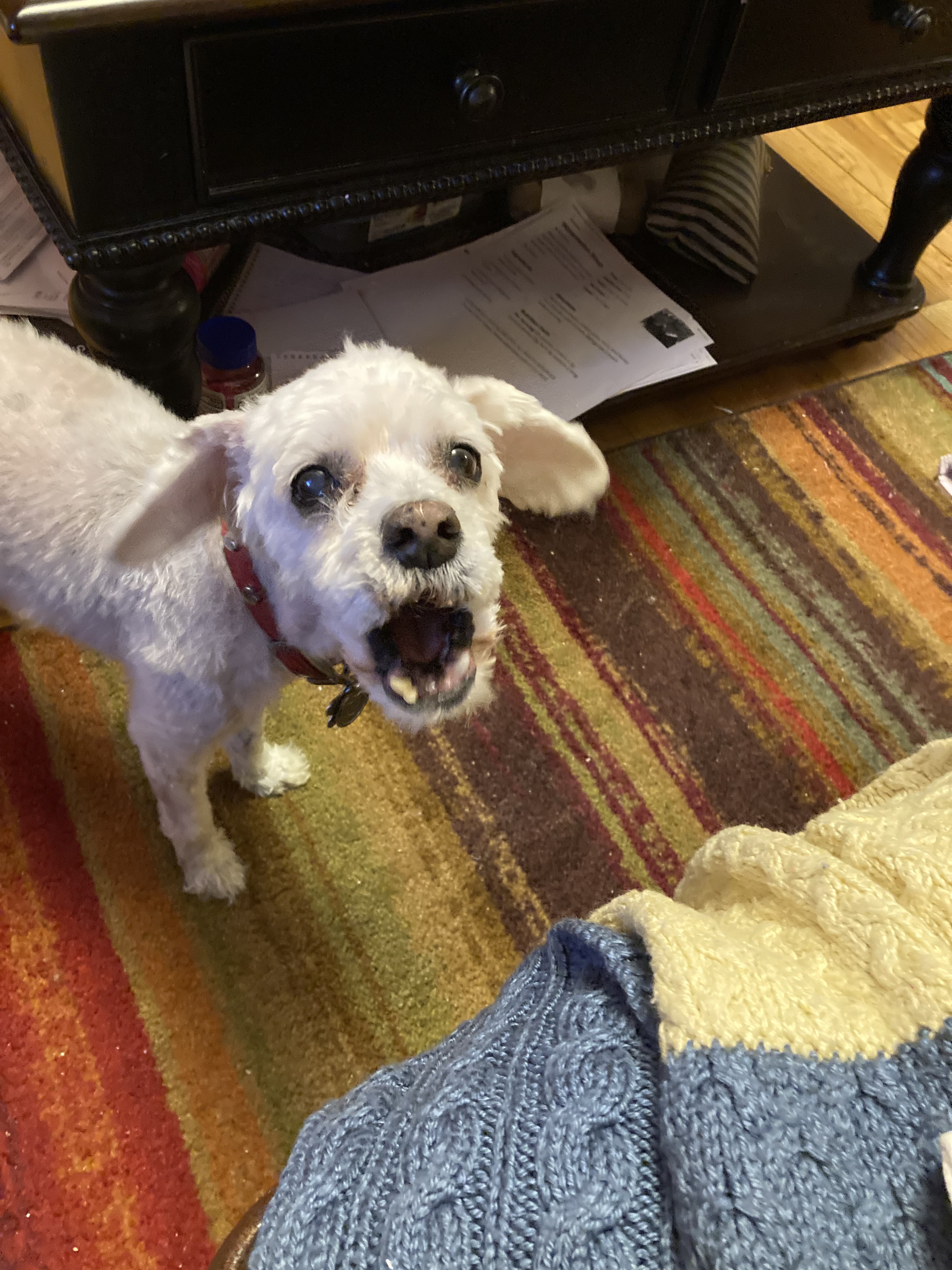
            Since the beginning of the Covid shutdown last March, the clergy at my synagogue have been hosting zooms to discuss both serious and unserious topics, to maintain our social connections from home. Sometimes I can’t make it to a session with the Rabbi or the Cantor, but it’s reassuring to know they’re always there and always coming up with something interesting to talk about. Ellie comes to every zoom, sitting on my lap, while Cricket sleeps in her bed next to me.

The one time Cricket came to Zoom

A few weeks ago, at one of our clergy connections, the Cantor was asking us how our idea of time has changed during the pandemic. He looked into references to time in biblical and Talmudic sources, but to me it seemed obvious, as in so many other areas, that dogs are the secret to mental health in general and to structuring time in particular; having to take the dogs out four times a day – marking breakfast, lunch, dinner, and bedtime – has kept me on a regular schedule all year, despite not always remembering which day it is.

“I’m ready to go again!”

            The dogs even make sure we stay aware of the seasons, because they don’t believe in skipping walks on cold days or rainy days or hot days. In reality, they do have preferences, but until they get to the front door and see and feel the weather for themselves, they are always confident that it’s beautiful outside. Often, when I open the door and the front steps are covered with snow, or rain and wind are aiming themselves straight at us, the dogs look up at me as if I’ve betrayed them, I told the group, and the Cantor said, yes, they want the other door.

What?!

Our cantor is a big fan of science fiction, so he would be the one to see that connection, but it sounded so right.

Is it possible that my dogs actually believe that I am choosing this snowy/rainy/windy world on purpose, just to annoy them? Of course it’s possible! They want the door that opens to the outside world that’s warm and smelly and rich with sounds, none of this weather business, and they are convinced that I could get that for them, if I wanted to. Mean Mommy.

“That’s my line.”

            Of course, this idea sent me cruising down a rabbit hole and I mostly missed the rest of the discussion about the nature of time. I was too preoccupied with the possibility that we could choose a different door and get a different world. If it were possible, would I choose the door to our world, or to somewhere else? I don’t know. There’s something reassuring about not having a choice, and having to make do with what reality brings. I love the Harry Potter books, and the idea of magic wands and magic words, but, too much magic could mean that there would be no rules and no consequences to our actions, or to anyone else’s. How would we learn how to adapt to other people and take responsibility for our behavior, if when one world gets tough we could just choose another door? Would there be infinite other doors? How would we know which one to choose? If we could choose the more pleasant, easy world, would that lead to a happier life?

            It’s a truism that reality is stranger than fiction, and often more frustrating and chaotic, but it can also be more interesting and definitely more varied than what we could imagine for ourselves. The desire for alternative facts, and the belief that all news is fake if it’s not what we want to hear, have become prominent (again) over the past few years. And I understand it. I understand finding reality overwhelming and incomprehensible and wanting it to be something different, something more comfortable and less challenging.

            But isn’t that what fiction is for? We get to read and write stories about what’s behind that other door, as a way to escape reality, but also as a way to reshape how we understand our realities, and find ways to cope with them, and tame their chaos. When we return to the real world from the fictional one we can feel rejuvenated, and use the knowledge and insight we’ve gained from our trip through that other door to make our real lives better.

            This is just a thought experiment, unless you know something about alternate dimensions existing in our world that I am not privy to. But sometimes it helps to think through these impossibilities, like if we’d choose to live forever, or what we’d do if we won the lottery, in order to appreciate the value of the world we actually have.

            Except, does this thought experiment really lead to more contentment with the here and now? I wonder if Cricket and Ellie would find such joy in a breezy spring day, full of smells and sounds to explore, if that’s what they experienced every day. And I think, probably yes.

            But we’ll never know for sure. Right?

If you haven’t had a chance yet, please check out my Young Adult novel, Yeshiva Girl, on Amazon. And if you feel called to write a review of the book, on Amazon, or anywhere else, I’d be honored.

            Yeshiva Girl is about a Jewish teenager on Long Island, named Isabel, though her father calls her Jezebel. Her father has been accused of inappropriate sexual behavior with one of his students, which he denies, but Izzy implicitly believes it’s true. As a result of his problems, her father sends her to a co-ed Orthodox yeshiva for tenth grade, out of the blue, and Izzy and her mother can’t figure out how to prevent it. At Yeshiva, though, Izzy finds that religious people are much more complicated than she had expected. Some, like her father, may use religion as a place to hide, but others search for and find comfort, and community, and even enlightenment. The question is, what will Izzy find?

I want to be back in the classroom in September, not on Zoom

            The staff of the synagogue school where I work is spending the summer, just like every other school, planning for the unknown. We’re doing curriculum development and lesson planning, for every scenario, and we’re building our technical abilities, and looking for ways to re-interpret our current ways of teaching for a two dimensional world.

            But it sucks.

“Harrumph.”

            I mean, I’m grateful that we’re doing all of this preparation, so that it won’t feel like we’re being dropped into a sea of ice cold water, again. And I’m grateful that the technology exists, both to allow us to work together from afar all summer, and to build up our online classrooms into more interesting places. But I want to see my kids. I want to hear them; without one person’s microphone blocking out everyone else’s, or all of their voices coming at me through a delay, or some of the kids not coming through at all because their internet connections are spotty or because every member of their family is online at once. I want to be able to talk with one of my kids privately, if they seem upset, without everyone else noticing or listening in. I want to be able to make eye contact with the quiet kid in the corner who thinks he’s invisible.

“Can you see me, Mommy?”

            Zoom, even with all of the bells and whistles, and integration with other apps and games and videos, is not the real world. I miss being able to talk to my students and forget what I look like, or what I’m wearing, or how silly I look when I’m trying to dance. I miss seeing all of the other kids in the hallways, and catching the eye of another teacher as we silently ask each other “are you okay?” And I miss being able to shut the door of my car at the end of the day and feel the transition from work to home starting to sink in.

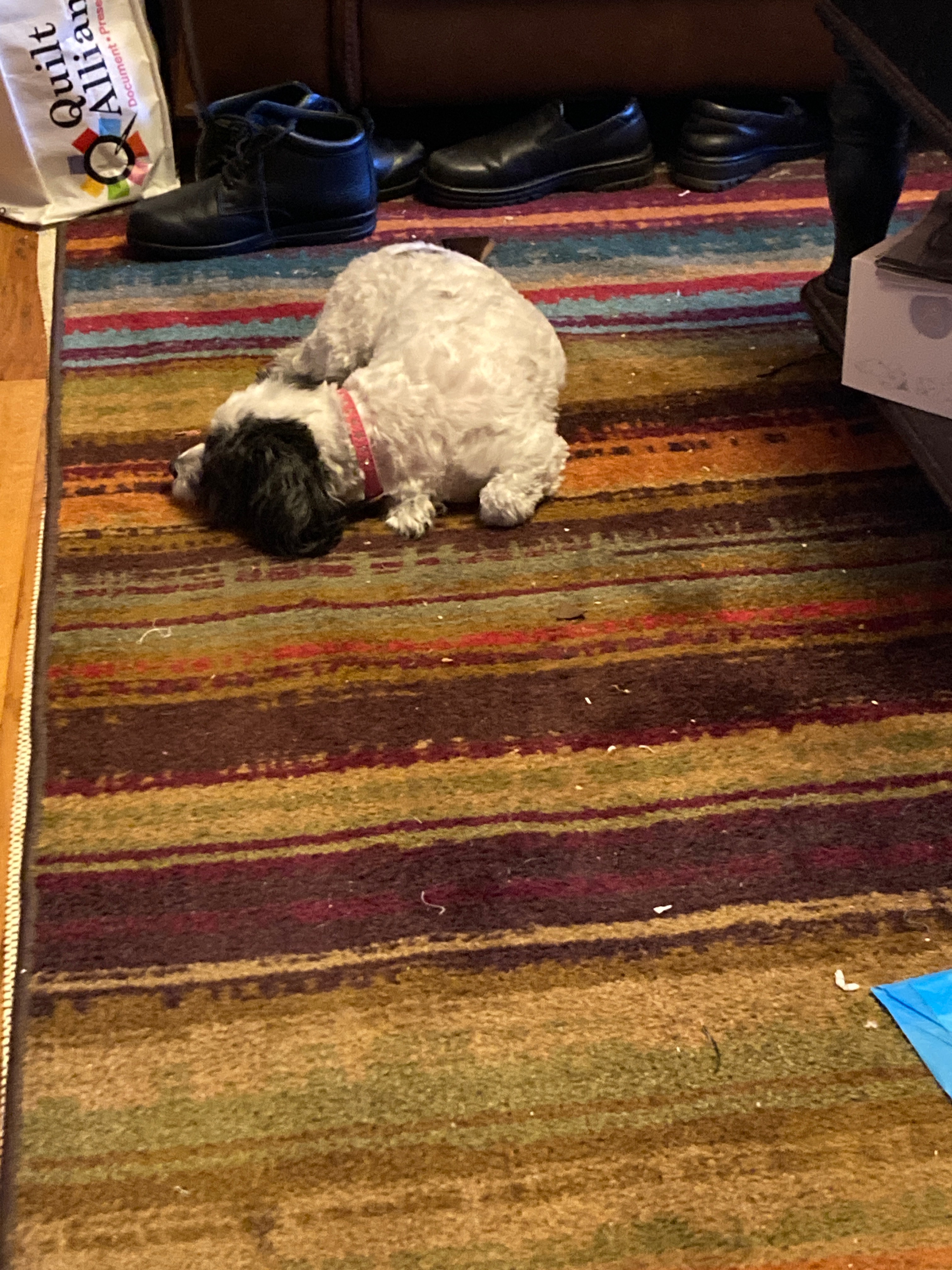
“Be quiet. I’m sleeping.”

            But I really miss being able to close the door of my classroom and knowing that it’s just me and the kids for a while, with no one looking over our shoulders, or recording our conversations, or judging each move we make or each word we say.

            It’s not that my classroom is so awful that it can’t withstand the scrutiny (I hope), but there’s something intimidating about having so many virtual doors and windows open at all times, and not knowing who’s listening in or watching from two feet out of camera range.

“Is somebody watching me?”

            Zoom is so public.

            We had a Zoom class just before Mother’s Day, and I was helping the kids create blessings for their mothers (and fathers, since school was going to end before Father’s Day), and one of the kids started miming at the screen, and then messaged me privately that she couldn’t answer with her mom in the room. Up until that second I had no idea that her mother had been there, just out of range, for the previous forty-five minutes.

            I can be silly with kids in a way I can’t with adults, at least adults I don’t know. I can play the role of the-one-who-knows-things with the kids, whereas with other adults around I’d be more self-conscious, recalibrating each time a new person came in. Just like I would feel different, and probably act differently, with my boss in the room.

I’m the boss.”

            And the kids are different too.

            A lot of the things the kids would have said in the classroom could barely even be thought when they were at home; not because they were unsafe at home (though I don’t know), but because they are different people at home than at synagogue school, and they are much more aware of being overheard, and of being their home-selves; being the big sister, or the good kid, or the chatterbox they are presumed to be when they are at home.

            In the classroom they can try on new behaviors, and say things they wouldn’t say with an audience. At home, even with Mom and Dad in a separate room, their internal censors are on and they are much more careful.

            I don’t really care if I ever step into a shopping mall again, and while I miss movie theaters, I actually like the variety and control and cost of streaming better. I do miss going to synagogue in person, but the alternate-universe-Zoom-synagogue has been a pretty good substitute. But, I miss my classroom, and my kids.

            And it sucks.

“Harrumph.”

If you haven’t had a chance yet, please check out my Young Adult novel, Yeshiva Girl, on Amazon. And if you feel called to write a review of the book, on Amazon, or anywhere else, I’d be honored.

            Yeshiva Girl is about a Jewish teenager on Long Island, named Isabel, though her father calls her Jezebel. Her father has been accused of inappropriate sexual behavior with one of his students, which he denies, but Izzy implicitly believes it’s true. As a result of his problems, her father sends her to a co-ed Orthodox yeshiva for tenth grade, out of the blue, and Izzy and her mother can’t figure out how to prevent it. At Yeshiva, though, Izzy finds that religious people are much more complicated than she had expected. Some, like her father, may use religion as a place to hide, but others search for and find comfort, and community, and even enlightenment. The question is, what will Izzy find?