Tag Archives: teaching

Talking Shpilkes

            Shpilkes is a Yiddish word that literally means “pins,” but has come to refer to “sitting on pins and needles,” or, feeling fidgety and nervous and needing to move.

            When I teach this word to my students, I tend to liken it to the ADHD symptoms they see in so many of their classmates (because even the undiagnosed kids seem to have shpilkes by the end of a long school day, which is when they come to me). This time, I was sitting with a mixed age group of kids, from second to sixth grade, for our twenty-minute elective period at the end of synagogue school for the day, and we were all exhausted and ready to go home.

            I gave them the option of sitting at their desks or on the floor, but most of them chose to sit at their desks, except for the one girl who chose to sit in my rolling chair, so I sat on the floor by myself. Whatever. As a warm up, I asked them to repeat the word “shpilkes” with me, over and over, because it’s just fun to say. We’d already done a session on Kvetching (complaining) before the holiday break, and I knew we weren’t ready to move straight to Kvelling (expressing joy at someone else’s accomplishments), so shpilkes was the next step on our Yiddish ladder.
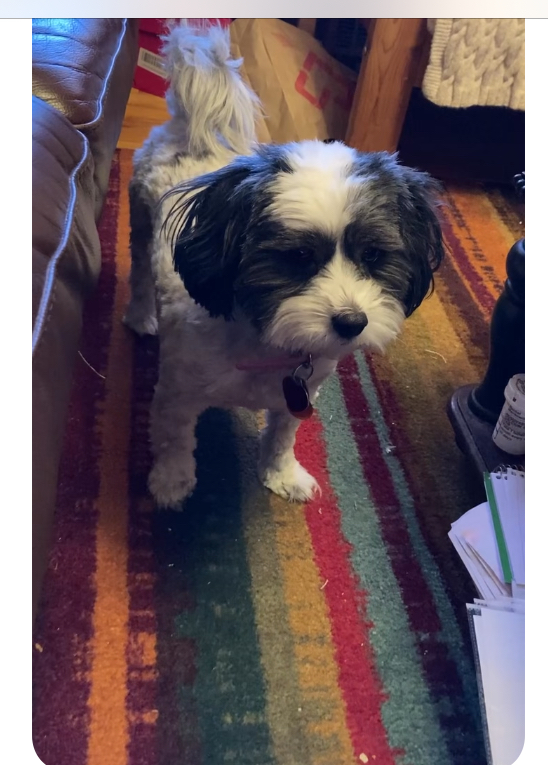
“Kvelling sounds terrible.”

            Once they’d giggled through the word a few times, I asked them if they had ever experienced having shpilkes themselves, or if they knew someone else who struggled to sit still, and they told stories about friends who couldn’t sit still, or couldn’t shut up, though no one was willing to jump in yet and admit that they themselves might struggle with sitting still. Then, one girl raised her hand shyly and said, I know someone who’s the opposite. She can get so focused on reading a book that she doesn’t hear what’s going on around her.

I asked if anyone else knew someone who could get so caught up, or if they’d experienced something like that themselves, and the stories kept coming. And then one of them asked, do you know the feeling when a song gets stuck in your head and you can’t get it out! Which led to an in-depth discussion of earworms and what causes them and how to treat them. One girl had developed a whole theory, saying that earworms are caused when you forget some of the lyrics to a song you like, so your brain just keeps repeating the song to try and remember the lost words. Her suggested treatment was to go to Spotify and listen to the song until the earworm crawled away in defeat, which, she said, worked every time.

            Aren’t our brains fascinating?! I said, from my seat on the floor. By then, one of the students had joined me on the floor, because all this talk of shpilkes had reminded him that chairs and desks are confining and it’s much more comfortable to stretch out.

            But, what about when one friend has shpilkes and the other friend has to deal with the consequences? Because, my friend keeps getting us into trouble when she talks in class, and she can’t help it, but we’re going to get kicked out and I really like that class.

To which one of the younger boys said, Yeah, it’s hard when you can’t understand why someone acts the way they do, even though you still like them and want to spend time with them. I’m paraphrasing, but only a little.

            And with minutes left to go, and so many more stories to tell and hands raised and legs swinging, I asked them if they’d ever seen a show called Glee (a few of them had, actually. Streaming makes everything new again). Glee was a TV show about a high school glee club, where they often took two songs from different genres and mashed them toegther, and sometimes, not all the time, the mash-up allowed us to hear each song in a new way because of how the two songs spoke to each other. The kids didn’t even need me to hammer the point home. They already had their hands up with stories to share about their friends who are really different from them but make life so interesting.

            Of course, my most literal student asked if I could supply examples, and I did try to find something from Glee on my phone, but the dismissal announcement interrupted me, and then we had to focus on listening to the walkie talkie calling out names one by one. But even then, more stories were spilling out, and each story reminded someone of another story, and another.

            It doesn’t always go like this. My current regular class has so much collective shpilkes that it feels like we’re hiking through a tornado just to get from the beginning of a sentence to the end. But sitting on the floor, listening to the stories flow around the room, reminded me that they all have so much going on inside of them, and sometimes, if I’m very lucky, they will share their stories with me in a way I can hear them.

“I only get Shpilkes in the middle of the night, when everyone else is sleeping.

If you haven’t had a chance yet, please check out my novel, Yeshiva Girl, on Amazon. And if you feel called to write a review of the book, on Amazon, or anywhere else, I’d be honored.

            Yeshiva Girl is about a Jewish teenager on Long Island, named Isabel, though her father calls her Jezebel. Her father has been accused of inappropriate sexual behavior with one of his students, which he denies, but Izzy implicitly believes it’s true. As a result of his problems, her father sends her to a co-ed Orthodox yeshiva for tenth grade, out of the blue, and Izzy and her mother can’t figure out how to prevent it. At Yeshiva, though, Izzy finds that religious people are much more complicated than she had expected. Some, like her father, may use religion as a place to hide, but others search for and find comfort, and community, and even enlightenment. The question is, what will Izzy find?


Improvisation

            One of the things I have had to learn how to do since I started teaching in the synagogue school is how to improvise. You never know what mood the kids will be in after a long day at public school, or what changes will come up in the outside world, or in our own worlds, and really, there has been a lot of change in the Jewish world over the past six years. Each year, there’s also the reality that a different group of kids will have different interests and different abilities and limitations, and I have to adapt my plans to fit what works best for them.

“Do you know what works for me? Chicken.”

            It has turned out that, this year, the one thing all of my students seem to love is performing; and while some of them like to sing, or dance, or tell jokes, they all like to act. I discovered this mostly by accident one Sunday morning, when one of my most energetic and curious students looked at the day’s quote from Leviticus, and dropped her head onto her desk and asked, “Why are there so many words in this book? What happened to all of the stories?”

            And she was absolutely right. Other than an interlude wherein two of Aaron’s priestly sons are killed for, um, inappropriate practices in front of God (which I did not share with my students, for obvious reasons), most of Leviticus is made up of a list of laws: fascinating and complex laws, divisive and bizarre laws, laws that only applied in the past and laws that can still serve us well today. And all of that can definitely lead to interesting discussions and many stories shared from their own lives, but it’s true, there aren’t many good stories in the text itself. So I, literally, tossed my lesson plan aside and asked her and her classmates which stories they remembered learning the year before, when they studied the book of Exodus, or the year before that, from Genesis. It became clear that though they remembered a lot of details, they tended to assign them to the wrong stories and often had no idea of the order of events (was it Moses who put all of the animals in the ark? And then he split the sea and ate an apple, right?). Instead of correcting them, I thought it would be more fun to have them act out the stories, one scene at a time, from the beginning.

            By the time the bell rang for the end of class, we were halfway across the sea of reeds (with Moses) and each student had played at least three roles (God, Isaac, and the dove, or Noah and God and Leah, for example). And it was fantastic! And exhausting. We had to drag ourselves through the rest of the activities of the morning. But the following week, they begged to do more of Genesis or Exodus, which was, as you can imagine, unusual. I did my best to add more acting into my lesson plans after that, though I had to argue for the value of singing, dancing, drawing, and writing, as well.

            And then, as a gift to the synagogue school from a generous congregant, we had a visit from a Jewish improv group, called The Bible Players (https://www.thebibleplayers.com/). They came for our last school day before Passover and worked with every possible age group. First they worked with the teachers, so we could learn how to lead some of the improvisations ourselves and adapt them for different holidays and lessons (they also gave us a packet full of every activity they’d done with us, and plenty more that we didn’t have time to try), and then they worked directly with the kids – getting them to play different characters, and mirror each other, and laugh and imagine and be brave and play. By the end of their time with The Bible Players, my otherwise sarcastic, eye-rolling students were glossy-eyed with joy and asking when they would be able to do it all again. How about tomorrow? Could we come back to synagogue school tomorrow and do it again?!

            And, of course, part of me was sitting back and saying, hey, what about me? Am I not fun? Didn’t I come up with exciting, enlightening, and innovative activities all year long? But a larger part of me was already looking through the packet of activities and planning how to add them into my lesson plans. They had taught us an especially effective clapping game to get the kids to quiet down that I intended to practice right away.

            The reality is, my next class of students may not love acting in the same way, and not every activity will work out, nor will I be able to match the level of enthusiasm and buy-in of the Bible Players, but they taught me something I’ve been struggling to embrace on my own: not only are we always improvising, but as teachers, we are at our best when we are improvising. In fact, if we know 100% what we’re going to do next, in class or in life, we are going to be bored, or bore everyone else. Learning needs to be exciting, and engaging, and interactive in order to work.

            I wish I could say that I am always ready to try something new, and always eager and open to new challenges, but I am really not. I move towards change reluctantly, and with as much side-eye as any of my students. I was exhausted the day the Bible Players came to teach us, and annoyed, and shy, and wishing I could just go home and take a nap. It wasn’t until I saw how much my students loved what they were doing that I started to open up and embrace the possibilities. Though, of course, when I tried the really effective clapping game, after the Passover break, it did not work at all, and a couple of the girls made sure to tell me that, “that was so two weeks ago.”

            To be honest, I am really ready for summer break. I am exhausted in every way. I have a lot of students this year, and they are all challenging and fascinating and full of energy and full of piss and vinegar, and they take pretty much all of my energy in every class. My one week off for Passover did not even begin to remedy the bone-deep fatigue that has set in, and yet, I’m still revising lesson plans to finish out the school year, and I’m still excited to try new things and see how they go over, and I’m still looking for new skills to learn so I can give my next batch of students more of what they need. It’s intoxicating to always be learning, and growing; and being in the classroom is like a whirlwind that I get caught up in every time, whether I mean to or not, and whether my body can sustain the effort or not.

            So, I will gratefully take my summer to recover and recharge, and then I will try it all over again next year, with the next class, improvising every step of the way, and hoping to get things right at least as often as I get them wrong.

“Is it nap time?”

If you haven’t had a chance yet, please check out my novel, Yeshiva Girl, on Amazon. And if you feel called to write a review of the book, on Amazon, or anywhere else, I’d be honored.

            Yeshiva Girl is about a Jewish teenager on Long Island, named Isabel, though her father calls her Jezebel. Her father has been accused of inappropriate sexual behavior with one of his students, which he denies, but Izzy implicitly believes it’s true. As a result of his problems, her father sends her to a co-ed Orthodox yeshiva for tenth grade, out of the blue, and Izzy and her mother can’t figure out how to prevent it. At Yeshiva, though, Izzy finds that religious people are much more complicated than she had expected. Some, like her father, may use religion as a place to hide, but others search for and find comfort, and community, and even enlightenment. The question is, what will Izzy find?

Back to School

            For my first day back teaching, I was a whirling dervish of energy. I followed along with the Israeli teenager who led us in a TikTok style dance; I taught Hebrew through Movement, which involved a lot of standing up and sitting down and walking, walking, walking; and then I taught my two classes and met (most of) my new students, which meant a lot more standing and dancing and crazy hand gestures and funny breathing exercises. At the time, I was sure I was going to be fine. I mean, it’s not like I was running around the building, or doing pratfalls for laughs (like my students).

            But a couple of hours after I got home, my body started to stiffen and the pain began to set in. By the next morning, I could barely move.

“Hey! I can’t move either!”

            It took me a few days to recover. And, if possible, the second day of teaching was even more challenging. So now, I’m scared. I’m not sure if this physical response is worse than last year’s, or if I just got out of the habit of feeling like I’d been run over by a truck a few times a week. And I’m frustrated, because I spent the whole summer trying to build up strength and endurance in the hopes that I would start the new school year feeling more resilient, and, at the very least, it didn’t work.

            It was wonderful to see my students from last year, and to meet the new kids and hear their unique stories and start to untangle all of the drama among them (this will clearly take all year). And I can see a lot of interesting discussions and tons of silliness in my future, but there’s a voice in the back of my head warning me, you may not last the whole year.

            The fact is, I know I will do everything I can to be there for my students and to live up to all of my commitments – but it’s going to be harder, and it’s going to hurt.

            A few weeks ago, my therapist said, in passing, that my disease/disorder/undiagnosed chronic illness, is degenerative. She didn’t say, “it may be degenerative,” she said “it is.” For many years, she didn’t even believe that there was anything physically wrong with me. She was convinced that all of the pain and exhaustion was psychological, and therefore hard work in therapy would fix everything. But after decades of intensive therapy, and obvious progress in my mental and emotional heath, my physical issues have only worsened, and, finally, her theory of the case had to change.

            But there are so many things I still want to do! I want to teach more, not less. I want to write more, and meet more people, and travel, and dance, and sing. I was really hoping that this summer’s home-made physical therapy regimen was going to make a difference, and I’m so disappointed that it hasn’t helped. To be fair, it’s possible that without all of that work over the summer I would have been in even worse shape for the start of the school year. But for many years now, I’ve been trying everything I could think of: every medication and supplement doctors have suggested, and every exercise and treatment and strategy I could find. But I’m going to have to accept that it’s possible that this is as good as my health is going to get, and find a way to deal with that.

            But really, I don’t wanna. I want to throw a tantrum and scream and kick the floor and just cry. It seems to make my students feel a whole lot better, so, maybe it’s the next thing I should try. It couldn’t hurt! Much.

” I love a good tantrum!”

If you haven’t had a chance yet, please check out my novel, Yeshiva Girl, on Amazon. And if you feel called to write a review of the book, on Amazon, or anywhere else, I’d be honored.

            Yeshiva Girl is about a Jewish teenager on Long Island, named Isabel, though her father calls her Jezebel. Her father has been accused of inappropriate sexual behavior with one of his students, which he denies, but Izzy implicitly believes it’s true. As a result of his problems, her father sends her to a co-ed Orthodox yeshiva for tenth grade, out of the blue, and Izzy and her mother can’t figure out how to prevent it. At Yeshiva, though, Izzy finds that religious people are much more complicated than she had expected. Some, like her father, may use religion as a place to hide, but others search for and find comfort, and community, and even enlightenment. The question is, what will Izzy find?

Hebrew Practice Groups

            At our first professional development of the year, we were asked which sound most characterized our summer, and I realized that mine was laughter, because the laughter in my online Hebrew class this summer was constant, even when we were on mute and could only see each other’s laughing faces. We became a tight knit group, with our young Israeli teacher, able to cover all of the emotional ground that came our way, without ever getting too depressed, because we knew we would be laughing again soon.

            But actually, I spent even more time in Hebrew practice groups this summer than in the class itself, because I had the time and because I finally felt like I could handle the social anxiety that comes with meeting so many strangers and making mistakes in front of them. It was all under the safe canopy of the same online Hebrew language program as my class, but in the practice groups I was meeting dozens of people from different Hebrew levels, and time zones, and ages and cultures.

            There are so many strange topics for discussion in the practice groups. Of course there are the standards: favorite food, favorite movie, what would you bring to a desert island. But then they start to get creative: what’s the weirdest food you’ve ever eaten (Ptcha – calf’s foot jelly); how would you solve global warming? (teach everyone how to fly: Laoof, like a bird, instead of Latoos, on a plane); how many languages can you speak (this one gets very competitive, and more than a few people have tried to count Spanish because they know how to say “Hola.”)

“I can teach you how to fly, if you want.”

            But we are always free to talk about something else in the breakout rooms, as long as we say it in Hebrew, so I’ve had long conversations about my dogs, or teaching, or growing up Jewish on Long Island. And if we’re pretty sure the teacher isn’t about to pop into the breakout room, we can discuss our favorite and least favorite teachers. You’d be amazed how diligently we can stick to Hebrew in the midst of a good gossip session. Because, you know, we’re studying here. We take it very seriously.

            The way the teachers lurk in the breakout rooms is always a topic of conversation. First of all, because they just appear and disappear without warning, like spies. But also, they keep their cameras off, as if we’re supposed to pretend they’re not really there. So, if I make a point of saying hello to the other students in the breakout room and don’t specifically say hello to the teacher, a disembodied voice might say, “Whatever, I’m not here, just ignore me,” which means, Hey, how dare you ignore me!

            Sometimes we’ll talk directly to the teacher – or to the box on the screen with the school logo on it – and ask for the Hebrew word for this or that, and the teacher will pop up on screen to answer “in person.” One time, a friend of mine asked her question, got her answer, and then said, “okay, you can go back into your little box now.”

            We get to meet a lot of teachers in the practice groups and see what their styles are – how they do corrections, how rigidly (or not) they follow their lesson plans, whether or not they have a sense of humor – and I’ve been able to get a much better idea of what works for me and what doesn’t, so that when a teacher’s style starts to get on my nerves, or leaves me feeling stupid, I’m less likely to assume it’s my fault (but only a little less likely).

            Our young Israeli teachers have also introduced us to something called pitzuchim – which literally translates to cracking nuts or seeds, but is used in Hebrew to refer to the way Israelis are always trying to figure out where they might know each other from (among American Jews this is called Jewish geography). It turns out that a lot of the teachers and students in the program have connections, through second cousins or long lost neighbors or who knows what else. So far, though, I have cracked no nuts or seeds on these zooms, which is kind of disappointing. Getting to Israel would be so much easier if I discovered a long lost wealthy relative with an empty apartment by the beach.

(Not my picture)

            This time spent in breakout rooms used to be the most stressful part of practice groups for me, and the reason why I avoided them so assiduously for years, but now, after the first few twinges of anxiety, I’ve come to really enjoy hearing everyone’s stories, and I’m less self-conscious about my broken Hebrew (though I still feel grumpy each time I make a mistake, which happens often).

            The most stressful part for me now is when we have to translate sentences from English to Hebrew, often using words I haven’t practiced recently (because I’m visiting practice groups at different levels from my own); but I’m getting used to laughing at my mistakes, and I’ve noticed that when I screw up, and laugh at myself, other people start to relax about their own mistakes. It’s almost like I’m doing a service.

            In some of the practice groups, after we go over some grammar from previous levels, we’ll read short articles together, or even just headlines, from online Hebrew language newspapers – often about food or travel or popular culture, so we can learn words we wouldn’t come across in class, like how to say “laundering money” in Hebrew. The words that are hardest to read in these articles are often borrowed from other languages. So, more often than not, our Israeli teachers will start to giggle when we can’t figure out how to pronounce “Mexico,”when it’s written in Hebrew letters.   

One of the lowest stress exercises that we do in practice group – though I can make anything feel stressful without really trying – is when the teacher puts an article on the screen and instead of asking us to read, and, God forbid, translate it, we just have to find one word at a time. It reminds me of being in first grade or so and realizing that there were English words I could just recognize on the page, without needing to sound them out, because they had become so familiar to me just by their shape.

            As a result of all of this time in the practice groups, I sometimes hear myself speaking in Hebrew, without having planned what to say ahead of time; the words just come out of my mouth, and I kind of look around the room, wondering who said that.

            And, really, during a summer where, aside from Mom, most of my in-person human interactions were at supermarkets or doctors’ offices, these practice groups gave me the chance to meet and chat with and learn from dozens of real people, who are fascinating and funny and weird and challenging. It’s still strange to me how real a community can feel, even when it only exists online; but in a way, the boundaries created by the computer (of time, and purpose, and mute buttons) creates a sense of safety that allows me to say what I really mean more often. Now, if only I could translate those safe boundaries into the real world…

“Pfft. Who needs the real world?”

If you haven’t had a chance yet, please check out my novel, Yeshiva Girl, on Amazon. And if you feel called to write a review of the book, on Amazon, or anywhere else, I’d be honored.

            Yeshiva Girl is about a Jewish teenager on Long Island, named Isabel, though her father calls her Jezebel. Her father has been accused of inappropriate sexual behavior with one of his students, which he denies, but Izzy implicitly believes it’s true. As a result of his problems, her father sends her to a co-ed Orthodox yeshiva for tenth grade, out of the blue, and Izzy and her mother can’t figure out how to prevent it. At Yeshiva, though, Izzy finds that religious people are much more complicated than she had expected. Some, like her father, may use religion as a place to hide, but others search for and find comfort, and community, and even enlightenment. The question is, what will Izzy find?
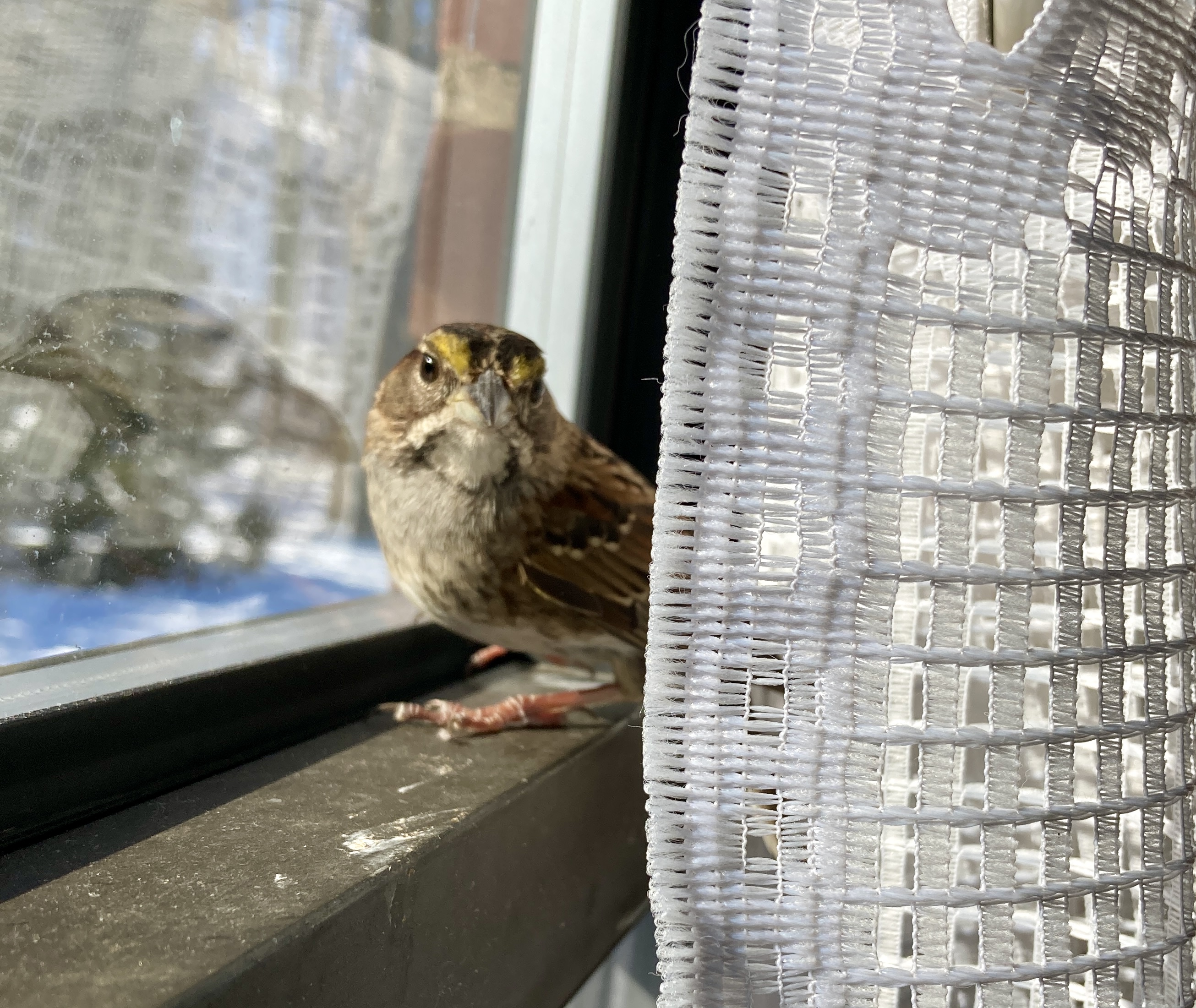
Renewal

            It was time to renew my social work license, five years after earning it, five years during which I haven’t been working in the field at all, and I felt torn. I mostly thought I should renew it, even if it cost money and took time, in case I wanted to work as a social worker again one day, but part of me wanted to burn that bridge, so I would have no choice but to focus on teaching and writing, without the option of an escape hatch.

            I received the renewal notice by email a few weeks ago, and kept looking at it, wishing it would go away. Partly, I was afraid that the process of renewing my license would be complicated or stressful, asking embarrassing questions about why I wasn’t actually working as a social worker. And I was afraid that renewing my license would cost a lot of money, or require me to reach out to former bosses, or current bosses, for documentation, or that I’d find out that I need to do a lot more expensive and time consuming trainings in order to qualify for license renewal in the first place. But I was also afraid of finally giving up on the idea of being a therapist.

The thing is, my decision not to seek a job as a social worker was not simple. It came after six months of applying for jobs and getting nowhere, even with personal contacts or recommendations. The biggest problem seemed to be that, despite being a beginning social worker, I could only work part time, or less, because of my health issues, and, at least at that time, the jobs that allowed for flexibility and limited hours were not available to beginners. But I was also not sure I was actually ready to be a social worker/therapist.

Towards the end of my time in graduate school I had been telling my teachers and bosses and advisors that I didn’t feel prepared and that what I really wanted was a third internship to help me figure out where in the field I belonged, but they all said that I shouldn’t need such a thing and it wasn’t possible anyway, so just get off your ass and get a job. And I couldn’t.

I liked the idea of myself as someone who could help people heal. And I liked the image of myself as a respectable and responsible adult who goes to an office and actually makes enough money to buy nice clothes and go on vacations. And I wanted to fight for better insurance coverage for mental health, and to argue against the ubiquitous manualized, supposedly evidence-based short term therapy that only actually helps if you have a short term problem. But the reality of social work, eh, I didn’t love it. I hated the phone calls, and the office politics, and the paperwork, and the long hours, and the clothes I had to wear, and the constant criticism from bosses and clients and client’s families, and I hated the staff meetings and the family drama and on and on.

Oy.

When I was first offered the job teaching after school synagogue school, five years ago, I accepted with relief, thinking that it would be a good first step, and allow me to accumulate experience working with children while I continued to pursue every available avenue to improve my health and eventually get to work as a therapist, and I kept taking one or two trainings each year to keep up my skills, just in case. But five years later, my health is worse, not better, and more importantly, when I think about adding more hours to my work week I tend to think about more teaching and more writing, not social work.

And then the renewal notice came, and it took me five read-throughs to realize that it wasn’t even due for another five months (when I’m anxious I tend to skim things and miss important information), but I still felt like I had to hurry up and get it done. So after a lot of handwringing, I went to the website and opened the renewal form, and one of the first things they asked if I’d like to go on “inactive” status, which would be free, and could be reversed at any time. And I thought, “Oh! I didn’t know that was an option!” It sounded perfect and I felt much better, for a second, especially about the money I would not have to spend, but then the relief went away and the nagging worries returned, because it’s hard to let go of something that once seemed like the answer to everything, even when it didn’t seem like the answer to anything anymore.

            And yet, I couldn’t convince myself to close the door on social work, given all of the time and money and hope I’d invested in that goal for so many years. So, I filled out the renewal form, which mostly consisted of checking a few boxes and paying the fee, and then I set to work planning more training classes, because, I don’t know, I guess I’m kind of stubborn.

If you haven’t had a chance yet, please check out my Young Adult novel, Yeshiva Girl, on Amazon. And if you feel called to write a review of the book, on Amazon, or anywhere else, I’d be honored.

            Yeshiva Girl is about a Jewish teenager on Long Island, named Isabel, though her father calls her Jezebel. Her father has been accused of inappropriate sexual behavior with one of his students, which he denies, but Izzy implicitly believes it’s true. As a result of his problems, her father sends her to a co-ed Orthodox yeshiva for tenth grade, out of the blue, and Izzy and her mother can’t figure out how to prevent it. At Yeshiva, though, Izzy finds that religious people are much more complicated than she had expected. Some, like her father, may use religion as a place to hide, but others search for and find comfort, and community, and even enlightenment. The question is, what will Izzy find?

What I’ve Learned So Far

            With the end of the synagogue school year I always try to take stock of what I’ve learned, and what I need to hurry up and learn over the summer to be prepared for next year’s challenges. This has been a hard year, personally (with the loss of the dogs) and globally, but I’ve learned that I have to find hope, even if I have to manufacture it out of nothing, or else I won’t be able to function.

            My biggest take away from this year is that I love working with these kids, from the youngest to the oldest, from current students to kids I never taught but met along the way. And I love finding out that I made a difference in their lives; even a small one, even just as a contact point, a place where they feel safe being themselves.

            I feel like I’ve been doing a child development observation project for the past five years and I keep learning more and more about what works and what doesn’t work for different kids, and I keep learning the humility that comes with being wrong over and over again. And I find that I don’t mind being wrong and making mistakes (unless those mistakes are pointed out to me endlessly and highlighted in neon, then not so much).

            One of my favorite things is when I meet kids who are clearly being parented well, kids who are their full selves and self-aware and able to accept their own limitations and seek help when they need it and seek out challenges that allow them to grow. Of course, I identify more with the kids who are struggling, who are frightened or insecure or unable to even express the chaos that’s going on inside of them. But I love all of them.

            And now that I’ve been here a while, some of the kids I worked with at the beginning are now teenagers, and some of the teenagers who helped in our classrooms are now young adults, and they still come back to check in and update us on how they are doing. I can especially relate to the way the teenagers and young adults are trying to figure out who they are, because I’m still working on that project myself. I watch as they try on different identities and personas and philosophies and I try to be patient when they are insufferably overconfident or simplistic or combative about their newly discovered truths.

The one area where I’ve been struggling to be patient, though, is when what the kids are trying on is a new worldview wherein Israel is the cause of all evil. A lot of the students who are protesting on campuses are not lifelong supporters of Hamas, or even especially well-educated about the Middle East and the plight of the Palestinians in Israel and the surrounding Arab countries. Most of them are just kids who are trying out new ideas to see how they fit, and they are energized by the communal atmosphere of the encampments and the belief that they can be completely right about something and their parents can be completely wrong. Most of these kids, given time and education, will not be supporters of terrorism, or of any of the other political ideologies they have been flirting with in college, and what I’m learning is that my job as an adult with the honor of interacting with them is to educate, and to listen, and to support. I do not need to pretend that I am convinced by their sudden certainties about the world, nor do I need to argue with them, but I can’t abandon them either.

This is an encampment I might even join
(not my picture)

            I know from my own experience that certainties can help manage the extreme anxiety that comes with having no idea what the future will bring. They are still trying to figure out how to do their own laundry and yet they’re expected to plan out their whole lives: career, finances, life partners, belief systems, etc. The job of their teachers is to open new doors of thought, and present the available knowledge with a good dose of skepticism, and suggest questions worth asking, and teach a tolerance for uncertainty, but a small percentage of professors seem to see their role as becoming gurus who expect their students to swallow their ideologies whole.

With a Professor like this, I’d listen to whatever he had to say. (not my picture)

            I would have done better with less certainty from the adults in my life when I was in school. I needed my teachers to ask me questions and offer me compassion and patience, and then, gently, to introduce the complications to my black and white view of things. I didn’t need their admiration anywhere near as much as I needed their interest and curiosity in who I was and how my mind worked.

This was me all through school. Different hair.
(not my picture)

            I’ve been reminded all over again this year how important it is to be an accurate mirror for my students. Unconditional positive regard only works when it is based in the reality of the child or young adult in front of me. If an oppositional, argumentative class clown is praised for being well-behaved when he isn’t, that’s not helpful. He wants to be seen as he is. He’s being oppositional for a reason and if I ignore his reality I’m not helping him.

            It’s a relief to have the summer off so I can recharge and focus on my writing and focus on myself, but this year especially I know I am going to miss my students, so I will make an extra effort to carry them with me, as a totem, to remind me of how much there is to look forward to in the future.

But first, a really long nap.

This is not my picture either, but it looks just like me.

If you haven’t had a chance yet, please check out my Young Adult novel, Yeshiva Girl, on Amazon. And if you feel called to write a review of the book, on Amazon, or anywhere else, I’d be honored.

            Yeshiva Girl is about a Jewish teenager on Long Island, named Isabel, though her father calls her Jezebel. Her father has been accused of inappropriate sexual behavior with one of his students, which he denies, but Izzy implicitly believes it’s true. As a result of his problems, her father sends her to a co-ed Orthodox yeshiva for tenth grade, out of the blue, and Izzy and her mother can’t figure out how to prevent it. At Yeshiva, though, Izzy finds that religious people are much more complicated than she had expected. Some, like her father, may use religion as a place to hide, but others search for and find comfort, and community, and even enlightenment. The question is, what will Izzy find?

Yiddish Storytelling

(This post was written before today’s attack on Israel by Hamas. I have no words, except to say that I’m sending love and prayers to family, friends, teachers and classmates in Israel right now. I will leave it to politicians and journalists to describe what is happening on the ground, but I decided to post this essay, about the joy of teaching Judaism to Jewish children, because that joy is a big part of what keeps me going and I hope it helps others too.)

            This year for my synagogue school elective, I’m teaching Yiddish, sort of. More like I’m teaching the kids some of the Yiddish words that have become popular among American Jews, so they can feel like they are part of the club when people around them are kvetching (complaining, whining) and kibbitzing (chatting, gossiping) and kvelling (expressing great pleasure and pride in someone else’s achievements) over a nosh (a snack) of bagels and lox.

“I like to nosh!”

            The hardest part of planning the class was trying to limit the number of words I would teach them. I mean, you have to do verklempt (choked up with emotion) and schlep (drag something, or drag yourself somewhere) and chutzpah, but how can you leave out farshtunkene (stinking, rotten, contemptible) or bupkes (nothing, literally “goat droppings”)?

            At first, I thought I would use video clips of famous comedy routines or movie scenes to help them get a feel for how the words are said, but most of the clips were way too grown up in content, or so chock full of Yiddish words that the kids would have been overwhelmed. So I decided to go with theme days, and have the kids tell their own stories using Yiddish words on that theme. For Chutzpah Day, I decided to leave it at just the one word, because everyone has chutzpah stories: times when they had the chutzpah to speak up or take action, times when they didn’t have the chutzpah to do something they wanted to do, and plenty of times when someone else had the chutzpah to do something crazy nearby. And for Oy Vey Day, of course, we start with Oy Vey, the classic expression of dismay and then plotz (exploding or fainting with emotion) and shpilkes (restlessness, or “sitting on pins”), which pretty much every child in synagogue school experiences everyday.

Oy Vey.”

            But I started with Kvetch Day, because I knew the kids would have a ton of complaints that they needed to get out, and the chance to vent, while saying funny words that make you spit or cough, is priceless. They go through so much tzuris (troubles, worries, suffering) in their daily lives, and there are so many times when brothers or sisters are nudniks, interfering with games or bothering them endlessly, and of course when your friend gets a new iPhone for Hanukah and you get socks, which is worse than bupkes, it stings.        

“Every day is a Kvetch day.”

My own adventures in Yiddish have been meaningful to me, which is why I wanted to bring it to the kids, at least in a lighthearted way. The language itself is a history of where Jews lived over a thousand years, picking up new words from each new town and city they lived in, a lot from medieval German, but also from Polish and Russian, and plenty from Hebrew itself.

            I wish I knew more about Ladino, the language of Jews from the Iberian Peninsula, who had to leave during and after the Spanish Inquisition. Ladino is based on an old version of Spanish, mixed with Hebrew, and just like Yiddish, picked up words as the people who spoke it traveled to new homes in Amsterdam, and South America and the Ottoman Empire, again with Hebrew laced through it like the blue thread woven through the tzitzit.

            There are so many other Jewish languages, from all the different places where Jews have lived, because the Hebrew from prayer and study bled into the language of the market place automatically as they lived their daily lives.

            We’re living through a period, now, where diversity is celebrated, and it’s ok, with most people, that Jews often maintain their own customs and languages as well as becoming full-fledged members of the communities where they live. But historically, that wasn’t the case. Even when Jewish separateness was enforced by the local governments, keeping Jews out of certain neighborhoods and professions, it still bothered the locals that the Jews had their own ways of living, and their own languages in which to do it, because you never knew what they were saying to each other.

            But right now, when everyone is allowed to celebrate their unique cultures, of food and music and language and fashion, Jews are feeling freer to celebrate it too, and to celebrate all of the different cultures that have been woven through Judaism over the millennia. There are tons of cookbooks for Jewish foods from the Middle East and Eastern Europe and South America and North America, and Jewish families on Long Island are eating foods from Morocco and Jamaica and Russia and Ethiopia at their Passover Seders, as a way to honor the diversity of the Jewish people, and because they’re really yummy.

            What I want most for my students is that they will gradually grow their idea of what it means to be Jewish, so they aren’t limited to what they see in their own communities on Long Island, but can also see that Judaism has existed and transformed over and over again in a million different forms, and therefore there will always be room for them to bring their own unique ideas to the table. And I want them to know that their own stories are just as important as Abraham and Isaac and Jacob’s and Tevye and Herzl and Golda’s. I especially want them to know that the Jewish people have always been complainers, and have grown and changed and lived good and interesting lives as a result of having their say. I want them to know that their voices are to be celebrated and heard, no matter how much phlegm they cough up along the way.

“Nu, we’re listening.”

If you haven’t had a chance yet, please check out my Young Adult novel, Yeshiva Girl, on Amazon. And if you feel called to write a review of the book, on Amazon, or anywhere else, I’d be honored.

            Yeshiva Girl is about a Jewish teenager on Long Island, named Isabel, though her father calls her Jezebel. Her father has been accused of inappropriate sexual behavior with one of his students, which he denies, but Izzy implicitly believes it’s true. As a result of his problems, her father sends her to a co-ed Orthodox yeshiva for tenth grade, out of the blue, and Izzy and her mother can’t figure out how to prevent it. At Yeshiva, though, Izzy finds that religious people are much more complicated than she had expected. Some, like her father, may use religion as a place to hide, but others search for and find comfort, and community, and even enlightenment. The question is, what will Izzy find?

Another Summer of Hebrew

            I started a new online Hebrew class for the summer, and my new Hebrew teacher is down to earth and clear and friendly, so I am hopeful that the class will be good and productive. But this is going to be my last Hebrew class for a while, because it’s expensive, and with another oral surgery coming up, and the pause on student loan debt repayment ending in August, I need to keep costs down; but also, I feel like I can’t focus on the classes during the school year anymore. I need more rest days, in order to recover from my work days, or else I won’t be able to work much longer.

“You should just stay home with us all the time.”

            I still love learning Hebrew, and I’m hoping that this last class will give me more confidence to continue learning new vocabulary on my own. Maybe I’ll even start writing in Hebrew and see how my voice translates.

            Writing in Hebrew is one of the few things we haven’t worked on in these classes from Tel Aviv, where the focus is on conversation skills and reading newspapers and watching TV. I think I would write poetry in Hebrew, because the language is so conducive to poetry, with all of the rhyming words and onomatopoeia and the leanness of the language overall. I gave up on writing poetry in English after too many discouraging teachers telling me to write like someone else, but maybe with Hebrew I could start again with a blank slate.

            I still want to become fluent in Hebrew, but I think if I take more classes I’d like to move towards Jewish learning in general, rather than Hebrew in particular. The focus in these classes has been on how Hebrew is spoken in Tel Aviv, with very little discussion of things that are recognizably Jewish, rather than Israeli. For me, Hebrew and Judaism are deeply intertwined, but Modern Hebrew has become a secular language, used for every mundane and profound purpose in daily life in Israel, and it feels like, as a result, some of the meaning has been stripped away.

I still want to learn more vocabulary, but I wonder if the words I really want to understand are the ones in the Hebrew Bible, or in the prayers, so that I don’t have to rely on someone else to tell me what they mean. I don’t want to lose sight of Modern Hebrew, and the way it has embraced so many different cultures and absorbed words from Arabic and English and French and Russian and more, I just want to re-invest in the connection to the past, where it all comes from.

I’m still not sure where all of this learning and exploring will take me, or how, or if, I will make use of it in my writing or my teaching, but sometimes learning is worth the effort just for its own sake, for the way it challenges our perceptions and widens our vision of the world and ourselves.

And maybe next summer, or when/if I start feeling better and have more energy, it will lead me to something more.

“Just make sure you take us with you wherever you go.”

If you haven’t had a chance yet, please check out my Young Adult novel, Yeshiva Girl, on Amazon. And if you feel called to write a review of the book, on Amazon, or anywhere else, I’d be honored.

            Yeshiva Girl is about a Jewish teenager on Long Island, named Isabel, though her father calls her Jezebel. Her father has been accused of inappropriate sexual behavior with one of his students, which he denies, but Izzy implicitly believes it’s true. As a result of his problems, her father sends her to a co-ed Orthodox yeshiva for tenth grade, out of the blue, and Izzy and her mother can’t figure out how to prevent it. At Yeshiva, though, Izzy finds that religious people are much more complicated than she had expected. Some, like her father, may use religion as a place to hide, but others search for and find comfort, and community, and even enlightenment. The question is, what will Izzy find?

The Broken Bookcase

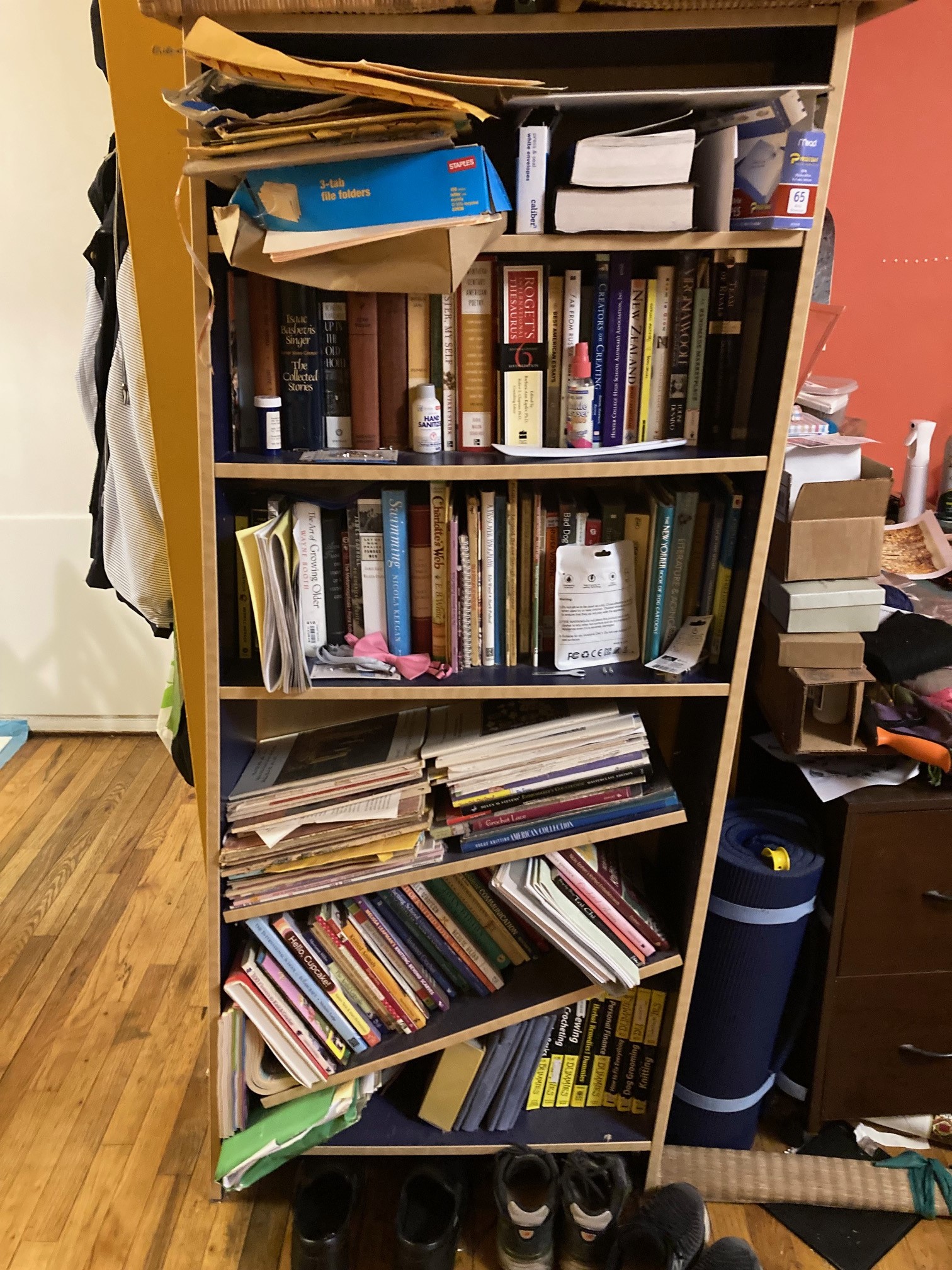
We have a blue Ikea bookcase in the hall that has been tilting for a long time now, but there’s been so much else going on that it never seemed important enough to try to fix it or replace it. We have bookcases everywhere, and I have five in my room alone, so one tilting bookcase didn’t seem like an emergency; until one of the shelves fell, and even then we just put “shelf pins” on the shopping list and eventually bought some, and of course, forgot to put them in. And then another shelf fell. And I still can’t be bothered to deal with the damned thing.

The Broken Bookcase

It’s not that a bookcase is such an expensive thing to replace, especially if we get another one from Ikea, its more that we’d have to actually go to Ikea, carry the heavy box to the car and from the car to the apartment, and then put the thing together, oh, and also empty the broken bookcase and take the broken pieces down to the garbage and refill the new bookcase.

I don’t have the energy for any of that, let alone all of it.

I’ve been trying to clear out the “extra books” from my collection for years now (so that we wouldn’t need so many bookcases), by re-reading the books that I’m on the fence about. I’ve already filled two boxes with books I no longer need, but giving books away is harder than you’d think. The library never wants them, and finding a place that wants the books, on the third Thursday of the month, at twilight, still requires carrying heavy boxes of books out to the car. So at this point I still have a box of discarded books on the floor, next to the bookcases, and I still have three shelves full of books to read through. I also have a bad habit of ordering more books all the time.

“She’s going to throw out our toys to make room for books, isn’t she?”

This feels like a metaphor for the way my brain has been lately: overwhelmed with ideas to follow up on, all resting on iffy shelves and waiting for me to start culling through them; but I can’t even think straight enough to do the culling before another ten or twenty ideas pile on. I feel like every day I’m looking at these tilting shelves in my brain, knowing that it’s all going to overflow at any moment, with no idea how to stop it.

I decided to take a break from going to online Hebrew classes for a few months, because I’ve been struggling to stay focused during the classes this past semester, and because the time I spend in those classes and doing the homework for them has kept me from doing other important things on my to-do list. I’m hoping to get back to the classes over the summer, when I have more free time to focus, but I feel the loss of the socializing and the Hebrew already. I still don’t even know what to do with all of the Hebrew I’ve learned so far, or why it’s been such an obsession for at least two years, if not my whole life.

I feel like there’s a path I should be on, and a long term goal I should be working towards, and that Hebrew language learning is part of it; but I don’t know what that goal is. I don’t want to move to Israel, and I don’t particularly want to go back to school full-time to become a translator or a rabbi or a cantor. I would like to go deeper into Jewish education, if I can, working with teens, maybe, as well as with the younger kids, and maybe even doing curriculum development. But I don’t know of a path to get there, and I don’t want all of that to be instead of writing my novels – the notes for which have filled up a bunch of shelves of their own.

I feel like there’s a whirlwind in my brain, pushing me in different directions all the time, keeping me confused and off kilter, and I’m worried that my internal bookshelves are as wonky as the ones in the broken bookcase in the hall, and it will all tumble down at any moment.

My hope is that once synagogue school is over for the year, I’ll be able to concentrate on all of those ideas whirling around in my brain, and organize them, and maybe even choose some to work on. But I’m afraid I’ll be as busy with doctors and tests this summer as I was last summer, without much improvement in my health to show for it, and those wonky internal shelves will just keep tilting.

But I keep slowly reading through my piles of books, and writing down all of my ideas, and sorting and discarding when I can, because this is how I move forward. It’s not especially practical, or fast, but it’s the way my mind works, so it will have to do for now.

“It’s important to just be yourself, Mommy.”

If you haven’t had a chance yet, please check out my Young Adult novel, Yeshiva Girl, on Amazon. And if you feel called to write a review of the book, on Amazon, or anywhere else, I’d be honored.

            Yeshiva Girl is about a Jewish teenager on Long Island, named Isabel, though her father calls her Jezebel. Her father has been accused of inappropriate sexual behavior with one of his students, which he denies, but Izzy implicitly believes it’s true. As a result of his problems, her father sends her to a co-ed Orthodox yeshiva for tenth grade, out of the blue, and Izzy and her mother can’t figure out how to prevent it. At Yeshiva, though, Izzy finds that religious people are much more complicated than she had expected. Some, like her father, may use religion as a place to hide, but others search for and find comfort, and community, and even enlightenment. The question is, what will Izzy find?

A Blessing a Day

            Just before sunset on Erev Rosh Hashanah (the first night of the Jewish New Year), my Mom noticed that one of the pawpaws (from a tree we grew from seeds 15 years ago, that only gave its first fruit last year) was starting to blacken in one spot, and when I got close to it I realized that the distinct pawpaw smell was already filling the air, and the fruit was becoming soft. There were eight or nine pawpaws on the tree this year, but we’d been waiting for a sign that they were ready to be picked, and for this one piece of fruit, this seemed to be the sign. So we plucked it from the tree, and brought it inside, and said the Shehecheyanu blessing (the Jewish blessing for new experiences), before sharing the first new fruit of the year.

Blessed are You, Lord, our God, King of the Universe, who has granted us life, sustained us, and enabled us to reach this occasion.

            It’s not so much that I believe God magically gave me a pawpaw just in time for the New Year, it’s more that I believe in the power of recognizing these moments of wonder in my life, as a way to remind myself that there will be many more of them in the future, in case I’m beginning to lose hope.

“I never lose hope that there will be more chicken treats!”

            One of the new things I’m trying this year with my synagogue school students is a blessing a day – or, really, a blessing a week, because we only have Hebrew class once a week – and we started the year with the Shehecheyanu blessing, because it’s associated with the Jewish New Year, and because it gives us a chance to talk about all of the new things we are starting in our lives, and maybe feeling anxious and excited about at the same time.

            I want the kids to know that there are hundreds of pre-set blessings that they can use, but also that they can create their own blessings, and celebrate things in their lives that are unique to them, or even just use words that have more meaning to them. For example:

            I am so grateful that the new KN95 masks are cheaper and more plentiful than they used to be, so I can wear them all the time instead of relying on less protective masks.

            I am grateful that people not only read my writing but invest in it enough to respond with their own thoughts.

            I feel blessed when Ellie sees that I am in pain and comes over to lick my hand, to let me know she’s there with me and loves me.

            I sense a power bigger than myself when I discover a new food/song/book that fills me with wonder and a sense of connection.

            I feel like the sun is shining down on me when my students smile and laugh and really seem to enjoy being in my class.

            For some reason, the girls in the class took to the Shehecheyanu blessing immediately and began fighting for the chance to stand in front of the classroom and give dramatic readings – as if they were on stage reciting Shakespeare. Who knew blessings could be so loud, and entertaining?!

“Me!!!!”

            I’ve been collecting blessings to teach to the kids this year, and of course I have to include the most used blessings, the ones over food, because the kids are always hungry! The Jewish food blessings are well documented – you’ll find yeshiva boys competing over who knows which blessing to say over which kind of food (for example, you have to say two different  blessings for an ice cream cone, one for the cone and one for the ice cream!). I’m not a big fan of getting into the weeds of the pre-set blessings, but I appreciate that they exist and can give me a reference point for how to create my own blessings.

            We often think of a blessing as something that is given to us – we are blessed by luck, blessed to be loved, blessed to survive a flood – but I like the idea of a blessing as what we say in response to that good fortune; so we’re giving the experience our own stamp, our own interpretation, to make sure it doesn’t go unnoticed, by us.

            I specifically went looking for a blessing over putting on a face mask, because I needed a reminder that I’m still wearing one for a good reason, and I found a blessing (at ritualwell.org) written by Rabbi Michael Knopf that blesses God for commanding us to protect life (this actually is a commandment, called Pikuach Nefesh, where we are told to break many of the other commandments if it will allow us to save a life).

Blessed are you, Lord our God, who has sanctified us with your commandments and commanded us to protect life.

It’s sufficiently vague to use for all kinds of protective behaviors: like getting a vaccine, or wearing a mask, or forcing yourself to go for a regular checkup even when you really don’t want to.

“I never want to go to the doctor.”

There were also blessings on Ritualwell for taking off masks, and all sorts of other things that don’t already have existing blessings in the canon. I’m hoping that by the end of the year I’ll have a whole file of blessing from my students to send in to the website, because kids are really good at seeing the specifics of their lives and the wonder in the every day. I’ll teach them the blessings for seeing a rainbow, or meeting a wise person, or surviving a life threatening experience, and then it will be their turn to teach me: how to bless an endless session of playing video games, or sharing a peanut butter and pickle sandwich with a friend, or rolling down a snowy hill until you can’t breathe for laughing.

I can’t wait!

“Peanut butter and pickle sounds pretty good.”

If you haven’t had a chance yet, please check out my Young Adult novel, Yeshiva Girl, on Amazon. And if you feel called to write a review of the book, on Amazon, or anywhere else, I’d be honored.

            Yeshiva Girl is about a Jewish teenager on Long Island, named Isabel, though her father calls her Jezebel. Her father has been accused of inappropriate sexual behavior with one of his students, which he denies, but Izzy implicitly believes it’s true. As a result of his problems, her father sends her to a co-ed Orthodox yeshiva for tenth grade, out of the blue, and Izzy and her mother can’t figure out how to prevent it. At Yeshiva, though, Izzy finds that religious people are much more complicated than she had expected. Some, like her father, may use religion as a place to hide, but others search for and find comfort, and community, and even enlightenment. The question is, what will Izzy find?