As the pain from the surgical procedure started to recede, I was able to gradually reduce the dose of Percocet (an opiate) until I’d completely transitioned back to Tylenol and Ibuprofen, and I was sure that that would lead to a big uptick in energy, because I was convinced that the Percocet was what was making me so sleepy, and dizzy, and nauseous. Come to discover, there’s such a thing as Percocet withdrawal, even when you’ve only been taking an opiate for a limited period of time. And Percocet withdrawal, it seems, can exist along a spectrum, from the version we’re familiar with from movies, where hard core addicts are locked in padded rooms, sweating and hallucinating for days until the drugs are finally out of their system, to something more like what I’ve been experiencing, which is extreme physical weakness, dizziness and depression.

My current form of depression involves swirling fears around the death of critical thinking in the academic world, and the super-fast pace of everything, and how thoroughly unprepared we are as a society for most of the things we have to deal with on a regular basis. It’s not just the doctors who prescribe medications without explanation (leaving it to the pharmacist to report contraindications and side effects in the tiniest type possible), it’s the short bursts of news on social media that have replaced comprehensive and detailed storytelling, and the eye rolling and foot stomping that has replaced careful listening and thoughtful responses. It feels as if we’ve bought into an assembly line philosophy of life, where all of the pieces of are laid out from the start, with very little room for variation, and we’ve applied it to things like news and medicine and school and work without ever recognizing that it doesn’t actually work for more complex, human activities. I saw this in graduate school for social work, where so much of what we were taught was manualized, until each problem, no matter how long lasting or deeply ingrained, was seen as solvable in 4-16 weeks, as long as you adhered to the plan. This was, of course, nonsense. I learned, finally, that the system is set up for the sake of insurance companies and legalities and institutional survival, rather than for the healing of actual human beings. And now I am watching people in the world at large fight over who can be louder, stupider, meaner and more unrealistic, and I keep waiting for the world to right itself and return to the boring, pragmatic, long-term work of connecting people to the resources they actually need, and listening to the people who have been left unheard, and teaching all of us more effective ways to communicate and function in our changing world. And I’m exhausted with the waiting.
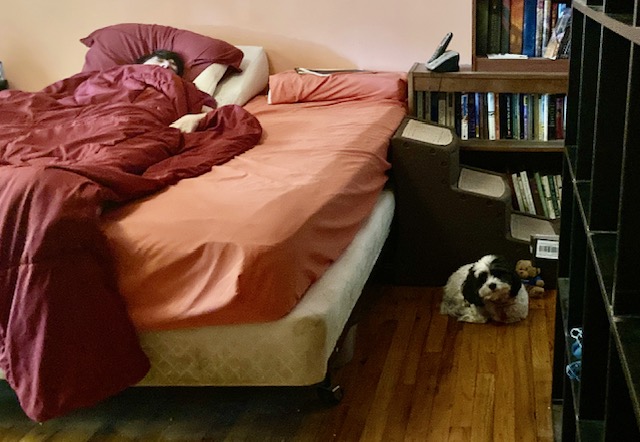
My hope is that as the Percocet leaves my system, my thoughts will shift from assembly lines and failed systems and the end of the world as we know it, to something more hopeful, but I worry that this might be more than just a symptom of a passing disorder. Nurse Tzippy has been keeping an eye on me while we wait.
If you haven’t had a chance yet, please check out my novel, Yeshiva Girl, on Amazon. And if you feel called to write a review of the book, on Amazon, or anywhere else, I’d be honored.
Yeshiva Girl is about a Jewish teenager on Long Island, named Isabel, though her father calls her Jezebel. Her father has been accused of inappropriate sexual behavior with one of his students, which he denies, but Izzy implicitly believes it’s true. As a result of his problems, her father sends her to a co-ed Orthodox yeshiva for tenth grade, out of the blue, and Izzy and her mother can’t figure out how to prevent it. At Yeshiva, though, Izzy finds that religious people are much more complicated than she had expected. Some, like her father, may use religion as a place to hide, but others search for and find comfort, and community, and even enlightenment. The question is, what will Izzy find?


Sending good thoughts and positive energy your way. My husband and I watch a lot of science fiction, and sometimes I feel that we are all just existing in a parallel universe. In a way, it’s comforting to think that an alternate me is living a different reality where things are better.
I’ve always worried that the me in the alternate universe would have even more problems and I wouldn’t be able to get to her in order to help her.
I’m afraid a lot of us need to recover from attention deficit syndrome. I’m sure you’ll do fine because you’re self-aware and cognizant of the pitfalls.
I don’t know. It’s scary out there.
Yes it is.
I took Percocet for a brief time after a major surgery and really disliked the effects: nightmares, fatigue, headache, upset stomach and an overall sense of apprehension or general unease (except I didn’t know what I was apprehensive or discomfited about). After 2 or 3 days I realised the Percocet was causing the reaction and stopped taking it. Tramacet (tramadol) was prescribed instead and was much better. I’ve also heard of people becoming very quickly physically addicted to Percocet. Ugh. Sorry to hear you experienced that.
Yeah, I have to be in a lot of pain to be willing to risk the Percocet. I guess I must have been on more of it for a longer time than in the past, on top of the anesthesia from the surgical procedures, and my body hit a wall.
I hope you feel better soon. 💐
Thank you!
Rough going, Rachel. Praying for you.
Thank you!
Am sending you a big hug. Nurse Tzippy is the best, I’m sure! (I took one Percocet once and imagined a gospel choir in my head, and not in a good way!) Hope to hear you’re feeling better soon.
Thank you!
Good luck. Sending positive thoughts your way, Rachel.
Thank you!
Nurse Tzippy deserves a raise…more chicken treats! (Seriously, hope you are soon feeling better. ❤️)
Ditto
Thank you! And Tzippy thanks you too!
Aw, you do have the cutest nurse ever. I hope you feel well soon.
Thank you!
I’m not really sure it’s the withdrawal, more maybe a glimpse of the reality we live in (how much I’m joking here I don’t know).
I’ve been playing with renaming our current age as the Age of Thick, as in loss of intelligence. I’ve read of others assuming the same – though, that is no recommendation.
I was really hoping it was going to be a temporary state. Oh well.
It probably will be a temporary state – too much reality is bad for us.
I do hope you are climbing back to good heath, though.
Slowly but surely. Thank you.
I remember the effects from hydrocortisone were unpleasant. Lucid dreams, brain fog, fatigue—yuck. Hope your recovery goes well.
Thank you! It’s amazing the things the brain can do, on and off drugs.
Hi Rachel, that was an incredible insightful and accurate write/think. Drug induced? Maybe. Regardless – I’m rooting for you. Cheers.
Thank you so much!
As you well know, history repeats itself. Just think about the egomaniacs that have tried to rule the world in the pas, and how many deaths it resulted in. *sigh* Hoping hard that the effects of the percoset are gone very soon and your mouth feels ok.
Thank you! I really don’t want to relive history; I was sure the whole point of learning about it was to prevent the horrors from happening again.
Yes, you would think, right?
Ugh… I’m with you – I have to be in terrible pain before I take a pain killing pill. Thank goodness, I haven’t needed to for a very long time. Here’s hoping the ‘effects’ wear off soon.
Thank you!
Dear Rachel, what a rough and unpleasant ordeal. So sorry to hear this. I too will keep you in my prayers. I want to introduce you to a YouTube channel. It’s beautifully done. You’ll find it at Mdays. Unfortunately she has lost a loved one not too long ago. She is at a delicate place right now. She and her family live in Israel. Her name is Moron and a delightful and creative woman. You’ll like her.
Thank you!
praying for healing. Everywhere.
Me too!
How frustrating. Hard when the medications bamboozle you.
Definitely! Thank you!
Wow. That’s quite the load. In my experience the opiates only caused monumental constipation but we don’t have to discuss that right now.
I guess the depression is better than that? or not.
Good luck and hang in there. You are wise enough to appreciate that this is withdrawal doing the talking in your head. Hoping for pain-free healing and thoughts about society to diminish. And you’re right about the US medical system and who it all supports, sadly.
I hate being right. I would love to find out one day that everything turns out better than I expect it to.
Jesus, please touch and heal Rachel and deliver her from pain, withdrawal, and every bad effect of her treatment. Thank You, Jesus, Amen,
Hope you feel better soon!
Thank you!
I’m glad Tzippy found his inner Nurse and is helping – I am sorry that you are going through this – I know from my personal experience with anxiety that ruminating thoughts are hard to dismiss – here’s to better days!!!!
For everyone!
Thank you for sharing such an honest reflection. I’m sorry you’ve had such a difficult recovery, but I hope each day brings more strength, clarity, and peace. Wishing you continued healing, and I’m glad Nurse Tzippy is there to keep you company.
Thank you!