The Bird’s Visit

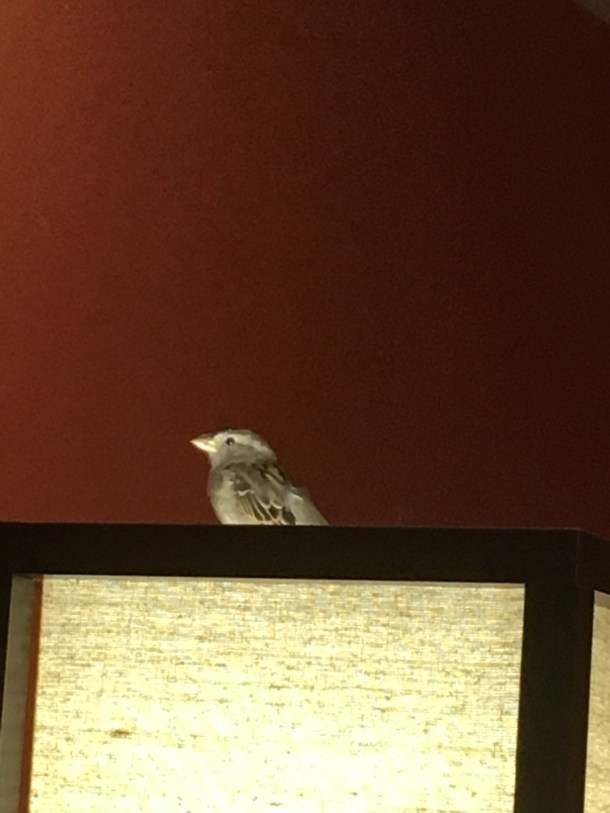
During the days between Rosh Hashanah and Yom Kippur (the Days of Awe) a bird came to visit my apartment. She showed up midday on Saturday; she was just there when I came back in from walking the dogs, flapping her wings against the inside of the living room window, inches away from the space where she must have accidentally come in (there’s a space next to the air conditioner that Mom uses to give the neighborhood birds their snacks). I tried to show the bird the exit, as gently as possible, but she ignored me.

IMG_1218

“I’m staying.”

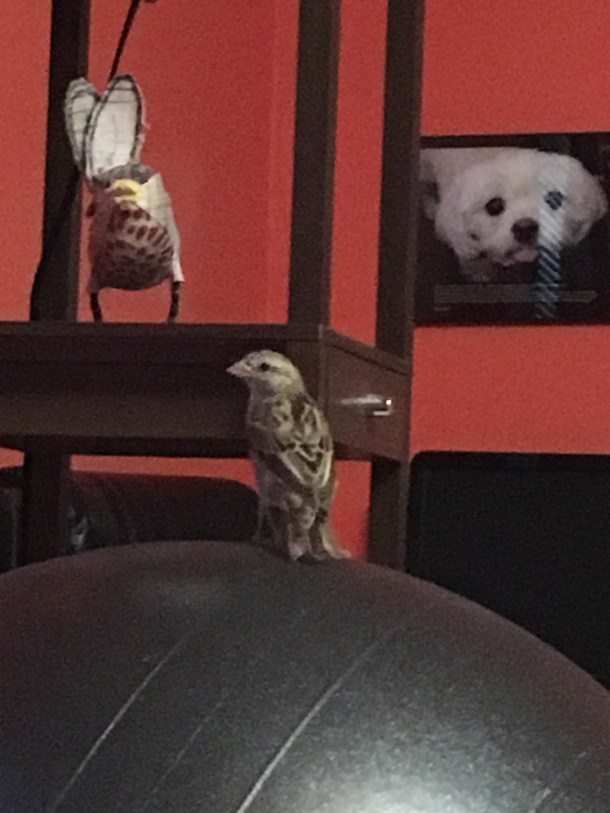
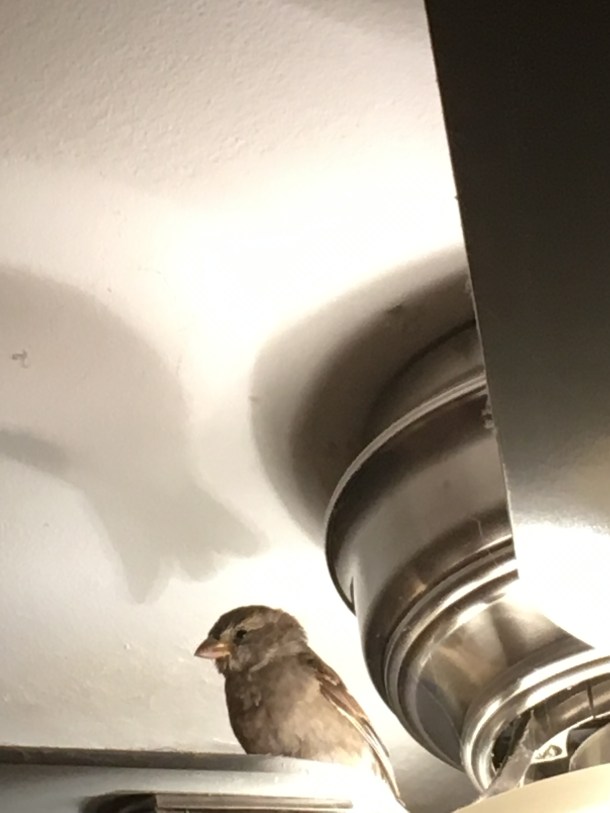
I, of course, took pictures of her flying around the apartment, from light fixture to curtain rod to picture frame, thinking she would be leaving at any moment. And when I left to pick up Mom from the train (she’d been out quilting with friends for the day), I was sure the bird would be gone when we returned. But she was still there, and Mom said that she was a (female) house sparrow, based on her size and markings.

We put a few pieces of challah on the window sill in the living room, to show her the way back outside, but the bird picked up each piece of bread and flew it to her safe place (a wooden loom on top of Mom’s bookcase) and ate in peace. Then she took a nap, head curled into her neck, half hidden behind the living room curtain.

sparrow sleeping cropped

Sleeping birdie.

We were sure she would be gone by morning, after her meal and a long nap indoors, but she woke me up at seven thirty the next morning with a big squawk. She had ventured out of the living room at some point and found her way into my room. And decided she needed company; and that her company should be awake.

sparrow with stuffed animals

“Something is very wrong with these animals.”

When we all decamped to the living room for breakfast, and the CBS Sunday morning show (Mom watches the whole show just to see the moment of nature at the end), the bird followed. She was very entertaining. She flew back and forth from the kitchen to the dining room to the living room, doing her own version of dog zoomies. She shared Mom’s breakfast (Mom got a picture of the bird eating challah on the kitchen counter), and pooped in all kinds of new places.

IMG_1268

“Don’t poop on me, Birdie.”

Later, the bird even followed me into the bathroom when I went to take a shower (I didn’t notice she was there until too late, but she was kind enough to wait for me on top of the medicine cabinet instead of hanging out in the shower with me. Small favors). Cricket was waiting right outside the bathroom door afterward, horrified.

IMG_0930

“Aaaaack!!!”

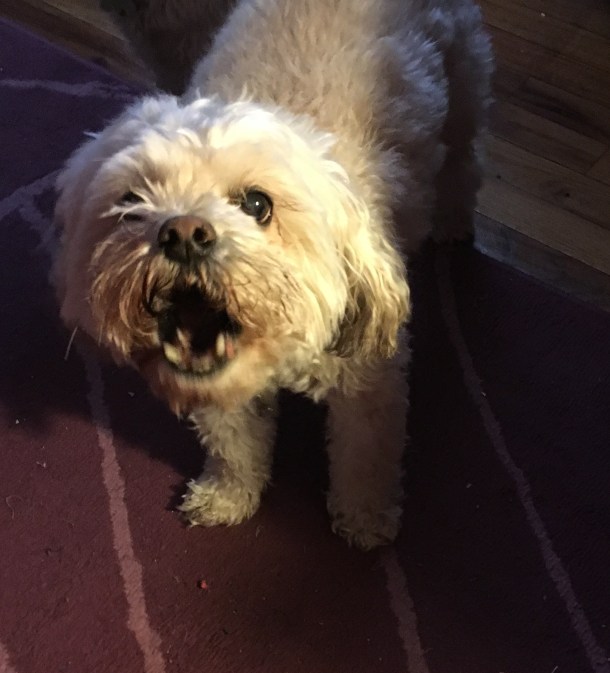
By the thirtieth hour of the bird’s visit, Mom was getting worried. She’d reached out to her cyber community and was reminded of the health risks of having a wild bird in the house, because of the poop she seemed to drop any and everywhere. So we removed all traces of food from the kitchen counters, and even got rid of the bread for the outdoor birds. But the bird decided to try the kibble left in the dogs’ bowls, and then she checked the living room floor for any crumbs the dogs might have left behind. Cricket started to notice the invasion at that point, because it was one thing to have a bird flying around in the light fixtures, but something completely different to have a bird calmly walking along the floor, trying to share her food. Cricket’s food is sacrosanct, just ask Ellie.

281

“It’s true.”

IMG_1272

“Now where did that fluffy monster hide the treats?”

When it was time to go to sleep for the night, the bird set herself up on her wooden loom again, and she was still there the next morning, though she was kind enough not to wake me up this time. I do prefer to sleep as late as I can.

IMG_1280

Butterfly watching over Birdie’s meeting with Canada bird.

I was seconds away from naming her (Tzippy, short for Tzipporah, Hebrew for female bird) when the bird finally left. Mom plugged the hole next to the air conditioner with a tissue, to discourage her from coming back in, but the bird seemed to have finished her visit by then and didn’t return. There had been a lot of extra squawking outside the windows that morning, maybe from her family or friends, telling her that she needed to come back out to the real world.


The depression I felt after the bird left was pervasive. I felt like we’d exiled her. Yes, she pooped everywhere, and didn’t clean up after herself; and yes, she woke me up too early in the morning; and yes, Cricket was getting annoyed with her. But she made me feel special, just by being there. She made me feel chosen.

There’s a moment in the prayer service at my synagogue where we put our arms around each other to say the Priestly Blessing, as a way to celebrate family and community ties. It took me a few years to get used to all of the touching and closeness involved in that blessing, but for the forty-some-odd hours while the bird was staying with us, I felt like she was holding out her wings to be included in our little family group: singing the blessing with us, arm in arm.

And I felt blessed, and full of awe. We focus so much on self-examination and looking for the sins we need to atone for during the High Holiday season, but the bird reminded me that sometimes there’s nothing to atone for. Sometimes your assessment can tell you that you are on track and you are loved, and that you deserve the visit of a little bird to remind you that every day can be full of awe, if you pay attention.

IMG_1247

Bye bye Birdie.


If you haven’t had a chance yet, please check out my Young Adult novel, Yeshiva Girl, on Amazon. And if you feel called to write a review of the book, on Amazon, or anywhere else, I’d be honored.

Yeshiva Girl is about a Jewish teenager on Long Island, named Isabel, though her father calls her Jezebel. Her father has been accused of inappropriate sexual behavior with one of his students, which he denies, but Izzy implicitly believes it’s true. As a result of his problems, her father sends her to a co-ed Orthodox yeshiva for tenth grade, out of the blue, and Izzy and her mother can’t figure out how to prevent it. At Yeshiva, though, Izzy finds that religious people are much more complicated than she had expected. Some, like her father, may use religion as a place to hide, but others search for and find comfort, and community, and even enlightenment. The question is, what will Izzy find?



A Greek Orthodox Funeral


A few weeks ago, I went to a funeral at a Greek Orthodox Church. The death was expected, though still sad. I’d kept in touch with one of my clients (from my senior center internship), visiting and calling her on a regular basis for the past two years. She had been actively dying for at least fifteen years (from cancer), and inspiring everyone with her persistence and her capacity to live fully within her limitations. But for the last year, things were slowly coming to an end and we talked our way through it together; coming to peace with her death, as much as that’s possible.

The funeral was open casket. Jewish funerals are, traditionally, closed casket, so this was not something I was really prepared for. Even from my seat six rows back, I could see her head clearly (they cranked up the bottom of the casket, with an actual crank, to make her visible during the funeral, and then cranked her back down at the end so they could close the lid). I think I was the only one in the room who didn’t go up to talk to her. They had dyed her hair, and put on makeup, so she looked sort of alive, but not really like herself.

The only people I knew at the funeral were from the senior center, and a few family members; everyone else was a picture I’d seen, or a story I’d been told (she was a great story teller). She told me, often, that I should write her life story for her, and I told her, just as often, that I wanted her to write it for herself. But she never did. I know there are rules about this in the social work code of ethics (avoiding dual relationships), but also just for me, writing her stories would have felt like stealing.

I didn’t start crying until the eulogies started. The director of the senior center talked about my former client as if she was right there in the room (she was!), and I used up all of my tissues within minutes, and had to reuse them, until I was basically wiping my face with snot (don’t judge me, I was desperate).

281

The saving grace was the distraction of the Greek orthodox rituals. I could focus on my curiosity and hold the grief at bay, just a little bit. The sanctuary had a domed ceiling, and gold painted apostles on the walls, and hidden doors where the gofer (I’m sure there’s a more dignified title for him, but I don’t know it) would sneak in and hand one of the clergymen something they needed. One clergyman was dressed in all black and stood in front of three microphones. The other one wore dramatic white robes, with an overlaid floor length scarf, and had a microphone attached to his head so he could walk through the room and swing incense around the coffin and down the aisle.

They both kept talking about how my former client had “gone to sleep” (at least in the English, I can’t tell you what they said in Greek or Latin). And with the raised pillows, and the hair and makeup, you could almost believe she really was just sleeping. The fact is, she would have loved to have been there, just to hear what people were saying about her, and of course, to critique all of the performances.

IMG_0238

As they wheeled her (now closed) coffin out of the building, the crowd followed her out through two enormous steel doors into the fresh air. Everything about the setting was so dramatic and impressive. She would have loved that.

I knew she was ready to die, and that her body had been ready for even longer than her spirit, and I was relieved for her when the end came. But she took up such a big space in my heart – as one of my first clients as a social work intern, but also as a friend. And I miss her.

Cricket and her special friend 001

It was a hard day. I sat with my former supervisor afterwards, both of us trying to absorb the loss and put it into some kind of safe, protected place where it wouldn’t leak out into the rest of our lives. But grief doesn’t really work that way. I remember everything: the times when my client was heartbroken, and enraged, and confused, and as lost as a child. The times when I couldn’t wait to see her, and couldn’t stop laughing, and the times when she cut me so deep I could barely breathe.

The idea that social workers can have a full caseload of clients and not be impacted by them, and not care about them, or miss them, or hate them, or love them – is crazy. We’re human. Yes, we have to choose how to behave, given those feelings, and follow our codes of ethics as far as we can, to make sure we are doing no harm, but the connections are real.

295

My former supervisor goes to a lot of funerals. That’s what happens when you work with seniors as your life’s work (and maybe why I’m reluctant to follow her down that path, even though I really like the population). You meet people and make connections and do as much as you can to help them, and then, often, you watch as they slip away. Seniors are just as complicated and troubled as everyone else, but maybe more so because they are usually more aware of death, and sometimes that makes them angry, or depressed, or desperate to fit as much as possible into each day, and it can be hard to live up to their needs and expectations.

The funeral did what it was supposed to do: it let me grieve, and it let me say goodbye. But I feel sad that I never wrote my client’s stories down. Even in my progress notes, I didn’t quite capture her voice, and that feels like a loss. For me, for everyone who didn’t get to meet her, and for everyone who did. But I will always remember her, and that’s a good thing.

032

If you haven’t had a chance yet, please check out my Young Adult novel, Yeshiva Girl, on Amazon. And if you feel called to write a review of the book, on Amazon, or anywhere else, I’d be honored.

Yeshiva Girl is about a Jewish teenager on Long Island, named Isabel, though her father calls her Jezebel. Her father has been accused of inappropriate sexual behavior with one of his students, which he denies, but Izzy implicitly believes it’s true. As a result of his problems, her father sends her to a co-ed Orthodox yeshiva for tenth grade, out of the blue, and Izzy and her mother can’t figure out how to prevent it. At Yeshiva, though, Izzy finds that religious people are much more complicated than she had expected. Some, like her father, may use religion as a place to hide, but others search for and find comfort, and community, and even enlightenment. The question is, what will Izzy find?


I Seem To Be a Teacher


The same week that I started teaching at synagogue school, I also ran a writing workshop on blessings at my synagogue. The combination allowed me to see very clearly how much easier it is to teach adults, and how much trouble I seem to have gotten myself into.

Things were a bit chaotic on the first day of synagogue school, because we only had partial class lists (most families register late, but the kids show up on the first day anyway), and the building was still a construction site, and, oh yeah, I’d never done anything like this before in my life!

It’s important to say that afterschool synagogue school is a unique set of circumstances: even the most well-behaved kids hit four o’clock and lose their minds; they can’t sit still; they have an enormous amount to say after keeping quiet most of the day; and they don’t really have room in their brains to fit in any more information. Desks are for climbing, other children are for bothering, and there’s a competition for who can say the nastiest things to the teacher – which would be me. It’s a joy!

I drove home after my first two hours of teaching in a state of shock. I felt like I’d been hit by a truck. On top of the chaos, the classroom was too warm, and early on, I realized I would not be one of those teachers who stands the entire time. But I didn’t vomit or faint, so that was a plus.

257

The girls were vicariously exhausted.

And, despite some rough spots, I actually did some real teaching (I know, because without realizing it the kids repeated things I’d said in week one when they came back for week two. They would be horrified to know this, so don’t tell them). The second day with the kids went much better than the first. We even came up with some ways to manage their extra energy: like standing behind their desks when they couldn’t sit still anymore, dance breaks, and even a little bit of Pachelbel Canon in D (“Ugh! Classical music!”), helped them get through it.

The blessings workshop, with the adults, two days later, was like a walk in the park on a cool day compared to synagogue school. We had ten people around the table, and everyone participated, and shared their blessings, and listened to everyone else with interest. The workshop was based on a post I did on the blog a few months ago (or the post was based on the work I was doing to build the workshop), with prompts for different categories of blessings, and an overall intention to help empower people to trust their own voices along with the voices of tradition. It went well enough that now I have to prepare for a new workshop on blessings leading up to Passover. I have six months, so I’m not too worried, yet.

281

“I’m worried for you.”

The thing is, the one career I was sure I didn’t want was teaching. It’s not that I expected to be bad at it, exactly. No, the real problem was that my father was a teacher, and I was afraid to be anything like him; or accused of being like him. My father was accused, multiple times, of inappropriate sexual contact with his students, so the idea of teaching and of going to jail seemed tied together in my mind from very early on. When people told me to get a PhD, in something, and become a professor, or teach writing after I got my MFA, I said no. I was too scared. What if I was accused of hurting someone? What if I actually hurt someone? What if I said the wrong thing? Or failed to be a good enough teacher? In my mind, I could go to jail for boring my students, or raising my voice, or just being in a bad mood, because my father’s paranoid ramblings at the dinner table suggested that that’s the kind of thing he’d done wrong, if anything. Even after I understood that my father was truly guilty of a crime, and had caused real harm to his students, I couldn’t uncross the wires in my brain around teaching.

Unfortunately, I never had a chance to see my grandfather in the classroom. He taught high school Consumer Education, and was the principal of an afterschool Hebrew school, but he died at age eighty, when I was eight years old, and he wasn’t in good health for the last years of his life, so his teaching was just a story I was told, not an experience I could draw from.

And yet, people kept telling me I’d make a good teacher, or even assumed that I already was a teacher (I’m something of a know it all), and I couldn’t shake the idea that this was the path not taken. When the chance to teach synagogue school came up a lot of internal bells started ringing, telling me that I had to at least try.

The dogs have offered to help me test out some of my ideas, and they keep reminding me that chicken treats are great motivators and that leashes are very reassuring (though I’m pretty sure that wisdom won’t translate especially well to human children). On the other hand, they are great at comforting and distracting me when I get home. They’ve always been wonderful at reminding me that I am loved.

249

“I love you, Mommy!”

244

Cricket is thinking about it.

I’m still overwhelmed with too many ideas for what to teach, and how to teach it, and I can’t fit even a quarter of my ideas into my actual classes. And I’m still comparing myself too much with other teachers, and feeling less than. But I am, slowly, developing more realistic expectations of myself. It will take some time to learn about classroom management, and how to not take the kids’ comments personally. But for now I seem to be teaching, and sometimes even enjoying it. And, maybe someday, I might even be good at it.

067

“Really?”


If you haven’t had a chance yet, please check out my Young Adult novel, Yeshiva Girl, on Amazon. And if you feel called to write a review of the book, on Amazon, or anywhere else, I’d be honored.

Yeshiva Girl is about a Jewish teenager on Long Island, named Isabel, though her father calls her Jezebel. Her father has been accused of inappropriate sexual behavior with one of his students, which he denies, but Izzy implicitly believes it’s true. As a result of his problems, her father sends her to a co-ed Orthodox yeshiva for tenth grade, out of the blue, and Izzy and her mother can’t figure out how to prevent it. At Yeshiva, though, Izzy finds that religious people are much more complicated than she had expected. Some, like her father, may use religion as a place to hide, but others search for and find comfort, and community, and even enlightenment. The question is, what will Izzy find?



A Summer of Singing


At the first official choir rehearsal for the Jewish High Holidays (Rosh Hashanah and Yom Kippur, starting Sunday night, September 29th), I received a loose-leaf full of music from the choir director. Most of the other choir members have been there for years (some for over thirty years), so while they mostly had to show up at rehearsals and sing, I had to take my loose-leaf home and study. Even the songs I thought I knew had to be relearned, because I was used to singing the melody with the congregation, and now I was singing the harmony with the other altos.

IMG_1035

“Do you really have to sing that again?”

The music kept repeating in my head all summer long. I knew my brain was doing this to be helpful, so that I could learn what I needed to learn in a hurry, but it meant that I was drowning in melancholy music for months. I couldn’t even escape it while I was sleeping.

The dogs are probably sick of hearing about repentance and atonement, but they seemed to like finally being able to participate in synagogue services, in their own way, in their own home. When the summer rehearsals started, I spent a lot of time being mute and grumpy, because I couldn’t sing along. But after months of studying I’ve learned most of the songs, and even figured out how not to be completely distracted by the other voices around me.

img_0510

Except for Cricket’s voice. That still distracts me.

Starting in September we had choir rehearsals once a week, and by then I knew most of the music, though some things were still beyond me, especially the songs where the altos just sing the oohs and ahhs in the background (it’s so hard to learn the music without words to hang the notes on!). There are a few pieces of music that still confound me, especially one that requires us to sing ten notes on one word, over and over again. I get three notes in and then shut my mouth and wait.

249

“I’ll sing for you, Mommy!”

Unfortunately, no one seems to have noticed all of the progress I’ve made, even though I make a point of singing out when I know what I’m doing. Maybe they think it was as easy for me to learn all of the music, or they forgot that I’m new to the choir altogether. I was kind of hoping for some praise; you now, gold star stickers to put on my loose-leaf, something like that. Maybe someday.

One very lucky break is that our temporary conductor is one of the altos, so she has been able to help us out with finding notes and some much needed attention. She also has her own interpretive dance style of conducting that’s really easy to follow, so that even when I’m looking down at the music and can only see out of the corner of my eye, I can understand what she’s telling us.

54 - wow, what's next

“I bet I could lead a choir!”

For the High Holidays, the choir will be sitting on a raised platform, in our newly redone sanctuary, and I am not looking forward to that. I’m used to being mostly invisible in the crowd at the high holidays, able to be grumpy or tired or whatever I am in relative obscurity. But this year I will be on public view, so I may have to put on a happy – or at least normal – face. This is also when I start to wish I’d lost more weight already, and bought a whole new wardrobe, and maybe had plastic surgery, because otherwise I just look like me. We don’t even get to wear robes to hide behind.

The biggest downside of being in the choir is that I can’t sit with Mom during the services. Hopefully she’ll be able to sit near the choir area, so that I can roll my eyes at her discreetly during the services. I think it might be frowned upon if I actually took out my cellphone to text my ongoing commentary during the services, but it might come to that. I mean, these are long services, and I have a lot to say!

017

“Do you? We never noticed.”

I’ve made some friends among the altos, though, so I should be able to nudge someone and whisper when something especially ridiculous happens. Which, of course, it will. With a new sound system, and echoing acoustics, and everyone stuffed together in one big room trying to express all of the repentance and atonement and misplaced guilt of a whole year, laughing fits are inevitable.

I wish you all a Shana Tovah U’Metukah (a good and sweet new year) with as much laughter as possible!

Happy New Year!

295


If you haven’t had a chance yet, please check out my Young Adult novel, Yeshiva Girl, on Amazon. And if you feel called to write a review of the book, on Amazon, or anywhere else, I’d be honored.

Yeshiva Girl is about a Jewish teenager on Long Island, named Isabel, though her father calls her Jezebel. Her father has been accused of inappropriate sexual behavior with one of his students, which he denies, but Izzy implicitly believes it’s true. As a result of his problems, her father sends her to a co-ed Orthodox yeshiva for tenth grade, out of the blue, and Izzy and her mother can’t figure out how to prevent it. At Yeshiva, though, Izzy finds that religious people are much more complicated than she had expected. Some, like her father, may use religion as a place to hide, but others search for and find comfort, and community, and even enlightenment. The question is, what will Izzy find?



Bird Blogger


I spend a good portion of time each week exploring blog posts on WordPress. I start by going through the sites I follow on my Reader, and then, if I have time, I check in with the posts in different categories, like dogs, birds, memoir, knitting, recipes, etc. Part of it is just simple outreach, looking for other bloggers who might be interested in what I’m writing too, but a lot of it is an endless curiosity about other people.

017

“What about us?”

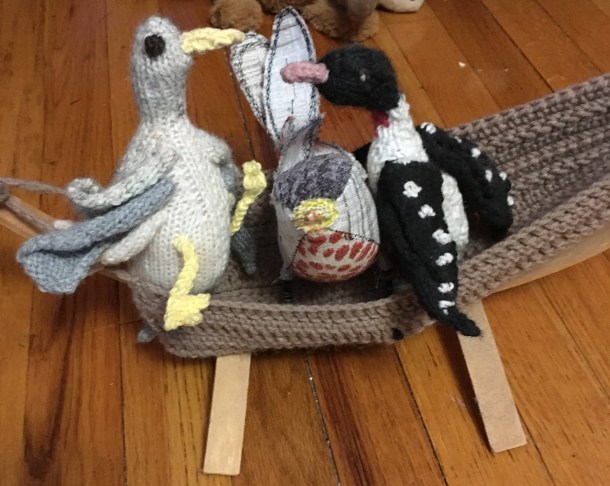
So when I came across a blog post that promised pictures of crafty handmade birds for the next thirty days, I decided to keep an eye on it. The blogger was sewing these elaborate stuffed birds, each with their own colorful personality, and I was charmed. After a while, out of the blue, I heard from the blogger herself, thanking me for my support and offering to make a bird just for me.

I was shocked! All I’d done was press like a few times, but her email reminded me that the small acts we do each day can have much bigger meaning in the world than we realize. I know that I have been impacted in big and small ways by the things other people have done, like smiling at me in the supermarket, or commenting on one of my blog posts, or posting a picture that breaks my heart or makes me laugh or just reminds me that I am not alone. We do these things every day, thinking we are such small actors in the world and it’s only meaningful to us, but I’m starting to realize that I can’t know what my impact on other people might be. And impacting even one person, even in a small way, feels wonderful!

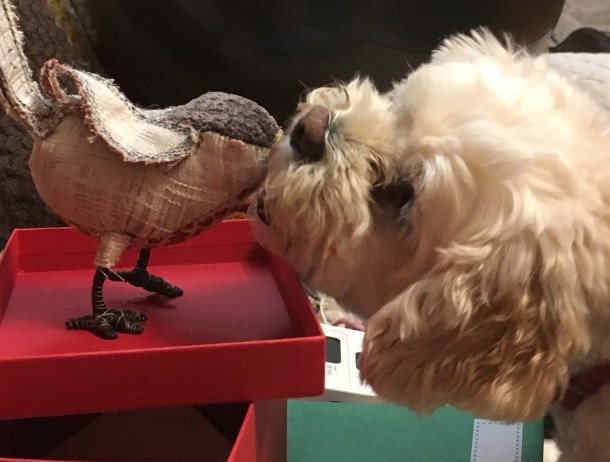
My beautiful bird arrived last week and she has been acclimating to her new environment, and new housemates. Cricket and Ellie were fascinated by the look and smell (and taste) of her, so she flew back into her box for a little while until they calmed down. My bird’s creator is Susan Fae Haglund, by the way, and she’s on Instagram and WordPress and Etsy too, so please look out for her work.

bird

“Hello everybody!”

bird-and-ellie.jpg

Ellie is trying to say hello.

Cricket and bird

Cricket really likes the new bird in the house.

When I first started this blog I thought it was something I was supposed to do, to build my “platform” as a writer, but it has become something I need to do for myself, to feel connected to people who matter to me. The majority of the book sales for Yeshiva Girl have come through the blog and I feel endlessly grateful for that. I want all of you to know that every blog I follow has made an impact on me, and made my world bigger and brighter than I could have hoped.

Thank you!

birds-2.jpg

The new bird is fitting in with the older guys.

birds-and-lamb.jpg

Even Lambie’s on board!


If you haven’t had a chance yet, please check out my Young Adult novel, Yeshiva Girl, on Amazon. And if you feel called to write a review of the book, on Amazon, or anywhere else, I’d be honored.

Yeshiva Girl is about a Jewish teenager on Long Island, named Isabel, though her father calls her Jezebel. Her father has been accused of inappropriate sexual behavior with one of his students, which he denies, but Izzy implicitly believes it’s true. As a result of his problems, her father sends her to a co-ed Orthodox yeshiva for tenth grade, out of the blue, and Izzy and her mother can’t figure out how to prevent it. At Yeshiva, though, Izzy finds that religious people are much more complicated than she had expected. Some, like her father, may use religion as a place to hide, but others search for and find comfort, and community, and even enlightenment. The question is, what will Izzy find?



Using Yousician


I came across a music learning app called Yousician during my adventures with Duolingo (the language learning app). Yousician has a free version, with lots of ads, just like Duolingo, so I decided to try it out and see if it would help me make more progress with learning to play my ukulele.

017

The first few lessons on the app were too easy, because I’d done the heavy lifting of learning the beginner stuff on my own, but now I’m getting to tasks that are harder for me to do – like switching from string to string or chord to chord quickly enough to keep up with the song. When I was working with my lesson books, I could play each song at whatever speed I liked, but Yousician is strict about timing, so I started to miss notes, a lot of them. Then I discovered the option to practice at slower speeds, until I could build up to regular speed without making so many mistakes. It kind of feels like doing musical aerobics, and I need to do it, because on my own I wouldn’t push myself enough. I was never, ever, going to buy a metronome. I still have metronome nightmares from my childhood piano lessons. That tick tock, tick tock thing is sinister!

IMG_0238

It really is obnoxious.

One of the other difficulties for me on the Yousician app is that instead of using musical notation, they use a form of tablature, telling me which fret to play, on which string, but not naming the note or giving the note a time value, like half or quarter note. It’s taking me a while to get used to this new system, and I still make sure to practice with my lesson books regularly, so I won’t lose the progress I’ve already made.

The Yousician exercises remind me of the first video game I ever had, for my brother’s TRS 80, called Typing Tutor. I loved to play it over and over, building speed and high scores, though I’m not sure it ever improved my overall typing ability. I became an expert at manipulating the ASDF keys, but how many essays are written with only four letters? Especially those four?

I’m still uneasy with the ukulele, just like I was with the guitar, and the piano. I’d like to believe that the ukulele and I will be good friends eventually, but we’re still getting used to each other’s quirks and limitations. I keep expecting the instrument to tell me all of its secrets, and suddenly make music, without much help from me. It’s possible that I have unreasonable expectations.

281

“You? Unreasonable expectations? Never.”

The dogs have accepted the Yousician app with the same long suffering patience as they accepted the ukulele practice overall, though it does wake them up sometimes from their naps and remind them that they really need to pee. They think I need another app to teach me how to take them for more walks each day, and to stop doing so many uninteresting things that prevent me from giving them all of the attention, and all of the chicken, they want. I don’t know, though. I think they do a good enough job teaching me how to do their bidding as it is.

IMG_1068

“Chicken treats?”

IMG_1077

I have mind control powers. Look into my eyes.


If you haven’t had a chance yet, please check out my Amazon page and consider ordering the Kindle or Paperback version (or both!) of Yeshiva Girl. And if you feel called to write a review of the book on Amazon, or anywhere else, I’d be honored.

Yeshiva Girl is about a Jewish teenager on Long Island, named Izzy. Her father has been accused of inappropriate sexual behavior with one of his students, which he denies, but Izzy implicitly believes it’s true. Izzy’s father then sends her to a co-ed Orthodox yeshiva for tenth grade, out of the blue, as if she’s the one who needs to be fixed. Izzy, in pain and looking for people she can trust, finds that religious people are much more complicated than she had expected. Some, like her father, may use religion as a place to hide, but others search for and find comfort, and community, and even enlightenment. The question is, what will Izzy find?
 

A Pawpaw Forest


Earlier this summer I wrote about my excitement when my two twelve-year-old Pawpaw trees flowered and seemed ready to fruit, and then I wrote about my grief when one of the Pawpaw trees was cut down by the co-op’s hired gardeners. Well, recently, when Mom was examining the stump of the dead Pawpaw tree, where she had set up one of her experiments to encourage new growth, she happened to look two feet further along the retaining wall and saw what looked like Pawpaw leaves dangling over the side. She examined them closely, comparing the leaves to the healthy Pawpaw leaves on the surviving tree about fifty feet away, and they looked very much the same. How odd!

002


The possible Pawpaw leaves were hanging from two stand-alone stems, half green and half brown, and wobbly from very recent growth. We had not planted new Pawpaw seeds, or even noticed any random Pawpaw trees planting themselves under the mass of other trees and bushes in the retaining wall, but there they were, as tall as the two year old trees that we’d had shipped to us a few years ago (unsuccessfully). But it just seemed so unlikely, to me, that new Pawpaw trees could have planted themselves right there, without any help, and just when we really needed them.

006

Mom brought me outside to examine the leaves for myself, and even let me pick one of the leaves to bring over to the big Pawpaw tree to compare. But I still felt skeptical, because that’s my automatic response to most things. It can’t be true, especially if I want it to be true. Mom was, and is always, more trusting. She pointed out the unique quilting design on the leaves, unlike any other leaves nearby, and the shine on the baby leaves, which I’d seen many times myself when our Pawpaws came back to life each spring.

003

A few days later, Mom went back to the same spot, to make sure the Pawpaw plants were still there, and not just a mirage made out of grief, and she found another, much smaller, Pawpaw sapling, maybe just a few weeks old. And she kept going back, and searching more carefully, and finding more Pawpaws. I still wasn’t convinced though. It seemed too much like the universe looking out for me.

010

It never occurred to me that my trees would try to re-create themselves. I thought, actually, that Mom and I would put in endless years of effort for no real reward, because that’s how my life has always seemed to me. But I think I might be wrong this time. We still have new-growth devices on three branches of the existing Pawpaw tree, and the makeshift device on the Pawpaw stump, and if these previously hidden little trees are real Pawpaws, then we are on our way to having a Pawpaw forest in the yard to replace the one tree that was cut down by the gardeners. And we still have a Pawpaw tree coming next spring, as a peace offering form the gardening company.

004

The Papa Pawpaw

We’ll have to replant the saplings in different parts of the yard, where they will each have sunlight and space to spread out, to give them a real chance to survive. But it seems miraculous already, that they even exist. There’s a metaphor in all of this, or too many metaphors to count, but here’s hoping the hidden Pawpaws are a sign of good things to come in the next year.


001

Ellie’s ready for some gardening!

IMG_1860

Cricket is already digging!

If you haven’t had a chance yet, please check out my Young Adult novel, Yeshiva Girl, on Amazon. And if you feel called to write a review of the book, on Amazon, or anywhere else, I’d be honored.

Yeshiva Girl is about a Jewish teenager on Long Island, named Isabel, though her father calls her Jezebel. Her father has been accused of inappropriate sexual behavior with one of his students, which he denies, but Izzy implicitly believes it’s true. As a result of his problems, her father sends her to a co-ed Orthodox yeshiva for tenth grade, out of the blue, and Izzy and her mother can’t figure out how to prevent it. At Yeshiva, though, Izzy finds that religious people are much more complicated than she had expected. Some, like her father, may use religion as a place to hide, but others search for and find comfort, and community, and even enlightenment. The question is, what will Izzy find?


The Last Summer at Camp


During my last summer at sleep away camp, at age thirteen, we had a strange outbreak of mosquitoes. We weren’t allowed to go in the lake for two weeks, and the mosquitoes were in pretty much every breath of air we breathed. I don’t know if it was an early case of West Nile Virus or something else they didn’t bother to explain, but I had to sleep in jeans and a sweatshirt, in ninety degree weather, to try to keep the mosquitoes at bay.

IMG_0887

“That sounds bad. I’m worried about this story.”

It was already a very, very bad summer for me. I’d begged to stay home, or better yet, go to California. I had this idea about California that wasn’t based on anything I can remember, except that it wasn’t home. I think my best friend at the time had been talking a lot about going to California for some reason, and she either went to California, or to Israel that summer, to visit family.

IMG_0917

“Oy. It’s getting worse.”

I was deeply depressed, irritable, anxious, and uncomfortable 24 hours a day. I’d lost weight (this was pre-anorexia, so I was normal thin, not skinny yet), and had some pretty outfits, and I’d assumed this would make me happy, but it actually made things worse.

Sex was everywhere in camp. There were a lot of rape accusations (all true as far as I could tell, but not taken seriously by the counselors, who were eighteen and nineteen years old, or the administration, who had no excuse). There was a lot of dating and flirting and coupling. I would not have been able to tell you why it was all so awful to me at the time. I couldn’t explain why I felt so thoroughly under attack. I’d had some memories of the sexual abuse by then, in vague images and awful feelings, but I didn’t know what it was, or what to do with it.

My parents came up on visiting day and I was sure they were going to take me home, but instead, my father announced that they were going to Israel in a few days and wouldn’t be back until it was time for me to come home from camp. And I couldn’t go with them. I screamed and cried and he took a picture of me, inconsolable (he framed it and put it up in the downstairs hallway in our house, where it stayed for years).

067

“Told ya.”

After the mosquito drama, or before it maybe (time was confusing that summer), the counselors took my age group on an overnight campout on a hill. It was coed, with the counselors down at the bottom of the hill, out of ear shot. None of this had been made clear ahead of time. There was at least one rape that night, but I only knew about it because it happened to a friend of mine. I have no idea what else happened, but we were a group of thirteen year old boys and girls without supervision, so I can guess. Someone stepped on my hand in the middle of the night, and no one seemed to notice when I screamed.

No one listened when I ranted about the campout for the next few days, because everyone else seemed to think that a coed sleepover for thirteen-year-olds was totally fine. I was the prude and the hysteric. And the fact is, I couldn’t explain why I was so angry about it when no one else had a word to say, except for the girls who whispered in my ear about rape, on the hill, and on other days and at other times, but refused to go to the administration, or to let me go for them.

None of the rapes, or attempted rapes, happened to me. I barely even touched a boy all summer. But the lack of concern from the adults enraged me. The counselors suggested that my problem was that I was too mature for my age group, and that was why I was so uncomfortable. My opinion was that I needed to walk home from camp, even if it took the rest of the summer. But I was too afraid, and had no money, and that made me feel powerless.


When a twelve-year-old girl was sent home because she had accused two boys of forcing her to give them blow jobs – and no one believed her, because, How can you force someone to give a blow job, really it’s the boys who were raped – I realized I was never going back to that camp.

And it was a terrible loss. The thing is, I’d never really been safe anywhere else. I was sexually abused at home and at my childhood best friend’s house. I was bullied at school. Camp was the one place that felt normal, where I could work through the kinds of painful experiences that everyone else had to go through too. It wasn’t a great joy, but it was a place where I had learned how to make friends, and set boundaries, and argue, and swim. But once sex became an issue, for me and for my peers, camp was no longer safe for me, with my abuse history. Maybe if they’d had better policies in place for how to handle problematic behaviors, or if the counselors were better trained, or if the adults had taken on more of an oversight role, things would have been different. But maybe not.

032

“I’m sorry, Mommy.”

Usually Mom drove to camp to pick me up at the end of the summer, but this time she arranged for me to go home with another Mom from our area and two of her daughters, because of her late return from Israel with my father. I felt really sick to my stomach on the drive, but I didn’t know the Mom or the girls well enough to say anything. When I finally got home I ran upstairs and barely made it to the bathroom in time, throwing up in the sink. I kept throwing up for the next two days, and by the time school started a week and a half later, I wasn’t eating much at all. My body felt like it had been filled with poison, and I didn’t want to risk adding more. Within weeks I was basically anorexic, and that seemed to help keep the poison at bay. By then I didn’t just want to be skinny anymore, I wanted to be invisible.


51WewBFUZ5L._AC_US218_

If you haven’t had a chance yet, please check out my Amazon page and consider ordering the Kindle or Paperback version (or both!) of Yeshiva Girl. And if you feel called to write a review of the book on Amazon, or anywhere else, I’d be honored.

Yeshiva Girl is about a Jewish girl on Long Island named Izzy. Her father has been accused of inappropriate sexual behavior with one of his students, which he denies, but Izzy implicitly believes is true. Izzy’s father decides to send her to a co-ed Orthodox yeshiva for tenth grade, out of the blue, as if she’s the one who needs to be fixed. Izzy, in pain and looking for people she can trust, finds that religious people are much more complicated than she had expected. Some, like her father, may use religion as a place to hide, but others search for and find comfort, and community, and even enlightenment. The question is, what will Izzy find?


Cricket Bites


Cricket is a biter. She has been a biter since she was a puppy, and now that she’s 12 years old, I don’t see it changing. We were warned that Cockapoos could bite – though the warning came after Cricket came home from the breeder, and from an unreliable source, so, not especially helpful.

puppy in November 010

She ate most of this pumpkin before we knew what was happening.

Cricket bites when she’s scared, angry, overexcited, etc. She resents any attempt to brush, comb, or clean her hair (though groomers have been able to do it, when she’s medicated). For her first two years, I worked hard at trying to condition Cricket to grooming at home. It was a long ritual, with lots of chicken treats and very gradual steps, and it was never, ever successful.

puppy in November 001

“You’re killing me, Mommy.”

puppy in November 039.jpg

“I kill you back!”

When the groomer left a small mat on one of Cricket’s ears, during a grooming visit a few months ago, I got nervous, because Cricket has very cottony hair, prone to knotting up if we’re not careful. I even took out the round-edged scissors to try to remove the small mat before it could grow. Cricket didn’t appreciate that, of course, and I decided to keep my fingers for a while longer. That meant that, at her most recent grooming, after the mat had grown and spread to both ears and her face, Cricket faced the indignity of being shaved down to the nubs. Her head is surprisingly small without all of the fluff, and she looked a bit like a tiny alpaca, with her naked ears and prominent nose, and big, wide open eyes.

IMG_1066

Escaping from the groomer’s house!


The thing is, at this point, I’m done battling with her about her hair. I’m done risking life and limb to save her from another bad haircut, that she will, of course, blame on me. She is a senior citizen in the dog world, and this is the best she’s going to be. I may have better luck cleaning her up once she loses a few more teeth, though. That’s something to look forward to, and since she has resisted every attempt at tooth brushing, with every kind of special doggy toothbrush and chicken flavored toothpaste, she won’t keep all those sharp little teeth forever.

anger

The immediate problem is that she has convinced Ellie that any attempts at home grooming are the equivalent of death threats, and Ellie has fluffy ears and a long fluffy tail that need regular combing to avoid mats. Ellie doesn’t bite, Thank God, but she does run away from me, or give me those puppy dog eyes that seem to say, Mommy, why are you hurting me? Aren’t I a good girl? Which really is worse than a dog bite in terms of long lasting damage to the soul.

032

“Cricket says you’re trying to kill me.”

I think we need to come up with something like a miniature carwash for dogs, where the dog is harnessed in and washed and brushed and dried without any human fingers put at risk. I mean, sure, the actual haircut would still have to be done by professional, but in between, the carwash could keep the girls from smelling like pee, and covering their faces with snot. And, I would be able to keep all of my fingers. Wouldn’t that be great?

004

“No, Mommy. I don’t think so.”

003

The poor miniature alpaca doesn’t think so either


If you haven’t had a chance yet, please check out my Amazon page and consider ordering the Kindle or Paperback version (or both!) of Yeshiva Girl. And if you feel called to write a review of the book on Amazon, or anywhere else, I’d be honored.

Yeshiva Girl is about a Jewish girl on Long Island named Izzy. Her father has been accused of inappropriate sexual behavior with one of his students, which he denies, but Izzy implicitly believes is true. Izzy’s father decides to send her to a co-ed Orthodox yeshiva for tenth grade, out of the blue, as if she’s the one who needs to be fixed. Izzy, in pain and looking for people she can trust, finds that religious people are much more complicated than she had expected. Some, like her father, may use religion as a place to hide, but others search for and find comfort, and community, and even enlightenment. The question is, what will Izzy find?

Ellie’s Magic Carpet


For a year now, Ellie has struggled to jump up onto the living room couch. It seemed odd, since she can easily jump up onto my bed, which is significantly higher off the ground, but Mom pointed out that there is a rug surrounding my bed, and no rug next to the couch (because when Ellie first moved in she peed through the rugs in the living room and hallway to the point where we were afraid to replace them).

028

“Oops.”

But it’s been a year, and we were at Costco recently and saw a (very) cheap area rug that would fit right in front of the couch. It wouldn’t be a terrible loss if the flood of pee returned to wash it away, but, maybe, we thought, it could be the magic trick to allow Ellie to jump up onto the couch instead of needing the Mommy elevator (that would be me) every time.

I was not especially optimistic: one, because Ellie still pees on the exercise mat in my room on occasion, and two, because I didn’t really understand Mom’s logic about wood floor versus rug as effective transport up to the couch. But it was worth a try.

We got home from Costco too exhausted to set up the new rug (this is a constant. I always look forward to going to Costco and I always come home feeling like I ran a marathon in cement shoes), but later in the day Mom set out the area rug, trapping it in place under the coffee table (or whatever you call a low table on wheels that sits in front of the couch and holds all kinds of miscellaneous tchotchkes).

At first, Ellie didn’t seem to notice the new rug. She saw Cricket sitting up on the couch and came over to me, as usual, with her front paws up in the air, asking for the Mommy elevator. But Mom said not to lift her up. “Encourage her to do it herself,” Mom said, sounding loving and sweet despite the horrible cruelty she was asking me to carry out.

032.JPG

“But why, Mommy?”

I got distracted by something (dinner, TV show, news alert, whatever) and then noticed that Ellie was stretched out next to me on the couch, with Cricket looking extra grumpy next to her.

003

“Harrumph.”

And that was it. The magic carpet had done its job! Ellie has been up and down, with no help from me, dozens of times since then. She still can’t figure out how to jump up onto Grandma’s bed – which is no higher than mine and surrounded by a fluffy rug – but I think that has more to do with Cricket’s dirty looks. It is, after all, Cricket’s bed. She kindly allows Grandma to sleep on it, out of noblesse oblige, but that courtesy clearly does not extend to her sister.

There have been no pee puddles on the new rug so far. It’s possible that Ellie has finally figured out that wee wee pads and carpets are not the same thing. Now if only that knowledge could extend to exercise mats…We’ll have to see how things develop.

I might also have to carry a piece of rug with me to place next to the car, so that Ellie will remember that she can jump onto the backseat by herself. Usually she only jumps in after she’s seen her sister doing it, but maybe the rug could work its magic there too.


In the meantime, I started to think that this metaphor might fit me too. Just like Ellie only needed one extra, small step to allow her to make a big step forward, something to help her feel a bit more secure and supported, would the same trick work for me?

006

Will it work for Platypus?

I’ve been struggling with the social work job search ever since I passed my licensing exam in the spring. I’ve written cover letters and sent out resumes like a good girl, but inside I’m terrified that someone will actually offer me a job, or even an interview, and call my bluff. This next step just seems too enormous to me. Internships and classwork and graduation and the licensing exam were all big things, but they seemed doable. This next jump feels more like jumping off a cliff.


But after watching Ellie’s transformation into a jumping bean, I started to think about what could serve as my area rug, or magic carpet, to make the next step in my life seem more possible. And then I got an email from one of the rabbis at my synagogue, asking if I’d be interested in teaching in the synagogue school this fall. They’d only need me for two hours a week, to teach Hebrew language and Jewish holidays, and I thought about it, for maybe a second, and wrote back: Yes!!!!

249.jpg

“Yes!”

I couldn’t believe I’d written that, and I was even more shocked when I went in for my meeting with the rabbi and couldn’t stop smiling. Teaching? Me? Children?


It’s only two hours a week, so that explains some of the doable-ness, but I think the real magic is that the job is at my synagogue. That’s my safe place. I’ve always been able to do things there that feel impossible everywhere else.

Of course, after I accepted the job, the anxiety flowed in and I started feeling like I had to write out all of my lesson plans for the year within the first twenty-four hours, and all of my internal monsters had to have their say: about what could go wrong, and how badly I could fail, and who would hate me, and on and on. But, surprisingly, but I still wanted to do it. How strange!

067

“Very strange.”

It’s possible that some part of me is thinking that this two hour a week job will be instead of a part-time/twenty-hour a week job in social work, but I think it’s more that a deal has been struck internally, if I can have this, then you can have social work. I didn’t even know I wanted to do this, or that I could do it. Just like Ellie didn’t know she needed an area rug to get up onto the couch.

I don’t know where any of this will lead, and it’s possible that I will need a few more metaphorical area rugs to get to the long term goal of becoming a therapist, but now I think they might actually be out there, waiting for me to be ready for them, or waiting for me to imagine them into existence.

We’ll have to see. But for now, I really need to memorize the Alephbet (Hebrew alphabet) song, and practice my Hebrew print writing, and figure out what a lesson plan might be. Wish me luck!

If you haven’t had a chance yet, please check out my Amazon page and consider ordering the Kindle or Paperback version (or both!) of Yeshiva Girl. And if you feel called to write a review of the book on Amazon, or anywhere else, I’d be honored.

Yeshiva Girl is about a Jewish teenager on Long Island, named Izzy. Her father has been accused of inappropriate sexual behavior with one of his students, which he denies, but Izzy implicitly believes it’s true. Izzy’s father then sends her to a co-ed Orthodox yeshiva for tenth grade, out of the blue, as if she’s the one who needs to be fixed. Izzy, in pain and looking for people she can trust, finds that religious people are much more complicated than she had expected. Some, like her father, may use religion as a place to hide, but others search for and find comfort, and community, and even enlightenment. The question is, what will Izzy find?