One of the most anxiety producing parts of being a social work intern is having to write process recordings every week. Some schools have moved onto a much simpler format for these, with two pages of basic description (and evaluation) of a meeting with a client, but my school, and many others, still use a long form that includes: a word for word (approximately) transcript of the conversation, a column to point out the skills the student tried to use, a column for the analysis of events that happened, and a column for the feelings and doubts of the student throughout the interview. On the first page of the process recording, there’s also a section for a description of the who, what, when, where, and why of the meeting, and on the last page there are questions to help you analyze the meeting’s success overall.

“What is she talking about?”
My early process recordings averaged 13 pages, for one client meeting, and one was up to eighteen pages (my supervisor was not in love with that). The hardest part, for me, is the word for word transcript. Obviously it’s not an exact record of what the client and I said, because I don’t tape my meetings and because I don’t have that kind of memory. In fact, each transcript takes me three or four passes, at least, to get it into the semblance of a back and forth conversation similar to what really happened (though, given that each of my meetings is an hour or so, a lot still gets left out).
I can’t imagine Cricket or Butterfly trying to reconstruct a word for word, or bark for bark, transcript of their day. Their sense of time is, to say the least, imprecise. Cricket forgets how long it’s been since she last saw Grandma. A minute could have passed since Grandma went downstairs for the mail, but when she returns, Cricket greets her as if she’s been gone for days. If she tried to record that event, there would probably be twenty pages in the middle, filled with despair and resentment, as if she’d been lost in the desert without water, for years.
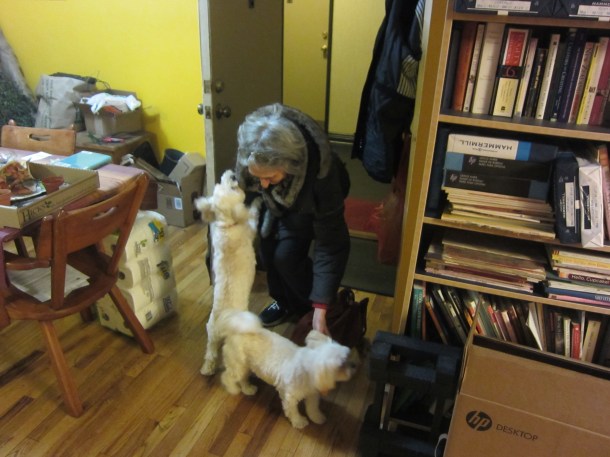
“Oh my God! Oh my God! Where were you?!!!!!”
For official purposes at my internship, I have to write out a summary of each of my meetings, and that gives me a general record to start from for the process recordings. For those reports, I describe what we talked about in the meeting, and what we resolved for the client to do by next week, etc. But to get those notes into dialogue form, I need to pull a lot more from my memory, and fill in the transitions between topics, and focus on particularly difficult moments: how we get from topic A to topic Z; what order things came up in; Did I say something to bring this up, or did it come out of nowhere; when I was overwhelmed and unsure what to say; when I thought I did well.
I often wonder if the work of remembering is this hard for everyone, or if it’s a specific problem for me, because my brain seems to store things out of order and scattered in various corners instead of in a more linear fashion. I dread doing these process recordings every week, but once they’re done, I feel like I really learned something, about myself, about the client, and about how I want to proceed. I resent having to do them, and yet I hope we don’t switch to the short form, because this method has been my best learning tool, and the best way for me to really resolve the leftover feelings I have after a session with a client.
Ideally, I would become so practiced that I could knock off a process recording in an hour. Then I could do one on every client meeting, or on my own therapy sessions, or on the news shows that drive me nuts. I could write out each of my interactions with the dogs to see where I’m going wrong: like, why is Butterfly still so stubborn about who should be in charge of her leash (I think it’s me, and she thinks I’m wrong)? Maybe there’s a secret hidden in plain sight, and if I could just diagram every moment, I could figure out what I’ve been missing.

“I will stay right here, looking adorable, until I get what I want.”
Maybe that’s what Cricket is really doing while she seems to be chewing on her feet: she’s processing, and analyzing, and deciding how she wants to handle things the next time I do something that bothers her – like when I say No, or Quiet, or I fail to give her treats when she wants them. Maybe she’s doing this all day long, and sharing her realizations with her sister, and that’s why they keep outsmarting me. That could also explain why they are so exhausted all the time.
It’s a theory.

“Getting Mommy to do everything we want, every day, is exhausting.”





































 rachelmankowitz