Tag Archives: Jewish

Life in the Absurd

            Out of the blue, one evening, Mom got an email about a pop-up vaccine site taking people over 65, and she called and got an appointment for the next morning. And then, after she’d gotten the vaccine and scheduled her second shot, she felt so guilty that she’d gone without me, and that so many of the sites on Long Island were reserved for older people and not for essential workers or teachers, that she started obsessively watching for new sites, and nagging me to do the same. I didn’t enjoy having to jump onto the computer each time she saw a hint of a possibility of an appointment for me, especially because they all turned out to be nothing. But then, three weeks later, an email arrived saying that there was a site taking people over 60 and teachers, from our town. She emailed back and got me an appointment for that evening.

            The only problem was that I was still at synagogue school, where I was so overwhelmed with the laptop and iPad (to teach the remote kids), while also corralling the in-person kids, that I didn’t think to check my phone. By the time I got home Mom was standing in the parking lot, waiting for me. She yelled through the window of the car that I had an appointment, and I screamed back, for what?

            The Pharmacy was in a small strip mall two towns over, down a badly lit hallway and behind a non-descript door. It was some kind of specialist compound pharmacy, with one pharmacist and two helpers, and I was one of the last appointments of the day. I made sure to tell the pharmacist that I teach synagogue school, in case she wanted to disqualify me on the spot as not a real teacher, but she just nodded and asked where I teach, and then she told me that I was getting the Moderna vaccine, and stuck the needle in my arm. One of her assistants filled out a vaccine card and scheduled my second appointment, and then they sent me on my way.

            It took all of five minutes, and I had a hard time processing that I had really gotten the shot, even while holding an ice pack against my right shoulder. Two days later my left shoulder started to hurt, in the same spot as on my right shoulder. I tried to find a reasonable explanation for it, like maybe I’d been sleeping on my left side to protect the right shoulder, though that didn’t explain the pinpoint nature of the pain. But I was still wiped out from synagogue school, or from the vaccine shot, or both, and I couldn’t really think it through.

 The next day, which turned out to be the second windiest day of the year, I decided I had plenty of energy to do the food shopping on my own, even though Mom said it was too cold to go out and she and the dogs all gave me funny looks. Instead of wearing my hair in braids or a pony tail, which is what I’ve been doing since my hair got so Covid-long, I left it down, and it rose in a whirlwind around my face until I couldn’t see a damn thing. Then I went into the supermarket and filled my cart with everything on the shopping list, and only realized at the checkout that I didn’t have my pocketbook with me. I asked if they could watch my cart, melting ice cream and all, at the customer service desk, and then ran out to the car, hoping my pocketbook would be sitting on the passenger seat waiting for me. It wasn’t.

“Oy.”

I knew I had to drive home and find my pocketbook, but I was afraid someone would see me driving away and think I was a criminal of some kind, racing out of the parking lot. It was only when I’d pulled out into traffic, heart racing, that I thought to check under Mom’s cushion on the passenger seat, and of course my pocketbook was right there. I was relieved and flustered and had a hard time figuring out where to make my U-turn back to the supermarket. I parked in the same exact spot I’d just left and then ran out, forgetting my mask in the car, so I had to race back and find it on the floor, under Mom’s cushion, which I’d managed to toss into the air in my frenzied search for my pocketbook.

I tried to walk back into the supermarket like a sane, rational person and gracefully guide my cart from the customer service desk to the next open checkout lane, but there were no open lanes, except for the self-checkout. I hate self-checkout. I don’t understand how this is supposed to be more convenient when every time I try to buy a fruit or a vegetable someone has to come over and play with the machine to get it to recognize my broccoli. But I paid for all of my groceries and managed to put them in my reusable and refrigerator bags, piled to the top of the cart. As soon as I got outside, of course, the bag on top of the pile fell off the cart, and the receipt flew away in the wind, never to be seen again. By the time I got home I felt like I’d been through all of the Herculean labors, and fell into bed, exhausted.

“I totally get it.”

            I’m pretty sure my life isn’t the only one falling into the absurd lately, but I like to tell myself that mine is the most absurd, just so I can feel like I’m winning at something.    

The fact is, everything has seemed nonsensical for a long time now, as if we’ve all been suffering from pre-Covid brain fog for years. There was that weird four year period when our president was a white supremacist, and then that year when people refused to wear face masks to protect them from a deadly disease. And then there were those news outlets that only believed in alternative facts. It was weird. Okay, it’s still weird. States are rapidly putting new voting restrictions into place, after what was deemed the most secure election in US history by the Republican in charge of cyber security. And US senators are proclaiming that they didn’t feel threatened by men with bear spray and flag poles attacking the Capitol police and setting up a gallows to hang politicians, but one little black woman knocking on a door in the Georgia Legislature clearly scared the bejeezus out of them.

“Humans are weird.”

            There are times when I believe that God is everywhere, and that the universe is a web of invisible circuits that bring us all together. And then there’s the rest of the time, when I still believe that God is everywhere, but I’m pretty sure the web of invisible circuits is broken, or at least rotting at significant junctures. Hopefully, once we’ve all been vaccinated we can start to do the work of fixing those connections.

To that end, I thought I’d share some new liturgical music from the musical director/composer/rabbinical student from my synagogue whom I’ve mentioned in the past (I make a short appearance in the choral section of the video.) The title of the song is HaRofei, which means the healer, and it’s based on Psalm 147. The lyrics alone are wonderful, but with the music and all of the voices and instruments he was able to bring together, it’s a stunner. https://youtu.be/fmsMljlUWok

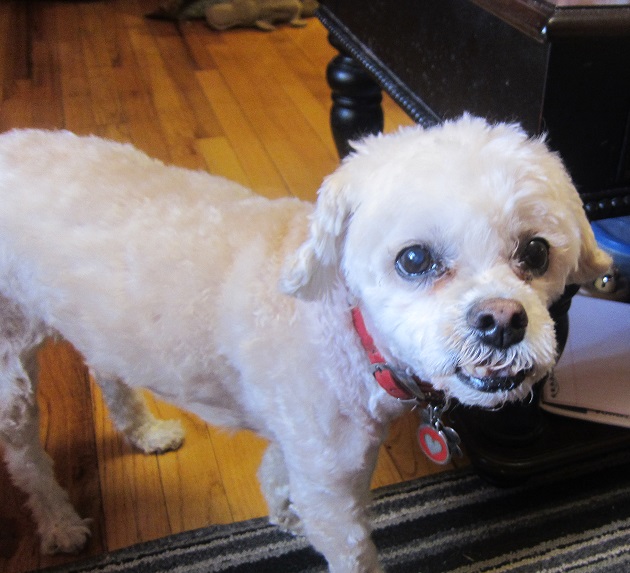
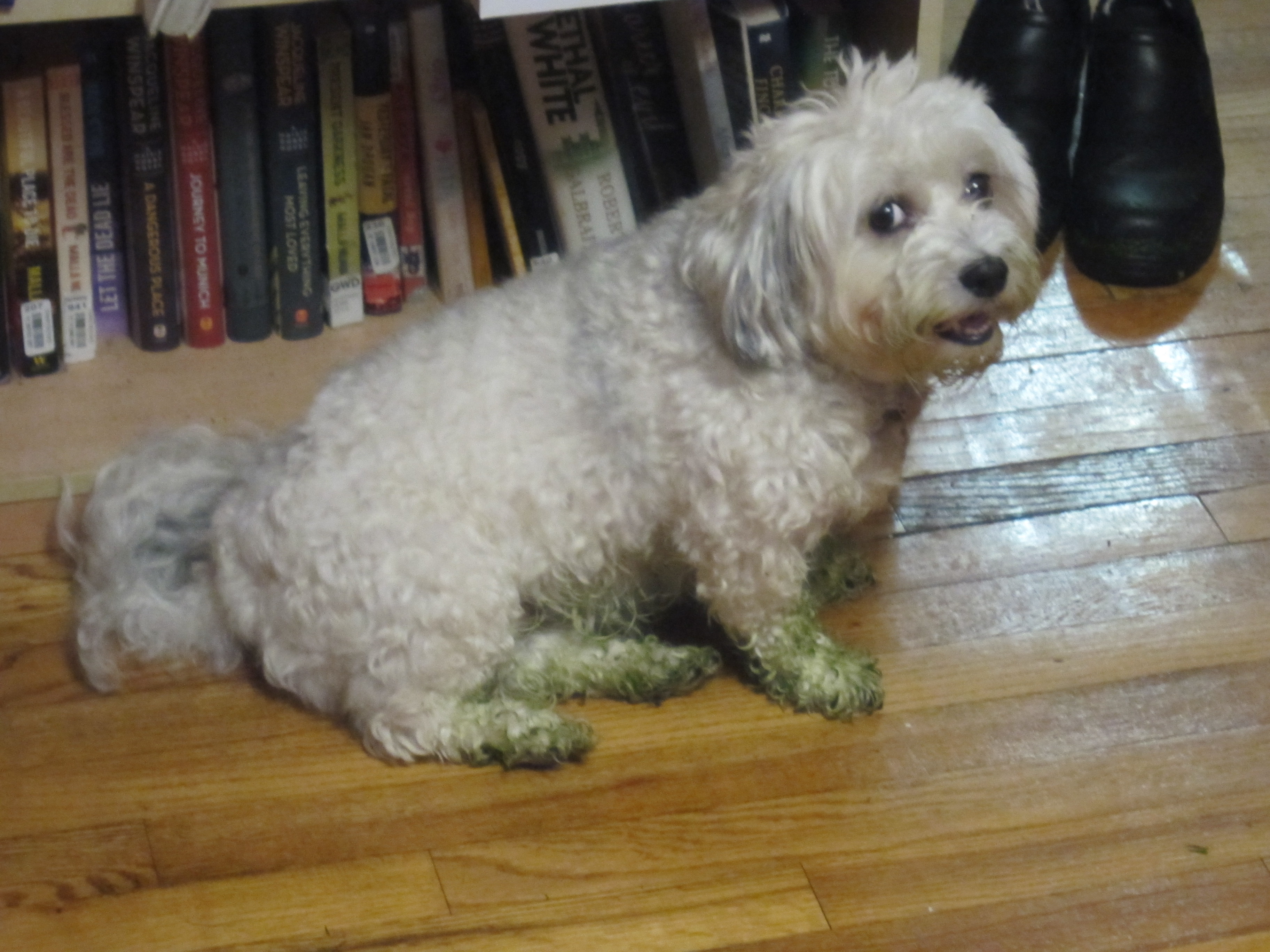
“Where are the dogs?”

If you haven’t had a chance yet, please check out my Young Adult novel, Yeshiva Girl, on Amazon. And if you feel called to write a review of the book, on Amazon, or anywhere else, I’d be honored.

            Yeshiva Girl is about a Jewish teenager on Long Island, named Isabel, though her father calls her Jezebel. Her father has been accused of inappropriate sexual behavior with one of his students, which he denies, but Izzy implicitly believes it’s true. As a result of his problems, her father sends her to a co-ed Orthodox yeshiva for tenth grade, out of the blue, and Izzy and her mother can’t figure out how to prevent it. At Yeshiva, though, Izzy finds that religious people are much more complicated than she had expected. Some, like her father, may use religion as a place to hide, but others search for and find comfort, and community, and even enlightenment. The question is, what will Izzy find?

Miriam’s Well

            Tonight is the first night of Passover, and I’ve been thinking about how this Jewish holiday makes me feel – this weeklong commemoration of the escape from slavery to freedom – and why it doesn’t make me feel free. Maybe it’s because so much of Judaism, both in its ancient and modern forms, leaves out the stories of women; the Hebrew Bible, and the advent of Monotheism, were bathed in misogyny and the distrust and erasure of women, and that absence of women feels especially obvious at the Passover Seder.

“But I’m at the Seder.”

            People have come up with all kinds of ideas for how to make the Seder more inclusive, more fun, more meaningful, or shorter. At the yearly Women’s Seder at my synagogue we add something called a Miriam’s Cup to the table, but there was never an explanation for what the cup was meant to represent and I assumed it was an afterthought, a salve to make women feel included.

The Hebrew Bible describes Moses, and his brother Aaron and sister Miriam, as delivering the Jews from exile in Egypt, together: “For I brought you up out of the land of Egypt and redeemed you from the house of slavery and I sent before you Moses, Aaron, and Miriam.” Miriam’s claim to fame is that, as a child, she was the one who stood by the Nile to watch as her baby brother Moses was picked up by the daughter of Pharaoh. And then, after the splitting of the Sea of Reeds, she encouraged the Israelites to sing and dance and praise God for the miracle of the splitting of the sea, even as the sea swallowed the Egyptian soldiers chasing after them in Exodus: “Then Miriam the prophetess, Aaron’s sister, took a timbrel in her hand, and all the women went out after her to dance with timbrels. And Miriam chanted for them, ‘Sing to the Lord, for He has triumphed gloriously; horse and driver He has hurled into the sea.’”

And yet, there are very few other references to Miriam in the Hebrew Bible, and no traditional rituals to celebrate her, in the Passover Seder or elsewhere. And that made me wonder why, if she was so important, she was largely left out of the telling of the story? There’s understatement and then there’s neglect.

Even her name is a problem: Miriam is a form of the Hebrew word for “bitter.” The assumption is that her parents gave her that name because of their hard lives as slaves in Egypt, but what you call a person matters; it impacts how you see them and how they see themselves.

“What does Ellie mean?”

When used at the Seder, Miriam’s Cup sits next to Elijah’s Cup (of wine) on the table. Elijah’s cup is set aside for the Prophet Elijah to drink when he comes to visit the Seder (Elijah is like a drunken version of Santa Claus, visiting every Seder in one night, through the open door instead of the chimney, but leaving no gifts). Elijah rode a chariot of fire into the whirlwind and was “translated” to heaven, without dying, and his visits to the Seder represent the hope for the coming of the Messiah. But Miriam had her feet solidly on the ground, and she died, like any other mortal, so her placement with Elijah at the table seems strange.

And yet, in 1987, Leila Gal Berber wrote a second verse to the song we sing about Elijah the Prophet, called Miriam the Prophetess, to be sung at the Seder, and weekly at the Havdallah service that ends the Sabbath each Saturday night. Miriam’s verse celebrates her as a redeemer, like Elijah, but that has never been her role. And, to me, it feels disrespectful to act as if the only way to honor Miriam is to tack her onto Elijah’s song, where she doesn’t belong.

“Harrumph.”

Why isn’t Miriam’s role as part of the leadership team that brought the Israelites out of Egypt enough? Why can’t she be celebrated with her brothers instead of with Elijah, who comes from a completely different part of the Hebrew bible? Aaron was the high priest, and Moses spoke to God, and Miriam acted as the first Cantor or prayer leader for the Israelites, teaching a people who had been raised in slavery to celebrate their freedom. Why isn’t that good enough? Miriam, unlike Moses, grew up as a slave. She never lived the privileged life Moses lived as an adopted member of the royal family. And yet, she celebrated God, who didn’t bother to speak directly to her. She had the faith and courage to help lead her people out of Egypt, despite having no experience of freedom to bolster her faith that life on the other side would be better.

            Why can’t we celebrate her for that?

But also, I didn’t understand why Miriam would be honored with a cup of water, while Elijah was honored with a cup of wine. And I was curious enough about that to go a-googling. I found out that Miriam’s Cup is meant to remind us of Miriam’s Well, the source of water that kept the Israelites alive through forty years in the desert, a story I’d never heard growing up. It turns out that the Rashi, a Medieval French Rabbi, derived the idea of Miriam’s Well from the description of Miriam’s death in the book of Numbers: “Miriam died there and was buried there. And there was no water for the congregation.” He decided that the juxtaposition of her death and the sudden lack of water meant that while she was alive the Israelites had water, throughout the forty years in the desert, due to her. The connection is tenuous, but some explain it as a result of Miriam’s guardianship of her baby brother by the waters of the Nile, or because of her celebration by the Sea of Reeds. Others see the well as a universal symbol of femininity, like a womb.

The Seder does seem like the right place for Miriam, and the cup of water could be made into a meaningful symbol of her role in the Exodus, because without water there is no survival, let alone freedom. Water is the most basic thing we need in order to stay alive, and yet, it is also something we tend to take for granted, like women.

There’s so much potential here, for water as a symbol of the feminine, and of freedom and survival, but it only works if we spin the story out, and if it expands from just the Women’s Seder (which takes place weeks before the actual holiday) to being included in the official Seders on the first and second nights of Passover; where everyone is included, and everyone can hear.

The story of Miriam’s Well can teach the importance of having water in the desert, and having a sister who looks out for you, and having a prayer leader who reminds you to sing and dance and celebrate, even when you are afraid. There is another song about Miriam, by Debbie Friedman, that celebrates the way Miriam led the singing and dancing after the splitting of the Sea of Reeds, which is sometimes sung at the Women’s Seder as well. Maybe if we can sing her song and tell her story at the Seder, Miriam can inspire us to add women back into our history and restore what has been erased. And, maybe then Passover will feel like a true expression of freedom, an experience of being free to speak and to be who we are, for all of us.

“Like us.”

This is a version of Debbie Friedman’s Miriam’s Song, by Project Kesher, working to empower Jewish women around the world – https://www.kveller.com/this-cover-of-debbie-friedmans-miriams-song-is-so-inspiring/?fbclid=IwAR3akG-p4sTMYJUpEGq9gG76U8HdfXctfVlRe_I09L-Oh6MRplAlEozF5UI

This is a version of Min Hameitzar, which is often sung as part of Passover services. The words translate, basically, to: From the narrow place I called on God and he answered me in the expanse. God is for me, I won’t fear, what can Man do to me? - https://youtu.be/EMe4-ggSkdY

If you haven’t had a chance yet, please check out my Young Adult novel, Yeshiva Girl, on Amazon. And if you feel called to write a review of the book, on Amazon, or anywhere else, I’d be honored.

            Yeshiva Girl is about a Jewish teenager on Long Island, named Isabel, though her father calls her Jezebel. Her father has been accused of inappropriate sexual behavior with one of his students, which he denies, but Izzy implicitly believes it’s true. As a result of his problems, her father sends her to a co-ed Orthodox yeshiva for tenth grade, out of the blue, and Izzy and her mother can’t figure out how to prevent it. At Yeshiva, though, Izzy finds that religious people are much more complicated than she had expected. Some, like her father, may use religion as a place to hide, but others search for and find comfort, and community, and even enlightenment. The question is, what will Izzy find?

A Purim Spiel

            The last thing we did in person at my synagogue last year, before the Covid shut down, was the Purim Spiel. Everyone was crowded into the sanctuary, with congregants of all ages singing from the “stage.” A few days later, the world stopped, but we had no idea that we’d be living on Zoom for an entire year, or more, and that our next Purim Spiel would be presented entirely on Zoom.

            I’d never seen a Purim Spiel (or even heard of one) before coming to my current synagogue nine years ago, but it turns out that they have been a Jewish tradition for centuries. A Spiel is a play (from the German/Yiddish) and a Purim Spiel is a comic version of the story from the Book of Esther that we read each Purim, with a lot of leeway for modern interpretations, humor, music, and especially satire. Many politicians and Very Important People have been lampooned in Purim Spiels across the world.

“Am I a Very Important Person?”

            At our synagogue, the Cantor writes the Purim Spiel each year, usually adapting popular songs to fit the Purim story: there was a Star Wars version, a Wizard of Oz version, a Billy Joel Extravaganza, etc. Once a year, it’s a chance for doctors and lawyers and teachers and children to get up on stage and sing their hearts out to an audience filled with every age group, including children dressed as unicorns and cowboys and princesses.

“That will never happen to me.”

            The goal of the Purim Spiel is to provide a catharsis and to give us a chance to laugh, and after the devastations of Covid and the economy and politics this year, we really need that. It will be easier to take a deep breath and move into the more sober tone of the Biden years after getting what we’ve just been through out of our systems, and then we can wash our hands of it, as much as that’s possible.

            Purim isn’t a major holiday on the Jewish calendar, unlike Passover or Rosh Hashanah. It’s very likely that the holiday of Purim was instituted by the rabbis to give Jews something Jewish to celebrate at this time of year instead of being drawn into the celebrations of their neighbors. Purim may have been based on an ancient pagan festival, celebrating Marduk and Ishtar, two of the important pagan gods of the ancient Near East, with the names changed only slightly to Mordechai and Esther.

            The story of Esther, considered by most scholars to be historical fiction, rather than history, highlights one of the major themes in Jewish life across Millennia: anti-Semitism, the baseless hatred of Jews because they are “the other.” But in this story the Jews win, because Esther, a Jew who hides her Jewish identity, becomes queen of Persia and is able to thwart an attempted genocide of the Jewish people. It’s a court intrigue, with all of the misunderstandings and frivolity and devious plans and feasting and blood lust you can imagine. The main characters are the King (silly and gluttonous), his first wife Vashti (smart and rebellious), his new wife Esther, her uncle/cousin Mordechai who encourages her to play her role to save her people, and Haman, the Grand Vizier and the bad guy.

            Imagine if, instead of going along with Hitler’s Final Solution, German leaders had listened to Jewish voices and turned around and killed Hitler and his henchmen instead – that’s the Purim story. It’s a fantasy, and a welcome one for a people who have often been the targets of prejudice and genocide and need at least one day a year to imagine what it would be like to turn things around.

Like if I sent You to the groomer?”

            The original commemorations for Purim were more sober and serious and focused on the formal reading of the Book of Esther; the custom of masquerading in costumes and the wearing of masks probably originated among the Italian Jews at the end of the fifteenth century. But whether it was originally intended as a party or not, the playfulness and laughter and blurred boundaries of Purim feel essential now.

            Usually our synagogue also has a Purim carnival for the kids, with games and rides and a costume parade, and Hamantaschen to eat, but that will not be possible this year. Hamantaschen were another late addition to the holiday, based on a German cookie called a Mahn-tash or poppy pocket, filled with sweet poppy seed paste. Hamantaschen are three-cornered cookies filled with sweet (or even savory) fillings, meant to resemble Haman’s three-cornered hat.

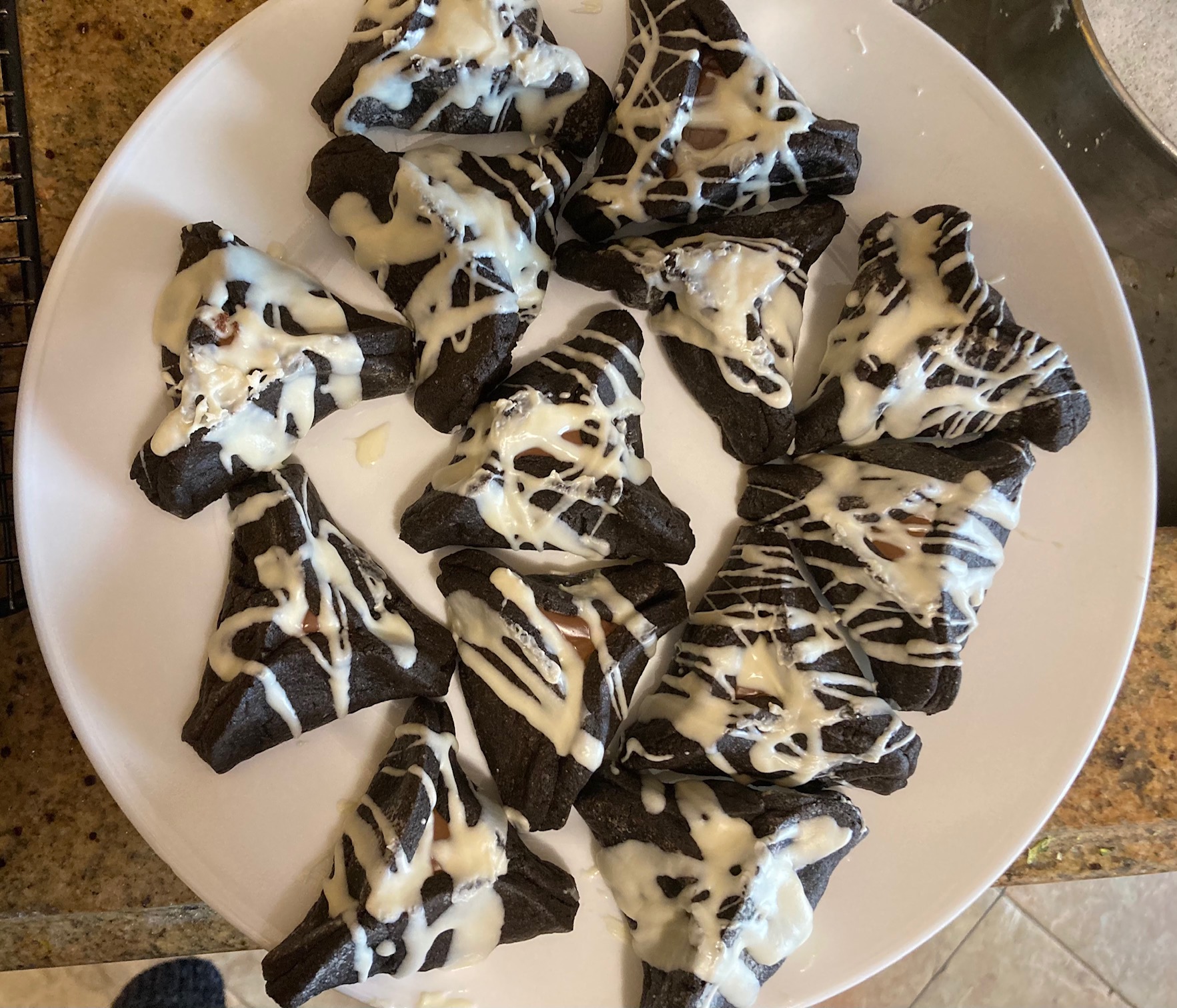
Triple Chocolate Hamantaschen (recipe from MyJewishLearning.com)

            For adults, Purim is also a time for drinking. The tradition is to drink until you don’t know the difference between cursed be Haman (the bad guy) and blessed be Mordechai (the good guy), maybe to let us know that feasting and drinking, and taking on the role of power, can make us into the bad guys if we’re not careful. We tend to learn these lessons best by acting them out, rather than just learning the theory, so this holiday is a low risk way to try out being one of the bad guys (with a mask), or to lose track of your moral rectitude for a moment (with alcohol), and re-learn the lesson that you need certain rules in place in order to be the person you want to be the rest of the year.

The masks and costumes are always fun, but resonate even more deeply this year. Many people who have been outsiders to society know how it feels to wear a mask in order to fit in, but we’ve all experienced the way masks can obscure aspects of who you really are, for better or worse, this year. Our Covid masks allow, or require, us to obscure who we are, and especially how we feel. I have masks for synagogue school, made by Mom, covered with chocolate chip cookies, or butterflies, or birds, or dogs, instead of plain surgical or black masks, because I can’t smile with a mask on and the colorful and playful fabrics can do that for me, even if I don’t feel like smiling underneath.

My Masks

            So this year the Purim Spiel was on Zoom, with wine and Hamantaschen optional, and without the music (because group singing on Zoom is heinous), but it still gave us a chance to act out our revenge fantasies, and laugh at ourselves. If nothing else, Jewish history has taught us that we can adapt to new circumstances, and make the best of what we have, as long as we continue to tell our stories and search for meaning, together.

“Where are the cookies?”

If you haven’t had a chance yet, please check out my Young Adult novel, Yeshiva Girl, on Amazon. And if you feel called to write a review of the book, on Amazon, or anywhere else, I’d be honored.

            Yeshiva Girl is about a Jewish teenager on Long Island, named Isabel, though her father calls her Jezebel. Her father has been accused of inappropriate sexual behavior with one of his students, which he denies, but Izzy implicitly believes it’s true. As a result of his problems, her father sends her to a co-ed Orthodox yeshiva for tenth grade, out of the blue, and Izzy and her mother can’t figure out how to prevent it. At Yeshiva, though, Izzy finds that religious people are much more complicated than she had expected. Some, like her father, may use religion as a place to hide, but others search for and find comfort, and community, and even enlightenment. The question is, what will Izzy find?

The New Year of the Trees

            On the evening of January 27th, 2021, and through the next day, Jews around the world will celebrate Tu Bishvat, the New Year of the Trees. Historically, this was an agricultural festival celebrating the emergence of spring in the land of Israel. Here in the Unites States, where we’re still in the deep freeze, Jewish children will celebrate the holiday by eating fruits and nuts that grow in Israel (like olives, dates, grapes or raisins, figs, pomegranates, Etrogim (citrons), apples, walnuts, almonds, carob, and pears.)

“We’re Jewish children too!”

            When I was a kid in Jewish Day School, a platter of dried fruit and nuts was brought to each classroom, and it was the only time during the year that I would see actual carob, rather than carob chips masquerading as chocolate chips. The idea that we were brought food in our classrooms was meant to show us the specialness of the day (and it did! It really did!), because after Kindergarten the whole idea of snack time had disappeared as completely as nap time, and food in the classroom was verboten.

(a picture of a Tu Bishvat platter I found online)

This year, because of Covid, we won’t be able to share food in our synagogue school classrooms, or have our usual Tu Bishvat Seder in the synagogue, where we tend to celebrate by dipping dried fruit into a rapidly diminishing bowl of melted chocolate. Instead, this weekend, the kids at my synagogue will have a Zoom chocolate chip cookie baking lesson, and the adults will sing Tu Bishvat songs on mute and learn about the history of Jews and chocolate.

We won’t have synagogue school classes again before Tu Bishvat, so this past week I sent my students home with a list of fruit and nuts to choose from, and a copy of the two blessings they may want to say. The first blessing is a simple blessing over the fruit itself:

            Blessed are You, Lord our God, Ruler of the universe, who creates the fruit of the tree.

The second blessing is the shehechiyanu, a blessing we say whenever we experience something new, or newish. We say this blessing on Tu Bishvat if the fruit or nuts we choose to eat is something we’ve never had before, or haven’t had for a while. As a kid, this blessing was always said over the weird Carob thingy on the platter, which looked nothing like the carob chips in my trail mix.

(I found this online too, but I can’t remember how to eat it.)

But over time I’ve come to realize that the shehechiyanu blessing is much more interesting than it sounds, because it doesn’t just say thanks for this new thing. Instead, it says:

Blessed are You, Adonai our God, Sovereign of all, who has kept us alive, sustained us, and brought us to this season.

So, it’s not just about celebrating the new thing; it’s about celebrating the fact that we survived long enough to experience this new thing. It allows us to acknowledge all of the work and suffering and fear and luck it has taken for us to get to this moment, and to bless all of it.

“Don’t be ridiculous.”

We inaugurated a new president here in the United States this week, and even though the celebration was muted by Covid, and the threat of violence, the feeling of renewal and relief was palpable, and we could say a shehechiyanu for that too. We have so much recovering to do in the United States, and around the world, and most of us have had a hard time seeing anything to be thankful for lately. But the shehechiyanu blessing reminds me that everything we’ve been through to get here is part of the blessing of this moment.

It’s easy to celebrate new plants and trees and fruit when they come up in the spring, but what if we can also bless the planting of those seeds, and the turning of the soil, and the worry that nothing will grow, that comes before the spring?

I’m not a gardener, but my mother is, and this is the time of year when she starts looking through seed catalogs and sometimes starts new seedlings in biodegradable containers, so that they can begin to grow and build strength before the ground is warm enough to support them. This trust that spring will come, and the awareness that we have a role to play in planting the seeds, is part of the process of getting to spring.

One of Mom’s indoor seedlings

So, maybe this is exactly the right time for Tu Bishvat and the New Year of the Trees, here and in Israel and everywhere else. Maybe we can say the Shehechiyanu and bless the fact that we are planting our seeds, even in the winter, even with our fear and doubt still in place, because we choose to believe that, in time, something beautiful will grow.

“I’m ready to help. Again.”

If you haven’t had a chance yet, please check out my Young Adult novel, Yeshiva Girl, on Amazon. And if you feel called to write a review of the book, on Amazon, or anywhere else, I’d be honored.

            Yeshiva Girl is about a Jewish teenager on Long Island, named Isabel, though her father calls her Jezebel. Her father has been accused of inappropriate sexual behavior with one of his students, which he denies, but Izzy implicitly believes it’s true. As a result of his problems, her father sends her to a co-ed Orthodox yeshiva for tenth grade, out of the blue, and Izzy and her mother can’t figure out how to prevent it. At Yeshiva, though, Izzy finds that religious people are much more complicated than she had expected. Some, like her father, may use religion as a place to hide, but others search for and find comfort, and community, and even enlightenment. The question is, what will Izzy find?

Why Can’t I Write a Midrash?

When the official Jewish Bible was closed, the rabbis still had questions they wanted to answer, so they started writing the Talmud (The Mishnah and then the Gemara), a compendium of (endless) arguments, commentaries, word play, stories and Gematria (a method for finding deeper meaning in the text, using the number values of the letters). And then, after the Talmud was considered closed, the next generation of Rabbis still had more questions, and answers, about what God really meant in the Bible, so they kept writing and collected the work in new books of Midrashim (a Midrash is a general term for the way the rabbis interpreted and elaborated on the biblical text, and Midrashim is the plural of Midrash).

Midrashim exist in many different forms: stories, homilies, parables, and legal exegesis. In a way, Midrash is the earliest form of fan fiction, where we take existing characters and situations from popular TV shows or books and imagine new scenarios for them. Just like we want to enter the world of Harry Potter, or J.R.R. Tolkien, or Little Women, our ancestors wanted to enter the world of the Bible and imagine themselves in the role of Abraham or Sarah or Miriam or Moses. They liked to think about how they would have behaved in front of the Burning Bush, or facing the Sea of Reeds with the Egyptian soldiers coming up behind them. And they wanted to imagine what it would be like to face God, and speak to God, and criticize God directly the way the characters in the Bible were able to do.

“I tell God my opinion all the time.”

The best known Midrash may be the legend of Abraham as a young child smashing his father’s idols. He tells his father that the idols destroyed each other, and his father didn’t buy it, because idols aren’t living beings. To which little Abraham says, exactly. According to MyJewishLearning.com, this Midrash, collected in Genesis Rabbah, was created to explain why God would choose Abraham in particular to be the father of the Jewish people, because he was willing to challenge the conventional wisdom of his time.

            Midrash fascinates me because it allows us to reinterpret the Bible through our own eyes. It’s about more than just figuring out what the original writers meant, it’s about finding something in the story that rings true for us in particular. A Midrash doesn’t have to be factual in order to express a deeper truth from the Bible, and therefore, possibly, meaningful to the reader as well.

            Unfortunately, since we have such a long tradition of rabbis (aka men) telling us what to think, many people still feel too intimidated to read the Bible through their own eyes. They imagine that the rabbis, who were often already a thousand or two thousand years distant from the source material themselves, must have heard the voice of God. But just because they had the confidence to believe they knew what was right, doesn’t mean they were right. Or that their answers are right for us.

“My answers are always right.”

            Midrash writing wasn’t just popular in the distant past, modern writers have taken it on as well. Consider Anita Diamant’s book The Red Tent, a reimagining of the story of Dinah in the Bible. Judith Plaskow is another modern feminist Midrash writer, who embarked on Midrash writing as a way to include the female voice in the story of the Jews, while still respecting the Bible itself and the traditions of Judaism. She wrote an essay called “The Coming of Lilith,” re-imagining Lilith as a woman who was wrongly punished for wanting to be considered equal to Adam. The original Lilith Midrash was written by men, as an attempt to make sense of the two different versions of the Adam and Eve creation myth in Genesis. In the first version, both Adam and his wife are created from the earth, and in the second version Eve is created from Adam’s rib (or his side), and the rabbis decided that these were two separate creation stories. In the first, the wife God created for Adam, Lilith, was too uppity and thought that she was equal to Adam, so, of course, she turned out to be a demon who defied God and threatened to eat children (no, really). When God created a second wife for Adam, Eve, God decided that she needed to know her place, so she was created out of Adam himself, as a subsidiary to him. Of course she still went and ate that apple, so, women, feh. It’s all their fault.

“That’s not nice!”

Judith Plaskow’s version of Lilith isn’t a demon at all, she’s a woman who refuses to be submissive to her husband and leaves him. Eve, the second wife, is told that Lilith is a demon who has to be kept out of the Garden of Eden because she’s a threat to children and women, etc, etc. But Eve gradually recognizes that Lilith is just a woman, like herself, and someone she could be friends with.

Both Midrashim represent the mindset, and the time period, of the writers themselves, and both give us new ways to read the original stories in the Bible and try to understand the inconsistencies and mysteries therein. Can I believe that there are women whose power to seduce or manipulate men can seem demonic? Yes. Are there women who are called demons who are really just people being held back from living their own lives? Yes. Are either of those readings what God, or the authors of the Bible, meant us to learn from the original stories in the Bible? We can’t know. The truth of the stories, and the lessons of the stories, are up to us to decide. And we can each decide differently.

“I don’t think Cricket believes that.”

I want to help my students, children and adults, see that Judaism isn’t a religion of passive obedience, or at least that it doesn’t have to be. If you are willing to engage in the storytelling, and the story-hearing, and take ownership of your own beliefs and values, Judaism can be as dynamic and meaningful as you need it to be.

            And yet, I keep struggling to write my own Midrashim, or to plan a way to teach people how to write Midrash. I’m intimidated by exactly those people who I want to thumb my nose at, and I think this happens in a lot of areas of my life. I know what I think, and what I believe, but I don’t feel like my beliefs matter, or have value, compared to the people who are RIGHT. The dichotomy between my confidence in my own opinions, on the one hand, and my belief that I have no right to that confidence on the other, is a constant.

The Bible is so tempting to work with, because it is notoriously tight-lipped when it comes to certain details. Don’t get me wrong, you will be bored to tears with lists of ancestors and sacrifices and tribes and kosher and unkosher animals, but the storytelling style is very lean and leaves a lot of room for the reader’s imagination. It’s instinctive to start asking questions like, what must have happened behind the scenes to make the characters act that way? What might they have been feeling or thinking that they didn’t say? And what else happened that the writers of the Bible decided to leave out, if we assume that these are true stories?

            But I keep hearing the rabbis (ancient and current day) yelling at me that I don’t know what I’m talking about, and I keep hearing my imaginary students telling me that this work is too hard and not worth the effort, because we could just read the existing commentaries and Midrashim, or we could write new stories of our own instead of dragging meaning from such a stubborn book. And I can’t disagree. But I’m still compelled by the possibility that I could find a way to place myself in the world of my ancestors, and see more of what was there than I’ve been able to see so far.

            I just don’t know where to start. Maybe with Lilith. Maybe, for me, Lilith isn’t a demon, or even a separate person from Eve. Maybe I can see both creation stories as part of the same story, with one woman seeing herself as equal to her husband, and subsidiary to him, at different times. Because, why wouldn’t the first woman be as conflicted over who she thinks she is, or who she thinks she should be, as I am?

If you haven’t had a chance yet, please check out my Young Adult novel, Yeshiva Girl, on Amazon. And if you feel called to write a review of the book, on Amazon, or anywhere else, I’d be honored.

            Yeshiva Girl is about a Jewish teenager on Long Island, named Isabel, though her father calls her Jezebel. Her father has been accused of inappropriate sexual behavior with one of his students, which he denies, but Izzy implicitly believes it’s true. As a result of his problems, her father sends her to a co-ed Orthodox yeshiva for tenth grade, out of the blue, and Izzy and her mother can’t figure out how to prevent it. At Yeshiva, though, Izzy finds that religious people are much more complicated than she had expected. Some, like her father, may use religion as a place to hide, but others search for and find comfort, and community, and even enlightenment. The question is, what will Izzy find?

Rededication

I’m exhausted. I’m (very) tempted to hibernate until spring; to fall into a sea of Christmas movies and jigsaw puzzles and coloring books and naps with the dogs. The schools in my area are preparing to go fully virtual this winter, in case the Covid surge hits us the way it’s hit the rest of the country. I feel like I’ve been running full out the past few weeks at synagogue school, hoping to make it to winter break before the wave inevitably hits.

There’s a deep weariness like cement in my bones, and I feel like my soul has taken a battering too, with the anxiety leading up to, and now out of, the presidential election, and the stress of Covid and how it impacts teaching; it feels like my soul and not just my body is black and blue and tender to the touch.

“Oy.”

I think we’re all feeling that way this winter. It would be nice if we could rest at home until the vaccines are ready for mass distribution, and then Santa and the reindeer could bring doses to every house and apartment and sprinkle fairy dust over all of us, instead of making us go to the doctor for a shot in the arm, or two.

“No fairy dust yet, but I’ll keep checking.”

One of the main themes of the Jewish holiday of Chanukah, along with celebrating the miracle of the oil lasting eight days, is the rededication of the Temple in Jerusalem after it was used for profane purposes (like, an altar to Zeus and sacrificing pigs within the walls). The word Chanukah itself means dedication, and, not coincidentally, this is often a time of year when we start planning our goals, or resolutions, for the coming year. But I’m not ready.

I keep thinking that I need to rededicate myself to knowing my limits, and respecting them; that I need to stop believing that I have to be someone else; someone who can multitask, and work eighteen hour days, and write three novels a year. I’m not that person, and no amount of beating myself up is going to change that.

But it feels impossible to move from constant self-improvement efforts to some semblance of self-acceptance. I feel like the ancient Temple in Jerusalem, before the Maccabees came in to clean things up. And just like with the Temple, before I can re-dedicate myself to moving forward, I need to really look around and survey the damage, because there may be miracles hiding in the wreckage, canisters of oil that will last eight days instead of one, for example, or other sources of light that have been in hiding. I can’t just turn my system off and on again and expect it to reboot.

“I think I see the light!”

I’m going to continue lighting the Chanukah candles each night, and hope that the growing light gives me inspiration, or at least some peace. But, I’m not ready for re-dedication yet. I need rest and presents and joy, and then more rest, before I can re-dedicate myself to the sacred tasks of my life. I think the dogs will be okay with that.

Night one
Night two, with help from Butterfly
Night three with Miss B
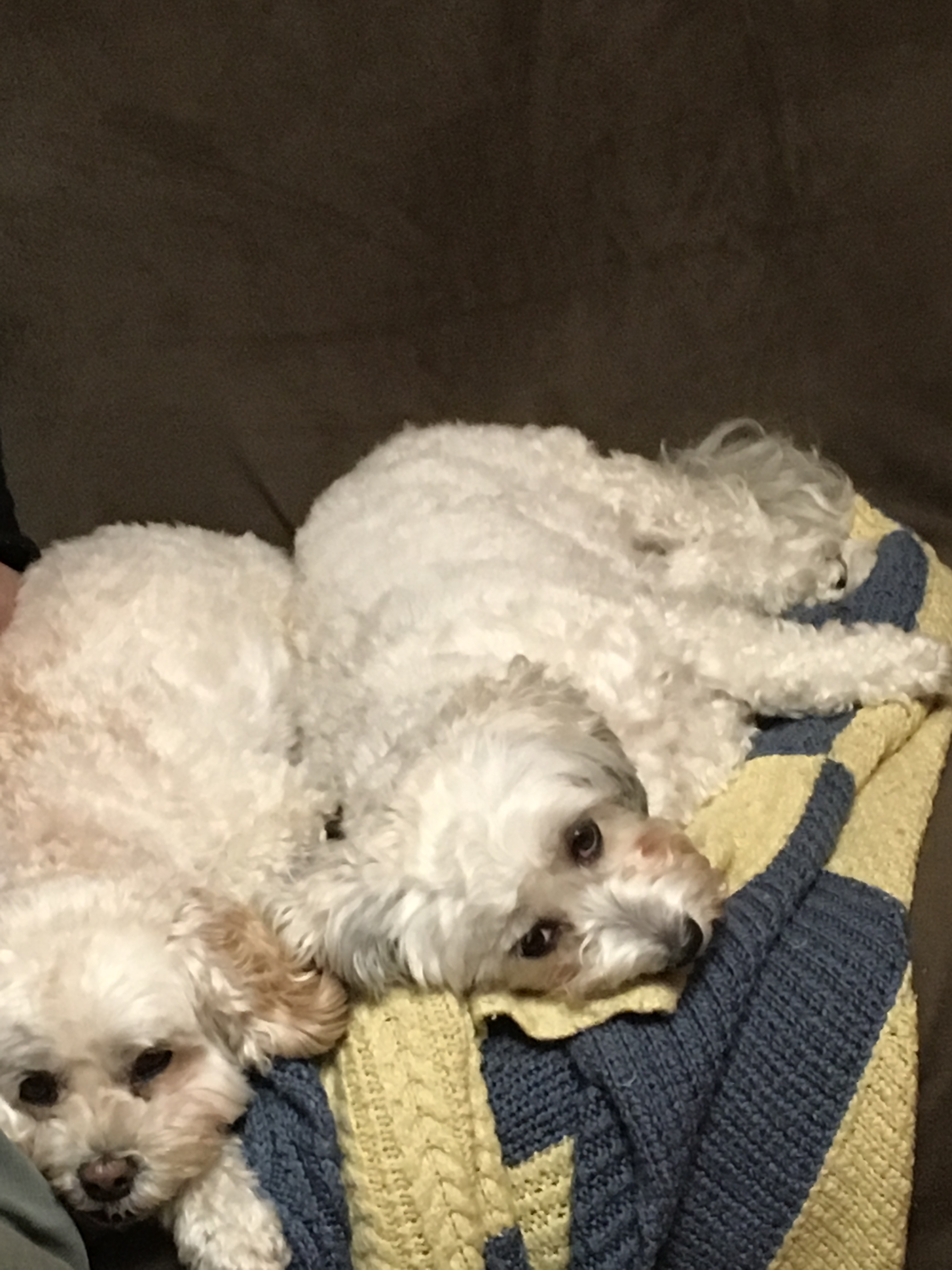
“We’ll think about it.”

If you haven’t had a chance yet, please check out my Young Adult novel, Yeshiva Girl, on Amazon. And if you feel called to write a review of the book, on Amazon, or anywhere else, I’d be honored.

            Yeshiva Girl is about a Jewish teenager on Long Island, named Isabel, though her father calls her Jezebel. Her father has been accused of inappropriate sexual behavior with one of his students, which he denies, but Izzy implicitly believes it’s true. As a result of his problems, her father sends her to a co-ed Orthodox yeshiva for tenth grade, out of the blue, and Izzy and her mother can’t figure out how to prevent it. At Yeshiva, though, Izzy finds that religious people are much more complicated than she had expected. Some, like her father, may use religion as a place to hide, but others search for and find comfort, and community, and even enlightenment. The question is, what will Izzy find?

This Chanukah

            We bought a new chanukiah (a candle holder with nine branches) for Chanukah, as a step up from the one we’ve used for the past two years: a tiny supermarket trinket with mini candles that burned down in minutes. That one replaced what we’d had for many years, which was nothing. It seems strange, given how much Judaism means to me, that I still struggle so much with the symbols and rituals of being Jewish. I still don’t light Shabbat candles on Friday nights, or bake or buy a challah, or say blessings over wine (or even grape juice). I take great joy in singing the prayers and in the sense of community and I love teaching the kids in synagogue school. But. There are still so many glitches.

The new Chanukiah in it’s place of honor next to Miss Butterfly

            One of the glitches is the story behind the holiday of Chanukah. The traditional story is that the Jews rose up against their Greek-Syrian oppressors in the second century before the Common Era. King Antiochus IV had outlawed the Jewish religion, ordering the Jews to worship Greek gods, and his soldiers attacked the city, killing thousands and desecrating the Holy Temple in Jerusalem. The Jews rebelled, under Judah the Maccabee, and retook the city and the Temple, and when they went to rededicate the Temple, and light the seven branched Menorah, they could only find enough consecrated oil to last one day, but, miracle of miracles, the oil lasted eight days.

Miracles shmiracles.

            Except. The war started as a civil war between those Jews, led by the Maccabees, who were determined to impose Jewish law on all of the Jews, even by force, and those Jews who had adopted Greek customs; the entrance of the Greek soldiers came later. The Maccabees won the war, killing Greek soldiers and their fellow Jews, and took control of the land of Israel for more than a century. Oh, and the oil that lasted eight days? It wasn’t in the original telling of the story. The miracle of the oil came up later, when the Rabbis needed an excuse for a festival of light to replace the pagan festivals of light the Jewish people loved so much.

            So, how do I celebrate a miracle (eight days of oil) that I know didn’t actually happen? And how do I celebrate a holiday that honors the killing of Jews like me who just wanted to have a foot in both the religious and the secular worlds?

            I struggle with the story behind this holiday just like I struggle with the story of Purim (punishing the man who planned the mass murder of the Jews by killing him and his whole family), but I can also see the value of a holiday that helps us find a way to feel hopeful during a dark time, be it a time of oppression or a time of literal darkness.

            The fact is, even though in America we tend to look at Chanukah as the sort of third cousin twice removed of the big winter holiday of Christmas, it turns out that many cultures have a festival of light around this time of year. Each one has its own story – whether it’s about the birth of Jesus, or the rebirth of the Sun, or honoring ancestors; the Hindus have a whole epic among the Gods for Diwali (celebrated mid-November this year) that ends in the triumph of good over evil.

            What all of these holidays have in common is the celebration of light. As the days get shorter and colder, and the nights get longer and darker, we all need something to remind us that light and heat and harvests and joy will return. We light candles, or clay lamps, or bonfires, or firecrackers, and we make a point of celebrating with our loved ones and eating special foods, all so that we can make it through the winter with our hope intact. We’ve gotten so good at this that, at least in America, we call this “the most wonderful time of the year!”

“The MOST wonderful?!”

            We still crave the symbols of our own cultures when we celebrate, though, just like we want to spend time with our own families and friends at this time of year. So for Christmas there’s Santa Claus, and mistletoe, yule logs (originally from a druid custom of rolling a flaming wheel down a hill to remind the sun how to rise), and of course Christmas trees (fun fact, people used to light up their Christmas trees with candles, before electric light came along, so Christmas tree fires were very common); and for Chanukah, we light our Chanukiyot and spin dreidels and eat potato latkes and chocolate gelt (coins); and for Yalda Night, a Zoroastrian Winter Solstice celebration in Iran on the longest night of the year, there are red fruits (like pomegranates and watermelons) to symbolize the crimson colors of dawn, and dried fruit and nuts and Persian sweets and poetry; and on St. Lucia’s Day in Sweden, the eldest daughter dresses in a long white gown, tied with red ribbons, and wears a crown of candles and lingonberry greens, and brings sweet rolls called Lussekatter to her family; and for the Chinese Lunar New Year lanterns are lit to celebrate the light of the moon, and dumplings and fish and rice cakes and noodles are eaten for good luck in the coming year; and for Diwali, clay lamps called Diyas are lit to celebrate the triumph of light over darkness and good over evil, and there are candles and firecrackers and intricate patterns of colored powders, and sweet and savory foods; and for Kwanzaa, an African American holiday to commemorate African Winter Solstice festivals, a Kinara (a candle holder with seven branches) is lit with candles in red, black and green, and gifts are given, and harvest foods of Africa are eaten, and the values of African village traditions are celebrated.

            But all of it, however specific the details are to our own cultures, connects us to the overall human need for light, and wisdom, and hope for tomorrow.

            When I think of it like that, Chanukah starts to take on more of a glow for me. And it also makes sense of my love for Christmas movies, which are really all about love and light and miracles, especially the small miracles that help us through each day.

            So maybe this year, even as Mom and I light the candles on the Chanukiah, and sing Chanukah songs to the dogs, we can think about all of the other people around the world celebrating their own festivals of light, and we can remember the creativity and ingenuity of all of our ancestors in finding ways to feel joy at such a dark time of year, instead of each of us hibernating in our own caves. And maybe, along with the obligatory potato latkes, we can celebrate with samosas, or Halwa, or dumplings, or Lussekatter. Maybe we’ll even drink some Swedish Glogg (flaming mulled wine!), though probably not. The dogs would much prefer a traditional Winter Solstice meal, with lots and lots of roasted meat.

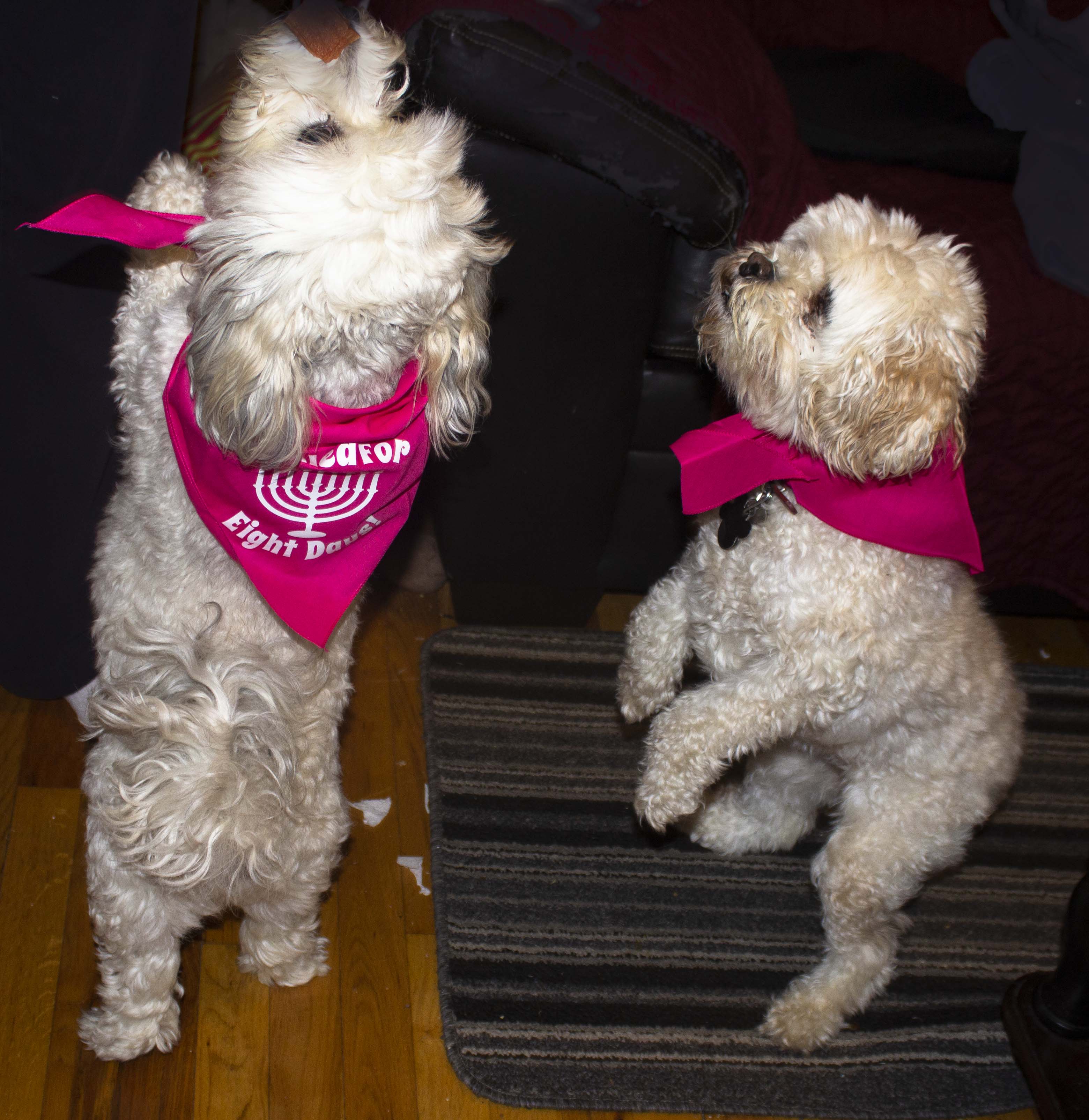
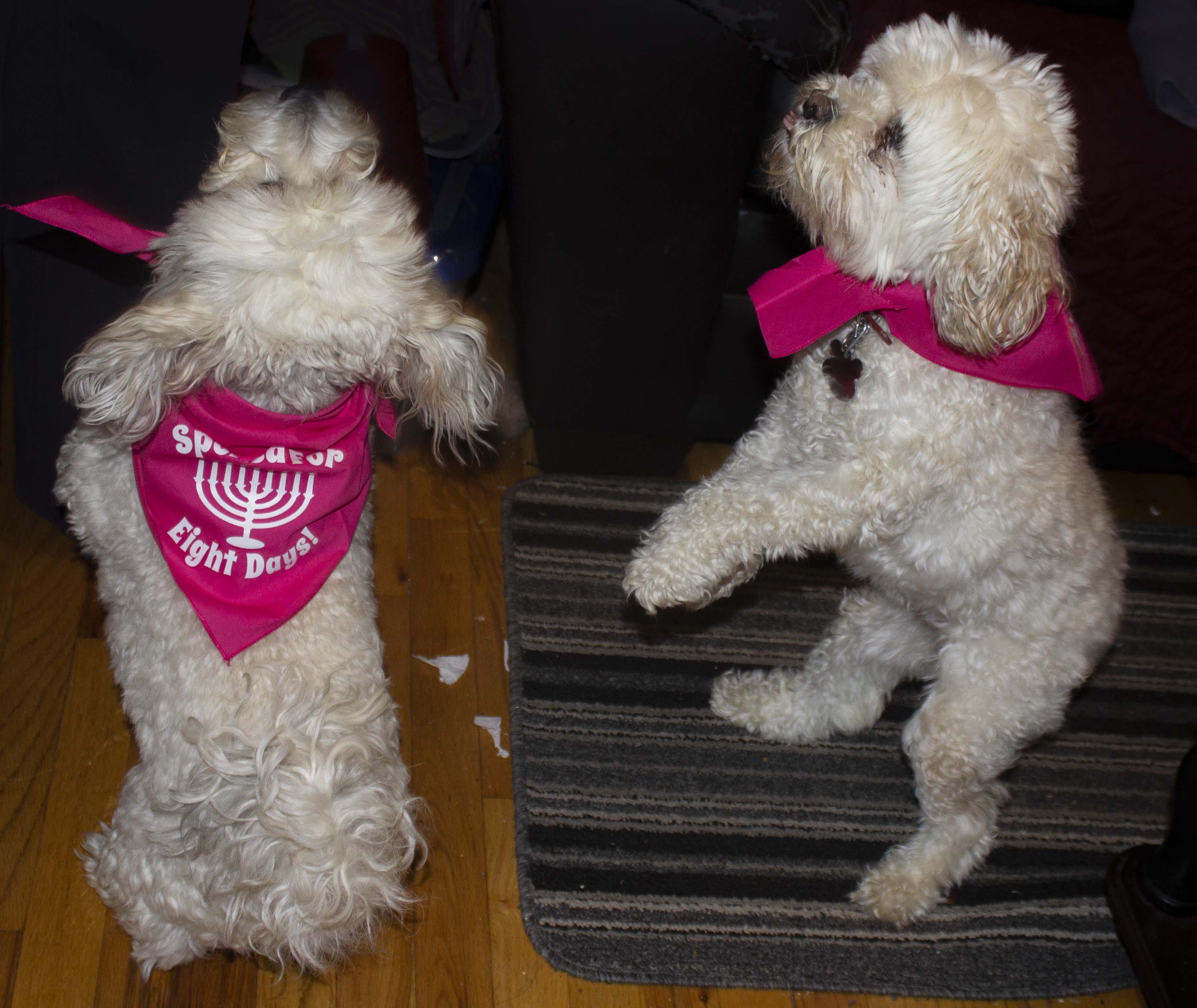
“We’re ready to be spoiled for eight days! Or more!!!!”

            I don’t want to erase the history that brought my people to this point, or pretend that my ancestors were any less flawed than they were. I want to find a way to honor the deeper meaning of the holiday, for me, which is that survival is possible, even through the darkest of times, if we are willing to look around and learn from each other.

If you haven’t had a chance yet, please check out my Young Adult novel, Yeshiva Girl, on Amazon. And if you feel called to write a review of the book, on Amazon, or anywhere else, I’d be honored.

            Yeshiva Girl is about a Jewish teenager on Long Island, named Isabel, though her father calls her Jezebel. Her father has been accused of inappropriate sexual behavior with one of his students, which he denies, but Izzy implicitly believes it’s true. As a result of his problems, her father sends her to a co-ed Orthodox yeshiva for tenth grade, out of the blue, and Izzy and her mother can’t figure out how to prevent it. At Yeshiva, though, Izzy finds that religious people are much more complicated than she had expected. Some, like her father, may use religion as a place to hide, but others search for and find comfort, and community, and even enlightenment. The question is, what will Izzy find?

Be a Mensch

            This past week in the United States has been stressful, for everyone, and because my synagogue school students are part of that everyone, I wanted to focus on teaching a lesson that would reassure them, somewhat, that there are areas of their lives where they really do have some control. And, because I love teaching Yiddish words, the lesson for this week was: what does it mean to be a mensch?

Mensch is a Yiddish word, from German, meaning “human being,” or a person of integrity and honor. The opposite of a mensch is an unmensch, a person treating others cruelly and without compassion, as opposed to the word ubermensch (Nietzsche alert) which is usually translated as “the superman,” someone who is superior to other humans. The word Mensch has gathered a lot of associations in American culture (bearded, male, Jewish) but it really means a person who is striving to be good every day, and doing what is right, even when it’s hard. We already have Yiddish words for the most righteous among us (a Tzaddik), or the smartest (a Chacham or a Maven) or the most powerful (a Macher). But being a mensch isn’t about being the best or the most, it’s about being human.

“I’ll take Maven and Macher.”

            There’s something wonderful about a compliment that can be given to everyone, instead of just to an elite few. Someone with a physical or intellectual disability has just as good a chance of being a mensch as someone who is born privileged in every way, because it’s not about your talents or your circumstances or your luck, it’s about how you choose to navigate the world you happen to live in. Oh, and mensch is not a gendered word, and it’s not limited to Jewish people, so it really can apply to anyone.

“Can I be a Mensch?

            We are so often looking for ways to be better than others, or to be the best, or to earn our place, and it’s exhausting, but the opportunity to be a mensch is always there, and there’s always something you can do that will fit you and your skills and interests.

            You can still have your foibles and be a mensch. You can fail a test, or lose your job, or struggle with substance abuse, or struggle to finish a Sunday crossword puzzle and still be a mensch. What you can’t do, is intentionally cause harm to other people. You can’t be a liar, or a bully, or be arrogant, or prejudiced and still be a mensch.

“I always tell the truth, whether you like it or not.”

            I’m a big fan of menschlichkeit, or mensch-iness. It’s like a pass fail course, where as long as you do the work, you’re golden. And we need things like that in a world that is so driven by competition and achievement and striving to be in the top one percent of everything.

            Being a mensch is about valuing other human beings for themselves, instead of for what they can do for you. And this, more than anything, is what I want to encourage in my students. Yes, I will be thrilled for them when they learn to write Hebrew words, or lead the prayers at their Bar or Bat Mitzvah. I will cheer them on when they swim or dance or act in a school play, and I will celebrate with them when they get into the college of their dreams, or find a cure for a rare disease, or create calorie-free chocolate frosting that tastes like the real thing (!). But all of that is secondary to how proud I am of them, right now, when they notice that a fellow student is struggling and needs help, or when they realize that they’ve hurt someone’s feelings and they are willing to take the risk of offering an apology that may not be accepted. Each time they re-learn the lesson that it’s more important to be good than to be great, I puff up with happiness, because that’s what’s going to get them through their lives; not being the best at anything, but being a mensch through everything.

            It can be hard, when we are thinking in such enormous terms as national politics and life and death, to remember that our real lives, and our real impact, comes locally – in our towns, communities, schools, and families.

            May we all make it through this election, and the pandemic, with our appreciation for mensch-iness intact.

If you haven’t had a chance yet, please check out my Young Adult novel, Yeshiva Girl, on Amazon. And if you feel called to write a review of the book, on Amazon, or anywhere else, I’d be honored.

            Yeshiva Girl is about a Jewish teenager on Long Island, named Isabel, though her father calls her Jezebel. Her father has been accused of inappropriate sexual behavior with one of his students, which he denies, but Izzy implicitly believes it’s true. As a result of his problems, her father sends her to a co-ed Orthodox yeshiva for tenth grade, out of the blue, and Izzy and her mother can’t figure out how to prevent it. At Yeshiva, though, Izzy finds that religious people are much more complicated than she had expected. Some, like her father, may use religion as a place to hide, but others search for and find comfort, and community, and even enlightenment. The question is, what will Izzy find?

Hope For Tomorrow

            The weather is finally getting colder, and despite the rising Covid 19 rates around the United States, things in my little world are inching closer to normal. We’re still living most of our lives masked and/or on Zoom, but we have plenty of toilet paper, and imported television shows from Canada, and the library is open for browsing again.

Except, people are still dying. 230,000 is the current estimate, but it grows every day. We’re so used to Covid that the numbers of dead barely make it into the headlines anymore.

The autumn Hallmark movies have already given way to the Christmas movies, and even though I could have used a few more weeks of fall festivals and leaf peepers and corn mazes, I’m still happy to cozy up with the dogs and watch all of the happy endings unspool. Given the temperature of the world right now, with political debates and health debates and tension and drama from every direction, I find great relief in spending a few hours embraced by a pool of kindness, generosity and love. All I would add is some chocolate fudge ice cream, with whipped cream, and peanut butter sauce, and then it would be perfect.

“Did you say chocolate?”

The schools in my area have been reporting more Covid cases recently, so synagogue school may have to transition from hybrid to fully online any day now, but at least I’ve had almost two months with my students in person, getting to know them and build relationships. The kids are doing their best to squeeze some normalcy out of their current abnormal: planning Halloween costumes, hoarding jelly beans, running and playing and making a lot of noise whenever possible. They make me believe that everything might be okay, someday.

“Did you say Jelly Beans?”

Other than missing the chance to see the kids in person, though, the possibility of renewed restrictions doesn’t really interrupt my life. I’m not a trick or treater (I prefer to choose my own candy, thank you very much), and Thanksgiving isn’t a big deal in my family, and I get at least two months’ worth of Christmas spirit through my TV, so that won’t be any different for me this year either. The fact is, other than the masks and the Zooms, I don’t feel especially inconvenienced by Covid anymore, which, in itself, is horrifying. How did we get used to all of this death so easily? Why is it so easy to adapt to the worst news?

I’ve never gotten used to Donald Trump, though, maybe because he is always creating chaos, uprooting us from our placid acceptance of the current evil to force us to face a new and crazier evil.

I’m ready for the election to be over, and I’d like to believe that Joe Biden will win, but I’m afraid that the damage will linger long after the cause of the damage has left the building.

In the meantime, Cricket has been helping me collect leaves for Mom’s craft projects, nosing her way past the green ones and focusing on the reds, and browns, and yellows, with sharp edges and mysterious wormholes. She likes the leaves that have been sniffed, pawed at, stepped on, and yes, probably peed on too, because those are the ones with the richest stories to tell.

The Leaf Sniffer at work.

Mom is deep into her craft projects, melding her photography and quilting and weaving and painting and eco printing, into all new works of art. And I’m jealous. I haven’t had the patience to make anything lately – no knitting, not much baking or cooking – I haven’t even done much cutting or gluing, since I can’t hang things on the walls of my temporary classroom in the social hall. It takes energy and focus to create new things and lately when I’m not teaching or writing, I’m watching TV or sleeping.

But there’s something about the impermanence of the autumn leaves that makes me want to collect them and make them into something, or just to keep them between the pages of books, or in photos, or in my memory. It’s the same with my students. I keep wanting to freeze certain scenes in my memory, so that I’ll remember how wonderful these moments have been, despite everything else.

“I can fly!”

I would like to say that I am hopeful about the future, and that I can picture a world that is freer from meanness, and full of healing and compassion and the right kind of compromise, where the best of each of us is respected and encouraged to grow. But I’m not quite as optimistic as all that. Instead, I’ve been trying to hold on to the hope that tomorrow, or the next day, or the next, will give me the chance to watch something good on TV, or listen to a podcast that makes me feel better about the world, or watch my students run around in circles and scream and play, whether I see them in person or on Zoom.

Tomorrow has to be better than today, right?

“Are you sure?”
“I don’t think she’s sure.”

If you haven’t had a chance yet, please check out my Young Adult novel, Yeshiva Girl, on Amazon. And if you feel called to write a review of the book, on Amazon, or anywhere else, I’d be honored.

            Yeshiva Girl is about a Jewish teenager on Long Island, named Isabel, though her father calls her Jezebel. Her father has been accused of inappropriate sexual behavior with one of his students, which he denies, but Izzy implicitly believes it’s true. As a result of his problems, her father sends her to a co-ed Orthodox yeshiva for tenth grade, out of the blue, and Izzy and her mother can’t figure out how to prevent it. At Yeshiva, though, Izzy finds that religious people are much more complicated than she had expected. Some, like her father, may use religion as a place to hide, but others search for and find comfort, and community, and even enlightenment. The question is, what will Izzy find?
Antisemitism

            I don’t want to write about antisemitism. I don’t even want to think about it. I have been lucky to live in the United States, and in New York, and especially on Long Island, because for most of my life anti-Semitism was a vague noise in the background, or a lesson from history, instead of an everyday reality for me. Even in High School, when I knew that my Jewish school was receiving bomb threats, I still didn’t take it in as a real danger. I was comfortable being an American Jew. It seemed normal, just like being a Catholic or a Methodist, or nothing. If anything, I experienced more conflicts within the Jewish community, especially between liberal and Orthodox Jews, than without. I knew I was part of a religious minority, but it didn’t seem to matter. Yet.

“Uh oh. That sounds like foreshadowing.”

            I’d heard about the blood libels in previous centuries, when Jewish people were accused of killing Christian babies in order to use their blood to make matzah. Setting aside the obviously unbelievable claim that Jews were killing babies for ANY reason, it’s important to know why this accusation would actually make religious Jews laugh. Jews who keep kosher salt their meat (this is where the name Kosher Salt comes from) in order to remove as much blood as possible before cooking, because blood isn’t kosher. And matzah, which is eaten at Passover, is made under very strict conditions, using only flour and water, under rigid time limits, so that the idea that anyone would add anything to the matzah, let alone human blood, is unthinkable.

“Matzah is boring.”

            But I remember, after 9/11, when an outspoken minority of people blamed Israel for the attacks on the World Trade Center, either with wild conspiracy theories about Mossad agents disguising themselves as Muslim Terrorists, or arguments saying that if Israel had never existed then terrorists would never have targeted the United States. The rhetoric made me anxious, but I didn’t see many people taking them seriously. And the extreme backlash against anyone who looked like they could be from the Middle East, or who seemed to be practicing Islam, was much more of an issue. It seemed wrong to focus on some anti-Semitic theories, when there was anti-Muslim violence going on all around me.

            Maybe things started to change with the onset of the Boycott, Divestment, and Sanction (BDS) movement, an umbrella movement that included groups that were specifically protesting the presence of Jewish settlers in the occupied territories, and groups that believed Israel had no right to exist, the Holocaust never happened, and Jews should be pushed into the sea. As the BDS movement became more popular on college campuses, I heard more stories about Jewish college kids facing demonstrations against Israel on campus that supposedly focused on anti-Zionism as separate from anti-Semitism. The problem with that argument is that Zionism started as a movement to save Jews from life threatening situations in Europe, especially in Russia, in the 19th century, and grew in intensity after six million Jews were killed in the Holocaust, just for being Jews. If the criticism had focused on the policies of the current government of Israel, without bleeding into a criticism of the existence of Israel, I could understand; just like you can be a patriotic American, or a friend of the United States, and disagree with the policies of the Trump administration. But anti-Zionism, if it means antagonism to the existence of the state of Israel, and unwillingness to recognize what led to the creation of the state by the United Nations, IS anti-Semitism.

None of this is to say that the Palestinians have been treated well, by the British, or the Jordanians, or the Egyptians, or the Israeli government; damage has been done and continues to be done. But if activists refuse to look at the causes of the complicated and painful current reality in the Middle East, and instead decide that everything is the fault of the Jews, for being there in the first place, then they are falling into old tropes that lead us all back into the darkness. When voices at the edges started to say, out of anger or ignorance, that the word Zionist was comparable to the word Nazi, they crossed a line that is hard to ignore, or forgive.

“Grr.”

But, even with all of that rhetoric, I still felt safe at home, in America. And then, neo-Nazi and white supremacist groups grew in strength, and terrorist attacks took place in Europe, and then white supremacists carried their tiki torches in Charlottesville, to protest the removal of confederate statues (that shouldn’t have even been there in the first place), and they yelled, “Jews will not replace us.” Wait, what? What do Jews have to do with this?

            And then I started to hear about swastikas on bathroom walls, in Long Island schools, and then synagogues in the United States were attacked. But… so were mosques and churches and schools and movie theaters, and the news people said that it was terrorism in general, not anti-Semitism in particular, no matter what the shooters, or the internet trolls, were saying. I wasn’t sure what to think, or how to feel. I had never directly experienced antisemitism. Microaggressions, sure. Lack of knowledge, or insensitivity about Jewish issues, or lack of historical memory, sure, but nothing like what I’d heard from older Jews, about how it used to be, even in America, when Jews were excluded from professions and schools and towns and clubs just for being Jewish, before and after the Holocaust took six million Jewish lives.

But still, I thought, I’m an American. Three out of four of my grandparents were born in the United States. That should make me safe.

“Safe, American Cricket.”

And then, a few weeks ago, for the first time, someone left anti-Semitic comments on my blog. I couldn’t read those comments from a distance, as if it were news that had nothing to do with me, because it was on MY blog, and it was directed at me. Reading those comments, three by the same author, highlighted for me the fact that I had never been targeted like that before, not on my blog, and not in person, ever. I was always more worried that I would alienate readers by writing about Jewish stuff on my blog because it would be too niche, or boring, than I was worried about facing antisemitism. I was able to remove the comments from my blog easily, and there has been no recurrence, but, I couldn’t forget about them.

            I still feel safe, or as safe as I am capable of feeling. But, anti-Semitism is real to me now in a way it wasn’t before. And the lessons of the Holocaust (be wary of hatred and targeting of people because of their race, religion, sexuality, gender, disabilities, or ethnic group) are more prominent again, for everyone.

It is so easy to blame someone, some group, some minority that you don’t identify with, when things start to fall apart. It’s so easy to project your own self-loathing and guilt and fears onto someone else who is not you, when you feel overwhelmed and hopeless. And it is shockingly easy for a leader in trouble, or seeking more power, to target vulnerable groups and aim societal anger and fear like a firehose in order to gain even more power.

I didn’t realize how easy it was to create baseless hatred, honestly. But now I do. And that really does scare the crap out of me. Because it could all happen again.

“Uh oh.”
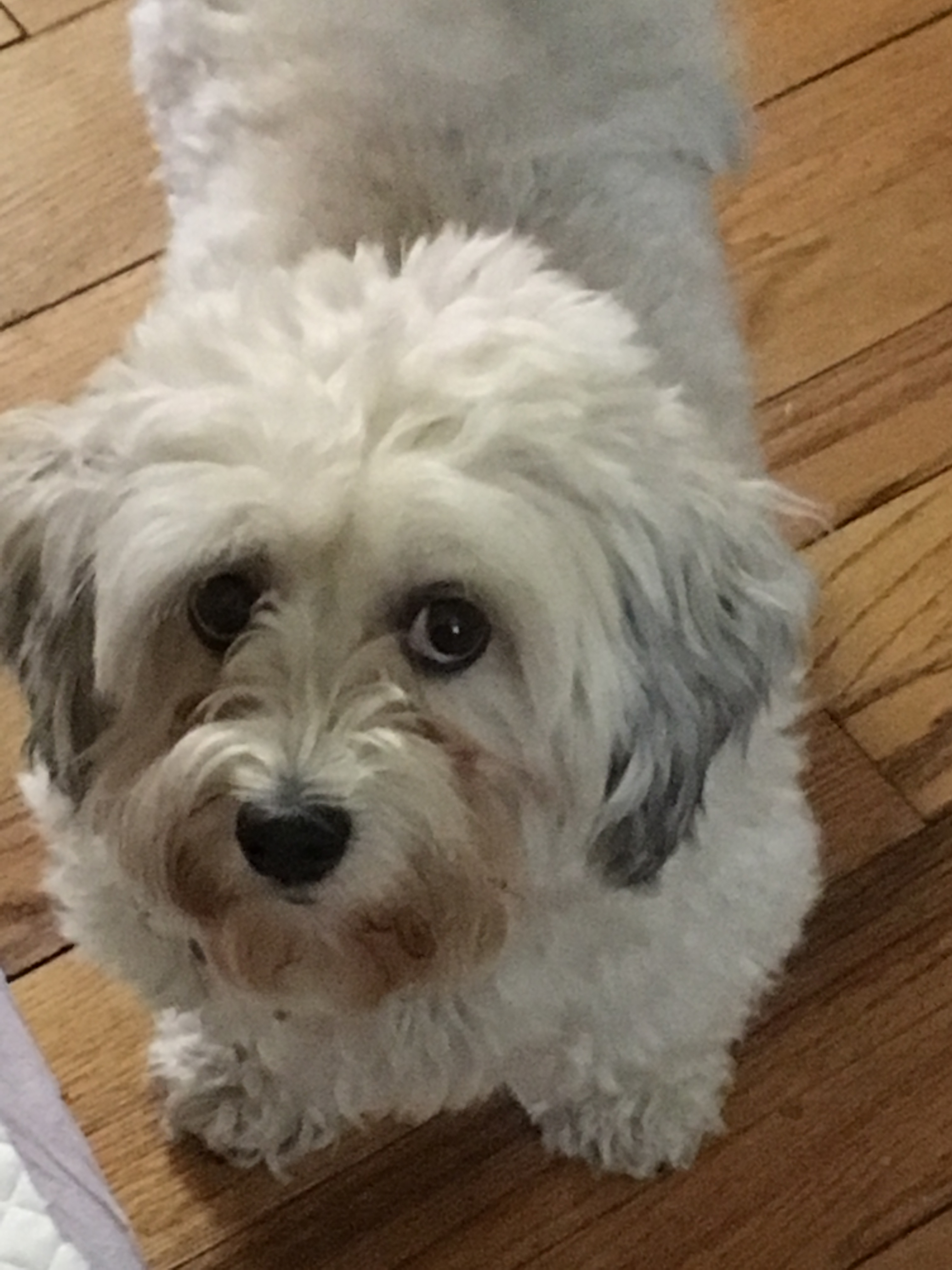
“Don’t worry, Mommy. I only hate people who deserve it.”

If you haven’t had a chance yet, please check out my Young Adult novel, Yeshiva Girl, on Amazon. And if you feel called to write a review of the book, on Amazon, or anywhere else, I’d be honored.

            Yeshiva Girl is about a Jewish teenager on Long Island, named Isabel, though her father calls her Jezebel. Her father has been accused of inappropriate sexual behavior with one of his students, which he denies, but Izzy implicitly believes it’s true. As a result of his problems, her father sends her to a co-ed Orthodox yeshiva for tenth grade, out of the blue, and Izzy and her mother can’t figure out how to prevent it. At Yeshiva, though, Izzy finds that religious people are much more complicated than she had expected. Some, like her father, may use religion as a place to hide, but others search for and find comfort, and community, and even enlightenment. The question is, what will Izzy find?