Tag Archives: Jewish

My Father Died

            I found out that my father had died by listening to Mom’s side of a phone call. It took a while for me to figure out that she was talking to my brother, and then even longer to figure out that he was telling her my father had died. I had to wait until the call was over to get the details – that my father had been in and out of nursing homes and hospitals for the past three years (which we sort of knew, from clues but not from direct information), that he didn’t have dementia (which is what Mom had assumed), and that there was drama around when and where the funeral would take place.

            I wrote to four people after I found out – two good friends, my therapist, and my rabbi. And my rabbi rushed out of a committee meeting (reluctantly?) to call me and see what I might need from him. He already knew the backstory, about the sexual abuse and the estrangement (I hadn’t seen my father in 23 years), and he said something that really stuck with me. He said that the commandment to Honor your father and mother is often misinterpreted. The word in Hebrew is Kaved, which actually means weight or weigh, not respect or honor. It means that you should weigh the role of your parents in your life when you decide what you owe them in return; you are not required to blindly honor or respect a parent simply because they are your parent, but because they acted as a parent should and raised you with love and respect and guided and protected you. The commandment to Honor your father and mother is not meant to be a get out of jail free card for any parent who abuses or neglects their children.

            I am not orthodox, like my brother and his family, and I don’t believe that my rabbi is the final word on what I can and can’t do as a Jewish woman, but it helped to have validation and support, both from a person I trust and from the tradition of my ancestors.

            I made sure to tell my rabbi not to put out an announcement that my father had died or to add my father’s name to the list for the Mourner’s Kaddish at our synagogue at Friday night services. I didn’t want to receive messages from people who care about me but don’t know my situation, telling me that they are sorry for my loss and may my father’s memory be a blessing. It isn’t a blessing. He wasn’t a blessing in my life.

“Grr.”

            Jewish funerals are required to take place as soon as possible after the death, but I did not go (though Mom watched it on Zoom to support my brother and his children). And I didn’t go to sit Shiva at my brother’s house, though Mom went to visit and to offer support, avoiding discussions about what did and did not happen in the past.

            I stayed home and sought comfort from my friends and my dogs and my therapist, but I was jealous of my brother’s ability to mourn our father, and all of the Jewish rituals that would support him through that process. I found myself feeling jealous of anyone who could find comfort in hearing their lost loved one’s name read out each week before the Mourner’s Kaddish, or who found comfort in saying the Mourner’s Kaddish and praising God in the memory of their lost loved one. I’m jealous of people for whom the traditional rituals work – like giving nostalgic eulogies and having friends and family over to reminisce and tell stories and share food for a week. Those mourning rituals are so beautiful and powerful, but only when thinking about the lost loved one is a comfort.

“Oy.”

            My situation doesn’t fit into the traditional framework. My father sexually abused me, and others. He was a pedophile and a narcissist and a manipulator, and he denied what he’d done and denied the significance of the things he couldn’t dispute having done, and never made any attempt to make amends. If anything, he continued to try to convince important people in my life that I was lying and he was a victim. The fact is, I still live in a world that doesn’t want to reckon with the reality that abuse and neglect are everywhere, and that they destroy lives every day.

            This was brought home to me, vividly, that night, when, after writing my emails and texts and making my phone calls, I tried to distract myself with an episode of New Amsterdam on NBC. It’s a hospital show with an idealistic bent, often too simplistic, but still hopeful about making the world a better place. It’s not my favorite show, but I watch it regularly and often find it comforting and/or interesting. But for whatever reason, that night, out of nowhere, the writers chose to go down a rabbit hole about Recovered Memories.

            Recovered Memories is a somewhat generic term that people often use to describe traumatic memories that have been forgotten at some point and then remembered later. A lot of how you define the term Recovered Memories depends on what your intentions are: if you want to debunk the idea that it’s even possible for memories to return after a period of forgetting, you will probably define Recovered Memories as wholly forgotten and then remembered only with the help of a therapist or a drug; if you believe that trauma can cause memories to fragment or be blocked for some period of time, you’ll probably define Recovered Memories more generally, as partial forgetting and partial remembering over time, often triggered by events in the present that remind you of the past trauma (like your own child reaching the age you were at when you were abused).

            On this episode of New Amsterdam, the writers decided to take the loveable psychiatrist on the show, who is more often than not empathetic and kind, and have him testify in court that all Recovered Memories, of any kind, are unreliable. They even had him quote a study about The Shopping Mall Experiment, where the researchers said they were able to “implant” memories in susceptible adults of having been lost in a mall in childhood. The study has been debunked for any number of reasons, but the biggest reason is that traumatic memory and “normal” memory are not the same, and while being lost in a mall might be scary, it would not qualify as a traumatic memory unless something traumatic happened while you were lost.

            But still, I wanted to believe that the writers on the show were going to handle the issue sensitively, and in the next scene they gave me hope when the psychiatrist’s female colleague confronted him with her own recovered memory (though not of abuse), and with the terrible impact his testimony would have on millions of women and children who had been abused and tried to testify to that in court. But then the psychiatrist doubled down on his belief that not only Recovered Memories, but ALL memories, are unreliable. He went on to specifically attack the legitimacy of his female colleague’s memories, by researching the probable season and location where the memory would have taken place, disputing her memories of the weather on that day in order to prove to her that it could not have happened the way she remembered it. He was relentless and wildly inappropriate, and the writers gave no explanation for why he would feel so strongly about this particular issue or why he would be willing to be so cruel to his friend.

By the end of the episode it seemed to me that the writers’ intention was to use this whole storyline as a way to question the female colleague’s memories of how her father had left her when she was little, so she could reassess her feelings towards her still living mother and therefore change her plans to move to London, which threatened the status quo at the hospital; but they could have found hundreds of other ways to change her mind without invalidating millions of people.

            I was in shock. The violence of the psychiatrist’s attack on his friend seemed to come out of nowhere, and the female colleague’s willingness to forgive him right away was out of character and bizarre. But more than that, the way the writers were misrepresenting the research was horrifying, especially because it is well known in the field that traumatic memories often have missing or distorted nonessential details, like the time of day, or the weather, or the clothes you were wearing, and those mistaken details have no bearing on whether or not the crux of the memory is true.

            The emotions I couldn’t produce in response to the news of my father’s death came roaring up as I watched this show and felt invalidated and manipulated all over again. You can’t prove it and therefore it didn’t happen. You have no pictures and I don’t want to believe you and therefore it didn’t happen. Your memories, your symptoms, your feelings, are nothing in the face of what I want to believe.

            But I’ve done the reading that the writers on New Amsterdam clearly did not bother to do, and I’ve done the listening, to many people who have been abused, and I know that the brain often tries to protect us from knowing things we are not ready to deal with. I just felt so let down that a show that had seemed thoughtful and kind was no longer trustworthy.

“Oh no!”

            I am still processing my father’s death, and trying to figure out how it changes things, if it changes things. I am safer now than I was as a child. I am loved and supported and listened to and believed; and I cherish the people who have brought me comfort and made my world a better place. But the mourning process is still ongoing, for the loss of the childhood and the father I could have had, and for the years spent trying to recover, and I wish there could be established rituals to help me through this kind of mourning. There are so many of us in similar situations, trying to cobble together the support we need to move forward. I can’t be the only one who struggles to create those rituals on my own, and I can’t be the only one who feels let down by a world that refuses to acknowledge the pervasiveness and validity of the need for those rituals.

“Would hugging a puppy help?”

If you haven’t had a chance yet, please check out my Young Adult novel, Yeshiva Girl, on Amazon. And if you feel called to write a review of the book, on Amazon, or anywhere else, I’d be honored.

            Yeshiva Girl is about a Jewish teenager on Long Island, named Isabel, though her father calls her Jezebel. Her father has been accused of inappropriate sexual behavior with one of his students, which he denies, but Izzy implicitly believes it’s true. As a result of his problems, her father sends her to a co-ed Orthodox yeshiva for tenth grade, out of the blue, and Izzy and her mother can’t figure out how to prevent it. At Yeshiva, though, Izzy finds that religious people are much more complicated than she had expected. Some, like her father, may use religion as a place to hide, but others search for and find comfort, and community, and even enlightenment. The question is, what will Izzy find?

Sodom and Gomorrah

            This year I was asked to teach a few extra classes in the synagogue school, on Saturday mornings, focusing on the week’s Torah portion (the chapter of the Hebrew Bible that is read by Jews around the world at the same time). I was nervous and excited about the opportunity, because it was new to me, but also because I’ve never really had the chance to teach the stories from the first and second books of the Hebrew bible. I usually teach the book of Leviticus, which is full of laws and holiness, but not many plotlines or characters or dramatic scenes. And then I found out which Torah portion I’d be teaching the kids, and I thought, when it rains it pours, because I would be teaching the Torah portion that contains Sodom and Gomorrah, The banishing of Ishmael, and The Binding (and almost sacrificing) of Isaac. You know, the light stuff.

“Eek!”

            I could, almost, imagine how to teach the drama of a parent who is willing to risk the life of his child on the say-so of God (kids sort of feel like this is what happens every day of their lives when their parents insist on sending them to school against their will), but Sodom and Gomorrah, with its themes of unforgivable evil and sexual violence, and God turning two whole towns into rubble? Not so much.

            I wrote up my lesson plan, tap dancing and editing and omitting my way to a version of the Torah portion that would be interesting to the kids, without giving them too many nightmares. But I still found myself thinking about Sodom and Gomorrah, and how hard this story is to reckon with, and why.

            The biggest problem, for me, is that the English word “Sodomy,” clearly based on the town of Sodom, has come to refer to homosexual acts, and many religious people have decided that this story is meant to teach us that God will punish you with death and destruction for engaging in homosexual acts, or allowing/supporting others to engage in those acts. Now, I know that the Hebrew Bible is often brutal, and I know that there is a biblical law against homosexual behavior (it’s in Leviticus, so I see it a lot), but it still felt unreasonable that God (and/or my ancestors) would see homosexuality as such a heinous crime that it should earn the destruction of whole towns, whole families, including children. So I decided to re-read the story to see what I was missing.

            In Genesis 18-19, three men come to Abraham in the plains of Mamre, two angels and God in disguise, to tell him that the towns of Sodom and Gomorrah will be judged and punished for their grievous sins (unspecified). Abraham tries to bargain with God, because his nephew Lot lives there, and he says, if there are fifty righteous people, or forty, or thirty, will you save the town? And God agrees to save the town even if there are only ten righteous people, but there aren’t even ten, so God tells Abraham that he will have to destroy the towns after all. But he sends his angels to warn Lot ahead of time, so he can save himself and his family.

            The two angels, in disguise, then go to the main square in the town of Sodom, and Lot invites the strangers into his home, without knowing who they are, and serves them a meal. The men of Sodom then surround Lot’s house and tell Lot to bring the two strangers outside so they can know them (to “know” is sometimes a euphemism for sex in the Hebrew Bible). Lot refuses to hand over his guests and instead offers up his two virgin daughters to the crowd. The men of Sodomrefuse his offer and try to break down Lot’s door.

            The angels then blind the men of Sodom and tell Lot about their mission to destroy the city. They command Lot to gather his family and leave, and not to look back. And then the cities of Sodom and Gomorrah are destroyed with fire and brimstone, and Lot’s wife looks back at the destruction and becomes a pillar of salt (I could do a whole essay on Lot’s wife, and how looking back at what you’ve lost is natural and not a crime, but I’ll save that for another time).

            Israelite prophets, in later books of the Hebrew Bible, named the sins of Sodom and Gomorrah as adultery, pridefulness, and un-charitable behavior. Many Rabbinic commentators have focused mostly on the lack of hospitality to the stranger as the sin of Sodom and Gomorrah, hospitality being the one Mitzvah (commandment) that Lot performs in the story, by inviting the strangers into his home.

“Strangers? In my house?!”

            The habit of blaming homosexuality for the destruction of Sodom and Gomorrah is much more recent. No Jewish literature, until the writings of Philo in the first century of the Common Era, actually mentioned same-sex behavior as a possible cause for the destruction of the towns. And the term Sodomy wasn’t coined until the 11th century of the Common Era, and even then it was widely used to refer to all non-procreative sexual acts (including heterosexual acts) rather than specifically to same sex relationships.

            There is a strikingly similar story to Sodom and Gomorrah in chapter 19 of the book of Judges. An unnamed man from the tribe of Levi is traveling with his concubine and his servant. He arrives in the town of Gibeah and plans to spend the night in the town square. A local man, from the tribe of Ephraim and therefore not a native of the town (like Lot wasn’t a native of Sodom), offers the Levite and his concubine and his servant shelter in his home. Soon the men of the city surround the house and demand that the owner send out the Levite “so that we may know him.” The owner, like Lot, offers up his virgin daughter and the Levite’s concubine instead, and the crowd rejects the offer, just like the men of Sodom did. Except, in this version there are no angels to intervene, and to save himself the Levite forces his concubine out the door, and the men of Gibeah rape her to death. There is no response from God, no fire and brimstone, instead the Levite carries his dead concubine home and cuts her corpse into twelve pieces, sending one piece to each of the twelve tribes, showing them the results of their baseless hatred of strangers.

            It’s a brutal way to send such a message, and the Levite doesn’t seem like the best messenger, since he offered up his concubine to save his own life, but the message in this version of the story is clear: If you don’t wise up and learn how to treat the strangers in your midst, destruction will come to you. If only because, at some point in your life, you yourself will be the stranger.

“I was a stranger once.”

            The mitzvah of hospitality to strangers was very important in the ancient Middle East, where traveling on arid land was a life or death venture. The conventions of hospitality were created to protect both the traveler, who would die without food and water, and the host, who could easily be killed by a traveler in need. These were basic codes of behavior that were meant to keep everyone safe, so when the Sodomites tried to attack the two men in Lot’s house simply for being strangers, it threatened the moral code of the area, and the safety of everyone.

            Sodom and Gomorrah feels like a lesson we keep having to learn, and a lesson we keep choosing to learn incorrectly. If you recognize rape as a weapon, rather than as a variety of sexual behavior (heterosexual or homosexual), then you can see Sodom and Gomorrah for what it is: a story about how selfishness, and violence, and baseless hatred of the stranger ultimately leads to the destruction of the people who commit these sins. The punishment doesn’t have to come from an outside force, like God, because it is already an inevitable result of making enemies out of everyone around you. If you send your daughters out to be raped by a crowd, they will die, or they will come back to you full of rage; either way you have destroyed the future of your family. If you treat strangers as enemies and abuse them, you will not receive any help from future strangers; in fact, they may strike out at you first, to protect themselves, knowing your reputation.

            If we read Sodom and Gomorrah through the lens of its sister story, the evil here, the “sodomy,” is clearly the baseless hatred of people who are not like us, and has nothing in particular to do with homosexuality. At some point the story was turned inside out, but that doesn’t have to be the last word. We can re-read the story and turn it right side out again to see the power of hospitality and welcoming the stranger to save all of our lives.

            By the way, when I taught my students about the banishing of Ishmael from his home, after the birth of his half-brother Isaac, they said that Ishmael should have been allowed to stay so that he and Isaac could have grown up together. And if Ishmael had been able to stay, then the descendants of Ishmael (commonly seen as today’s Arabs) and the descendants of Isaac (the Jews) would have been one family, one people. We are so quick to see each other as strangers, imagining that our differences are unbridgeable oceans, but maybe we are all half-brothers and sisters, feuding over our birthrights and our parents’ love, fighting over resources that don’t have to be scarce if we can heal the wounds of the past. Maybe, if we re-read our own stories, we can find a way forward that makes all of us safer and better off.

“Harrumph.”

If you haven’t had a chance yet, please check out my Young Adult novel, Yeshiva Girl, on Amazon. And if you feel called to write a review of the book, on Amazon, or anywhere else, I’d be honored.

            Yeshiva Girl is about a Jewish teenager on Long Island, named Isabel, though her father calls her Jezebel. Her father has been accused of inappropriate sexual behavior with one of his students, which he denies, but Izzy implicitly believes it’s true. As a result of his problems, her father sends her to a co-ed Orthodox yeshiva for tenth grade, out of the blue, and Izzy and her mother can’t figure out how to prevent it. At Yeshiva, though, Izzy finds that religious people are much more complicated than she had expected. Some, like her father, may use religion as a place to hide, but others search for and find comfort, and community, and even enlightenment. The question is, what will Izzy find?

Back to School

            Before we started the new synagogue school year, I had a million ideas for how to improve my teaching – lessons learned from my two years of teaching synagogue school so far, and from reading and googling, and from my online Hebrew classes and virtual tours of Israel. I had too many ideas to fit into the few hours a week that I would get with my students.

            I wanted them to learn more about Jewish history than the Holocaust: like the Babylonian Exile in 587 BCE and how it taught the ancient Israelites that they could bring God with them wherever they went; like the transition to Rabbinic Judaism, after the destruction of the Second Temple in 70 CE, when all seemed lost without the Temple, and yet the rabbis found a way forward by canonizing the Hebrew Bible and continuing the traditions in study and prayer and laws and customs; like the Spanish Inquisition and the forced conversions and the massacres and endless exiles of the Jews from one European country after another that spread the Jews around the world, where they were able to learn from different cultures and bring the world’s customs into Judaism; to Modern Israel, where Jews from around the world have been able to make a home and attempt to blend different cultures and races and customs and foods into one country; to modern antisemitism, and antizionism, and conflicts between Jews and Palestinians, and conflicts between different branches of Judaism. There’s so much for them to know!

“It’s too much.”

And I wanted them to have a sense of what’s in the Hebrew Bible, and that they have a right to question any and everything in it, and I wanted them to be able to sound out Hebrew words, and begin to understand Hebrew when they heard it, and begin to build a love for the language. I wanted them to be familiar with the prayers, but more than that, I wanted them to feel empowered to create their own prayers and to know that their own thoughts are just as valuable as those of the rabbis who wrote our prayer books. And I wanted them to have fun and make friends and be silly and feel like part of a community that embraces them as they are.

“We’re perfect!”

My first in-person day of Synagogue School, back in September, was a bit chaotic, but not terrible. We were in a nursery school classroom, because our space was being used for the High Holiday services, so I told myself that any excess difficulty I was having with the kids came from being in a crowded space, with too many toys (there’s something about toys meant for younger kids that makes the older kids lose their minds). I also had thirteen students, with more boys than girls for the first time, and when I told people that I had a boy-heavy class this year they looked horrified and said things like, better you than me. But the boys I had in my class last year were wonderful; they were thoughtful, and creative, and kind, so I thought that if even a few of this year’s boys were anything like last year’s I would be very happy. I wasn’t too worried.

            And during the break from in-person classes we continued to have zoom classes, which went really well. I was a little bit nervous about going back to in-person classes after a three week break, especially because we’d be returning to our regular “classroom” in the social hall, but I still thought everything would be okay.

The kids dribbled in one or two at a time for our second in-person class, in October, so we got a sort of relaxed start to class, but as time passed and more kids showed up I realized I’d forgotten how hard it is to hear in the social hall, and how much space there is for the kids to get into trouble. And I was at sea. The kids were screaming and wandering around and struggling to concentrate on the lesson. But I still wanted to believe that it was the fault of the room, and the long break between in-person classes, and that it would get better on its own.

I had a short break from my class, to teach an elective to my students from last year, and then I walked back into my classroom and I saw my students sitting calmly and listening to the teacher who had been working with them for the past half hour, handling the same exact kids with the same exact problems; and I suddenly realized that the problem was me.

“Uh oh.”

After I got over the humiliation, somewhat, I emailed the teacher who had performed this miracle, and asked for her help. And she was wonderful. She’s been teaching for a long time, both in Synagogue School and before that in regular school, and she said, first and foremost you need to create structure in the classroom so that the kids can feel safe. She said, they need to know what’s expected from them, or else the world feels chaotic and they don’t know what to do. Kids don’t come pre-programmed, they need help building the skills to stay focused and be kind to each other, and to me.

            The master teacher calmed me as successfully as she had calmed my students, setting clear guidelines for what I needed to do, and explaining the reasons for each behavior, and helping me problem solve different situations while firmly sticking to her overall goal: create structure so the kids know what’s expected of them.

            But it’s hard. I tend to take everything the kids say to heart. When they tell me they’d rather be anywhere than in synagogue school, I think it’s my fault, because I’m boring. And when they can’t sit still, I feel like I’m evil for making them sit instead of letting them run around. When they drag their feet through an activity, or want to always do something else, I take that as a sign that I’m teaching the wrong things, rather than that they need some reinforcement that the lesson I’m teaching is worth their time.

            So now I am starting again; not from scratch though. I need to remind myself that I am the adult in the room and I actually do know what to do, even when the kids tell me that I don’t. And I need to remind myself that structure and discipline do not equal abuse or squashing of potential, if done with careful intention and empathy. But most of all, I need to keep reminding myself that I cannot be perfect and it’s not even required. I can make mistakes and learn from them, and I can choose what to teach, based on what matters to me and what I’m good at, and that doesn’t make me a meanie or a bad teacher.

“Mommy’s a meanie!”

            And maybe that’s one of the best lessons I can teach my students; that we don’t have to do everything and be everything and learn everything right away, or ever. We can each be our own imperfect selves and, maybe together, as a whole, we can get where we want to go.

            With all of my hopes at the beginning of the school year for what I could teach the kids, I think if I could teach them that they are enough as they are, that would be enough. But first I have to learn it myself.

“We’ll help you, after our nap.”

            If you haven’t had a chance yet, please check out my Young Adult novel, Yeshiva Girl, on Amazon. And if you feel called to write a review of the book, on Amazon, or anywhere else, I’d be honored.

            Yeshiva Girl is about a Jewish teenager on Long Island, named Isabel, though her father calls her Jezebel. Her father has been accused of inappropriate sexual behavior with one of his students, which he denies, but Izzy implicitly believes it’s true. As a result of his problems, her father sends her to a co-ed Orthodox yeshiva for tenth grade, out of the blue, and Izzy and her mother can’t figure out how to prevent it. At Yeshiva, though, Izzy finds that religious people are much more complicated than she had expected. Some, like her father, may use religion as a place to hide, but others search for and find comfort, and community, and even enlightenment. The question is, what will Izzy find?

Egyptology and Hieroglyphics

            I took two Egyptology classes in college, basically because they fulfilled requirements for my philosophy major and for my honor’s scholarship. One class was on Hieroglyphics and learning how to draw them, and the other was on Egyptian philosophy. I hated my teacher, but it turned out that I actually loved the class where we learned how to draw the Hieroglyphics. There was something magical about seeing the origins of the letters in actual objects, like the ground plan of a simple house is the Hieroglyph for “house,” and an outline of a mouth stands for “mouth,” and a pair of legs in motion means “to come.” But there were also Hieroglyphs of animals, like an Egyptian vulture for the letter A, and a horned viper for the letter F, that hinted at even more meaning to be discovered.

Hieroglyphic translation chart from greatscott.com
“Why so many birds and no pictures of me?”

            The Ancient Egyptian language was written in four scripts, over the course of time. First Hieroglyphics, then Hieratic, (meaning “priestly”) which was a simpler cursive form of Hieroglyphics written mainly by priests, and then Demotic (meaning “popular”) which was a more rapidly written form of the Hieratic script, first appearing in the eighth century BCE and used by the common people, and finally Coptic, which was the final version of Egyptian writing, using the Greek alphabet in addition to seven Egyptian letters representing sounds that didn’t appear in Greek.

            Ancient Hebrew would probably have fit in between Demotic and Coptic, because it was a language that could be written quickly and by the common man, but it wasn’t yet filled out with vowels and spaces to allow for easier reading.

            One of the important differences between ancient Egyptian and ancient Hebrew, though, is that Hebrew continued to develop into what is now Modern Hebrew. Hebrew was eventually given vowels, and spaces, and punctuation to help modernize the language and allow people to read it and speak it more widely. Whereas the ancient Egyptian language stayed in Egypt, ancient Hebrew speakers were exiled from Israel, multiple times, and chose to bring their language, and their religion, with them into the diaspora.

            Despite not liking my Egyptology teacher, I still learned a lot from his class, especially about the influence of ancient Egypt on the development of Judaism. Take for example, the Egyptian belief in magic. In the Hebrew Bible, when Moses goes to Pharaoh to ask him to let the Israelites go, he turned his rod into a snake to show God’s power, but then the Egyptian magicians were able to do the same thing, and Moses had to level up, with the plagues. Was Moses using magic? He was raised by Egyptians after all. The Hebrew Bible is full of magical things, like burning bushes and the splitting of a sea. The magical realism of Egyptian religion and literature definitely influenced the stories in the Hebrew Bible, but then, in the minds of the writers of the Hebrew Bible at least, these acts of God took on a deeper meaning, a poetry, that was beyond magic.

“What’s beyond magic? Is it food?!!”

At the high point of Egyptian civilization there were 2500 gods, with different main gods in charge in different eras, and each god had a place to dwell and a personality and a backstory. And while we think of Judaism as absolutely monotheistic, early on, even though Yahweh was the main God of the Jews, other gods were still acknowledged and worshipped by the Israelites. Prophets eventually came along to yell at the people to stop worshipping other gods and only to worship Yahweh. But even then, Yahweh was considered the god of a particular place. It took exile for the Jews to invent the idea of a god who can travel. When they were exiled to Babylon, after the destruction of the first temple, they realized that they could take their religion, and their concept of God, with them. Eventually, this image of a God who can go wherever you go, became a God who can be whenever and whatever you need God to be. And if your god can be everywhere and anywhere, maybe your god is The God. Period.

            But this transition took a long time, and a lot of wrestling with the gods and ideas of other people and places. Many of the values we think of as particularly Jewish, or Judeo-Christian, were already there in Egyptian writings. One of the most obvious borrowings from Egyptian literature shows up in the book of Proverbs, in the Hebrew Bible. Proverbs is a collection of wisdom literature, addressing morality and good behavior, and is made up of six sections. Each section seems to have been composed at different times, but the third section in particular borrows directly from the Instruction of Amenemope (a piece of Egyptian literature composed between 1300 and 1075 BCE). Some lines are taken almost verbatim and others come very close in their messages, for example: give charity to the poor, avoid the “strange” woman, avoid harmful speech, use fair business practices, and tell the truth. These are all values embraced in Proverbs, and in the Hebrew Bible overall, but in no way unique to the ancient Israelites.

            Somehow, knowing some of the influences on the Israelites, and seeing what they chose to keep and what they chose to change, makes the ancient Jews feel more real to me. They didn’t appear out of nowhere; they were a product of their time, and interacted with the ideas around them. I can relate to that process of sifting, and it gives me more confidence in my own right to reassess their ideas, in order to determine what I believe in, and who I want to be going forward.

“We believe in the power of chicken.”

If you haven’t had a chance yet, please check out my Young Adult novel, Yeshiva Girl, on Amazon. And if you feel called to write a review of the book, on Amazon, or anywhere else, I’d be honored.

            Yeshiva Girl is about a Jewish teenager on Long Island, named Isabel, though her father calls her Jezebel. Her father has been accused of inappropriate sexual behavior with one of his students, which he denies, but Izzy implicitly believes it’s true. As a result of his problems, her father sends her to a co-ed Orthodox yeshiva for tenth grade, out of the blue, and Izzy and her mother can’t figure out how to prevent it. At Yeshiva, though, Izzy finds that religious people are much more complicated than she had expected. Some, like her father, may use religion as a place to hide, but others search for and find comfort, and community, and even enlightenment. The question is, what will Izzy find?

Prayer is Work

            Walking into the synagogue for the third day in a row of Rosh Hashanah services (one evening and then two mornings), I yawned and said to Mom, this prayer thing is work. I actually do work at my synagogue, as a teacher, so there’s a blurring of the lines for me between work and prayer on a regular basis. But I was specifically referring to the exhaustion of dressing up, and spending hours standing and sitting and standing, and dealing with my endless social anxiety so that there was no energy left to do much else. But when I was flipping through the prayer book later that morning (and our prayer book for the High Holidays requires a lot of flipping to get from one prayer to the next, because if we tried to say every prayer in the book we’d be there all week), I saw the word Avodah, which means both work and worship, and I had an aha moment.

“Aha!”

            In the back of my mind, I knew that the word Avodah was used to refer to the animal sacrifices in the ancient temple days, and that after the second temple was destroyed, in 70 CE, the sacrifices were replaced with prayer, and therefore the word Avodah came to refer to prayer. But more often than not, the word Avodah, in Modern Hebrew, refers to work: like a nine to five job or a chore that needs to get done. Sitting there in the sanctuary, praying that we would remain seated for a few more minutes, I wondered, were our ancestors so low on vocabulary that this one word, Avodah, had to have two meanings, or was there more poetry in the dual usage?

In our modern world we tend to think of prayer as transcendent, and spiritual, and somewhere above our regular lives, but in traditional Judaism, prayer and ritual are grounded in everyday life. You wake up and say the Shma, you go to the bathroom and say a blessing, you wash your hands and say a blessing, you pray three times a day, in community or alone, and then you continue to say blessings all day long; it’s not separate from your real life at all – it is your life.

But I’m not traditional in that way, and I tend to experience prayer as an oasis I can escape to on Friday nights, on Zoom or in the sanctuary, with my community. Except on Rosh Hashanah and Yom Kippur. The long standing/sitting/standing intervals and the hours and hours of prayer definitely feel like work; but, also, still, transcendent. The work of prayer isn’t, usually, physical labor, but it does require us to stretch our minds to find the wonder in our world, and to search our hearts in order to develop our relationships with God and community.

And this year’s High Holidays were, if anything, more work than usual.

Cricket was not happy.

When the world seemed to open up last spring, we had so many plans for things to “go back to normal,” including having our High Holiday services in person. We were so sure we’d be rushing back to shul that the clergy planned for two or three seatings for morning services, to accommodate all of the vaccinated congregants and still allow for social distancing. But then came Delta. We tried to ignore it at first. We had choir rehearsals week after week, gradually putting our masks back on and sitting further apart, and then our re-opening committee said that not only couldn’t the choir sing, but no one except the clergy could sing in the sanctuary, even masked and vaccinated. And then people started to call in to the synagogue to say they would be watching services online instead of coming in person, to be safe, and, ironically, we were able to plan longer services, since we’d only need one seating for each service to accommodate those still willing to come in person.

            Mom and I decided to go in person instead of watching online, partly because Mom was asked to put on a one woman show in the social hall, to share her photographs and quilting and fiber art, just in time for the High Holidays, and partly because I was going to read my pawpaw essay on the first evening of Rosh Hashanah services.

            I was, of course, anxious about how many people would show up, and how the essay would be received, and how my reading would go (would I pause in the right places? Read too fast? Mumble too much? Fumble over my words?), but most of my anxiety was about how I would look. I’ve gained weight from my attempts at Intuitive Eating, and even on my best days I feel unpresentable, so I was afraid of putting myself up on the Bima in full view.

            I know, I know. It doesn’t sound like the right mindset for such a solemn and spiritual occasion – the beginning of the new Jewish year, the time to atone and make amends and return to the true path yada yada yada – I should be wearing all white with flowers in my hair and smiling beatifically, la la la.

            I felt honored to be asked to read, truly, and hopeful that people would get to know me better from hearing my essay, but… I was afraid. I forced myself to practice my “for the most part thinking,” as in, I will do my best to read my essay with appropriate drama and clarity and humor, and try to look up once in a while, but I can’t expect to be perfect or look perfect. I will try instead to be grateful for the opportunity to share my thoughts, and accept that I will be nervous and self-conscious and therefore imperfect.

            I worked on that a lot, but I wasn’t especially convinced.

Ellie wasn’t convinced either.

            I was nervous all day before my reading, preparing my all back outfit and trying not to look in a mirror. That night, I wore a mask with pictures of dogs on it (over my KN95) to help me feel like the girls were with me, even though they couldn’t be in the sanctuary itself, and I planned to envision a crowd of dogs sitting in the first few rows of the sanctuary, heads tilted with interest as I read, though probably in the mistaken hope that I might say the word “chicken.”

            I walked up to the Bima when it was time, and placed my pages on the lectern, and told the small in-person crowd about the significance of my doggy mask and my imagined crowd of doggy listeners, and they laughed. And then, it went really well. I forgot to think about how I looked, and instead read my essay as if I didn’t know the end of the story ahead of time. I even looked up every once in a while and made eye contact with people in the sanctuary. And I remembered to mention that there was a picture of the pawpaw tree in the social hall, along with the rest of Mom’s beautiful artwork (hint, hint).

Part of Mom’s exhibit – Pawpaw tree is second to last on the right.
The Magic Garden Quilt
Dahlia Art Quilt
Dandelion Thread Painting
Chestnut Leaf Sunprint, with stitching
Mom with her photos and fiber art!

            And then I walked off the Bima and tried, and failed, to put my masks back on as I returned to my seat. It took me three tries to figure out that the reason the masks kept popping off my ear was because I had them upside down, with the nose clips at my chin.

But the response was lovely: lots of warm, kind comments. And then, we went on with the holiday. There was a two and a half hour service the next morning, and Tashlich at the water in the afternoon (the one service each year when congregational dogs are invited. Cricket had a great time sniffing other dogs, while Ellie hid behind my legs), and then there was another two and a half hour service the following morning. And when I finally got home on the afternoon of day three, knowing we wouldn’t have to go back until Yom Kippur, I felt like I could sleep through that whole week and still be exhausted from all of the emotional and physical work of prayer.

Mom and the girls, exhausted.

But saying that it felt like work doesn’t mean I regret it, or wish I’d just stayed home. Instead, it means that I put a lot of effort into something that is sacred to me. I pushed myself to be present, and I built more spiritual muscles in the process.

Yom Kippur, a week later, was, as usual, even harder. The services were longer and there were more of them in a shorter period of time. I didn’t fast, but I went to all of the services and did all of the standing/sitting/standing calisthenics. I switched to sneakers, not so much to avoid leather (one of the things traditional Jews avoid for Yom Kippur) but because my feet hurt, a lot. Yom Kippur requires more standing, and more chest beating and introspection, and repentance. The music was beautiful, and mournful, though, and we were told to hum along with the Cantor as he sang in full voice, standing even longer than the rest of us.

I was asked to do a reading at the concluding service on Yom Kippur, a poem by Yehuda Amichai this time, and I did my best to read it as if the words were my own, as if it were as much a part of me as the essay I read at the beginning of Rosh Hashanah, ten days earlier.

By the end of everything I felt like I’d been hit by a truck, and I still felt guilty for all of the ways I’d cut corners (not fasting, avoiding some of the more penitent prayers in favor of my own thoughts), but overall I felt like I’d done my best. I’d made the most of the opportunity to be present with my community, and within myself, and I was grateful to be finished with the work, for a while, and to be able to rest and let it all settle in.

Did I come to any exciting revelations about my health, my body, my spirituality, or my future from all of that prayer? I’m not sure yet. But I put in the work, and I took a few small steps forward; and, really, every step is worth taking, even if it’s not clear, in the moment, where it will take me.

The girls are ready for whatever comes next, as long as it’s a walk.

If you haven’t had a chance yet, please check out my Young Adult novel, Yeshiva Girl, on Amazon. And if you feel called to write a review of the book, on Amazon, or anywhere else, I’d be honored.

            Yeshiva Girl is about a Jewish teenager on Long Island, named Isabel, though her father calls her Jezebel. Her father has been accused of inappropriate sexual behavior with one of his students, which he denies, but Izzy implicitly believes it’s true. As a result of his problems, her father sends her to a co-ed Orthodox yeshiva for tenth grade, out of the blue, and Izzy and her mother can’t figure out how to prevent it. At Yeshiva, though, Izzy finds that religious people are much more complicated than she had expected. Some, like her father, may use religion as a place to hide, but others search for and find comfort, and community, and even enlightenment. The question is, what will Izzy find?

Ellie’s Grey Eye

            For a few days in a row, Ellie’s left eye was a little bit red and she occasionally seemed reluctant to open it, but she’d had similar symptoms before and they usually cleared up on their own, so I wasn’t worried. The vet had given us an ointment way back when, but when we ran out we didn’t bother to get it refilled. When I saw the redness in Ellie’s eye I had it in the back of my mind to call the vet and ask if she should come in, or if we could just refill the old prescription, but it didn’t feel like an emergency.

“Really?”

            And then, at around ten thirty one night, Ellie looked up at me (to tell me that it was time to go out for the final walk of the day) and her left eye, almost all of it, was grey. It looked like a particularly opaque cataract, except that her eye had been clear just a little while before. I started to panic. My baby was going blind! She had multi-system organ failure that was showing up first in her eye! The emergency vet clinic would cost thousands of dollars I did not have, but how could I not rush her out to the car right away!

            I was freaking out.

“EEEEEK!”

            Mom went to the computer to google the symptoms while I watched Ellie dance around on her toes to let me know that she really, really, really wanted to go outside. There were a bunch of possibilities, like a sudden cataract or irritation, Mom said, so let’s wash her eye with warm salt water and see of that helps. We took the girls out for their walk, because they were now barking up a storm, but I was still freaking out. When we got back inside I made the salt water mixture and held Ellie in the bathroom sink and poured the water over her eye, over and over again, to her great frustration. I was hoping the greyness would just disappear with the water, but no such luck. At least the salt water didn’t seem to be hurting her (though she was very annoyed at getting wet and required serious treats as a reward).

            I went to sleep that night worried that I was condemning my baby to death, or at least blindness, by not rushing her to the emergency vet, but Mom said we would go to Ellie’s own doctor the next day and he would know what to do. I was not convinced. I had nightmares about stray dogs coming to my house for help with serious medical problems and I couldn’t help them. The guilt was endless and I woke up feeling like the most awful, selfish, hopeless, incapable person to ever live. And then Ellie came running into my room with a smile on her face and almost no greyness left in her eye.

            Oh Lord.

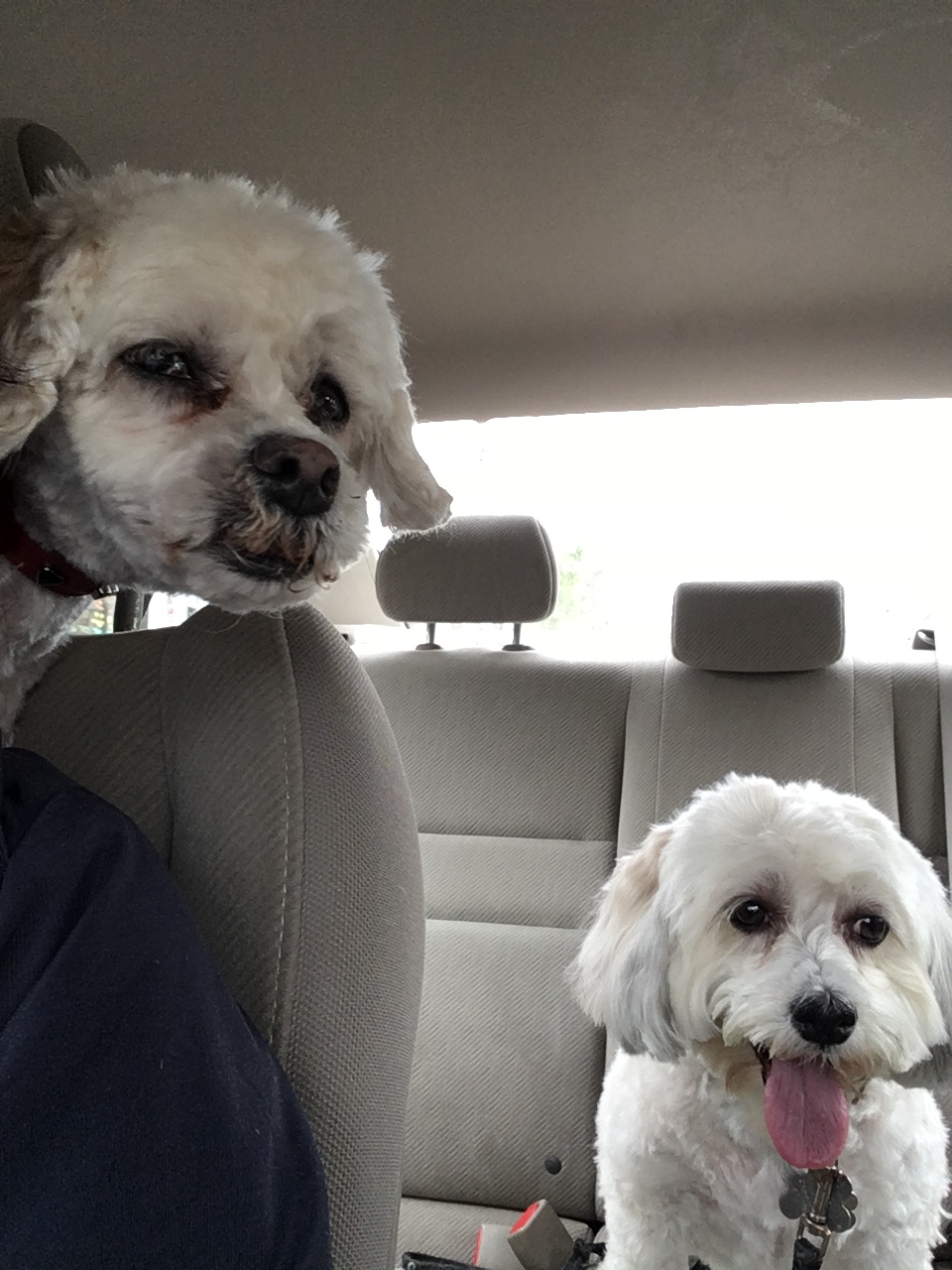
            We made the appointment with the vet anyway, and did everything we could do to distract Cricket while shuttling Ellie out of the apartment. Ellie cried in the car, but she always does that. She sits in the back seat and makes very high pitched conversation with us, to make sure we don’t forget she’s back there (when her sister is in the car with her, Cricket will climb behind my neck, in the passenger seat, to deal with her anxiety and leave Ellie in the back on her own anyway).

“Hey! Don’t forget about me!”

            By the time we’d reached the vet’s office, and the vet tech came out to get Ellie, I actually had to point out which eye was bothering her, because it was hard to see even the redness now. And then we had to sit in the car and wait. I hate this. Going to the vet is always anxiety producing (for me almost as much as for my dogs), but at least I can be there with them to give them comfort and ask questions and remind the doctor of whatever I think he needs to know. With Covid, I just have to sit in the car and wait while they steal my baby away from me.

            Eventually, the doctor came out and told me that Ellie had had a thorn in her eye (!) and he’d removed it, but there was an ulceration at the wound site and she would need eye drops twice a day, and she’d have to come back in a week to have her eye examined again to make sure it was healing. The vet has something of a hang dog face to begin with, but he looked even sadder this time, clearly upset for what my baby girl had been through; which sort of helped, but also sort of made me worry more.

            Then the vet tech brought Ellie back out to the car and, other than the yellow stain on the hair around her eye from the examination, Ellie looked fine. She was eager to get onto her own feet and get the hell out of there, and she had a lot to say about her adventure on the drive home.

            As soon as we got home, Ellie and Cricket had a tête à tête about the vet visit (mostly Ellie reassuring Cricket that she really didn’t miss anything good), and Cricket seemed to be reassured. They both got a treat for their different traumas and then bedded down for their afternoon naps.

            My first attempt at giving Ellie her eye drops that night was not especially successful (she kept closing her eye so that the drop just rolled down her face, but I eventually figured out how to tilt her head back far enough to get the drop into her actual eye). Once she got the hang of the eye drop routine, though, she got so excited about the treat-to-come that she started to dance around before I could get the drop into her. By the end of the week I just accepted that I would never be good at this, and if it took three drops before one got into her actual eye, so be it.

            We never figured out how Ellie had gotten a thorn in her eye, but given her propensity for rolling around on the floor, bed, and ground whenever and wherever she can, it’s not a big mystery. Days after her visit to the vet she managed to get what I hope was just poop on her back (we have dead mice out there in the yard, and who knows what else I don’t what to know about), and she had to have a full bath to wash it all off, and of course treats to make it better, which meant that along with the twice daily eye drop treats she and her sister had pretty much hit the jackpot.

            We went back to the vet after a week of eye drops and he stained her eye again and there was no sign of the ulceration. I was pretty sure there wouldn’t be, because of how healthy and wide open and brown her eye looked, but we had to check and make sure.

            So now we’re back to the usual problems – with Cricket intimidating Ellie away from Grandma, and off the couch, and away from the leftovers meant for both of them. Not that any of that went away while Ellie was suffering; Cricket doesn’t believe in having mercy on an injured opponent. She takes any advantage she can get.

“Who me?”

            G’mar Chatima Tova! To another year of silliness and treats and good health for everyone!

P.S. Ellie begs for treats even while she’s sleeping

If you haven’t had a chance yet, please check out my Young Adult novel, Yeshiva Girl, on Amazon. And if you feel called to write a review of the book, on Amazon, or anywhere else, I’d be honored.

            Yeshiva Girl is about a Jewish teenager on Long Island, named Isabel, though her father calls her Jezebel. Her father has been accused of inappropriate sexual behavior with one of his students, which he denies, but Izzy implicitly believes it’s true. As a result of his problems, her father sends her to a co-ed Orthodox yeshiva for tenth grade, out of the blue, and Izzy and her mother can’t figure out how to prevent it. At Yeshiva, though, Izzy finds that religious people are much more complicated than she had expected. Some, like her father, may use religion as a place to hide, but others search for and find comfort, and community, and even enlightenment. The question is, what will Izzy find?

Traveling around the world with BeamZ

            I don’t remember when the BeamZ ad first showed up on my Facebook feed. I’d been looking for Hebrew language courses some time before then, so my feed was filling up with Jewish-related ads, and this one advertised a free virtual tour of the Jewish Quarter in Paris. Free? Paris? I looked into it a bit to make sure it wasn’t just a scam to get my email address or something, and it seemed genuine, so I decided to try it out.

            Mom and I dutifully sat in front of the computer to see what would happen, and it was, a bit, underwhelming. It was raining in Paris that day, and the host was sort of hitting the end of his rope, telling us that he wasn’t making enough money to keep working as a tour guide and would need to rethink his line of work. His internet connection was also spotty, but there was something about the whole thing; something charming about being on a real time tour of a foreign city.

            The way the BeamZ platform works is that instead of asking for a flat fee up front, they ask viewers to pay a tip to the host if they like the tour. You can pay from two dollars up to twenty dollars (with five to seven recommended), and if you leave early, or feel like it was a waste of your time, you just don’t pay. The guilt for not paying is relieved by the fact that there are so many viewers of each tour at the same time. That arrangement meant that we could take the risk of signing up for more tours, knowing that if we didn’t like the host, or the connection was bad, we could just leave without owing any money or feeling any (or much) guilt.

            I continued to get e-mails from BeamZ, listing more possible tours, and I realized that this wasn’t only a Jewish-centric enterprise; there were tours from Quebec and Tokyo and Vietnam and Amsterdam and Scotland, too. We decided to sign up for another tour, this time to a Flea Market outside of Paris (because Mom is a big fan of flea markets) and that’s when we discovered Patrick. Patrick was relaxed and friendly and knowledgeable, and even though I’m not a flea market/antiques person, I still had a good time. Watching his tour, I started to understand how the platform could really work for a host who could build a following, because there were viewers on the tour who’d been with him week after week, and he kept adding more tours to his list – like a series on sacred places and another on famous Americans in Paris – and hundreds of people were showing up.

“A market for fleas?!”

            On our next Paris tour, Patrick took us to a popular foodie area and showed us the inside of his raspberry pate au choux and chocolate-covered macaron, and walked us through a kitchen supply store and a chocolatier. The immediacy of watching random Parisians walking down the street, some wearing masks and some not, with no one really aware of being filmed, or caring, made it feel like we were really there in Paris, except that I didn’t have to do the walking. And it only cost a few dollars for each of us, instead of having to pay for airline tickets and hotels and transportation. And each tour was only forty-five minutes long, so I didn’t have time to get (too) bored. It was like a little vacation in the middle of the day, and a chance to visit a place I wouldn’t be able to see otherwise.

“Did you say food?”

            I tried a tour of Jewish Berlin by myself, but it felt too much like a history class, and a painful one, because we visited a Jewish cemetery in East Berlin that had been destroyed by the Nazis and remade as a memorial to Holocaust victims. There was a haunting sculpture depicting the people who’d been brought to the Jewish retirement home, in front of the cemetery, when it was made into a detention center for the Jews on their way to the death camps. I made it through the whole tour, and found it interesting, but I wasn’t up to the next three tours in the series.

            We tried a few other tours, to Venice and Quebec and Edinburgh and Loch Ness and Budapest, with mixed results, and then I signed us up for a Tokyo tour. Usually the television coverage of the Olympics is full of stories from the host country, and how the people live their lives, but because of Covid there were only a few overhead shots of Tokyo’s Olympic village, and I wanted more. Our guide, Eriko, walked us through a lotus filled pond – with a walkway running through it – and the lotus plants were as tall as she was! And then we visited a Shinto shrine, and a Buddhist temple, and then we went to a market under the train tracks where they sold pretty much everything, but especially seafood. And there was a candy stall at the end of the market that sold boxes of candy sushi, where you could put together your own little piece of sushi however you wanted! We even saw a pine tree bent by a bonsai master into the shape of a circle! It was placed in front of a Buddhist temple, so that if you looked through the circle you could see another Buddhist temple across the park. Eriko was lovely and seemed to enjoy the trip as much as we did, and we immediately signed up for another tour with her, this time to an area outside of Tokyo called Kamakura, where we could virtually sample Japanese street food.

“Sushi in a cup!”

            And then we went back to Patrick, for a second attempt at Paris’ Jewish Quarter, Le Marais. He told us from the beginning that this tour would be about the sweet and the sour; the memorials to the Holocaust, yes, but also the life of the Jewish quarter today.

            Le Marais means the swamp, because in the Middle Ages the streets in the area were flooded regularly, which is probably why the Jews were allowed to live there. The streets are still what they were in the middle ages, made of cobblestones with a channel down the middle for water to pass through. And there are plaques everywhere to commemorate the French Jews who were murdered in the Holocaust. An especially painful one commemorates the 11,400 Jewish children collected in the Marais and sent to their deaths; one as young as 27 days old.

            One of the main streets of the Jewish Quarter is Rue Des Rosiers – the street of rosebushes – and it is filled with kosher restaurants and pastry shops and Jewish bookstores. Many Jewish people still live in the Marais today and it’s a lively place. I went to the Rue Des Rosiers as a teenager, but I didn’t really know what to look for back then, and I didn’t even get to try the food because I was struggling with a serious eating disorder at the time, so it was so nice to be back there, with Patrick and my virtual friends, in a very different state of mind.

I almost bought that hat when I was in Paris.
This was the best part of my Paris trip as a teenager. By far!

            Some of the streets in the area are set aside for pedestrians, but others have metal poles at regular intervals to prevent cars from ramming into people. Patrick acknowledged that there is still anti-Semitism in France, but he said that there is much more anti-Moslem sentiment among the French. When one woman asked about the number of Jews of color living in France, Patrick told us that French law forbids the counting of people by color, religion, or ethnicity, because of how the Nazis used those lists in the Holocaust, so any count would have to be approximate.

            The last stop on the tour was the Memorial de la Shoah – the Memorial of the Holocaust – which included a wall of names of the French Jews killed in the Shoah (in France they use the Hebrew word Shoah rather than Holocaust). In this memorial, there was a chimney-like installation, with the names of the death camps inscribed on it, and underneath they mixed together ashes from Auschwitz and earth from Israel, to both mark the horror and to provide some form of good burial for those who were murdered.

            The final moment of the tour was the wall of the righteous among nations, listing 3,800 non-Jewish French people determined by Yad Vashem to have helped save Jewish lives during the Shoah. Somehow the balance of the sour and the sweet on this tour was just right.

            There are more BeamZ tours of Prague, St. Petersburg, Glasgow, Lisbon, Barcelona, India, Vietnam, etc…and they’re adding more tours, and more countries, all the time. Covid be damned. My only real problem is deciding where to go next. I’m trying to remind myself that I don’t have to go everywhere right away, because there’s plenty of time to explore at my own pace, if only because Covid doesn’t seem to be going away.

            Cricket and Ellie tend to sleep through these tours, though every once in a while there’s a dog on the screen, barking in a completely different dialect, and they’ll perk up for a second and then go back to their naps. Maybe, one day, BeamZ will do a canine tour of Paris and the girls will be able to take part.

“We’re ready!”

            Until then, in case you’re interested in going on a virtual tour to visit the humans of the world with BeamZ, here’s the link: https://www.beamz.live/

“We’ll wait here.”

If you haven’t had a chance yet, please check out my Young Adult novel, Yeshiva Girl, on Amazon. And if you feel called to write a review of the book, on Amazon, or anywhere else, I’d be honored.

            Yeshiva Girl is about a Jewish teenager on Long Island, named Isabel, though her father calls her Jezebel. Her father has been accused of inappropriate sexual behavior with one of his students, which he denies, but Izzy implicitly believes it’s true. As a result of his problems, her father sends her to a co-ed Orthodox yeshiva for tenth grade, out of the blue, and Izzy and her mother can’t figure out how to prevent it. At Yeshiva, though, Izzy finds that religious people are much more complicated than she had expected. Some, like her father, may use religion as a place to hide, but others search for and find comfort, and community, and even enlightenment. The question is, what will Izzy find?

Abraham the Father of Multitudes

            There’s a belief – that you are supposed to take on faith – that all of the books of the Hebrew Bible, and even the Oral Torah (the commentaries on the Hebrew Bible written later by the rabbis, called the Mishnah and the Gemara) were given by God at Mount Sinai, along with the Ten Commandments. According to Jewish dogma, in fact, the books of Genesis, Exodus, Leviticus, Numbers, and Deuteronomy were all written by Moses (and inspired by God) in about 1300 BCE. Unfortunately, it’s more likely that these stories were written and collected during the Babylonian exile, after the destruction of the first temple in 586 BCE, and a long time after the events described would have taken place.

            My Rabbi likes to say that the early stories in Genesis, pre-Abraham, are meant to be like Rudyard Kipling’s Just-so-stories, fables really, to explain the origins of things in our world. Why is childbirth painful? Why do we wear clothes? Why do we speak so many languages? Why are we scattered across the earth? And the answers were often adapted from what surrounding cultures had come up with to answer those same questions.

“Just so you know: dogs don’t wear clothes, and we all speak Woof.”

            There’s a well-founded theory, new to me but not new to biblical scholars, that everything before the story of the Exodus from Egypt, the central story of the Hebrew Bible, was written to make that Exodus more meaningful, and to explain why the Israelite tribes were able to escape slavery and enter freedom in the land of Israel. Others say that even the Exodus story itself is a fiction, created by a mixed group of tribes living in the land of Israel centuries later, to create a cohesive story of how they became a nation.

            This idea makes me feel seasick, as if the ground under my feet has been pulled away, but in another way it’s freeing. It allows me to see my ancestors, and these stories, as less concrete and more open to interpretation. There are reasons why every culture writes its own history, creating its own heroes and villains. Even the American story, so much more recent in history and therefore much easier to fact check, is full of exaggeration and idealization and interpretation meant to bolster certain values. This is what people do: we tell stories about our lives and our families. Some of these stories are even true, but many of them are meant to be symbolically true and to be emblematic of the life lessons we want to teach our children, rather than sticking strictly to the facts.

            And in the ancient world, history and chronology and literature were treated very differently than the way we treat them today. The idea that we fact check our stories at all would have seemed strange to them, and the idea that the science of a story would have to be correct would just seem silly. They didn’t care if the splitting of the Sea of Reeds was possible, just that it felt true to them.

“I never let facts get in my way.”

            Despite my endless questioning of the biblical authors, I always took it on faith that Abraham (and Isaac and Jacob) were real people. I assumed that the authors of the Hebrew Bible were mythologizing and interpreting every which way, in order to make these patriarchs seem more important and to make them stand for more than just individual people doing idiosyncratic things, but I assumed that at least some of the stories were based in fact. It never even occurred to me to wonder if Abraham himself was a fictional character, created by later generations, to validate cornerstones of the Israelite faith. Part of me even accepted that the mythological characters of Adam and Eve, and even Noah, were historical in some way. My questions, when I had them, were more often about the way the biblical authors interpreted events, editorializing and exaggerating to particular ends, rather than whether or not the events themselves had ever taken place.

            But, if the stories of the Hebrew Bible are fiction, why do the patriarchs, and especially Abraham, matter – so much so that three world religions see Abraham as their forefather?

            The name Abraham basically translates as Big Daddy, or father of multitudes. And yet, Abraham is a mess as a husband and a father, which makes him an interesting choice for patriarch. He’s certainly not a good role model, except, maybe, in his faith in God.

            So what is the point of this Abraham character? And why has he resonated with so many people for so long? We can ask that question whether we believe that God wrote the Hebrew Bible or that many different authors wrote it for their own different purposes, actually. Why has Abraham lived up to his title as the father of multitudes, inspiring so many people to believe in monotheism and this Yahweh version of God?

            The Hebrew Bible doesn’t present us with a paragon of goodness who is born knowing how to do everything right – no, Abraham is flawed, and makes terrible mistakes, even life threatening mistakes, in his misreading of what God wants from him.

            He learns.

            And God is with him every step of the way, not always cheering on his actions but trying to guide him and be with him as he makes his mistakes. Maybe his imperfection is what allows us to relate to him, and go on this journey with him, and believe that, maybe, we can have our own, similar, relationship to God.

“I’m imperfect too, and you love me anyway.”

            This is a God who will stick with you when you struggle, and continue to spur you on to be better, and give you second and third chances to learn. Isn’t that what we all want, really, to be supported along the way and not required to be perfect from the start, or even at the end, in order to earn that support?

            So, does it matter if these characters really existed thousands of years ago? Maybe it’s even more powerful to think that our ancestors were able to imagine these characters and their stories, and create this vision of God. I’m a fiction writer after all; I believe in the power of a good story, whether it’s factually true or not.

“Tell us another story, Mommy.”

If you haven’t had a chance yet, please check out my Young Adult novel, Yeshiva Girl, on Amazon. And if you feel called to write a review of the book, on Amazon, or anywhere else, I’d be honored.

            Yeshiva Girl is about a Jewish teenager on Long Island, named Isabel, though her father calls her Jezebel. Her father has been accused of inappropriate sexual behavior with one of his students, which he denies, but Izzy implicitly believes it’s true. As a result of his problems, her father sends her to a co-ed Orthodox yeshiva for tenth grade, out of the blue, and Izzy and her mother can’t figure out how to prevent it. At Yeshiva, though, Izzy finds that religious people are much more complicated than she had expected. Some, like her father, may use religion as a place to hide, but others search for and find comfort, and community, and even enlightenment. The question is, what will Izzy find?

Israeli Music

(Note: I was originally planning to post this essay back in the spring but decided to pull it when the violence broke out in Gaza and Israel, because it felt like the wrong time to share my lighthearted adventures in Israeli music. Since then I have had a lot of time to think about my silence, and the value of silence and expression at different times. I still don’t have a clear mathematical equation to tell me what to say when, so I have to trust that my readers will take this essay for the love letter it was meant to be, with the understanding that love doesn’t mean perfect acceptance of the loved one’s behavior.

Israel is imperfect and Israeli governments have made problematic decisions that are at odds with world opinion. Israel is also the ancient homeland of my people and the modern miracle that gave many Jews a place to thrive after the Holocaust. Should that miracle have come at the cost of Palestinian peoplehood? No. Were there ways to allow for both peoples to live peacefully in their homelands? Possibly, possibly not. Can things change going forward? I hope so.

Israel is a complicated place, with conflicts between Israelis and Palestinians, and between Jews of Ashkenazi and Mizrachi or Sephardi descent, and between secular and religious Jews. It’s a place where emotions run high and violence and spirituality and hope are all deeply ingrained. Sometimes the only thing that can make it all bearable, for me, is to listen to the music and sing along – expressing all of the hope and bitterness and love and anger at full voice.)

My Israeli Music Mixtape

            My best friend in Seventh Grade was Israeli. She had come to the States with her family a year or so earlier, and we became friends because I was new to our orthodox Jewish school and willing to help her with her English homework. I also understood more Hebrew than most of my classmates, and we shared a love of music. She made me a mix tape of the Israeli songs she thought I should know, to fill out the list of Israeli songs I’d learned in school and camp (she was also a big Billy Joel fan, so I learned his songs too). Eventually she switched to public school and we drifted apart, but I heard years later that she’d become a DJ in Israel, which seemed appropriate.

            Last summer, the Cantor at my synagogue did a Zoom session on Jewish music (of the Non-liturgical kind), and one of the songs he played was an Israeli song, and it was like a time capsule, sending me back to junior high and afternoons singing along with my mix tape. As soon as the Zoom was over I went searching for that old mix tape, and found it. When I tried to play it in my old tape deck from college, though, the tape crumbled in the machine. Not to be deterred, I went to YouTube to re-find some of those songs, and found a bunch of other familiar Israeli songs as well. I made a short playlist, and searched out the lyrics, in Hebrew and English, thinking I could use them in synagogue school in some way, and then filed them away.

            Then, a few months later, I came across an American podcast called Israel Hour Radio: one hour a week filled with Israeli music, both the classics and the modern stuff. I started listening to the archives, with theme episodes on classic songs of the seventies and eighties, and Eurovision hits, and countdowns of the best songs of each year.

On Yom Ha’atzma’ut (Israeli Independence Day) this past year, I played some of the Israeli music videos for my synagogue school students. Unfortunately, the sound from my computer diffused quickly in the cavernous social hall that we’d been using as a classroom during Covid, and, more importantly, most of the songs were in Hebrew, which turned out to be the real deal breaker.

            But I’d had such high hopes! I wanted the kids to love the music as much as I did at their age! I wanted them to hear Ofra Haza singing Yerushalayim Shel Zahav and be knocked out by the clarity of her voice and the way it soared and how her technique seemed so transparent that you could hear her soul right through it.

Ofra Haza

And I wanted them to know that Israel has won the Eurovision song contest a bunch of times, with Hebrew songs, on a world stage! Most of all, I wanted them to know that Hebrew is more than just a language to pray in; that you can even dance to it!

“I can dance!”

            Growing up, so much of my education about Israel was focused on politics and religion, and not on the daily lives of the people who live there. It didn’t even occur to me that they had their own radio stations, let alone that they’d gone way beyond folk music and Israeli dancing into Rap and Hip Hop and Rock and Techno and Pop and Reggae. There’s also a deep strain of humor, silliness, and protest music, as well as a lot of love songs.

            My favorites are still mostly in the category of Shirei Eretz Yisrael (Songs of the Land of Israel), because they are like love songs, filled with longing for a better world, acknowledgement of the bitter and the sweet, and hope for the future. My dream is that, with time, my synagogue school students will like these songs as much as they like Netta (the Israeli Eurovision winner from 2018 who became famous singing a song in English, with lots of clucking noises and chicken-like dance moves – no, really).

Netta

            There was always a strong tradition of public singalongs in pre-State and Modern Israel, as a way to build a national identity from the patchwork of Jews from Eastern Europe and America and Asia and the Middle East. That tradition landed in my American life, in summer camp and synagogue and school, so that I could sing more in Hebrew than I could speak. In my endless YouTube searches this past year, I discovered a relatively recent phenomenon called Koolulam, an Israeli group that creates public sing along videos. They choose a song and prepare the lyrics in Hebrew, Arabic and English, and then they bring together people from all across the country – Muslim, Christian, Jewish, single and with families, young and old – and they teach them the song and make a video of the final version. They call themselves a “social musical initiative” dedicated to bringing disparate groups together. In a way, Koolulam is an extension of the original Israeli imperative of nation building through singalongs – but now the goal is to bring everyone in the country together, not just the Jews. And the resulting videos really are inspiring.

            So, maybe next year, when we can sing together again, I’ll be able to teach my students some of my favorite Israeli songs, even if they are in Hebrew, and no one is clucking. Though I’m sure we could find an excuse to add in the clucking.

“Really?”

            In case you’re interested, I’m adding links to a few of the songs on my Israeli music playlist, but for a deeper education I recommend listening to back episodes of podcast.

NettaToy (the chicken song) - https://youtu.be/CziHrYYSyPc

Ofra HazaYerushalayim shel zahavwith English subtitles https://youtu.be/72QC8EGnxTw

David Broza Yihieh Tov with English subtitles https://youtu.be/qtI7h5A9eEQ

Nina Simone - Eretz Zavat Chalav (A land flowing with milk and honey) - https://youtu.be/YBAAkJyEhlA

Koolulam – Al Kol Eleh for Israel Independence Day https://youtu.be/oxzR9Z-kG6Q

Koolulam One Day (3000 people Muslim, Christian, Jewish) https://youtu.be/RjPpMXMjIj0

Ishay Ribo and Nathan Goshen - Nechakeh Lecha https://youtu.be/ryTO71_eMO4

English translation for Nechakeh Lecha https://lyricstranslate.com/en/%D7%A0%D7%97%D7%9B%D7%94-%D7%9C%D7%9A-nechake-lecha-we-shall-await-thee.html

Amir Dadon and Shuli Rand – Bein Kodesh lechol https://youtu.be/sCJh9YcrL3k

English translation for Bein Kodesh lechol https://lyricstranslate.com/en/%D7%91%D7%99%D7%9F-%D7%A7%D7%95%D7%93%D7%A9-%D7%9C%D7%97%D7%95%D7%9C-bein-kodesh-lechol-between-sacred-and-profane.html)

“We need more music, Mommy.”

If you haven’t had a chance yet, please check out my Young Adult novel, Yeshiva Girl, on Amazon. And if you feel called to write a review of the book, on Amazon, or anywhere else, I’d be honored.

            Yeshiva Girl is about a Jewish teenager on Long Island, named Isabel, though her father calls her Jezebel. Her father has been accused of inappropriate sexual behavior with one of his students, which he denies, but Izzy implicitly believes it’s true. As a result of his problems, her father sends her to a co-ed Orthodox yeshiva for tenth grade, out of the blue, and Izzy and her mother can’t figure out how to prevent it. At Yeshiva, though, Izzy finds that religious people are much more complicated than she had expected. Some, like her father, may use religion as a place to hide, but others search for and find comfort, and community, and even enlightenment. The question is, what will Izzy find?

The Choir is Back

            I recently found out that my synagogue’s choir will be singing in-person at High Holiday services in September. Up through most of June, we thought we’d be recording one or two more videos (to add to the collection we made last year) and using them for services – both online and on screens in the sanctuary. But with the changes to the protocols in New York, our plans have changed.

“Am I singing?”

            In-person choir performances mean rehearsals all summer, starting right away, and also early morning services for Rosh Hashanah and Yom Kippur – which I’m really not looking forward to. Instead of waking up late and eating breakfast and leisurely strolling with the dogs and then getting to synagogue for the 11:30 AM service, the way Mom and I used to do before I joined the choir, I will have to be up and dressed and ready to sing by 8:45 in the morning.

            I’d actually gotten pretty comfortable with the distance singing – making the videos and singing along to a voice in my ear – and now I will have to re-acclimate to four-part harmonies, and ignoring what someone else is singing (loudly, next to me).

“Grr.”

            I’m also anxious about what to wear for services, and which shoes to wear for all of the standing; and I’m worried that I won’t have enough time to get all of my planned writing done this summer, with my Hebrew classes and choir rehearsals and doctors’ appointments and on and on.

            Before the first choir rehearsal could take place, though, a former choir member (whose wife still sings with the choir) died, at age 95. It wasn’t unexpected, given his age and overall health, but it was still a shock. He was full of life, and jokes and opinions, and participated in all of our study sessions and services over zoom during Covid. Almost as soon as the congregational email went out, letting us know of his death, the Cantor wrote to the choir members to ask if we’d want to reschedule our first choir rehearsal and instead go as a group to the first night of Shiva, to sing for our friend. And we all agreed.

This was our first communal funeral since Covid began – the first time we could fill up the sanctuary and sit side by side to mourn one of our own. And it was very sweet. We were able to hear from the children and grandchildren of our lost friend, and share their memories and jokes and tears. And then at Shiva that night, the choir members gathered around his wife, arm in arm, to sing Oseh Shalom (a prayer for peace), which we sing together at the end of every choir rehearsal.

I’d forgotten the power of this, I think, in my fear of the social obligations that come with returning to an in-person world. And maybe I hadn’t even realized what a big part the choir played in these connections – these physical, in-person connections, where we sing to each other and come together.

Sometimes I worry that my social anxiety, and the holes in my social skills, mean that I can’t be a real part of a community, and can’t be a good friend. I worry that I don’t have the gregariousness or the generous instincts other people have by nature. But these are the times when I feel the power of ritual, of having a scaffolding to hold me up as I figure out how to be of use.

It shocks me every once in a while that I’ve found this community, and that I can find a place in it for myself, despite my fear of doing or saying the wrong thing. I’ve learned, slowly, over a long period of time, that everyone says or does the wrong thing sometimes, maybe even all the time, and the world doesn’t end as a result. I still keep a mental list of all of my gaffs and awkward encounters and missed opportunities, but I’ve also collected enough memories of others doing the same things that I’ve learned that it’s okay. We’ve survived a bad joke, or a social misstep, or an inappropriate story, or a missed connection thousands of times, and we are still here.

“How bad are these bad jokes?”

Community can be a fragile thing and requires a lot of work and commitment, and a willingness to speak up when you feel hurt, and to apologize when you are the one who hurts others; but I’ve learned that communities are the safety nets that keep us afloat when our jobs and families and friendship groups can’t quite catch us.

“I will always love you, Mommy!”

When Mom and I first joined the synagogue, nine years ago, I felt the power of going to Friday night services every week and hearing the list of people who had died over the past year, even though I didn’t recognize any of the names. I felt the sanctity in the idea that we mourn together; that these deaths matter to all of us and not just to the close relatives and friends. Over time, more of the names have become familiar, as people I knew, or the loved ones of people I knew, or people I’ve heard stories about from way-back-when have been added to the list. In a way, it feels like an honor to be able to help create a container for the grief, to be able to take on a small part of the weight of memory for someone else, knowing they will do the same for me.

So, I will listen for my friend’s name every week for the next year, and remember how much he valued this community and would want it to survive after his death, if only so we can continue to tell his stories to the next generation. And, as long as the current vaccinations can keep the Delta variant at bay, I will try to embrace the shorter than usual choir rehearsal period, and the earlier-than-heck morning services, because being an active part of this community means that I can help create a safe container for so many different feelings, including joy.

If you haven’t had a chance yet, please check out my Young Adult novel, Yeshiva Girl, on Amazon. And if you feel called to write a review of the book, on Amazon, or anywhere else, I’d be honored.

            Yeshiva Girl is about a Jewish teenager on Long Island, named Isabel, though her father calls her Jezebel. Her father has been accused of inappropriate sexual behavior with one of his students, which he denies, but Izzy implicitly believes it’s true. As a result of his problems, her father sends her to a co-ed Orthodox yeshiva for tenth grade, out of the blue, and Izzy and her mother can’t figure out how to prevent it. At Yeshiva, though, Izzy finds that religious people are much more complicated than she had expected. Some, like her father, may use religion as a place to hide, but others search for and find comfort, and community, and even enlightenment. The question is, what will Izzy find?