Tag Archives: Jewish

The Opioid Epidemic


Recently, the media has been filled with glee around the guilt of the Sackler family (Purdue Pharma) in the origins of the Opioid Epidemic. I have no interest in arguing on their behalf, because the avarice and lack of compassion in their decisions is obvious and really not up for debate. But it interested me that they were singled out, and that the media was willing to simplify the whole epidemic down to the choices of one, rich, Jewish family. I am sensitive to the specter of anti-Semitism, because of the endless role it has played in history, and this struck me as worth examining.

E pre groom

“Are you sure we need to discuss this?”

The Sackler family is responsible for OxyContin, one of the opiates that flooded the market in the nineties, and they attempted to downplay the risks of addiction in their marketing campaigns and ignored misuses of their drugs in favor of making an enormous amount of money, but they could have accomplished none of this on their own. Doctors, who knew that opiates were addictive (Morphine has been around for a long time, Opium for much longer), over-prescribed these medications, and some even made an illegal business out of the underground market for opiates (though most did not). Pharmacies and distributors bought larger amounts of opiates than could ever be used responsibly, knowing they were feeding addiction and illegal markets and doing it anyway. We, as a society, defunded and underfunded addiction treatment, ignoring and demonizing substance abusers so that they could not find a way out, even if they’d wanted to. Families ignored, friends ignored, schools ignored, government ignored, and the FDA approved more and more variations of opiates for the marketplace.

It’s also important to recognize that the Opioid Epidemic has become national and world news in the last few years largely because of the rise of Fentanyl, and then Carfentanyl, both of which are more lethal than Heroin, and have led to many overdose deaths. And Fentanyl has nothing to do with the Sacklers. It’s also important to see that when people of color were losing the war against drugs we didn’t call it an epidemic, instead we blamed the addicts themselves for their problems. This time it is young white people who have been dying, and that seems to have made a difference in the coverage.

Another big difference for the current epidemic is the growth of social media, and technology in general. In the past, a teenager might have had to drive forty minutes to the bad side of town to buy drugs. Now, with a text, you can have anything brought to you in ten minutes. Anything. You don’t have to go to the bad part of town, or spend a lot of money; sometimes all you have to do is open the medicine cabinet in your friend’s house. If we are having an opioid epidemic, then we are having a Benzodiazepine and Marijuana Tsunami, with an alcohol chaser. Vapes, which are everywhere now, can easily be adapted for use with all kinds of different, hard, drugs, and used out in the open. In middle school.

IMG_0930

“You can’t take my Benzos!”

The question is, why did this happen? Why were we so eager to believe the lie that opiates could be made non-addictive? Or that addiction is a small price to pay for pain relief? Or that the market can be trusted to make moral decisions?

This is our culture. American culture. The Sacklers were certainly not acting on Jewish law and morality in their decision making; they were, actually, following the prevailing American value that money is good, and drugs are good, and let’s not think too hard about the downsides, or address the complexities, or look at the people who are struggling, because, really, it’s their own fault if they can’t pull themselves up by their bootstraps.

There are reasons other than Anti-Semitism to explain the hatred and blame of the Sackler family in particular. One, there was a recent document release from their trial, and the information in it was really juicy and obnoxious and therefore caught people’s attention. Even more important, a lot of Americans recognized in the Sacklers a stand-in for the Trumps, and there is great satisfaction in seeing a similarly rich, and corrupt, family being brought down.

But their Jewishness made me nervous. It’s always scary for me to see a Jewish person in the news for criminal, immoral, or unjust behavior – not just because what they did is upsetting, but also because of my fear that their crimes will be used against the whole of the Jewish people. The Holocaust is not as far in the past as some people would like to believe, and we’re seeing an upsurge in anti-Semitism everywhere.

I still don’t know if anti-Semitism played any role in the coverage of this. The origins of the Opioid Epidemic are complex and interwoven and need to be addressed from multiple directions. Simplifying it all down to the greed of one company, and one family, felt good for a moment, because it made us feel like we finally had a handle on what happened. But the epidemic is still happening. We still have a lot of work ahead of us to change our laws and policies and culture, in order to prevent more overdose deaths and lives lost to addiction in all kinds of ways. We want to blame someone, like the Sacklers, or Central American migrants, or corrupt doctors, because we want it to be someone else’s fault, and therefore someone else’s responsibility to fix. But that won’t work. This is our problem, and it belongs to all of us.

012

“Is she serious, Ellie? This is so not my fault.”

011

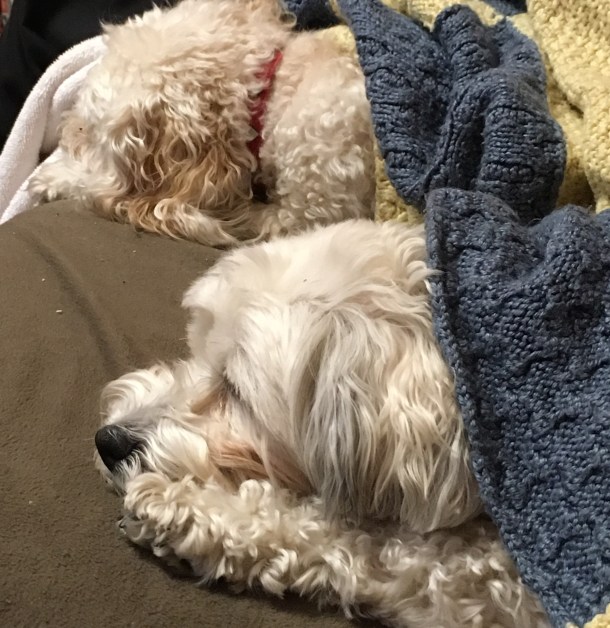
“Just pretend to be sleeping, Cricket. It always works for me.”

If you haven’t had a chance yet, please check out my Amazon page and consider ordering the Kindle or Paperback version (or both!) of Yeshiva Girl. And if you feel called to write a review of the book on Amazon, or anywhere else, I’d be honored.

Yeshiva Girl is about a Jewish girl on Long Island named Izzy. Her father has been accused of inappropriate sexual behavior with one of his students, which he denies, but Izzy implicitly believes is true. Izzy’s father decides to send her to a co-ed Orthodox yeshiva for tenth grade, out of the blue, as if she’s the one who needs to be fixed. Izzy, in pain and looking for people she can trust, finds that religious people are much more complicated than she had expected. Some, like her father, may use religion as a place to hide, but others search for and find comfort, and community, and even enlightenment. The question is, what will Izzy find?


The Book is Ready


51wewbfuz5l-_ac_us218_-e1543031950131.jpg


I’ve spent many years trying to publish my first novel, Yeshiva Girl, through the traditional publishing route: sending it out to agents, and then watching as my agent collected rejections for me, and then sent it out again, and again. I had hoped that the #MeToo movement would be a sign that the world was ready for Izzy, but the rejections kept rolling in. Izzy has a story to tell that I think a lot of people can relate to, in one way or another. And, fundamentally, I didn’t want her to be alone on a shelf anymore, I want her to be out in the world, so I decided to self-publish on Amazon.

Yeshiva Girl is about a Jewish girl on Long Island named Izzy (short for Isabel). Her father has been accused of inappropriate sexual behavior with one of his students, which he denies, but Izzy implicitly believes that it’s true. Izzy’s father decides to send her to an Orthodox yeshiva for tenth grade, out of the blue, as if she’s the one who needs to be fixed. Izzy, in pain, smart, funny, and looking for people she can trust, finds that religious people are much more complicated than she had expected. Some, like her father, may use religion as a place to hide, but others search for and find comfort, and community, and even enlightenment.

I want to thank my brilliant and talented Mom, Naomi Mankowitz, for the beautiful cover design and page layout for the book, and for every day of love and support throughout my life. And, of course, I need to thank every dog who has passed through my life and taught me about unconditional love and healing. And thank you to all of you, for your support and encouragement for me through the blog, and for inspiring me to take the leap into self-publishing!

me and the girls

We’re sort of ready for the leap.


Please check out my Amazon page and consider ordering the Kindle or Paperback version (or both!) of Yeshiva Girl And if anyone feels called to write a review of the book on Amazon, I’d be honored.


The Interfaith Bible Seminar


Leading up to our yearly ecumenical Thanksgiving service, the local clergy decided to try out an interfaith bible seminar, including two liberal synagogues (one being mine) and a Methodist church. It’s a trial run, to see how we all do, and then maybe more churches and synagogues will be willing to join the group for next year.

I had a lot of questions. Are we all reading the same translations? No, but they are surprisingly similar. Do we read the books in the same order? Nope. The Methodists read from the Old Testament, but also from other books, and on a three year cycle that excerpts pieces out of order. Jews, in general, read the first five books of the Bible, chapter by chapter, in order, throughout each year (though we may excerpt different parts of those chapters, for speed, and then there’s the prophets and the writings, but I won’t overwhelm you with that here.). Do we get the same messages from these stories? No, but no one does. We all see the words through our own kaleidoscope of different life experiences, as it should be.

I was excited to see how the whole trial run would go, because my rabbi has an unorthodox style of Bible study to begin with, pulling in references from Ancient Near Eastern mythology, Orthodox, Reconstructionist, and Reform Bible commentators, and Christian Bible scholars as well. But there’s plenty he doesn’t know about Christian philosophy and how different denominations respond to the Bible (clearly five years of rabbinical school was not enough).

I don’t know if Methodists in general are as laid back as this particular Methodist pastor, but ours was very friendly, and interested in all of our similarities and differences, especially because our congregations are, in terms of American politics in particular, very similar in our beliefs. He liked to connect the bible stories we were reading with current events, though we were all careful to keep the word “Trump” unspoken in our sacred spaces.

The books chosen for study were: Daniel, Esther, Ruth, and Ezra, though I’m not sure why. They do offer a lot of meaty discussion topics, though, including a lot of strangers-in-a-strange-land references, and conversion, and monotheism versus polytheism. In Daniel, there was a lot of My-God-is-Stronger-than-Your-God stuff, but luckily that’s not a bone of contention between Jews and Christians, since we’re talking about the same God, for the most part.

I tend not to read the Bible as a how-to book on life, more like a learn-from-our-mistakes sort of book. But, the books are written in a very understated style, which leaves plenty of room for interpretation, so that what I see as a mistake never to be repeated, someone else may see as a model for how to live a righteous life.

I feel like I could read through these books another hundred times and still find new things, which, as a reader, I love. And I like the feeling of being taken back in time, as if I am living in the desert with Abraham and Isaac and Jacob. It’s a form of time travel, and visiting my ancestors, that allows me to take a few deep breaths outside of my daily life.

We didn’t read through each book line by line in this seminar, the way we usually do, because we only had an hour and a half per book, so we just touched down in the text every once in a while, ready to hop away from any topic that seemed too heated, if necessary. I’m sure we would have been getting into a lot more tricky conversations if we’d been trying to read from the New Testament, though a lot of my fellow congregants would have enjoyed that, especially because they could bring up the Jesus-was-a-nice-Jewish-boy line of argument. We did hear a little bit about which readings from the Gospels were paired with the readings from the Old Testament, which was interesting, but not especially controversial.

I’m not sure what I’ve learned from this interfaith adventure so far, except that I want it to continue. Whether we study in Hebrew, or Latin, or English, and read the New Testament or the Koran, or the Bhagavad Gita, we are all searching for the same things – each other, and how to be the best versions of ourselves.

The fourth and final session of the Bible seminar was snowed out this past Thursday, so instead of reading Ezra, I was outside in the snow with Cricket and Ellie. And it was perfect, because I realized that snow is, just like the Bible, one more thing we see differently depending on who we are and how we feel at that moment. Cricket was in heaven, catching snowballs and digging tunnels and racing around, and Ellie was more circumspect, especially when she realized that her paws were cold, and getting colder. She ended up waiting on the porch for us, where it was dry and warm(er). Some people hear the word snow and feel oppressed by the amount of snow they will have to shovel, or the slippery commute home, and the layers of clothing they will have to pile on. Others think of hot cocoa and cozy family time indoors, and snowsuits and sleds. And everyone is right.

036

Cricket, wondering where Ellie went.

028

Ellie, hiding from the snow.

Except, Cricket is more right, because I agree with her. Snowball fight!

Cricket in snow 2


Healer of the Broken Hearted


We had a solidarity service at my synagogue last Sunday, in the aftermath of the shootings at the Tree of Life synagogue in Pittsburgh. Four synagogues came together in one building, and by the time Mom and I arrived, twenty minutes before the service started, there was no parking left. People had to stand along the sides of the sanctuary after all of the seats had been filled. The clergy of all four synagogues led the service, with readings by the rabbis and songs by the cantors. There was an enormous amount of crying, but I couldn’t cry. The music was beautiful. The presence of clergy from all of the local Christian denominations was meaningful (the local mosque was planning another service for the following day). But the words didn’t reach me. I just wanted to find comfort, and to feel something, but I couldn’t feel anything.

Maybe if I could have brought Cricket and Ellie with me, things would have been different; maybe if we didn’t have to feel such a sense of relief at seeing the police officers lined up in front of the synagogue to protect us; maybe if it were just small service, with my fellow congregants, on a Friday night. I don’t know. Maybe if there hadn’t been so much violence leading up to the shootings, with two black shoppers targeted in a supermarket, and pipe bombs in the mail, and church shootings, and terrorist attacks in other countries and in our own. We can barely breathe between horrific events, let alone mourn.

IMG_0570

We’re all exhausted.

I keep swinging between anger, disbelief, fear, and confusion. At the solidarity service at my synagogue, the focus was on taking action against guns, which of course I agree with, but I can’t see that going anywhere now, any more than it has every single time this issue has come up after mass shootings in the past few years. More than a few years now. We can vote, certainly. We can stand in solidarity with the other victims of mass shootings, and against racist and anti-Semitic violence. But then what?

It turns out that one of the three congregations housed in the Tree of Life synagogue was also a Reconstructionist group, and they had celebrated Refugee Shabbat, as we did in my own synagogue, a few weeks ago. The shooter had found a list of the synagogues that participated in Refugee Shabbat, including my own, and that’s where he got the address for the Tree of Life synagogue, and that was the final straw in deciding which Jews to kill.

The subject of HIAS, the Hebrew Immigrant Aid Society, has come up a number of times lately at my synagogue. There was actually an educational seminar about HIAS planned for Sunday. And then Saturday came, and a man decided to kill Jews at prayer, supposedly because Jews, through HIAS, are to blame for inviting refugees to “invade” our country. To be clear, HIAS does not choose who comes into the country, it works with the state department, along with many other organizations, to help new immigrants integrate into their new communities. If I had to leave my own country and seek safety elsewhere, I would like to believe that there would be an organization like HIAS there, to help me settle in and feel welcome.

One of the songs from the Solidarity Service on Sunday at my synagogue was “Healer of the Broken Hearted,” or in Hebrew, Harofei lishvurei lev. According to my rabbi, the image of a doctor in the Hebrew Bible always refers to God, mostly because every heroic role in the Hebrew Bible belongs to God, the ultimate multiple personality. But this is the image of God that I like best: the comforter, the healer, the one who sees that we are suffering and takes our pain seriously.

Healer of the broken hearted

            Binder of our wounds

            Counter of uncountable stars

            You know who we are

            Hallelujah.”


This week has felt strange: fragmented and confusing. I wanted to be at Synagogue, and I wanted to hide away at home. I needed to watch the news, and I hated to watch the news. And then there was a hashtag encouraging everyone, Jews and non-Jews, to come to Shabbat services. This week’s Friday night service at my synagogue was going to be a Family Service (kid-friendly, loud, and short), but I decided to go anyway. The sanctuary was packed again, and the music was great again, and the neighboring churches sent their clergy to add their words of support again, but it was more than that.

Maybe it was because a few more days had passed since the shootings, or because all of the children in the room changed the atmosphere in the room to something like joy. There was one little girl doing interpretive dance (including cartwheels and high kicks) down the far left aisle, and the five member kids’ choir remembered most of their songs, and the Bat Mitzvah girl ignored the tragedy in the air to celebrate her special day with her family. It didn’t hurt that there was cake after the service, with pink cupcakes and chocolate covered pretzels and an enormous amount of chocolate frosting.

IMG_0554

“Frosting?”


But, in the end, it’s always the music. On Friday nights at my synagogue we often exchange one of the traditional prayers (Ahavat Olam) for an alternative version, written by Rami Shapiro:

We are loved by an unending love.
We are embraced by arms that find us
even when we are hidden from ourselves.

We are touched by fingers that soothe us
even when we are too proud for soothing.
We are counseled by voices that guide us
even when we are too embittered to hear.
We are loved by an unending love.

We are supported by hands that uplift us
even in the midst of a fall.
We are urged on by eyes that meet us
even when we are too weak for meeting.
We are loved by an unending love.

Embraced, touched, soothed, and counseled

ours are the arms, the fingers, the voices;
ours are the hands, the eyes, the smiles;
We are loved by an unending love.

Even if we can’t envision God as the healer of our wounds, we have something more

concrete to rely on: community. We have the power to see each other, and heal each other. Among all of the roles we can play in each other’s lives, this is one of my favorites.

Hallelujah.


001


The Buddy Call

When I went to sleep away camp for the first time, at age nine, everything was new to me. Living in a bunk with other girls, sharing sinks and toilets and showers and such a small space, when I was used to having my own room, and my own door to close out the world. But one of the biggest changes was the lake. At day camps on Long Island I’d been swimming in pools, with see-through water and the burn of chlorine up my nose. At sleepaway camp we swam in a lake, with murky depths, and floating docks that moved with the water.

IMG_1754.JPG

Cricket is not sure about this whole swimming thing.

I didn’t do very well on my first swim test, on the first full day of camp, but that was okay with me, because it meant that my advanced beginner swim classes would be held in the shallow water by the shore, where I could touch the ground under my feet. I was willing to learn surface dives and summersaults and treading water, and basic swim strokes, as long as I could reach out and find the ground when I needed to.

We had swim classes every morning, five days a week, and in the afternoons we had free swim. For my first three summers at camp “free” swim was required, and we needed to have a buddy. The social anxiety of, every day, having to ask someone to go swimming with me, and be tied to me, metaphorically, for forty five minutes, was brutal. I did have friends at camp, in a way I didn’t during the school year, but even so, every day the specter of rejection hovered over me. “Will you be my buddy?” is as excruciating a question to ask as you might think it is, even when I was only asking for temporary friendship.

The buddy rule was to make sure that if one person started to drown, their buddy would notice and call for the life guards on the dock. And to make sure we were all still alive, at some point during each free swim period, we had to go through the torment of the buddy call.

So, some background. Depending on our swimming ability we received a buddy tag corresponding to the shallow water (red), deeper water (yellow), and deepest water (green). I had a red tag, so I could only go for free swim in the shallow water. Someone with a yellow tag could go into deeper water, still surrounded on three sides by contiguous docks, with life guards standing at regular intervals. A green tag meant you could go into the deepest water, which was outlined in stand-alone docks connected by buoy ropes. There was only one lifeguard on each of the scattered docks, so you were mostly on your own out there.

I never wanted a green tag. I was happy to be trapped in red water, even though it meant that friends with higher level tags wouldn’t want to be my buddy, because they’d be restricted to shallow water with me. We lined up at the buddy board, and each pair of swimmers would be assigned a number, in Hebrew, in red, yellow, or green water. Our tags would be placed on the board, under our assigned number, so that if, god forbid, we failed to respond to the buddy call, they would know whose body to search for.

I’d been studying Hebrew since kindergarten, but even I found it stressful to have to remember my number in Hebrew, under stress. The problem is that the number fifteen, using Hebrew letters as numbers, spells one of the names of God, and therefore can’t be said out loud. So instead of using the letters for ten and five, we had to use the letters for nine and six to make fifteen, I think. Just trying to think this through again is bringing up long buried panic.

Anyway. You’d be swimming along, splashing your neighbors (red water was always crowded, because I wasn’t the only one happy to stay in the shallow water), and then the whistles would blow, and you had to stay still throughout the buddy call. If you were in yellow or green water, and more than an arm’s length from the dock when the whistles blew, you’d have to tread water the whole time. I would stand in red water and listen for my number, reminding my usually non-Hebrew speaking friend where our number would be in the order, worried the whole time that I was remembering or counting wrong.

I always needed a nap after free swim because of the stress of it all.

002

“Cricket, are you sleeping?” “Not anymore.”

Even now, I feel like I’ve spent my whole life dreading the buddy call, but now it’s the “Are you married?” “Do you have kids?” “Where do you work?” questions. The questions that really seem to be asking if I have proven myself worthy of being chosen. And if I haven’t? It kind of feels like I’m not allowed into the pool, or the lake, of life.

Cricket thinks it’s nonsense, of course. I mean, really, who wants to swim in a lake anyway? She also believes in the reject-them-before-they-can-reject-you philosophy, with lots of barking added.


IMG_0238.JPG

“I don’t always bark, but when I do there’s a very good reason, Mommy.”

I’m not sure where Ellie stands on these issues yet. We’ll just have to wait and see.

ellie relaxed.JPG

When she wakes up from her nap.

Sleepaway Camp


It’s probably the heat that made me think of sleep away camp. I spent five summers in upstate New York, supposedly in the Berkshires, pretending it was cooler out of town. The memory that started the ball rolling was of Friday nights in the dining hall. The whole camp would eat together for that one meal, eating half-burned, half-raw, Kineret pre-frozen challahs, and singing Shabbat songs.

IMG_0105

“I could eat.”

018

“Food? Where?”

Friday night to Saturday in camp was a big production. First, on Friday afternoons, we had to clean up the field in front of our bunks, then we had to clean our bunks, and then shower, and then dress up, in something other than shorts and t-shirts. All of the kids on A-side (ages 8-12) would go to one Shabbat service, and all of the kids on B-side (ages 12-16) would go to another, and then we came together for dinner in the dining hall, with all of the counselors, and visiting parents, and staff, and various random adults. And we would sing. The acoustics were glorious! And everyone joined in, even the coolest of the cool kids.

Friday night services at camp were a little awkward, because we were all dressed up and self-conscious and mixing with the other age groups with kids we didn’t know as well. And it was formal and serious, something else we weren’t used to. But once we got into the dining hall something changed. Everyone knows food. We sat by bunk, with our counselors, and listened to the noise level grow as everyone else entered the building. Then we went up to the front tables to pick up extra challah and extra chicken and potatoes. And once we finished eating, and cleaned our tables, we started singing Friday night songs, and even if you didn’t know what the words meant, the huge sound of clapping hands and stomping feet pulled everyone along. There were call and response songs, and bouncy songs, and slow, sweet songs.

It was perfect. I could forget for a moment about the cool kids at the next table who wouldn’t even deign to make eye contact with me, and just sing and feel connected.

After dinner we went off by age groups, and the night dwindled down, and we returned to our bunks in the dark, with only the bathroom lights to guide us (because we weren’t supposed to touch the light switches until the Sabbath ended).

Saturday was taken up with prayer, and some sort of “meaningful” activity, or napping. We ate cold cuts for lunch, and macaroni salad, and egg salad, and Butterscotch pudding for dinner (because the kitchen staff wasn’t allowed to cook, or even heat up any food, on the Sabbath).

On Sunday morning, we went back to the normal pace of life. We went to prayer services every morning, back in our shorts and t-shirts, and thinking about other things. We had to clean our bunks, and go to swim lessons, and play some god awful sport in the hot sun, and paste pompoms on Styrofoam cups or some such thing.

There were no dogs at camp, and I missed Delilah and her restful presence. Even her barking would have been okay with me, compared to some of the shrieking that went on at camp. Had no one ever seen a spider before getting to camp? I mean, really.

delilah close up

My Delilah, looking much more serious than she really was.

I’ve always felt like there was a novel in those five years of camp, or a memoir, or something. But then, I tend to think everything belongs in a book, if it happened to me.

Camp was a constant balancing act between enjoying the freedom of a whole world of mostly children, and the strangeness of being away from home, and feeling the deep down fear that I would never see my Mommy again.

The memories come back in sharp bursts: like the campout on the hill; and the girl who ran through a glass door; and the girl who was stung by 39 wasps; Color War, when my bunk was split down the middle, and my counselor was on the opposite team; the Violent Femmes singing A Blister in the Sun; sitting on the stone steps by the lake, and singing Little Boy Blue and The Man in the Moon; or lining up in the community building to play Human Foosball.

In a way I felt outside of my body even when it was all happening the first time around, and not just now as I look back and try to narrate.

A lot of time at camp was spent keeping us busy, and keeping us Jewish, rather than doing things that actually interested me. There was no writing class, or voice, or dance, or acting class. I had no TV, or access to a phone. We had one musical show per year, per age group, and we had to audition, so sometimes I got a role, and sometimes I didn’t. We went swimming twice a day, and chose between aerobics, or softball, or basketball, or soccer for sports. In the afternoons there was woodworking, or radio, or arts and crafts, or photography, or nature, and I wasn’t much good at any of it.

But Friday night was my night. I didn’t feel left out, or weird, on Friday night. Everyone sang. Everyone was there, and I fit in.

puppy in October 034

Just like baby Cricket,

Ellie between two beds

and not-so-baby Ellie.

The Christmas Quandary

I like the smell of burning wood, and the Snowflake lights, and the chill of the beginning of winter. I like hot cocoa, and eggnog, and any excuse to top things with whipped cream. But I have mixed feelings about Christmas, because I’m Jewish and it’s not my holiday. We didn’t talk much about Christmas in my Jewish Day School growing up, but every show I watched on TV at this time of year (and I watched a lot of TV) had a Christmas themed episode, and it was, as intended, enchanting.

cricket-in-snow-2

“I love whipped cream!”

If you look through a list of the creators of Christmas movies and Christmas music, you’ll find tons of Jewish names. It could be a coincidence, but I think it’s because, as outsiders, Jews were desperate to feel that sense of magic and belonging. The whole town comes together to celebrate, with food and drink and sparkling lights. Who wouldn’t want to be a part of that? The idea that some magical character will know exactly what I need, and provide it, is every child’s wish. As is the idea that being a good and kind person should pay off.

But then I’m reminded, by this or that song, that this is not my holiday. I do not sing songs about Jesus. I don’t believe in the virgin birth. I am not the target audience for movies about the crucifixion, or stories about how Jews add the blood of gentile children to their matzot at Passover (where did that idea even come from?). These stories remind me that there are large groups of people who think I have horns coming out of my head.

IMG_0523

“What?!”

And then I watch an ice skating show on TV, or hear someone singing Silent Night (or singing a Jewish prayer to the tune of Silent Night, at Friday night services at my synagogue), and I change my mind again. There’s something so peaceful and kind about the intentions behind Christmas: the generosity of reaching out to strangers who need help; families returning to each other; angels bringing miracles to people who need them.

030

“Dear Santa, can I have more chicken?”

I’ve been watching all of the Christmas movies on the Hallmark Channel again this year, because they soften the edges of a harsh world for a little while, with all of that love and magic and inevitable good fortune. But they also force me to see all of the holes in my life, where things and people are missing. I see a cozy family in front of the fire, or a bright shining star in the sky, and I think of my Butterfly, and how she embodied all of the sweetness and light the world could offer, and I miss her terribly. And I miss the good fortune that all of these two dimensional heroes and heroines on TV are experiencing, getting everything they’ve ever dreamed of. And it hurts.

IMG_0433

My Butterfly


And then it changes again, and I feel hopeful that some of that magic is still out there for me, and it will find me, no matter what my religion or culture or skin color or gender, when I’m ready. I’d really like to believe in that.

IMG_0876


Passover


I feel like I want to take a pass on Passover this year. I’ve done it before. I tried to do the whole thing last year – closing up cabinets and shopping for matzo meal and gefilte fish and kosher for Passover candy. I spent an inordinate amount of time looking up articles about kitniyot (some Jews say that beans and corn and rice are fine for Passover, others say no, based on which crops used to grow next to other crops way back when). It is, of course, a fascinating debate. I made a double recipe of Sephardi Charoset (dates and figs and chestnuts and wine and on and on) and resolved to think Passover thoughts for the whole week. But, I didn’t have a Seder to go to, and I hate (really, really hate) Matzo.

charoset on matzo

Sephardi Charoset on Matzo is much yummier than it looks (not my picture).

charoset balls

Here the Charoset is shaped into balls (not my picture). I’ve even seen these covered in chocolate. Seriously.

The problem is that Passover is a family holiday; it’s not a pray-in-synagogue holiday. Everyone comes back to the synagogue the next week with stories about their uncle Zephyr, who drank all of the wine before dinner, and second cousin Zoodle who has a matzo allergy but refuses to abstain and then spends the rest of the night complaining about his belly pains. It’s a badge of honor to come back with the most unbelievable family stories, and I had none.

img_1915

“I could eat some matzo!”

030

“And chopped liver?”

I used to love Passover when I was little. I loved Grandpa standing at the head of the table, reading from the Maxwell House Haggadah. I loved falling asleep in the guest room, still wearing my dressy clothes. I loved chopped liver, and Brisket and Tzimmes, and super sweet gel candies pretending to be fruit slices.

maxwell-house-haggadah

There were things I loved about it after my grandfather died, too, just not as many, and not in the same whole sort of way. I loved learning the Yiddish versions of Hebrew songs from the Haggadah, and how the Yiddish words made me feel drunk and silly (in a good way). But I didn’t like when we had guests to our Seder who couldn’t read Hebrew, and my father still insisted on doing the whole thing in Hebrew, making them feel stupid. I hated fighting with my father, every year, because I didn’t want to drink four whole glasses of wine, and to end the argument he called me an apikores (an apostate, but in a bad way).  I remember having to carry all of the boxes of Passover dishes in from the shelves in the mudroom, because my father’s diabetic neuropathy had mostly crippled one of his arms, and I remember scrubbing out kitchen cabinets on my own, because my mother had to escape my father’s screaming abuse.

I remember the last Passover at my parents’ house, just before the divorce, when my father calmly told me that he felt better when he knew my mother was in pain. And I just stood there, frozen, with no more arguments or suggestions or strategies to make him into a real Dad.

Passover is the celebration of the Exodus from Egypt, from slavery into freedom, because we need celebrations to remind us that we really did escape, and the past is over, even though, sometimes, it just doesn’t feel that way.

This year, I’m going to celebrate the exodus by trying to help people at my internship, and studying for my future, in the hopes that that’s what will make the past seem more like the past for me. I’m pretty sure that Cricket and Butterfly are willing to help me with that project, though they were really looking forward to the Brisket.

010

“No Brisket? Is she kidding?”

Happy Chanukah


051

Happy Chanukah!


Chanukah, from what the rabbis tell me, means Dedication, as in the rededication of the Temple in Jerusalem after misuse, when one night’s worth of oil lasted for eight nights. The dogs rededicated themselves by going for their pre-holiday haircuts (and kerchiefing), and Mom started a new tradition of sewing her holiday cards instead of buying or printing them. I’ve decided that I’m going to rededicate myself to joy, and love, and fun. It’s so much easier to dedicate myself to work, or exercise, or obligations, because the internal and external pressures towards those goals are enormous. But fun? The dogs think I have lost too much of my oomph in this area, and I agree.

cricket-hairy

Cricket before her haircut,

046

and after.

021

Butterfly before

041

and after.


When I was little, my mom used to make scavenger hunts for me and my brother, for each night of Chanukah, as a way to make up for how small our presents were. One night, we split a package of dimes from the bank; one night my father came home with a used VCR for the whole family that someone else was giving away; we got packages of plastic combs, and socks, and small bags of candy. But we didn’t care, because it was the time and care Mom put into those scavenger hunts that was magical to us. She’d write clues on index cards and hide them throughout the house, one card leading to the next, until we found the ultimate prize.

My brother was convinced that the size of our presents meant that we were poor, even thought we had a nice house, and two family cars, and we both went to private school (on scholarships). But really, Mom was so careful with money, because our father was profligate. He put a lot away for retirement, and bought himself presents, and liked to give gifts to other people. He didn’t understand why I would need regular shoes and sneakers. He was especially angry when my feet grew so fast that I needed a second pair of shoes in less than a year.

My brother chose to ignore the profligacy, and focus on the poverty, and aimed for a good upper middle class career in his adult life. I focused on the unfairness, and the confusion, and ended up as a writer and a fledgling social worker.

But both of us love the play time of Chanukah, and being able to remind ourselves of the joy of running through the house looking for those hidden index cards in Mom’s handwriting, letting us know that we were the most important people in the world to her.

The dogs like to think of every day as a scavenger hunt for treats that will magically fall from the sky just for them. They’re pretty sure that every day should be a holiday, full of treats, and love and joy.

037

“The treats are coming! The treats are coming!”

011

“The treats are hiding under the snow, Mommy.”

008

“Wheeeeeeeeeeeee!”


The Purpose of the Sukkah


I don’t have a Sukkah at my apartment building; not only because the co-op board would frown on it, but because I really don’t want to. I have a lot of grumpy “I refuse” moments when it comes to religious practices. I don’t want to bow or bend during services. I don’t want to kiss the Torah scroll when it is carried past me at synagogue. I don’t want to wear a Tallit, a Jewish prayer shawl, even though many liberal Jewish women now wear them, and there are beautiful ones to choose from. And I don’t want to build a Sukkah and eat and pray in it for seven or eight days.

drawing-of-a-sukkah

This is a drawing of a Sukkah that I found on google images.

I didn’t roll my eyes or make snotty comments in the Sukkah at my synagogue during services for the first day of Sukkot. I sat amidst the greenery and decorations and prayed with everyone else. But I refused to borrow the Rabbis Lulav and Etrog (palm frond and other species, plus a large citron) to say the prayer and shake the Palm frond in every direction, like the Jewish version of a rain dance. I didn’t have a good intellectually-driven reason for skipping the ritual. My internal monologue sounded something like, “I don’t wanna! You can’t make me!” One woman suggested that I didn’t want to do it because it was a man’s ritual. (There’s something to be said for that, but not in the way she thought. The lulav has a phallic quality to it, especially with the Etrog – only one bulbous shape rather than two, but still – right next to it.) Someone else said that maybe I didn’t like the magical thinking of it (eh, I tend to be a fan of magical thinking).

lulav-and-etrog

Not my Lulav and Etrog.

I’m not an expert on the religious significance of Sukkot – the seven or eight days when Jews are supposed to eat and pray in a hut-like temporary shelter, with greenery overhead, instead of a roof, so that you can see the sky and the stars. There are various points of view to choose from. There’s the historical significance: to remember when we were nomads in the desert. There’s a social action interpretation: sit in the temporary shelter and think about what life is like for those without a secure home. There’s a self-awareness angle: to force us to think about the ways that we are too protected in our daily lives, and separated from nature and the world around us. It goes on and on. Just ask your nearest rabbi, who has to come up with new sermons about the holiday every year.

I remember putting together our Sukkah as a child, with my father and brother, and getting my fingers stuck between two of the flattened pipes that my father used as the frame for the temporary building. I remember having to carry full dishes of food, to and from the house late at night, while my father sat at the table in the Sukkah on our front lawn, like a king.

There is so much baggage left in my Judaism; personal, crummy, anecdotal baggage that I don’t want to have to relive constantly. It’s a funny mix. I love going to shul. I love singing the prayers, and being with my community, and studying. I love just looking at the Hebrew letters in my prayer book, as if they are my old friends returning to me. But then I hit these bumps, like the Sukkah, or candle lighting, or kissing the Torah, and I trip over the invisible rubble in my mind.

I’ve been told that, next year, our synagogue will be inviting animals into the Sukkah for a visiting day, as they’ve done in the past. There will be dogs, of course, but also snakes and gerbils and parrots and on and on. Maybe, when I can bring Cricket and Butterfly with me, I won’t find the Sukkah quite as intimidating. Or maybe Cricket will think the plastic fruit on the walls were put there just for her delectation, and I’ll have a whole new set of horrible memories of Sukkot to carry with me in the future.

pix from eos 059.jpg

Cricket is ready to go!

pix-from-eos-023

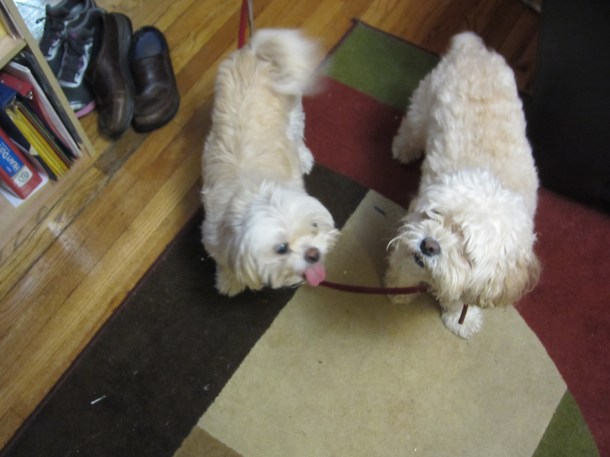
She’s training herself, to see how much she can fit into her mouth at one time.

pix-from-eos-026

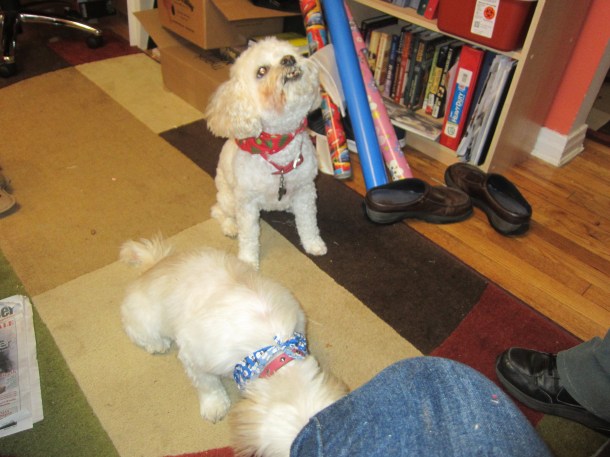
Butterfly is practicing her facial expressions, for after Cricket misbehaves in public.

pix-from-eos-013

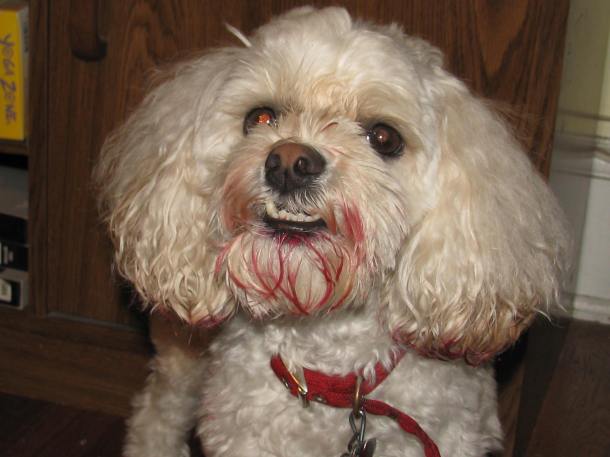
This is her “I’m the cute one” face.