Tag Archives: pets

How do I make the blog into a book?

What I like most about writing this blog is that it leads to conversations with people all around the world. I get advice, and sympathy, and connection, and crankiness, and humor, and on and on, until my three page investment turns into days of feeling like I am not at all alone.

pix from eos 006

“Look at all of our friends!”

The blog has taken the shape it has as a result of both the comments I get and the blogs I read. I’m not isolated or impervious; I absorb what I read and what I see and, mostly unconsciously, I challenge myself in response. The community aspect of blogging is so satisfying, but I still feel like a second tier writer, because I haven’t been accepted by the cool kids at the publishing houses and literary magazines.
“So not cool.”

I’ve been getting rejection letters from agents and publishers, telling me that I am a wonderful, talented, exquisite writer, but… but what? Isn’t that what I’ve spent my life working towards? Isn’t that the point? I can’t even begin to understand the market forces that turned publishing into this quagmire, whether there are just too many writers trying to get published, or too few publishers willing to take a risk.

When I was first looking for a graduate program in creative writing, and collecting rejections from the schools I’d applied to, I was told that MFA programs weren’t interested in my writing ability, they were interested in the uniqueness of my story. The writing, they believed, they could teach me, but they couldn’t teach me how to be interesting. I think agents and editors have taken the same view. They’re looking for a hook, a unique story, something the world is currently clamoring for, and if they have to rewrite every word, so be it. Most of them have graduate degrees in writing themselves.

It has been suggested to me that I try to make this blog into book, because dogs are popular lately, because people seem to like my blog posts, and because my novels are not getting picked up. But I don’t know. It feels like I’d be trying to make a piano into a guitar.

I’ve been reading through my blog posts from the beginning, and I’m not as disappointed as I was afraid I would be, but I’m also not magically coming up with an idea for how to structure it. Is it a book about writing the blog, or is it a book of the blog, not self-conscious, not even revised so much as sewn together?

My Delilah

Delilah is perplexed.

When I first started the blog, I was squeamish about memoir writing. One of the things I like most about writing fiction is that I can change things for the better. I can make up lives that I would want to live. It took me a while of writing blog posts to get desperate enough and brave enough to put more memoir and risk into the posts; to tell people who I really am, when I’m not just trying to be acceptable. And a lot of people reached out to me as a result, and showed deep understanding and compassion for me that I would never have gotten if I’d left out the painful parts.
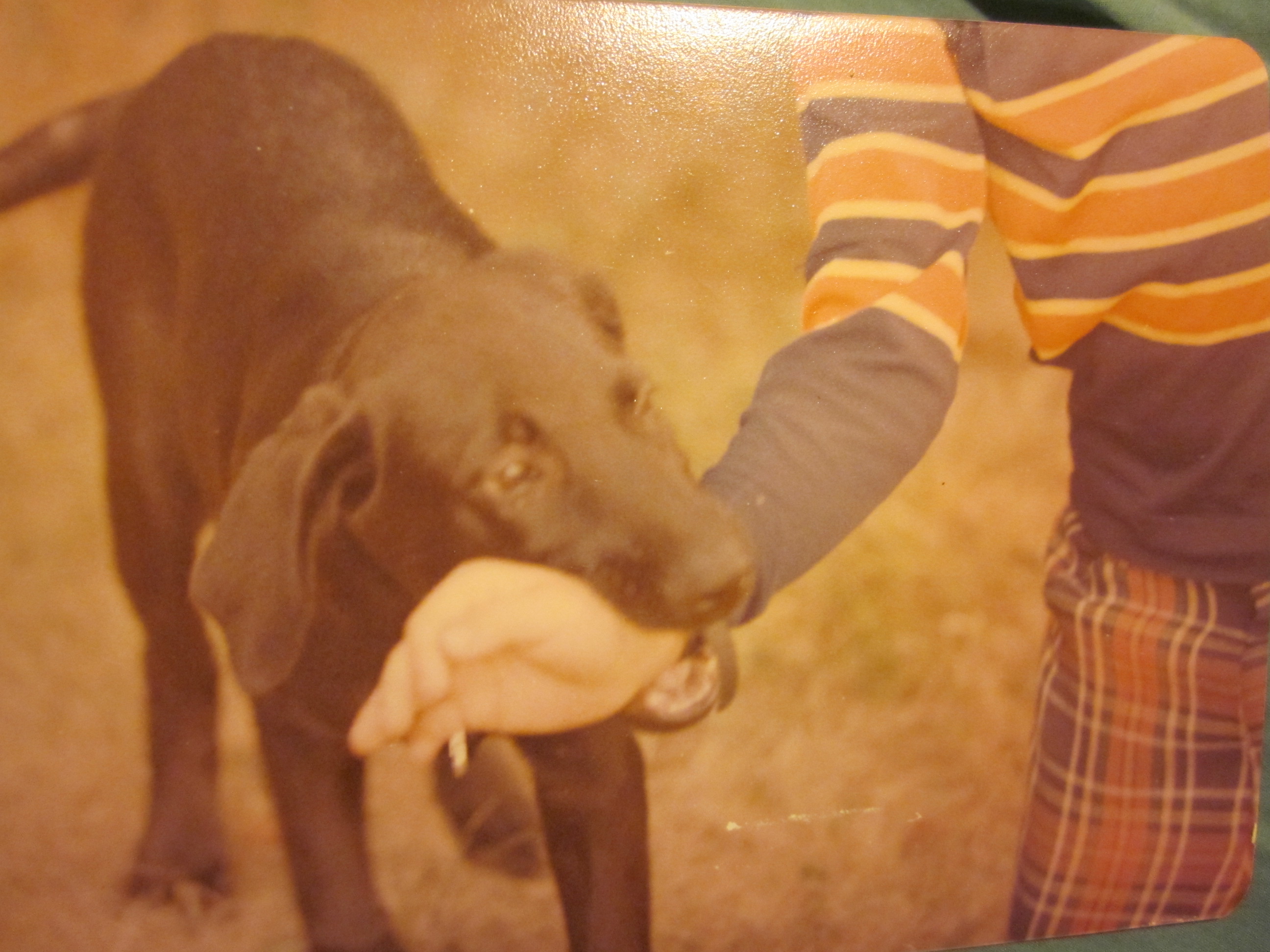
Samson chewing on my brother.

Samson chewing on my brother.

I had a creative non-fiction teacher who said that the best way to write an essay is to bring two separate ideas together, and the drama and surprise will come from the place where the two ideas meet. I kept that in the back of my mind, not really getting it, until maybe a year into writing this blog. I started to notice that no matter how unrelated my chosen topic seemed to be to the theme of the blog – dogs – as soon as I forced myself to find a connection, the essay came together. For some reason, just writing about each topic that interests me can get bogged down, tedious, and flat, but when I try to combine it with the dogs, I find new things, new angles, that I didn’t know were there.
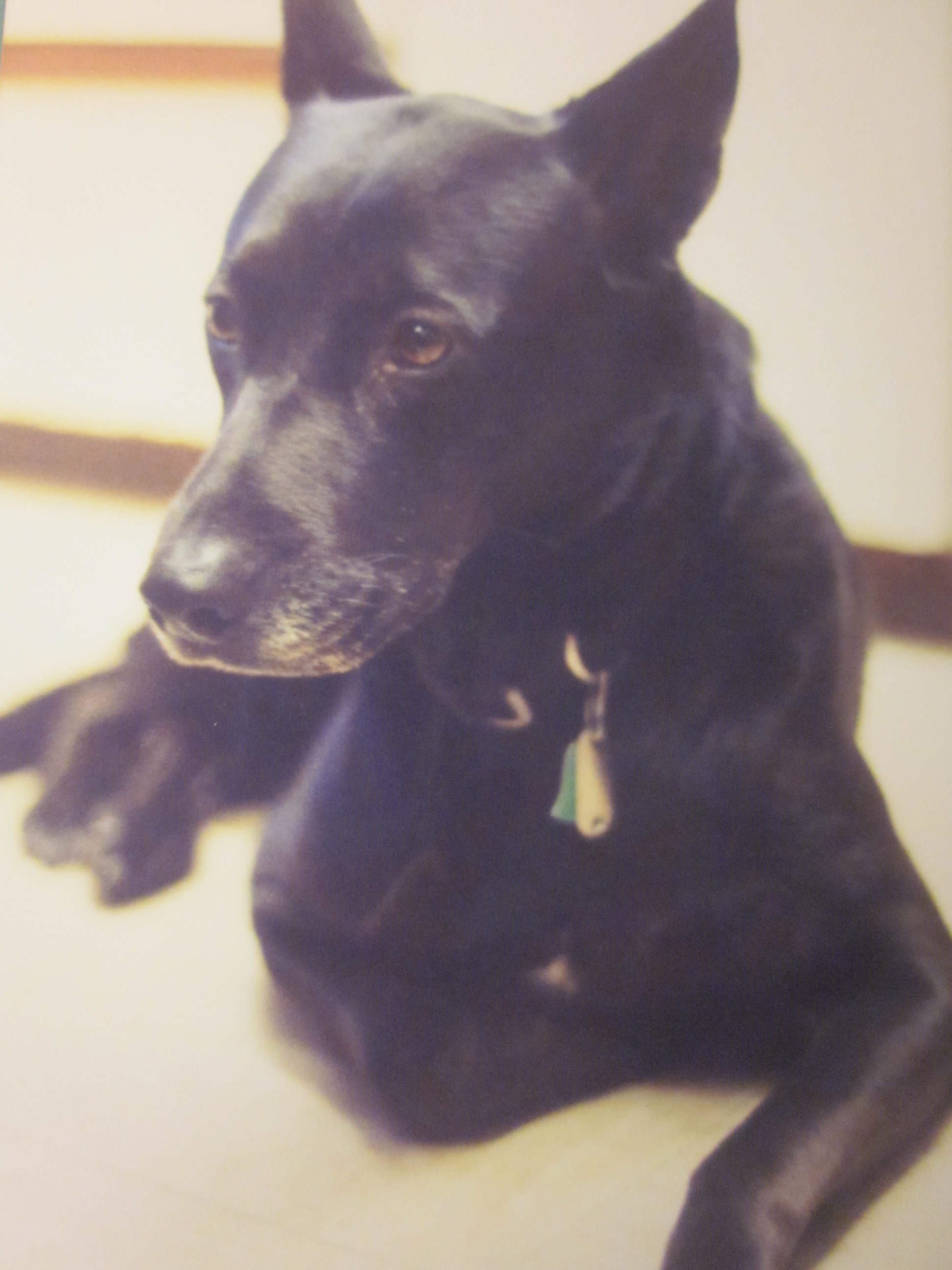
Dina

Dina always had her own way of seeing things.

Miss Butterfly.

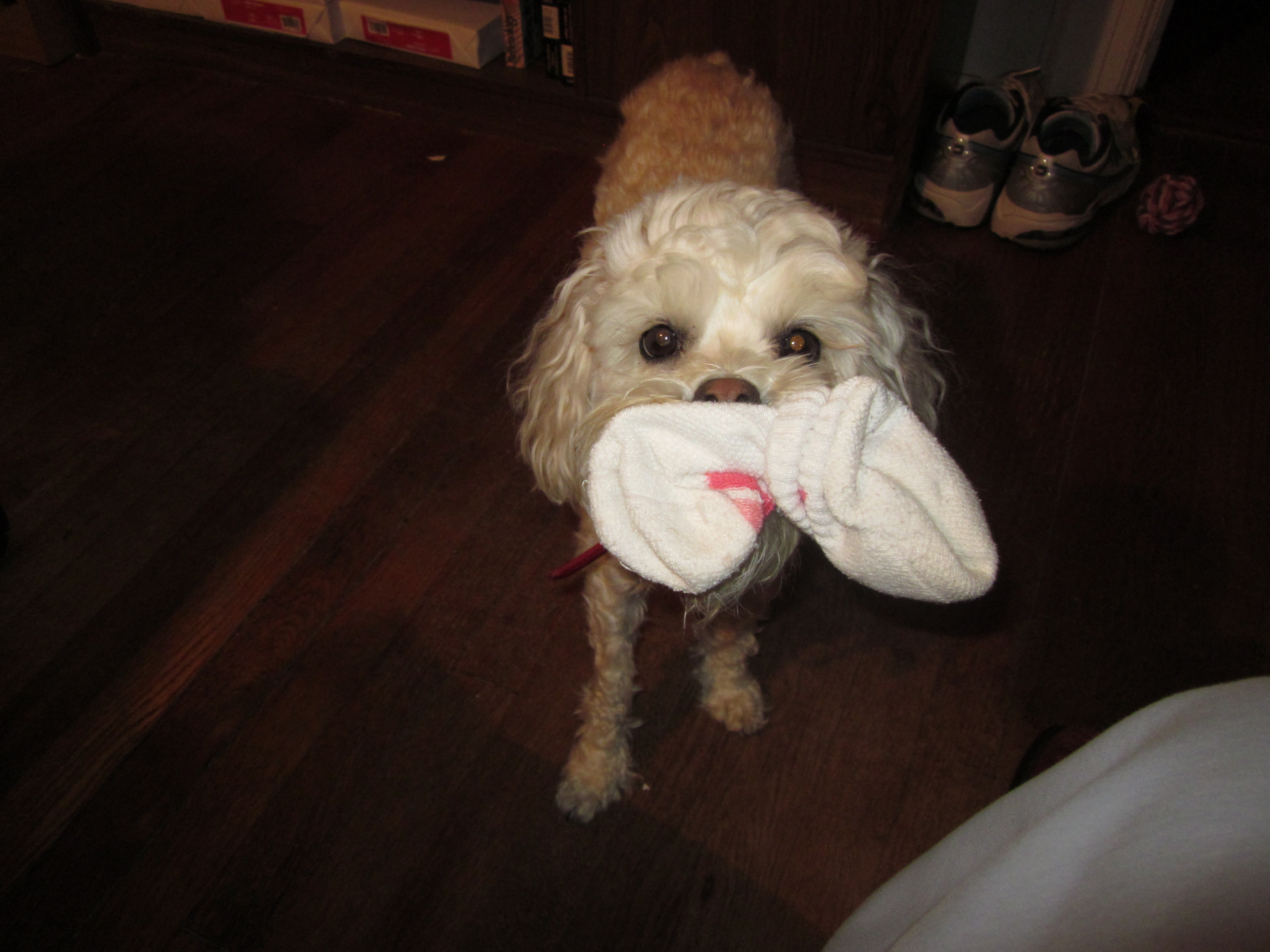
Miss Butterfly brings socks and warmth.

Miss Cricket.

Miss Cricket makes everything more interesting.

I feel like every six months or so, I let myself reach down another level, admitting things that are scary to admit in public, showing another layer. And I’ve needed to do it this way, at this pace. I can only push my boundaries a little bit at a time, and only when I feel ready. I think there’s still a lot of room for me to grow, and that makes me worry about turning this into a memoir too soon.

I don’t want to lose this.

Harrumph.

Harrumph.

Cricket is an Honorary Human Now

In her early middle age (she is almost nine years old), Cricket has developed the most common human disorder, lower back pain. She has always known she was a human, and now she has proof. Unfortunately, when she first started to exhibit symptoms, I had no idea what I was looking at and started to imagine the worst.

Cricket, the pulling machine.

Cricket, the pulling machine.

First she threw up during her mid-day walk, which isn’t that unusual for her, but then, out on a walk she did this funny thing where she walked backwards three steps and sat down, demurely, on top of her back feet. As soon as we returned to the apartment she ran under the couch, to her apartment, and stayed there. Even when chicken treats were offered, she didn’t leave her apartment. I had to bring her room service. Normal, for Cricket, is staring at the treat bag until it opens, then jumping up and trying to climb my leg to get to the treats. This sad looking dog under the couch was someone I didn’t know.

couch dog.

couch dog.

"Ouchy."

“Ouchy.”

I did a full body check on her to see if any particular part was sore, but she didn’t yelp or grumble at any particular point. She seemed to recover a bit on her next walk, running and barking at our neighbors, but still, she was strangely subdued indoors, and not up to jumping on the bed that night.

The next morning, Friday, we called the vet’s office and they said that Cricket’s regular doctor wouldn’t be available until Monday morning, and since Cricket seemed to be doing better we decided that would be soon enough.

We went out to Friday night services, after a day of watching Cricket go almost back to normal. I even thought we might be able to cancel her doctor’s appointment. But when we came back home, Cricket jumped up to greet her Grandma, and started to cry in pain. I sat down on the floor with her, but she walked backwards and kept crying; until she saw her sister sneak out the open front door of the apartment and start down the stairs. Cricket immediately stopped crying and ran to the top of the steps to catch Butterfly, but then she balked again.

I carried Cricket down the stairs and outside for her walk, but she just kept sitting down on her feet and looking very frightened. I had to carry her back up to the apartment. Her whole body was vibrating, and she was gulping air. I put her on my bed and she struggled to find a comfortable position to sleep in, dragging her back legs behind her to each new location. I had nightmares about dying dogs all night long.

"Mommy, I don't feel good."

“Mommy, I don’t feel good.”

When I took the girls out early Saturday morning, Cricket still looked frightened and her back feet started to twist, as if she was walking more like a ballet dancer in toe shoes than like her usual tomboy self.

The thing is, I kept worrying that her symptoms were neurological, because of the walking backwards, and the twisted feet, and the fear in her eyes. I was afraid we’d find out that she had Lyme disease (because she’d been bitten by a tick two months earlier when I forgot to give the girls their monthly meds). I was pretty sure the whole thing was my fault.

We called the vet to see if Cricket could have an emergency appointment, and they scheduled us in for Sunday morning.

All day Saturday, Cricket’s symptoms only got worse, and it was a relief when it was finally Sunday morning, and we could take her to the doctor. Well, it was a relief to me. Cricket hid under the bench in the vet’s waiting room as usual, and had to be dragged out to stand on the scale and check her weight. She’s vain, and that scale is so public!

In the examining room, she did her best to hide behind me, which is normal for her, and the vet tech was able to, easily, put the blue muzzle over her head for the exam, which is not normal at all. In the past, Cricket has been able to pop those things off with one paw grab, and a defiant twist of her head, but not this time.

The doctor did a neurological exam to see how Cricket walked and stood and responded to being in different positions, and she said that, neurologically, everything was fine. But I wasn’t ready to believe her. She wanted to do an x-ray, to make sure there was no arthritis or orthopedic issues, and help her to make a diagnosis, and I agreed whole heartedly with the plan.

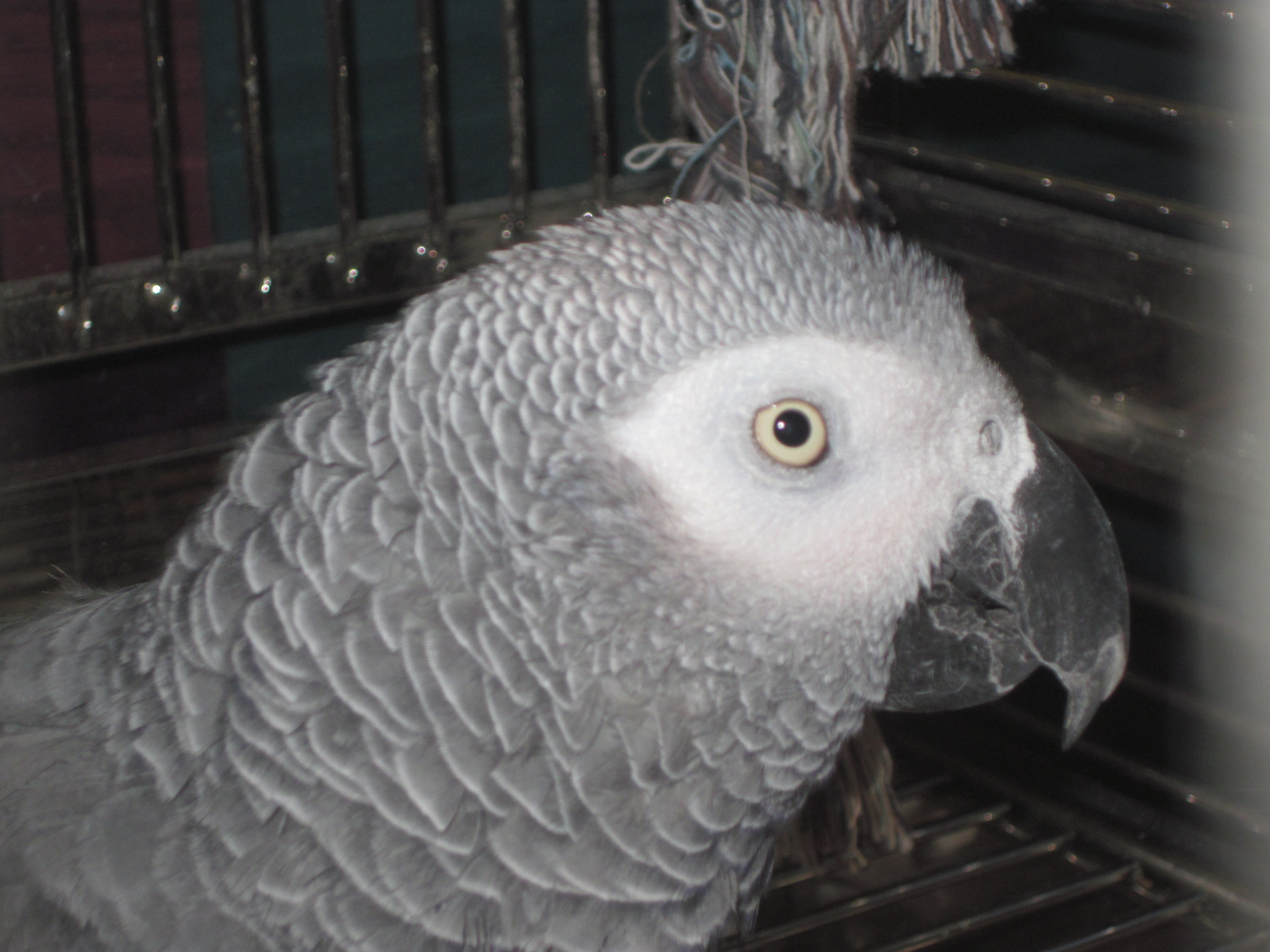
The doctor gave Cricket a shot of a pain reliever that would calm her enough to allow them to do the x-ray, and then we all waited in the waiting room, with Boopy the African Grey parrot, until the meds kicked in. Boopy is a scratchy glutton, just like Cricket. He stood right next to the bars of his cage and stared at me, then lowered his head for scratching. When I was too slow to comply, he stomped one of his feet, and then lowered his head again.

Boopy is very demanding.

Boopy is very demanding.

"I'm waiting, human."

“I’m waiting, human.”

Cricket’s x-rays were perfect, meaning they showed no arthritis and no other issues with her hips or legs, which meant that we could assume the problem was with a disc in her back. I still didn’t believe it, though. I don’t mean that I argued with the vet, or refused the meds she prescribed (Prednisone and Gabapentin), I just wasn’t sure any of it would help.

The doctor told us to limit Cricket’s movement, either by keeping her in her crate (which we gave away years ago because she used to climb up the sides trying desperately to get out), or keeping her in a small room where she couldn’t crawl under or climb over anything (there is no such room in our apartment). The vet also said that Cricket shouldn’t crawl under her couch, and I just couldn’t imagine that. The only place Cricket had felt safe for the last few days was under her couch.

A cozy couch, and a soft tushy to lean on, that's what Cricket needs.

A cozy couch, and a soft tushy to lean on, that’s what Cricket needs.

When we came home, of course, Butterfly sniffed Cricket all over, in her armpit, under her ears, to find out where she’d been and what Butterfly had missed. Clearly it was nothing good, so Butterfly could relax on the floor, knowing she’d had the better part of the deal.

"What is that smell?"

“What is that smell?”

We gave Cricket the first dose of Prednisone right away, with a big serving of peanut butter, and pretty soon, she thought she should be able to jump off beds again. She still couldn’t jump onto the beds or climb the stairs, but whatever independence she could manage she wanted to have. The frightened look was gone. The vet really had got it right, thank god.

The vet warned us that the Prednisone would make Cricket eat and drink more, and therefore pee and poop more, and within a few days, Cricket became the queen of poop, outperforming her sister, by a lot. She was feeling better every day, by literal leaps and bounds, and she was convinced it was because of the peanut butter, and therefore I should give her more.

Peanut butter heals everything.

Peanut butter heals everything.

Pretty soon, I’ll need to start her on a physical therapy regimen to build up her core muscles. For some reason, the physical therapists for humans are unwilling to work with Cricket, so I will have to do this myself, with the aid of many many chicken treats.

I guess being an honorary human doesn’t count with some people. Harrumph.

"What do you mean, I'm not human?!"

“What do you mean, I’m not human?!”

Children’s Television

When I was seven years old, I inherited my parents’ old black and white television set. I could never fall asleep as early as everyone else in the house, so I watched whatever was on until Johnny Carson at 11:30 PM, when I could relax. I felt like he could see me through the TV, and therefore I wasn’t alone. I’d leave the TV on as a night light, waking up at Three AM to the buzz of the target on the screen.

I had a philosophy teacher in college who told us that people who leave the TV on for company are fooling themselves, but I didn’t like him anyway.

Delilah, my childhood Doberman pinscher, used to sleep on my bed during the day, so she watched TV with me sometimes. I don’t think she cared much for it though. Maybe she liked the steady hum of the TV in the background of her dreams. She just liked being with me, especially if I had snacks in my room, or was up in the middle of the night. In a way, I was the TV show she watched.
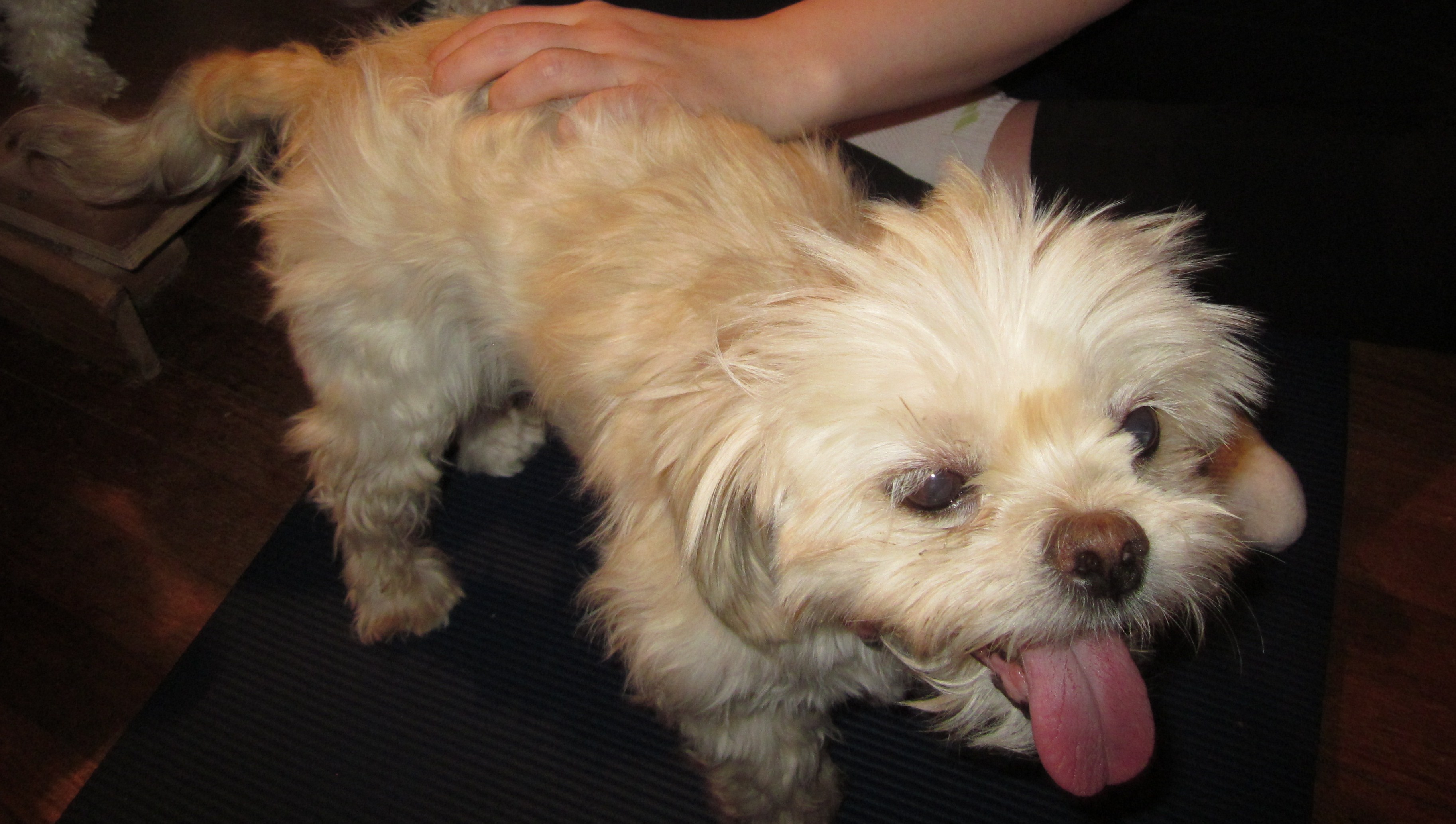
My Delilah

My Delilah

From an early age, I would read through my TV guide with a highlighter and count up how many shows I could look forward to in the coming week. My favorite issues of the magazine were the ones at the end of the summer that previewed the new shows for the fall. It was just like getting my new school books in August and being able to preview all of the potentially exciting homework for the year ahead, and similarly disappointing by October and November when school and TV turned out not to be as wonderful as I’d hoped.

“Rachel, someone peed on these hastas! This is much more interesting than your TV shows.”

I never felt satisfied by children’s television. There were times, watching The Smurfs, where I saw glimpses of my real life, in the tininess of the smurfs compared to the enormous Gargamel, but most of the time, shows for children portrayed us as super powered beings, as if the average eight-year old could overcome abuse and war and neglect without any help. I needed Wonder Woman to come to my house and help me, not to always be helping the government. I needed the Bionic Woman to hear me with her super hearing, and run to scoop me up, and jump out of the window with me in her arms. And I needed some explanation of how these children on TV were able to survive, because it didn’t make sense to me.

I didn’t like the way the adult characters in kid’s shows talked so slowly and with such simple language, as if I were an idiot. That’s not how real people talked. I liked Cookie Monster, though, because he would start out counting and then just start shoving cookies in his mouth and losing control. This I could relate to.

My Dina, the peanut butter monster!

My Dina, the peanut butter monster!

I watched mostly shows meant for adults, instead. I felt like these were my teachers. In school we never talked about real life. There was no discussion of how often to take showers, or which clothes to wear, or how to earn money, or how to make friends. There was an endless list of rules that everyone else seemed to live by automatically, and I couldn’t find the list anywhere.

“Hygiene is overrated, Mommy.”

I loved The Love Boat. I didn’t understand that it was unrealistic. I thought the floating, fizzy feeling of the show was completely possible in real life. Even when dark things happened, the tone of the show was never dark. And a little girl got to live on the ship, and be doted on all the time, and her Dad was the captain, and there was a cruise director planning activities, and everyone was so happy to be there.

For some reason I really liked The Fall Guy with Lee Majors as a bounty hunter. I liked that his job was to catch bad guys, and that he worked so hard to do it. In my real life, the adults I knew would have given up as soon as it started to look difficult or dangerous. I loved his persistence.

My favorite shows were the ones that made better lives seem possible. Like on Kate and Allie, where these two divorced Moms, with three kids, shared a house. I loved the idea that friends could be your family, and that you could depend on them and not have to survive on your own. On One Day at a Time, a divorced woman moved out with her two teenage daughters to live in an apartment in the city, and it was not sugar coated at all. The point of the show seemed to be that women can do this; they can start over, even when it’s hard, even when things go wrong along the way. And I wanted to believe in that.

I still believe in the transformative power of TV shows, but I think we need a better idea of how to present it. Two dimensional images on a screen are not enough. Maybe the images could be projected, like holograms, into the room. Cricket and Butterfly would love that! We’d need a less furnished room to watch TV in, so that the characters wouldn’t be projected onto the coffee table or impaled by a lamp. And maybe there could be a device we’d wear, like a sensor on our foreheads that would see how we’re feeling and pick a show to fit our needs. Cricket would get a laser light show, so she could chase the lights around the room until she was exhausted, and then there’d be soothing music to help her take a nap. Butterfly would get bird songs, in stereo, all around the room. And she’d need some smell-o-vision, and a treat dispenser, and maybe an automatic scratchy hand she could go over to when she’s itchy.

Butterfly and her buddies are ready to watch TV.

Butterfly and her buddies are ready to watch TV.

Cricket's not so sure about this arrangement.

Cricket’s not so sure about this arrangement.

And for me, as a kid, I would have loved to have recognition that I was there in the room, and that I mattered; that the TV show only came to life because someone was watching it. Even better, a character on the TV could wave to me, and say, Rachel looks tired, maybe we shouldn’t have a smash ‘em up car chase right now, let me go get my acoustic guitar.

“I like acoustic guitar too, Mommy.”

The Gossip Couch

Dogs love gossip. They collect their gossip by sniffing pee puddles and seeking out the butts of other dogs for important information. This one’s in heat, that one just had puppies, the other one had pizza for lunch, this one and that one had playdate in a yard filled with something stinky. Dogs do not care about world news. The whole idea of world news would just seem silly to a dog. Their minds are completely local. Neighborhood news, family news, that’s what they want.

Cricket and Butterfly sniff in with each other regularly.

Cricket and Butterfly sniff in with each other regularly.

Cricket's traditional news-gathering pose.

Cricket’s traditional news-gathering pose.

We believe that it is important for us to know what’s happening in the country, and in the world at large, so we teach ourselves to read the New York Times or the Wall Street Journal, or listen to Public Radio, or watch CNN, but it takes time and effort to build up a tolerance for serious news. Gossip, on the other hand, is a natural instinct. I remember people whispering to each other in nursery school, about who was a poopy pants, and who still needed a sippy cup. The idea that we get much more excited to find out what our neighbors are doing with their free time than about the latest government snafu, is embarrassing to us, but to dogs, it’s a given.

My last graduate program was a low residency writing program. We’d go to campus for a week at a time, twice a year, and then the rest of the work would be done online, from home. But that one week was packed with gossip. Of course there were lectures and readings and writing workshops, but there was also drama and intrigue and a lot of alcohol. I’m not much of a drinker (or not a drinker at all) but watching how other people act when they are drinking can be very entertaining.

Every night after dinner, and more student readings, some people would head out to the same bar, the one closest to campus so we could all walk there. For most of the residencies, I went back to my room and got work done and maybe went out once or twice during the week. But at my last residency there was no work to do, and no workshops to go to, because I was there to graduate. I committed myself to going to the bar, every night, to people watch. But my favorite part of the night was getting back to the dorms, and sitting on the gossip couch, catching up on what everyone else saw at the bar. Many people forgot that they were married, and forgot to take their meds, and forgot that they were there to write, and therefore provided quite a lot of material for the rest of us to chew on.

Whenever the most recent returnee from the bar got off the elevator, we had to question him or her about the latest news, and each subsequent arrivee was drunker, and better informed.

Yes, gossip can be mean, and cruel, and about feeling superior to the other guy, but it’s also about feeling connected to the actual world you live in, to the day to day people you interact with. Sharing personal news and knowing what’s going on in our community makes us feel grounded and connected and a part of the world, instead of separate from it. I hate when everyone else seems to know something and I’m on the outside. And sharing gossip with someone, especially if it is juicy gossip, can bond you, as if you are showing your vulnerable belly to that friend, admitting you care about such things.

People use the word “gossip” as a judgment against particular pieces of news. It means, your news is petty compared to the important news of the day. We know so much about what’s going on in the world, that it’s hard to place importance on our own lives within that enormous picture. But gossip can fix that. Gossip focuses in on all of those small details in our daily lives, it focuses on us, and our friends and enemies. It reminds us that we matter too. However small we may seem in the larger, worldwide, scheme of things.

Cricket and Butterfly gossip with each other all day. Butterfly sniffs Cricket’s ear, Cricket sniffs Butterfly’s butt, they listen to the birds and the neighbors and share significant looks. They know that this one smokes and that one’s on a low carb diet and the other one eats too many onions. They know which dogs have personality problems and which cats hide behind which bushes. They keep track of the comings and goings of the squirrels and the birds and the neighbors and the mailman. It’s like a twenty-four-hour-a-day soap opera with all of the repetition and long drawn out dramas you would expect from a daily serial. And they love it.

News-gathering must be done, no matter the weather.

News-gathering must be done, no matter the weather.

Butterfly checks in with the print media, when she can.

Butterfly checks in with the print media, when she can.

I try to remember this when I’m writing and start worrying that what I’m writing about is too trivial compared to what someone else has written. We need the big and the small, the weighty and the trivial, to balance each other out and give us perspective.

My Voice

My Voice

When I was little, I used to sing stories to myself. I would walk to the library, make up a story, and revise it over and over, all to some endless tune in my head. My mother loved that I would sing around the house, and she wanted me to sing more. It was her idea to find me a voice teacher when I was in eighth grade. She wanted me to know that my voice was worth taking seriously.

I was always singing, or shouting, it's hard to tell.

I was always singing, or shouting, it’s hard to tell.

My first voice teacher had an opera background, but she spent most of my lessons on vocal exercises and breathing exercises, teaching me how to breathe from my diaphragm, and stand up straight, and relax my shoulders. I’d never much liked practicing scales on the piano, but vocal exercises made more sense to me. She taught me to sing through the mask of my face, like a raccoon, and to change the shape of my mouth to make the consonants clear and the vowels more open.

My father insisted that we sing songs together after Friday night dinner, as a family. But, he didn’t believe in normal limitations, like that a baritone might struggle to hit a glass-shattering high note. He refused to choose a key that everyone, including him, would be comfortable with, and he didn’t care about the quality of the note when he was done with it. He could rip it and strangle it, and drown the note in coughing, but if he hit that note, even for a second, he’d won.

And he did not like competition. He didn’t want me to practice singing between voice lessons. He would complain that I was “caterwauling,” even if I practiced in my room with the door closed. He’d complain about the money Mom was spending on my lessons. And eventually, he made it clear that he believed in the ban on kol isha – the voice of a woman – that we’d learned at school. I could sing at home, but it would be unacceptable to allow my voice to be heard by men outside of the family. He believed that singing, for a woman, is a salacious, sexually provocative act, and if I do it, I am a whore.

Unfortunately, around the same time as I was getting used to my voice lessons, we had a guest speaker at my orthodox Jewish school. Only the girls were invited to the gym to listen to her. She performed for us first, doing her own version of beat boxing, using her mouth like a drum and her hands as tambourines. The things she could do, the sounds she could create with no musical instruments to back her up, were incredible. There was something like bird song about her voice, as if she was born with these songs in her body and she just had to release them. She wasn’t just hitting notes, she was putting spin on them, like a tennis player, top spin and back spin, hollow sounds and full sounds, cold and warm, shivery and strident, all from one voice. I wanted her to be my teacher.

After her performance, she told us that she’d been a voice student at a prestigious conservatory, training for a professional music career, when she started to visit Chabad (a Chasidic Jewish outreach group) on the weekends. She gradually became more and more religious, until it became clear that as a religious Jewish woman she could never sing in front of men. She’d pieced together a career as a speaker, and sold her music to strictly female audiences. Her message was clear: being religious comes first, before anything else you might want, or love, or need in life.

Her visit haunted me. I didn’t stop singing altogether, but I felt her hand tightening around my throat.

My black lab mix, Dina, came along when I was sixteen years old, and she was a singer too. You had to hit a certain note, something in the howl-range, and that would set her off. Her pitch was pretty good and she could sing a nice clear note or series of notes, but she didn’t seem to enjoy it. She seemed like a button had been pressed in her brain and she had to sing, and had no control over it, and no choice. She seemed relieved when the singing stopped, as if it had taken so much out of her and now she could rest in silence.

Dina as a puppy.

Dina as a puppy.

I took a few years off from trying to sing, until my last semester of college, when I had two credits to kill. I’d been feeling like a robot, detached from myself and my voice, and I hoped voice lessons would help unlock something. I didn’t have to perform in public; my lessons would be in a safe, partially soundproof room. I still couldn’t practice at home, though, so I’d sing in the car on the way to and from school.

This was my first male voice teacher, and he was closer to my age, and friendly, and an opera singer. Whenever he actually sang something I sort of cringed, though. I’m not an opera fan. The vocal quality they strive for is bombastic and brassy and kind of hurts my ears, but he was very nice. He had me singing from an opera workbook, in Italian. There was something freeing about singing in a language I didn’t understand.

I sang to Dina at home, but not too loud, and never in full voice, and gradually, the hand around my throat grew tighter and tighter, telling me to stop singing, and I did.

Dina had a lot to think about.

Dina was a very good listener.

When I think back to that girl singer, though, telling us that she had to give up her dreams in order to be a good girl, I wonder if I ignored something important. With her words, yes, she told us to hide ourselves from the world, but her body carried a different message. Her voice seemed to be saying that, if you have a bird trapped in your chest, flapping its wings and trying to sing its song, you have to let it sing, or it will die.

birdie

My Therapy Dog is Leaving Me

My therapist is moving. For as long I’ve known her she’s had an office in her house, with her husband occasionally vacuuming above our heads, and a dog barking to let us know if someone is coming up the driveway to kill us. But now, she and her husband are getting older, and the house is too big, and the driveway is a hell-scape in the winter. So they are moving into an apartment. There’s no office attached to this apartment, or even nearby, so my therapist will now be sharing office space at a building with elevators and valet parking. A building that does not allow dogs.

I’m fine with the move in every other way – no more climbing up their mountain of a driveway, no more feeling like I’m invading her husband’s life by being in his house when he’s watching TV – but not having the dogs there for therapy is inconceivable. Her miniature poodle, Teddy, and her Golden retriever, Delilah, offer the kind of comfort and approval no human can supply. They love me. They know me. They offer themselves up for petting. Teddy, especially, is one of my best friends.

Teddy!

Teddy!

Teddy is a ten year old miniature poodle, and I have known him since he was a ball of black fluff curled on his mom’s lap. Teddy greets me at the door, and ushers me to my seat, and sits on my lap, and gives me kisses, and listens carefully to everything I have to say. Delilah, the Golden Retriever, is a more recent addition, but she offers comfort whenever she can, when she’s not busy taking care of her Dad. In fact, the closer we get to the move, the more time she chooses to spend in the office, as if she knows something is about to change and she wants to soak up as much therapy time as possible. I don’t think I’d have survived therapy this long without my buddies there, letting me know that I’m wonderful and special no matter what I talk about.

Delilah!

Delilah!

I’m worried that it will be strange not going to the house anymore. Will I feel like saying different things in the new office? Will my therapist seem like a stranger in different surroundings? Will I even recognize her without Teddy in the room?

The new office is in a building full of other therapists, and yet they don’t allow dogs. How can this be? What is with this overwhelming prejudice against dogs, especially in places where they can do the most good?! My therapist is considering sneaking Teddy in on Saturday mornings when the building is mostly empty, but, Shh, don’t tell anyone. It would be harder to sneak Delilah into the building. Maybe in a very big suitcase, on wheels, with air holes?

Delilah looks concerned.

“Are you sure about this, Rachel?”

I worry about Teddy, actually. He has been a co-therapist for most of his life. He looks forward to telling people when to come in, and when to leave. He has meaning and purpose in his life from his work. What will he do in an apartment all day? He might actually have to play with other dogs! I think Delilah with her Golden temperament will be able to adapt, but Teddy takes things to heart. He gets depressed when his mom goes away. He loses weight and has tummy troubles. He loses his spark. How will he feel knowing his Mom is going to work without him?

“How will the humans know where to sit without my help?”

I offered to have him over for visits with me and my dogs, for my sake as much as his, but my therapist said it wouldn’t work, because Teddy would be outraged to see me with other dogs. Because I belong to him.

What will I do without him?

Don't worry. Cricket and Butterfly are coming up with a plan.

Cricket and Butterfly are working on a plan.

My Life as a Jewish Woman

One of my blogging friends suggested that I write about my life as a Jewish woman, and it scared me, because writing about being Jewish always scares me, just like writing about anything else people might judge me for scares me. I worry about anti-Semitism; I worry about people feeling alienated from me for being different; I worry about being rejected, and looked down on most of all. The image of the Jew as vermin has always stuck with me. I was born long after the holocaust, but it has never felt that far away.

“What are you talking about, Mommy?”

I grew up in Jewish environments, getting a Jewish education (or a few different Jewish educations), so being Jewish always felt normal to me. It was only when I went to college that being Jewish became an issue. Most of the higher educational world, no matter how many students at a school are Jewish, is based on a Christian world view. It is assumed that when you mention the bible, and you will, you mean the King James Version, including the New Testament. In a discussion about history or biology, or, god forbid, art history, teachers would reference books of the bible I’d never heard of, and I felt like I needed Google and Wikipedia, before such things existed.

“Ask me, Mommy. I know everything!”

It wasn’t just factual references that I missed and had to look up, there were world view things I couldn’t relate to. So much talk of heaven and hell, and turning the other cheek, had never come up in my childhood. I felt like I’d need a PhD in Christianity before I could understand much of anything. So I did my honors thesis on comparative religions, and read the King James Bible, and the New Testament, and the Koran, and forty other books on various religions around the world. I can’t pinpoint what I did with all of that information, and I didn’t feel like an expert when I was done, but I did feel more grounded. I felt like I knew enough to get by.

Despite the adjustment period, there was something freeing about not being in a Jewish environment anymore. I stopped feeling like someone was looking over my shoulder all the time, giving me demerits for each non-orthodox behavior. No one cared if the sandwich I ate for lunch was kosher. No one cared that I wore pants. If I went to school on a Jewish holiday, no one even noticed. It didn’t matter to anyone how religious I was, or wasn’t. They noticed that I was a good, and maybe compulsive, student. They noticed that I talked back to teachers (sometimes too much, sometimes just the right amount).

Being outside of a Jewish point of view allowed me to see how many different world views there really were. I started to see that even the Jewish world was not as unitary as it had seemed. Not all Jews are orthodox and steeped in the Talmud, not all Jews were red diaper babies raised by union activists, all Jews are not from Eastern European shtetls, all Jews are not “New York liberals,” or Pro-Israel, or Pro-peace, or well educated, or small minded, or wealthy, or clever, etc., etc.

The only really Jewish thing about my life now is the fact that I go to synagogue on Friday nights. I don’t keep kosher (sorry, God), and I don’t take out a prayer book three times a day, and I don’t wear a Star of David necklace. I do have a mezuzah on my door, but I never remember to kiss it.

My life isn’t especially Jewish, but I am. It is a big part of my identity, probably as big as being female, or American, or a writer. Being Jewish is essential to how I view the world around me, how I watch the news, how I meet new people. I am probably more skittish about traveling to, say, Germany than the average American woman. I am probably more sensitive about how Israel is portrayed in the news (though some evangelical Christians have me beat on that one).

The fact is, though, that I felt like just as much of a Jewish woman during the fifteen years when I did not belong to a synagogue as I do now. The rituals, and the belonging, while comforting and satisfying, are not the source of the identity for me. I know people who were raised without much involvement in Jewish community life, and they too feel their Jewishness strongly. There’s a mix of pride in the heritage, and fear of being targeted, and shame at being different, that we all share.

My dogs remind me, though, that my Jewish identity isn’t all of who I am. They are deeply connected to the energy of the universe, and they could care less if I am Jewish or Muslim or Christian or agnostic. The dogs represent the connection I have to everyone, not just to one small group.

“Hi Mommy!”

“If you’re Jewish, are we Dogish?”

I went to the supermarket one day, and some kid with weird hair was standing outside. Normally, I wouldn’t ever think of stopping to talk to a strange teenage boy, but he had a bulldog puppy with him and that changed everything. I met the dog, I got kisses, I talked to the boy on the other end of the leash, and he was friendly and talkative, and grateful that I liked his dog, and we parted as friends, feeling better about the world and the other people in it. Dogs do this!

Who could walk past a bulldog puppy! (not my picture)

Who could walk past a bulldog puppy! (not my picture)

So yes, I am a Jewish woman, and an American, and a writer, but before all of that, I am a dog person. It’s not an identity, it’s just what’s there, under all of the layers of identity, and my dogs think it is the most obvious thing about me.

Me and baby Cricket

Me and baby Cricket

How The Writing Workshop Turned Out

I was so proud of myself. I went a million miles out of my comfort zone to set up the writing workshop on aging at my synagogue. I wrote a heartfelt proposal and sent it out for people to read. I presented the proposal in person in front of 20 or 30 people, and got an extraordinarily positive reaction, and six people signed up for my theoretical workshop on the spot. I sent emails and coordinated, and negotiated, and scheduled, and got furiously to work planning my first workshop session, and five people showed up – only two from the original list. But five people was good, and people talked and wrote and stayed for an hour longer than I expected. The next time there were four people, and the time after that only two, plus me.

After three sessions, I took February off from the writing workshop – because so many people were snow birds escaping the winter in New York, and because I wanted to be a snow hermit and hide in my apartment. The anxiety I felt before each class was debilitating, even though the classes themselves were a lot of fun. I could barely move on a Wednesday after a Tuesday workshop. Three naps instead of one, and a long list of self-recriminations about things I should have said, and shouldn’t have said. I spent the extra time reading for, and planning, new lessons for the rest of the sessions. I drafted and revised and cut and pasted until the writing prompts and the writing samples came together in perfect symmetry to get to the heart of a subject within an hour and a half. I talked up the workshop at the next Engaging with Aging meeting, and to whoever asked at other events.

Me, napping.

Me, napping.

Me, trying to reach out.

Me, trying to reach out.

And when we came back from break, there were three students, then two, then just one, my mom, my loyal mom. People asked for my forgiveness for missing classes, for forgetting, and overscheduling, and having bridge at exactly that time and day. Intellectually, I knew they weren’t rejecting me, or saying anything about the quality of my work or what I had to offer. I knew that I’d done a good job, planning lessons and prompts and being supportive and gentle and only pushing a tiny bit when I knew someone was ready to go a step further. But how can you be a teacher without students?

Butterfly wants to help.

Butterfly wanted to help.

Even Cricket felt bad for me.

Even Cricket felt bad for me.

These are good, solid, interesting people, with stories to tell and a lot of strength and survival skills and knowledge to share. And yet, the idea of waking up in the morning and choosing to go to a class where you will have to write about yourself, as if you matter, as if someone else should care what you think, no, that they can’t do.

One woman told me that what her sixteen-year-old grandson wanted for his birthday was for her to write down something about how she and grandpa got together and stayed together all those years. And I thought, wow, what a lovely and loving thing for a sixteen-year-old boy to ask for, and she thought, Oy, can’t I just give him money?

I ended the writing workshop in April, a month earlier than expected, and people kept asking me if I would start it again in the fall, maybe on a different day, at a different time, for a wider audience. I was tempted to try again, but also gun shy. I didn’t want a repeat of that experience of sitting in a big empty room, staring at the clock, hoping someone, anyone, would show up. Maybe if I could have brought Butterfly with me, to sit on my lap and calm me down while I stared up at the clock, but she sheds, which means she’s not hypoallergenic and therefore I’d be treifing up the library at the synagogue for people with dog allergies. And Cricket, the non-shedding dog, would be barking and growling, and scaring the nursery school kids into cowering under their tiny tables in the classroom next door.

A bark to scare small children

Cricket has a bark to scare small children

All hair all the time

Butterfly is all hair all the time

I went to the next Engaging with Aging meeting, after the end of the workshop, because I’d gone to all of the previous meetings. I sat and listened as the discussion wandered and flailed. They needed some way to disseminate information, to share the advice they’d gathered from each other, and from the social worker at the Jewish Community Center. But how?

I didn’t mean to speak up. Words just started coming out of my mouth. Why not write up personal stories, about how you’ve dealt with a particular aspect of aging, what you learned, what you struggled with, where you went for help, and put it in the newsletter, or on the website. Maybe telling stories in order to help someone else is going to make it easier for people to open up. Within minutes, I had volunteered to interview, edit, and encourage people to get their stories down on paper. I’ve never been a journalist. I’ve done very few interviews. How did this happen?

So, this is what I’m doing next. I am not at all comfortable out here on this cliff, but it’s an opportunity to do something new, and something satisfying, that might actually help people. Wouldn’t that be great?

Cricket thinks so.

Cricket thinks so.

Listening for the Worm

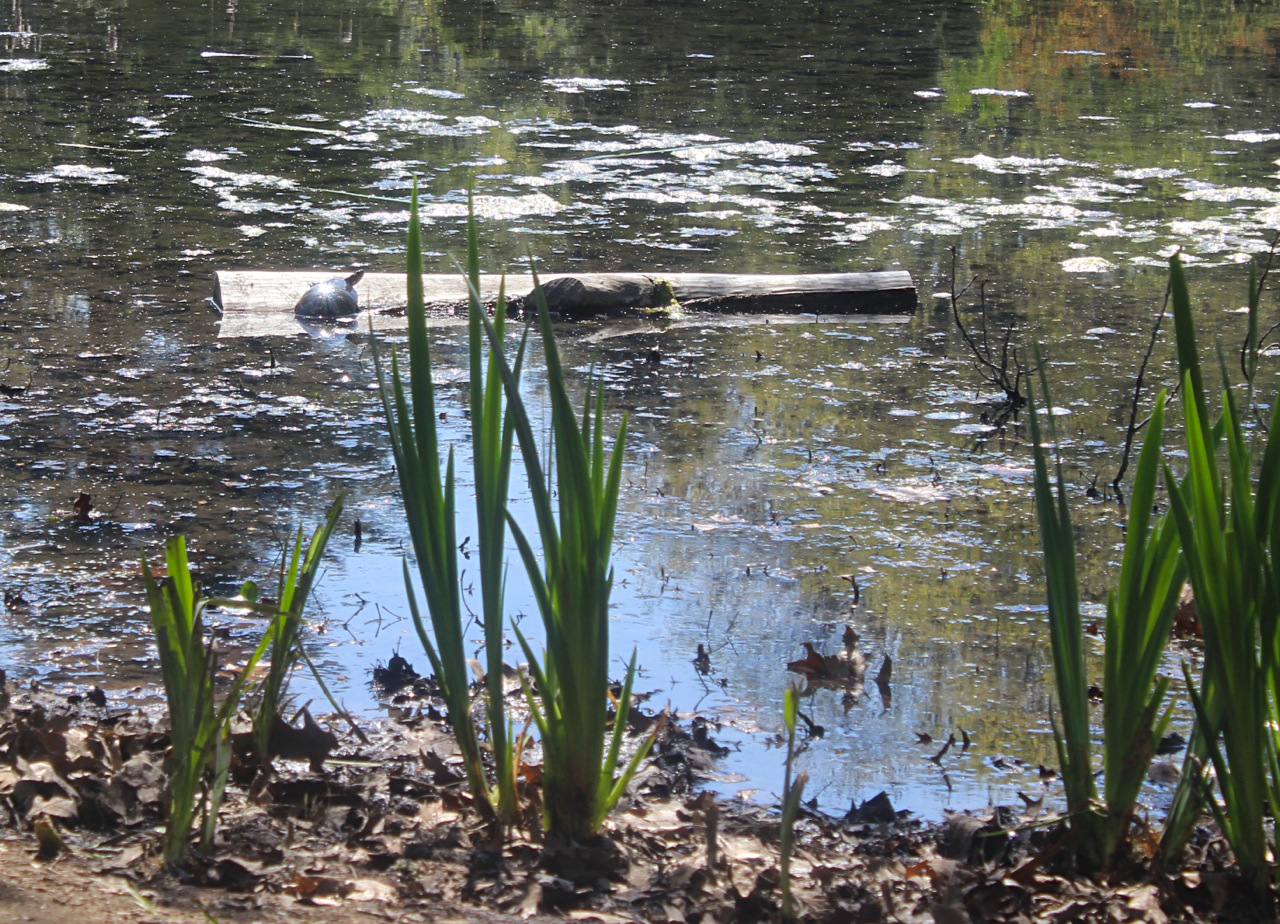
Two days before Mother’s Day, I went to a local garden with Mom where they were having a sale on their plants. The sun was too hot for me and the plants were strangers, so I sat on a bench by the pond, in the shade, while Mom gathered up her new friends. I’d been told that a turtle did a log rolling exhibition in the middle of the pond, when he felt like it, but at that moment he was just resting on the log, getting some sun, so I watched as a duck did a systematic search of the pond, spiraling out from the center, doing surface dives with his butt up in the air and his orange feet paddling furiously. He was looking under the water for something, but I couldn’t see what. Had he lost his keys? Finally, he got tired and went to the spot where the other ducks were resting in the tall grass.

Can you see the turtle out there on the log?

Can you see the turtle out there on the log?

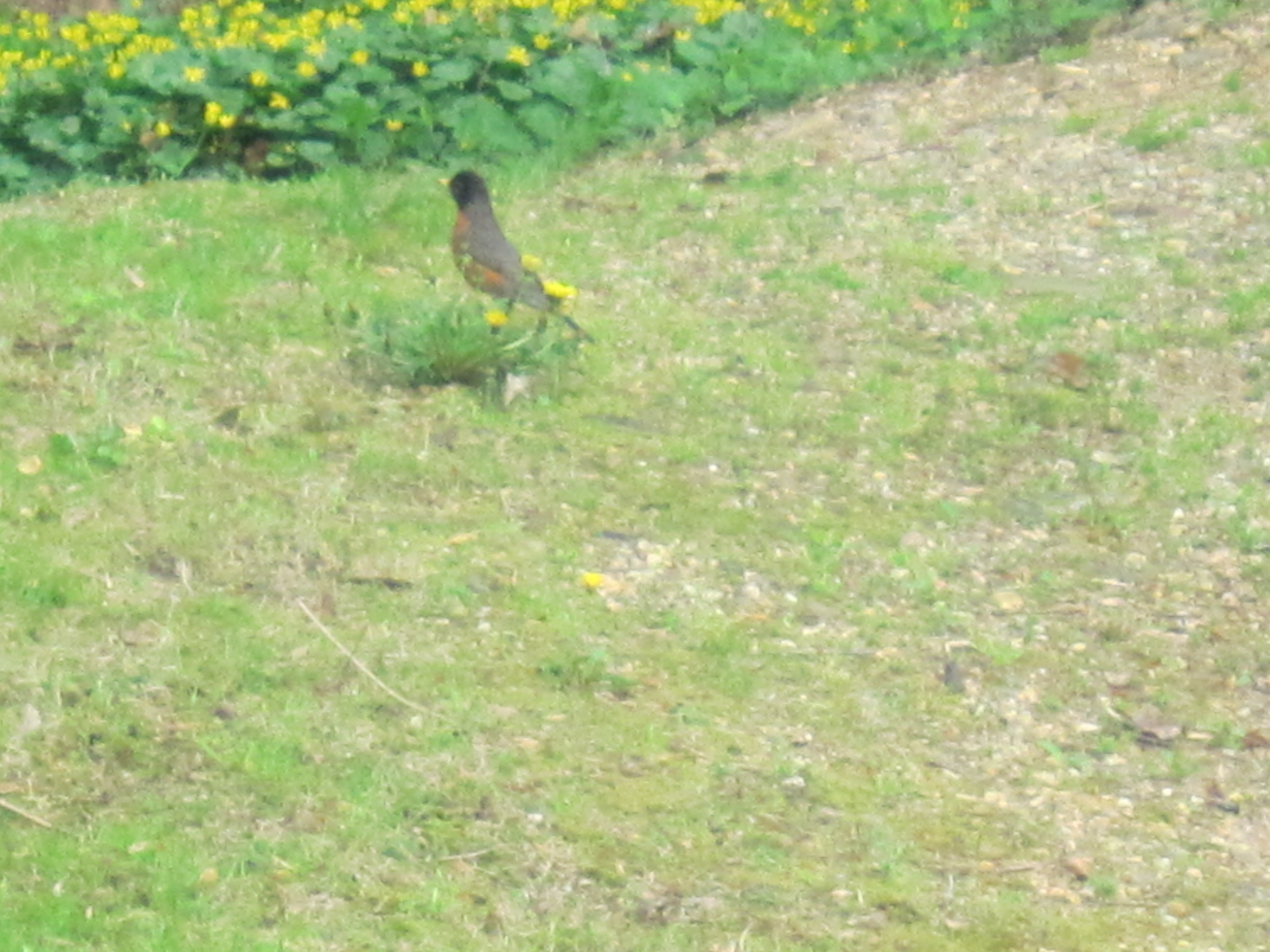
That’s when I noticed a lone robin coming towards me. He was hopping, and looking around, and pausing, and pecking for seeds. I sat still on the wooden bench and watched him as he stepped closer and closer to me. He stared in my direction for a long moment, and then hopped and pecked, and came even closer. Is it possible to make eye contact with a bird? He seemed about to say Hello, when someone approached from the other side of the pond, and he startled and ran for the trees.

When I got home I noticed that there were quite a lot of birds standing on the grass in our yard, just staring into space. Most often they were robins, with their red breasts puffed up and beaks in the air. Mom said that the robins were listening to the underground noises that would tell them where to dig for worms, but I thought it looked like they were doing their daily meditation exercises, breathing in the smells of spring and exhaling the toxic cold of the winter.

Is he listening?

Is he listening or meditating?

The way they leaned and tilted and turned their heads and stretched, it looked like they were doing a form of bird yoga. Mountain pose and Triangle pose were recognizable, but the most impressive pose was when they tilted forward with their weight cantilevered precariously over their tiny legs.

007

Bird Yoga

It always seemed to be one bird alone, with a wide expanse of lawn to search, instead of two birds, or a group, working together. Maybe listening for the worm is a lot like writing, you need to be alone to concentrate.

“I’m not a bird!”

Butterfly does her own version of listening for the worm, or listening for the birds who are listening for the worms. She will run and gallop and stop short to listen, with her nose in the air, and her ears turned to the sound. She captures bird song, and the growling of low planes, and the sound of wind ruffling the leaves, until she feels all filled up. Cricket doesn’t do this. Cricket fills herself up by sniffing every blade of grass. Twice.

Butterfly, listening for the birds.

Butterfly, listening for the birds.

Cricket sniffing, again.

Cricket sniffing, again.

I’ve tried to convince the robins in the backyard that I am not a danger to them. I’ve told them the story of the robin at the pond who wanted to be my friend, but they are still circumspect, even though I am no danger to their food supply. I don’t eat worms, first of all, and I don’t have the patience to stand in one spot and wait for food to come. I prefer the short walk to the kitchen myself. But they insist on fluttering away when I get too close. Maybe if I just sit on the front step, and wait, one brave bird will consider looking my way.

The Cuckoo Clock


When I was little, my brother and I slept over at Grandpa and Grandma’s house in Chappaqua. We stayed in the guestroom, with the two twin beds at perpendicular angles, and while we were there we were almost like friends. My brother is two years older than me and, at home, I was a bother and a nuisance, but at Grandpa’s house we were a team. He needed me as much as I needed him, because we were in a strange place and didn’t know what to do, though, of course, he still didn’t want to actually talk to me.

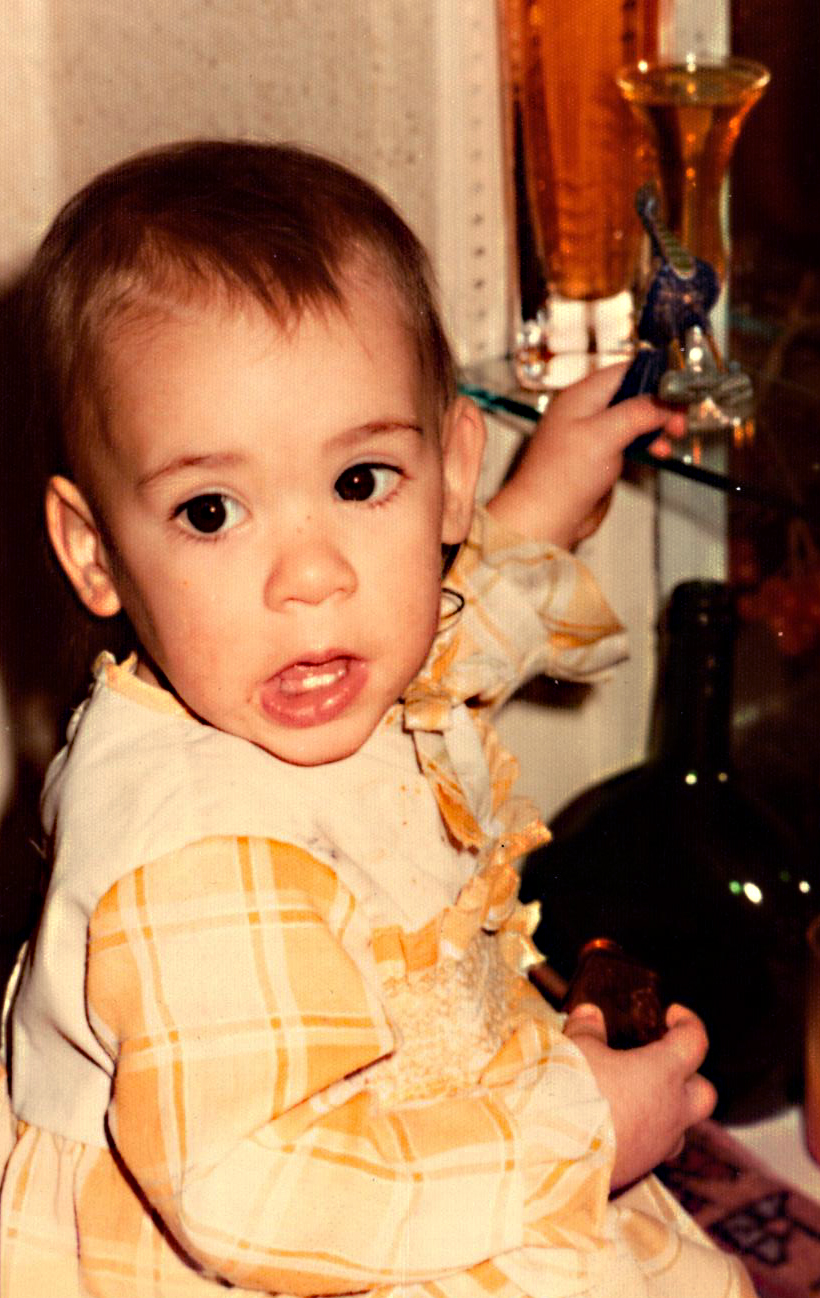
There was some vague sense that our presence was a problem for Grandma, and that we really shouldn’t be seen, or heard. There were glass figurines by the front door – which no one ever used – and I was not allowed to play with them, though there are pictures of me trying to touch them as a toddler. They had no children’s books that I remember, or toys. Grandma had tambourines and maracas and two strange little keyboard/recorder hybrids on top of the piano, and we were allowed to play with those, I think, but not for too long, and not if we gave her a headache.

"What?"

“What?”

My grandparents’ house was built into a hill, so that on one side of the house, the first floor you saw was the main floor of the house – well lit, sunny, and facing a green lawn – and on the other side of the house, the first floor you saw was the garage, and basement, and laundry room – dark and mildewed, and with a rickety stairway up to the main floor. We always entered the house through the laundry room and walked up the rickety stairway into the light.

Me in the living room, looking for the light.

Me in the living room, looking for the light.

When we first arrived, we sat awkwardly in the big chairs at the dining room table and ate butter cookies from a blue tin, and listened to the chimes of the grandfather clock. I don’t remember Grandma talking to us much, except to say no, and don’t do that. She liked for us to sit quietly on the floor and look through old family photo albums with strangers in them who she never identified. For entertainment, we’d crack open nuts from the nut bowl, and that’s how I found out that I loved hazelnuts, and hated brazil nuts, and found walnuts incredibly frustrating to work with.

There was dust everywhere, hanging on the rays of sunshine coming through the windows. And there was a hidden attic, with stairs that had to be pulled down from the ceiling, and there was a laundry chute in the wall that sent the dirty clothes down a slide to the laundry room. We were not allowed to try the ride for ourselves; we asked.

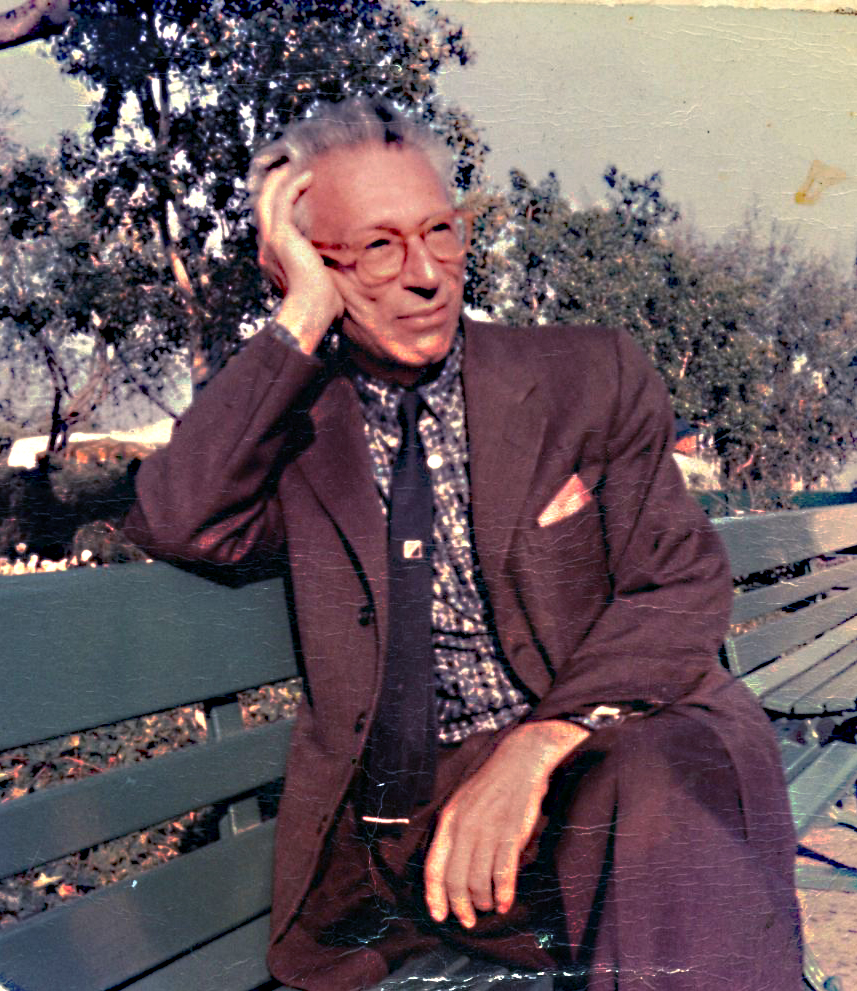
Grandpa took me and my brother food shopping at the local Grand Union, after snacks, and educated us about the wonders of “Red Dot Specials,” and out-of-date bread, and slightly bruised fruit. He’d spent a lifetime teaching Consumer Education and he wanted to share it all with us. He’s probably the reason I’ve always loved supermarkets; he made them seem like magical places, full of everything we could ever need.

Grandpa

Grandpa

He drove us there in his white Mercedes convertible, so that we could feel what it was like to drive with the top down, but I think he also took us out to give Grandma a break from having children in her house.

When we came back, we put the groceries away and then went down to the garage. The house sat on a big piece of property, mostly taken up by a pond. Grandpa had rowboat and life vests and oars hung up in the garage, as if it were a boat house, which it sort of was, and he’d take the row boat out on the pond as often as possible. I’m not really sure what he did out there, because I refused to get in the boat. The water in the pond was an opaque green and I was certain that there were evil creatures skittering around in there. I expected the Loch Ness monster to jump up and roar at any moment. I was even afraid to walk across the little wooden bridge to sit on the bench by the water to wait for Grandpa and my brother to come back, because I expected eels to fly up and grab my legs. I preferred to stand in the driveway, or over by the little stream, where the monsters couldn’t get me.

Late at night, they took us out for ice cream (maybe at eight PM, but it felt like midnight to me) and we ate ice cream sundaes, and brought home candy necklaces, and candy dots, and red licorice strings, and my brother even shared some of his with me, because I ate faster than he did, and because he was better at saving some for later.

At night, though, the house was too quiet. They didn’t have a dog anymore. I would hear about Rufus, the small, shaggy dog my grandmother used to dote on, but by the time I was born there was no sign of a dog in their house, no toe nails clicking on the hardwood floors.

Rufus

Rufus

But, there was the cuckoo clock in the guest room. It was so loud! Every hour, it seemed, the little bird would pop out of the front door of the clock and make noise, and it felt like the whole clock was giggling and shaking. I could hear the tick tick of the cuckoo clock all night. It was wonderful! I looked forward to visits from that cuckoo, like a long lost friend, checking to make sure I was alright. I always wanted to bring the cuckoo clock home with me, but everyone said no.

A Cuckoo Clock (not mine).

A Cuckoo Clock (not mine).

When the dogs wake me up now, at way-too-early in the morning, they remind me of that cuckoo clock. They have the same persistence as the cuckoo, the same cacophony of noise, and the same visible shaking from making all of that noise, as if any second their pieces are going to pop out from excitement. Their little tails wag like metronomes and remind me of the pendulum swinging side to side at the bottom of the clock. And I feel that same sense of relief I felt when the cuckoo came to visit. I’m not alone! Someone else is here, and talking to me. Hello!

"Who us?"

“Who us?”