Shabbat is the weekly Jewish holiday of rest. It starts at sundown on Friday and ends after sundown on Saturday. The theoretical, biblical, reason for a day of rest is, of course, that God created the world in six days and therefore took a well-earned break on day seven. But really we all need a day of rest each week, even if we didn’t create a whole world by ourselves. (I’m pretty sure I need more than one day of rest in seven, but this isn’t the time to quibble).

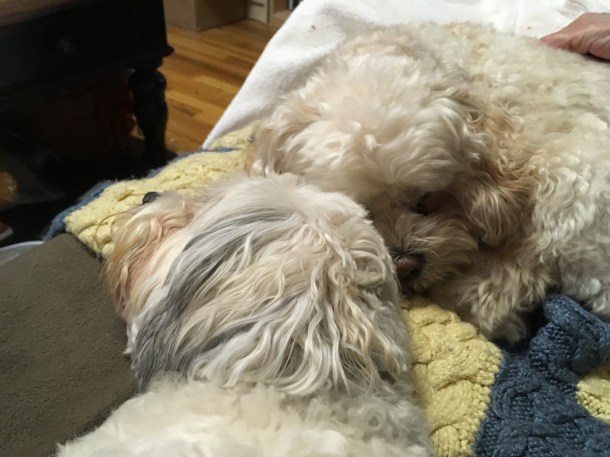
Cricket believes in resting seven days out of seven.
I grew up going to synagogue every Saturday morning, first for junior congregation with the other kids, and later to the adult services, which lasted two and a half hours and ended with Slivovitz (plum brandy) and gefilte fish. But it’s been a long time since I went to synagogue regularly on Saturday mornings. Instead, I go on Friday nights, because my synagogue is more of a Friday night kind of place. We only have Saturday morning services when there’s a Bar or Bat Mitzvah to celebrate, or a holiday that falls on Shabbat. So, for a long time now, I’ve treated Saturday like, well, any other day. A day to do chores, make appointments, get my work done, etc. I took the time out for Friday night services as my weekly celebration of Shabbat and felt like that was enough.
I didn’t realize that I was really missing those Saturday mornings until I started to teach Synagogue school on Saturday mornings at my synagogue and was able to sit in on the children’s service. We all sat together in the first few rows in the sanctuary, with the Rabbi sitting right in front of us and leading us through the short service in a very relaxed, informal sort of way. When we read the morning blessings, the Rabbi asked everyone to share a recent accomplishment, or an exciting event coming up, or a difficult problem we needed support with, and the kids raised their hands. They shared about their new braces, and trips to Disneyworld, or New Jersey, and injured wrists, and newborn siblings. I didn’t have the nerve to speak up, but their openness inspired me. It was prayer as a chance to check in with our community and ourselves, and take a deep breath (or ten) and feel the natural holiness that we bring with us into the room.
And then we drank grape juice and tore through Challahs (really, these kids can do some real damage to a very large loaf of bread), and went to class. The mood of Saturday morning class is so different from the after-school rowdiness of synagogue school earlier in the week. We can meander through a discussion and hear from everyone more fully, and share our outside interests in music and Lego and animals and bring them into the discussion of the Torah lesson for the day, knitting together the ordinary and the holy.
Shabbat was hard for me growing up, because Shabbat was one of the battlegrounds my father chose to fight over. He made us walk six miles to the orthodox synagogue, and he stopped us from watching television or doing homework. The day became a wasteland, with nothing to do and nowhere to go, because we didn’t live in a Jewish community with other people in the same situation. And it wasn’t restful at all. It didn’t feel holy or sacred to replace the toilet paper in the bathroom with tissues, just to avoid ripping paper on Shabbat, or to cover the light switches with plastic to keep from turning the lights on and off; it felt more like prison.
For years now, I’ve had therapy on Saturday mornings – either group or individual – and I accepted that I couldn’t go to Saturday morning services at a synagogue, because I knew that therapy was more important. But I realized that I liked this Shabbat School version of Saturday morning prayers. I liked that it didn’t take hours, and we didn’t have to dress up, and we did get to talk, a lot, about our actual lives. This past week the cantor ran the children’s service, and we all sat in a circle-like clump on the floor to sing along with him and his guitar, and then to breathe together, and then dance together, and I thought, yeah, I could do this every week. If only my dogs could be invited.

“I wanna go!”
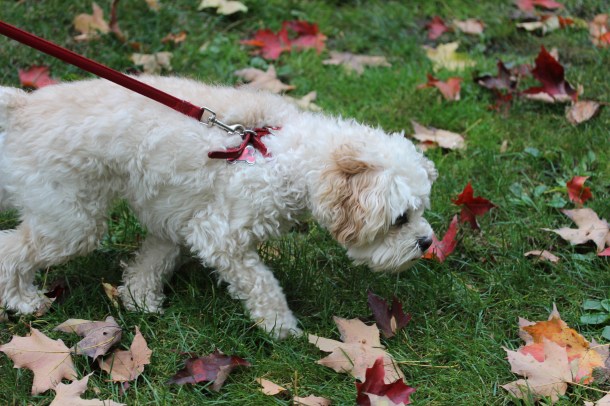
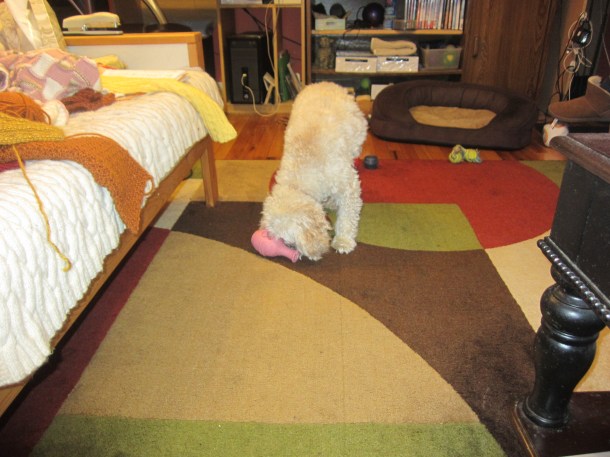
Cricket and Ellie know all about rest and holy time, and they don’t need as many memory aides as humans do to help them get to that peaceful, connected place. They just need the birds singing to them in the morning, and the air filled with smells from near and far, and a few chicken treats and cuddles. Though I really would love to see Ellie dancing along with the kids at Shabbat school, and she would love to share their Challah. Cricket would probably steal the whole challah and hide it under the ark, where only she and the rabbi could find it. But they’d probably enjoy that too, hunkering down in the sanctuary to share bread.

“Did you say Challah?!”

“I could eat.”
What’s a community for, really, if not to take time out to share good food, and sing, and maybe even dance?
If you haven’t had a chance yet, please check out my Young Adult novel, Yeshiva Girl, on Amazon. And if you feel called to write a review of the book, on Amazon, or anywhere else, I’d be honored.
Yeshiva Girl is about a Jewish teenager on Long Island, named Isabel, though her father calls her Jezebel. Her father has been accused of inappropriate sexual behavior with one of his students, which he denies, but Izzy implicitly believes it’s true. As a result of his problems, her father sends her to a co-ed Orthodox yeshiva for tenth grade, out of the blue, and Izzy and her mother can’t figure out how to prevent it. At Yeshiva, though, Izzy finds that religious people are much more complicated than she had expected. Some, like her father, may use religion as a place to hide, but others search for and find comfort, and community, and even enlightenment. The question is, what will Izzy find?
































 rachelmankowitz