In college, after I decided not to be an English major, or a comparative languages major, I had to go for an interview with the head of the French department to see if I could become a French major. Sitting there in his office, I could barely put a sentence together, despite being in advanced French classes and doing well in them. The head of the French department was nonplussed and sent me packing, and I ended up as a philosophy major, where they accepted everyone.
Even after that debacle, though, I still felt tied to the languages I’d studied (French and Hebrew), and the languages I wanted to study (Spanish, Latin, Russian, German, Yiddish, etc.). I’m not sure what the draw is for me, because I have no particular talent for languages. My brother still remembers all of his high school French without even trying, or caring, but for me it’s a struggle.
Recently, I’ve been spending even more time and effort on my language studies, as a strange sort of antidote to all of the social work reading I’ve had to do for graduate school. I have computer games and audio cds and textbooks and short stories and poetry collections, in both languages.
The dogs have had to listen to a lot of people speaking French and Hebrew through the speakers on top of my dresser. They stretch out on the bed, or on the floor, and pretend they’re being told a bedtime story in gibberish. Actually, I have no idea how much they understand. It’s possible that when I try to repeat the Hebrew words the computer flashes at me, the poor puppy dogs are shaking their heads and thinking, How can you not know that word yet, Mommy? We’ve heard it a thousand times!

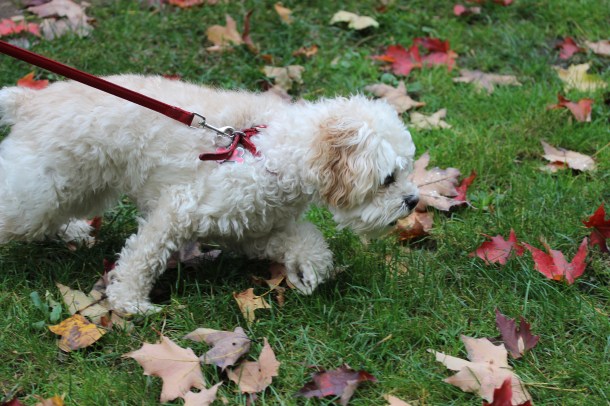
Butterfly is listening carefully.

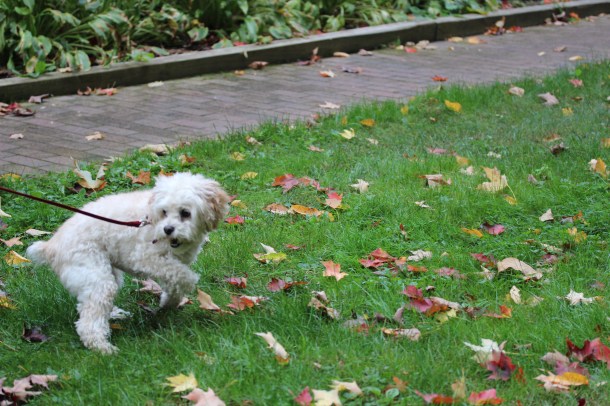
Cricket, on the other hand, is getting annoyed.
It’s also possible that they couldn’t care less, and barely register that these words are in French or Hebrew instead of in English, because clearly no one is talking about chicken treats or pee trips, so what’s the point?

“J’ai faim, Maman. You are starving me.”
I still have trouble producing words from the black hole of my mind. You would think, with all of the information I’ve stuffed in there over the years, the words would be spilling over the sides, but no, they go in and get sucked into another dimension and reappear only when they’re in the mood. I’m a writer with two master’s degrees, and I can’t think of the word for that plastic thing you use to mix cookie dough, or the metal version of it that can flip pancakes. I run through fork, knife, plate, napkin, flipper, baking thing, until Mom calls it a “spatula” and I say “Yes! That’s it!”
I can, and have, made a fool of myself in public many times when the wrong words popped up, or no words popped up at all. I think some of my nerve pathways must blink in and out of service like an old TV antenna. If I’m in a new environment, or under stress, even the most well-travelled pathways in my brain are hard to find. With the foreign language pathways, just the stress of being asked to remember a word can be enough to shut down the whole system.
Cricket never seems to struggle to find the right word, or bark, for a given situation, but maybe that’s just bravado and she’s desperately wishing for a larger, more comprehensive vocabulary with which to express her disdain. Do other dogs understand her? If she went to Paris, would Cricket be able to understand the dog in a beret, smoking discarded cigarette butts at an outdoor café? I don’t think she cares.

“I have all the words I need.”
Maybe this herky jerky, non-fluent feeling I get from trying to speak in French and Hebrew is what I’m actually reaching for, though, as a metaphor that fits how I feel. My fluency in English doesn’t match the dysfluency of my mind. Maybe the struggle to find words in a foreign language, grasping for words and struggling with grammar, feels more like my internal experience of myself. And maybe, by working through this language learning process, I will eventually be able to feel more whole, or at least feel more like a dog.




































 rachelmankowitz