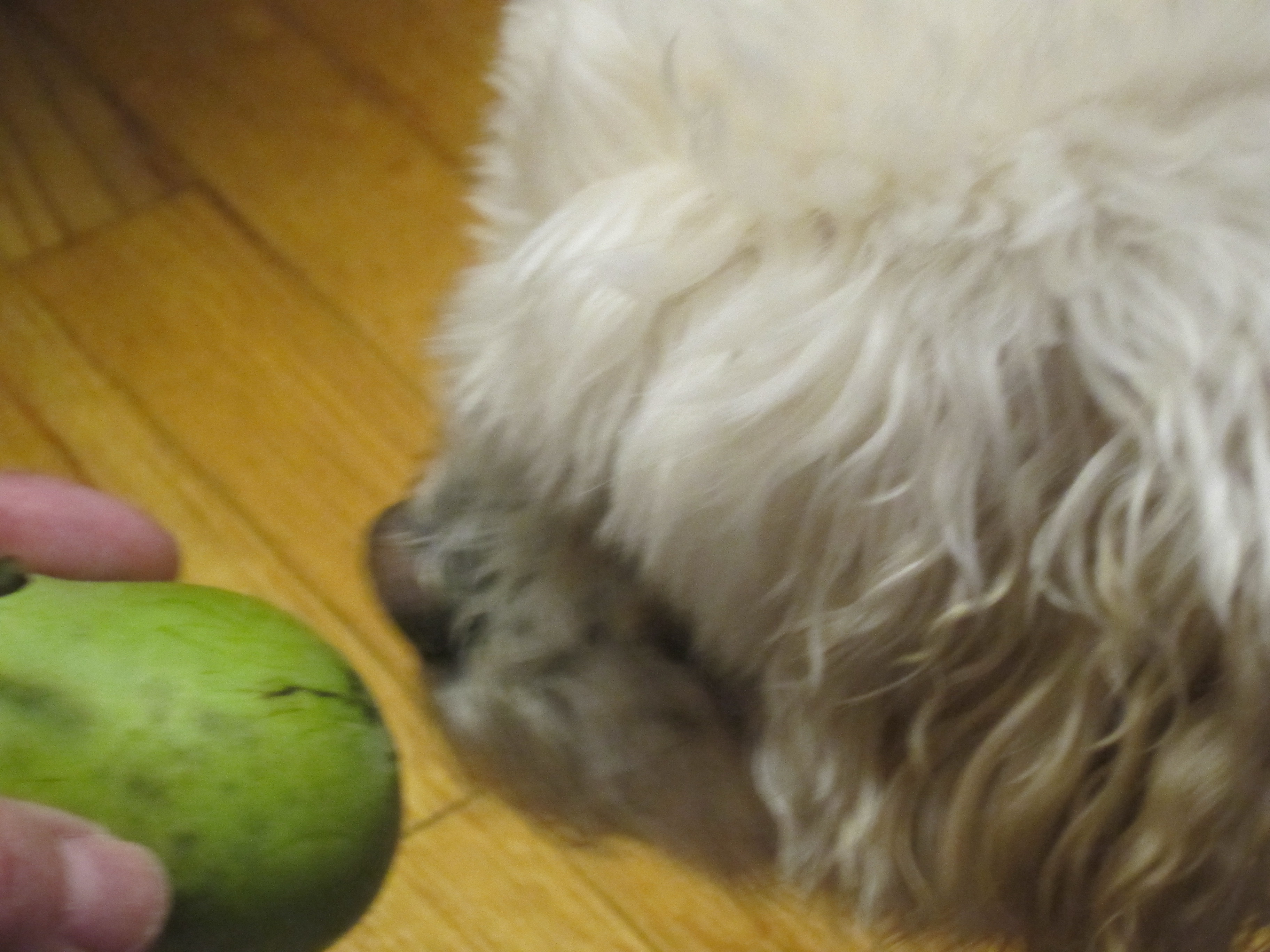
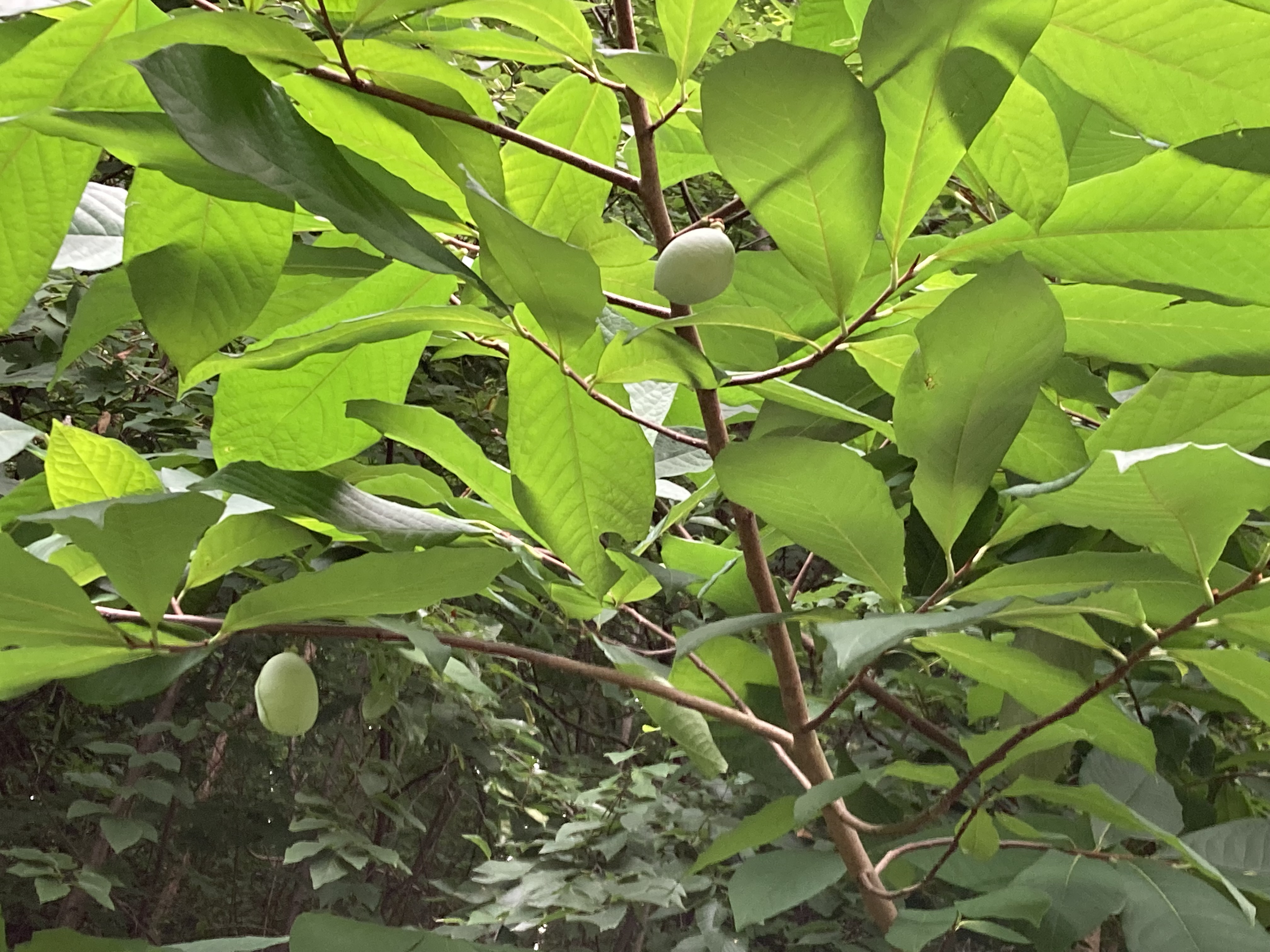
Recently there have been a bunch of articles about pawpaws in the national media, notably in the Atlantic and the New Yorker, framing paw paws as the latest gotta-have-it new thing for Brooklyn hipsters, which is weird, because I learned about them from a friend in graduate school, in North Carolina, sixteen years ago. My own pawpaw tree finally gave its first fruit last year, at age fifteen, and this year we had eight or nine pawpaws of various sizes and shapes. It’s possible that everyone else heard about pawpaws around the same time as I did, and only now do they have enough fruit to harvest and sell at random outdoor markets in Brooklyn, but who knows.
There’s something magical about these awkward, exotic, frail, native American fruit that is made for proselytizing, so I can understand why the people who have tasted them have been whispering and planting and trying to grow the fan club.
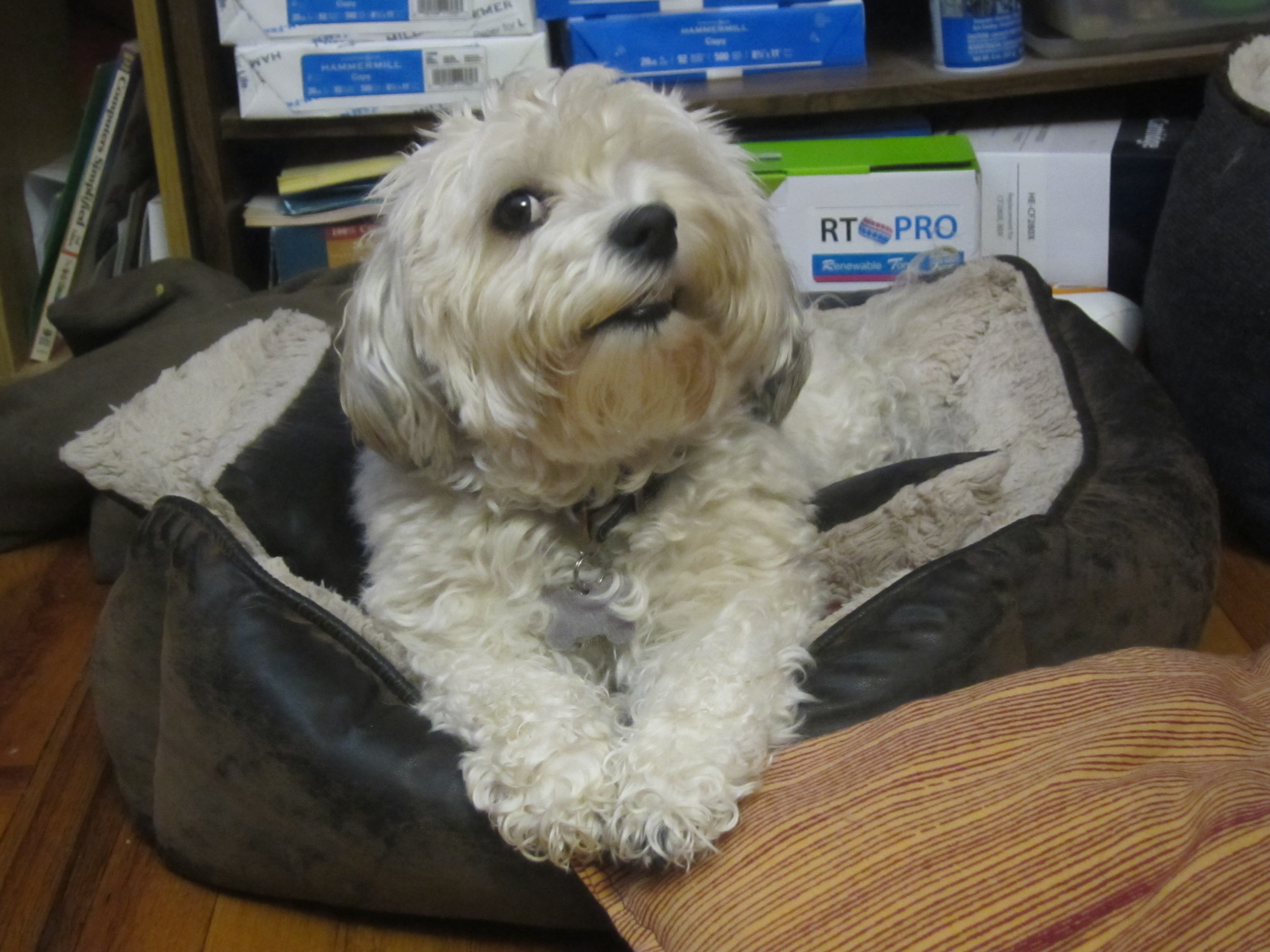
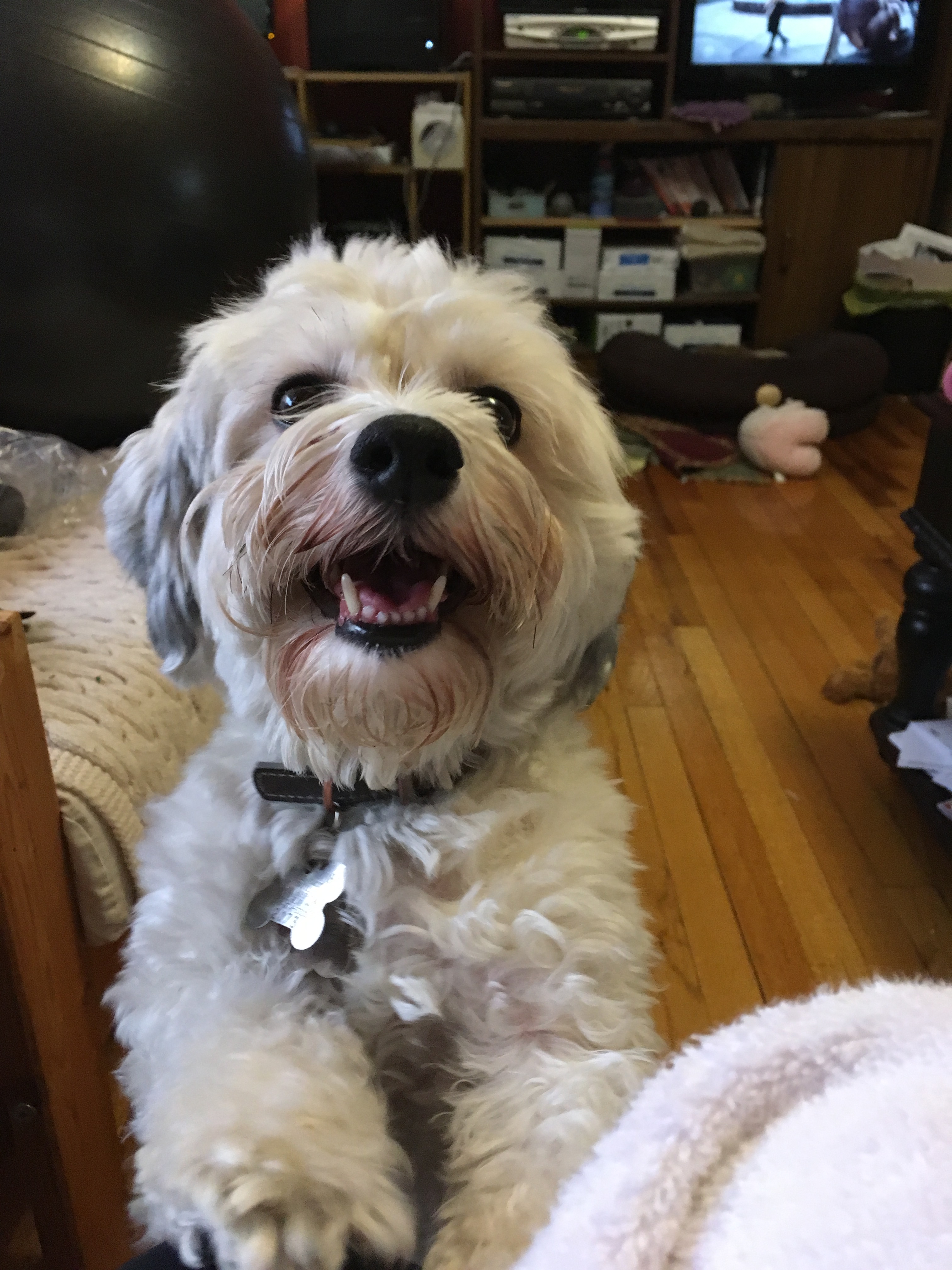
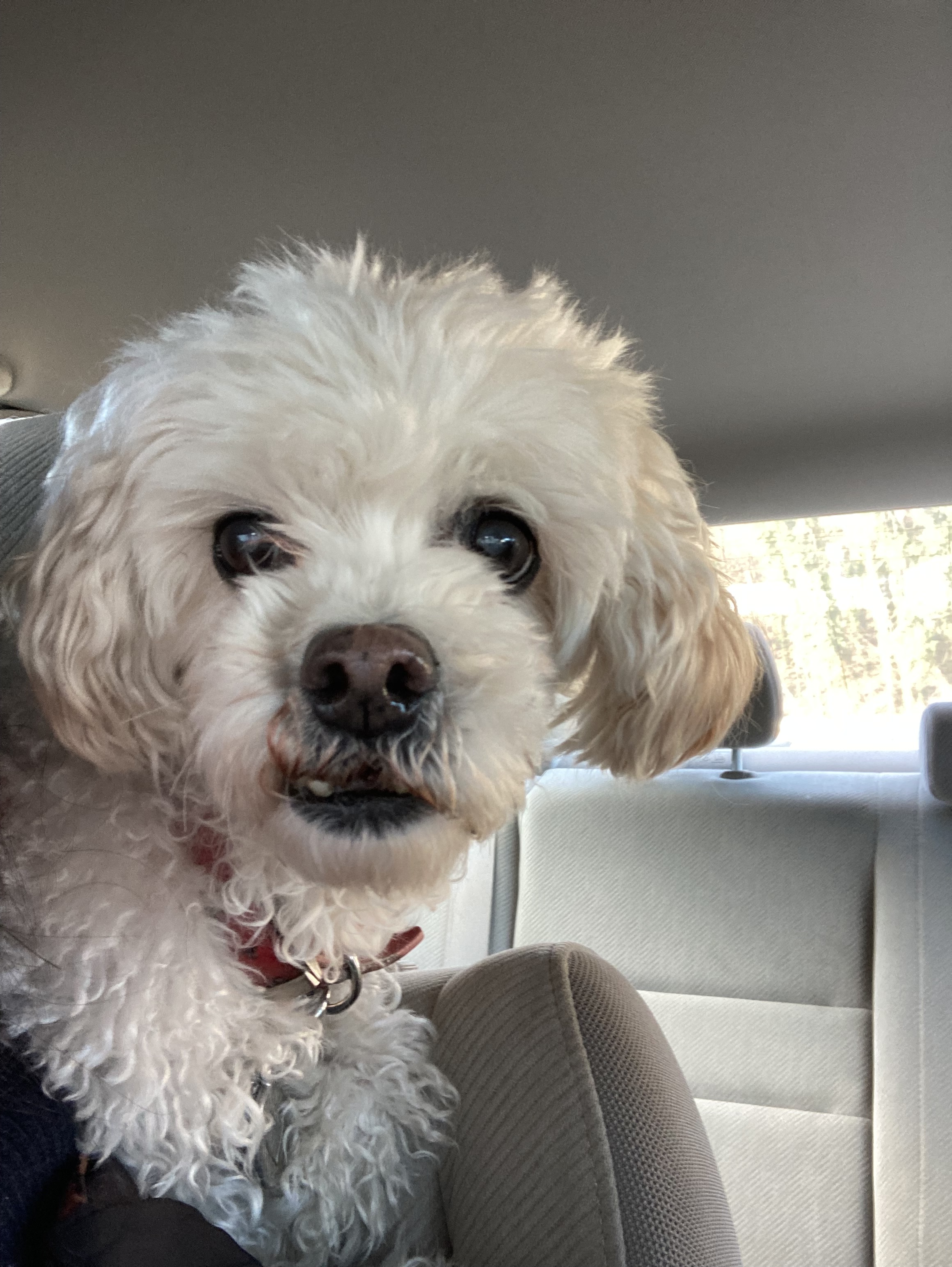
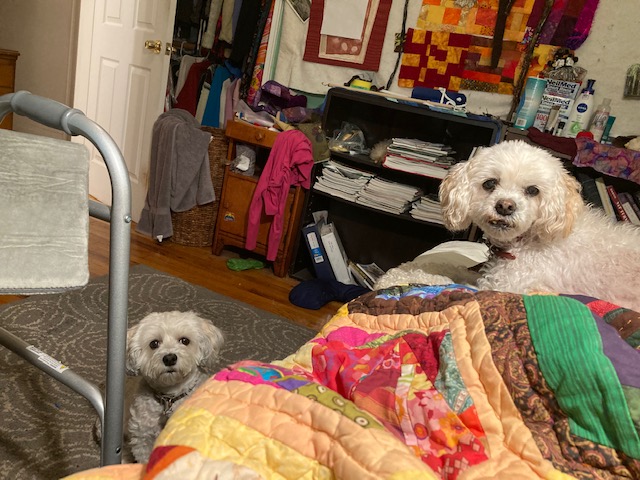
Cricket is in the club
Mom and I ate the first of this year’s pawpaws just before Rosh Hashanah, and the last one to celebrate the end of Yom Kippur ten days later, and in between we shared the rest of the pawpaws with family and friends, with my therapist and rabbi, and possibly with a squirrel or two, because the biggest pawpaw disappeared after the gardeners came one day a few weeks ago; so either they knocked the fruit to the ground and squirrels ran away with it, or one of the gardeners took it home. Either way, I hope whoever found it enjoyed it.
My hope is that we will get an even bigger harvest of pawpaws next year, and that my younger trees will be ready to fruit sooner rather than later, because there’s real joy in being able to share a pawpaw with someone who’s never tasted one before. I don’t think I’ll ever have enough fruit to start freezing the pulp for cakes and jams and pies and so on, the way the foragers in the magazine articles described, but I only need a few each year to keep the magic going, sharing them with new people and reminding myself of how special they are.
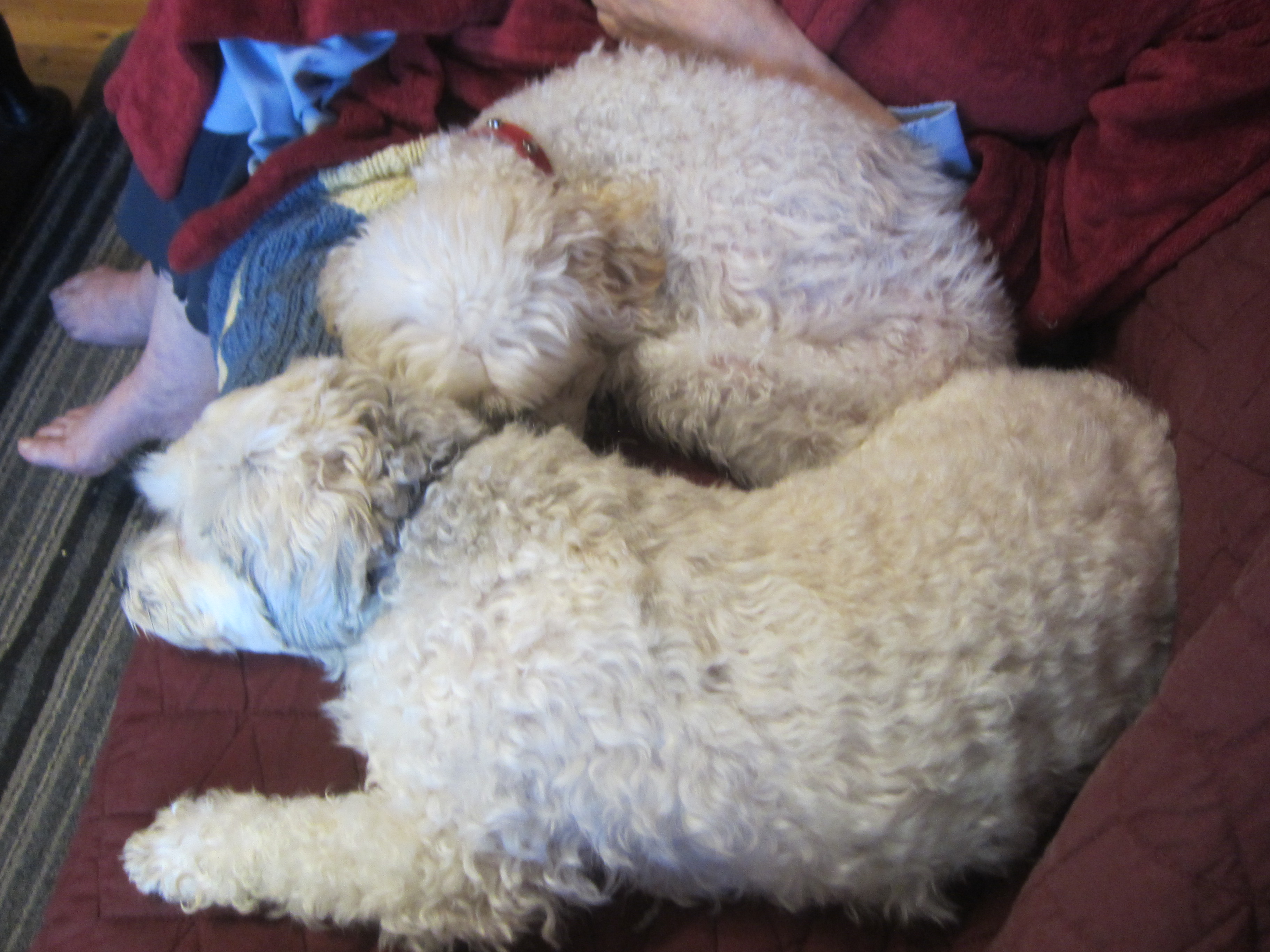
“But I like cakes, jams, and pies!”
One of the articles talked about scientific research being attempted to make the pawpaws better able to withstand travel and time, so that they can be sold at supermarkets instead of turning to mush before the truck can ever get there, but I’m not sure how I feel about that kind of pawpaw. There’s something about the resonance of pawpaws, the way they seem to encapsulate longing and patience and grief and love and loss, in a sweetness that only lasts a few days, and I’m not sure it would be the same if I could just pick up a pound of pawpaws on the way home from work.
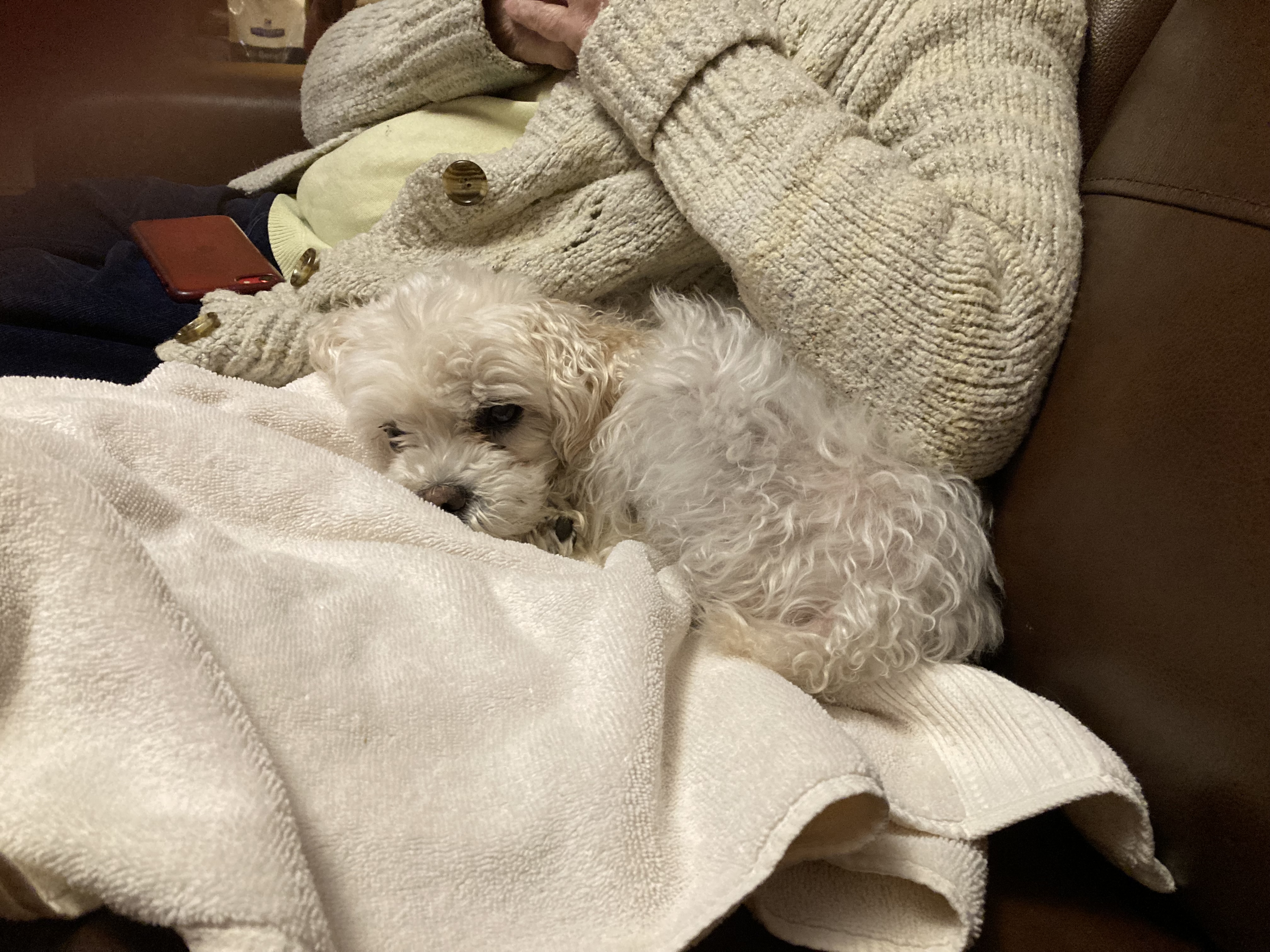
My favorite supermarket.
In case anyone is interested I’m going to add links to some of the pawpaw articles (though some of my favorites are no longer available online), because sharing an article about pawpaws is almost (but not quite) as satisfying as sharing a pawpaw itself.
If you haven’t had a chance yet, please check out my Young Adult novel, Yeshiva Girl, on Amazon. And if you feel called to write a review of the book, on Amazon, or anywhere else, I’d be honored.
Yeshiva Girl is about a Jewish teenager on Long Island, named Isabel, though her father calls her Jezebel. Her father has been accused of inappropriate sexual behavior with one of his students, which he denies, but Izzy implicitly believes it’s true. As a result of his problems, her father sends her to a co-ed Orthodox yeshiva for tenth grade, out of the blue, and Izzy and her mother can’t figure out how to prevent it. At Yeshiva, though, Izzy finds that religious people are much more complicated than she had expected. Some, like her father, may use religion as a place to hide, but others search for and find comfort, and community, and even enlightenment. The question is, what will Izzy find?
I made it through the Jewish high holidays. It was touch and go there for a while, because I couldn’t go to the last few choir rehearsals, and because three of the other synagogue school teachers got Covid at the same time, including the Cantor! So I was relying heavily on my KN95 mask to get me through.
I made sure to wear my sneakers (because there’s a lot of standing at the high holiday services, especially on Yom Kippur), and I practiced the music as much as possible on my own, and I even started to do breathing exercises (there’s an app for that!), to build up my breath capacity after months of not singing much at all.
“I breathe all the time without an app, Mommy.”
The surprising thing was how much fun it was to sing with the choir again. I’d forgotten that it was more than just work. When, after missing Rosh Hashana with Covid, the Cantor made his triumphant return for Yom Kippur, it was truly joyous to hear him sing again, and to be able to sing along with all of the tunes the choir doesn’t lead, and realize how much of the music that we only hear once a year is actually familiar and comforting and really powerful.
It was fun to be with a crowd again; to have so many people in one place, at one time, experiencing the same things, hearing the same stories and singing the same songs and laughing at the same jokes, and it was wonderful to see the children of the congregation (many of whom have been my students over the past few years) go up to the bima and take pride in opening the ark, where the Torah scrolls are kept, but even more so at just being seen.
The high holidays are still a lot of work, don’t get me wrong. And waking up early, and dressing up, and singing and praying and standing and sitting, over and over and over again, was grueling. And the dogs really hated the constant coming and going (mostly the going), especially when we had more than one service to go to in a single day.
“Harrumph.”
But it was worth it. Beforehand, I was so focused on how hard it would all be, and how much pain I would be in, and how tired I would get, that I forgot how extraordinary it can feel to be surrounded by a community I truly like, and share history with, and can sing with, and even sometimes dance with.
I’m sure I will forget all of this again by next summer, when it’s time to rehearse with the choir again and build up to the high holiday services again. I’ll probably spend hours, and days, and weeks, dreading the whole thing and resenting the choir rehearsals and worrying about what to wear, but so far, I can still feel the joy, and it’s wonderful. There are so many difficult things in life that really don’t feel worth all of the effort and pain and anxiety; but some things, like this, are totally worth the effort. Thank God!
“Sleep is always worth the effort.”
If you haven’t had a chance yet, please check out my Young Adult novel, Yeshiva Girl, on Amazon. And if you feel called to write a review of the book, on Amazon, or anywhere else, I’d be honored.
Yeshiva Girl is about a Jewish teenager on Long Island, named Isabel, though her father calls her Jezebel. Her father has been accused of inappropriate sexual behavior with one of his students, which he denies, but Izzy implicitly believes it’s true. As a result of his problems, her father sends her to a co-ed Orthodox yeshiva for tenth grade, out of the blue, and Izzy and her mother can’t figure out how to prevent it. At Yeshiva, though, Izzy finds that religious people are much more complicated than she had expected. Some, like her father, may use religion as a place to hide, but others search for and find comfort, and community, and even enlightenment. The question is, what will Izzy find?
Just before sunset on Erev Rosh Hashanah (the first night of the Jewish New Year), my Mom noticed that one of the pawpaws (from a tree we grew from seeds 15 years ago, that only gave its first fruit last year) was starting to blacken in one spot, and when I got close to it I realized that the distinct pawpaw smell was already filling the air, and the fruit was becoming soft. There were eight or nine pawpaws on the tree this year, but we’d been waiting for a sign that they were ready to be picked, and for this one piece of fruit, this seemed to be the sign. So we plucked it from the tree, and brought it inside, and said the Shehecheyanu blessing (the Jewish blessing for new experiences), before sharing the first new fruit of the year.
Blessed are You, Lord, our God, King of the Universe, who has granted us life, sustained us, and enabled us to reach this occasion.
It’s not so much that I believe God magically gave me a pawpaw just in time for the New Year, it’s more that I believe in the power of recognizing these moments of wonder in my life, as a way to remind myself that there will be many more of them in the future, in case I’m beginning to lose hope.
“I never lose hope that there will be more chicken treats!”
One of the new things I’m trying this year with my synagogue school students is a blessing a day – or, really, a blessing a week, because we only have Hebrew class once a week – and we started the year with the Shehecheyanu blessing, because it’s associated with the Jewish New Year, and because it gives us a chance to talk about all of the new things we are starting in our lives, and maybe feeling anxious and excited about at the same time.
I want the kids to know that there are hundreds of pre-set blessings that they can use, but also that they can create their own blessings, and celebrate things in their lives that are unique to them, or even just use words that have more meaning to them. For example:
I am so grateful that the new KN95 masks are cheaper and more plentiful than they used to be, so I can wear them all the time instead of relying on less protective masks.
I am grateful that people not only read my writing but invest in it enough to respond with their own thoughts.
I feel blessed when Ellie sees that I am in pain and comes over to lick my hand, to let me know she’s there with me and loves me.
I sense a power bigger than myself when I discover a new food/song/book that fills me with wonder and a sense of connection.
I feel like the sun is shining down on me when my students smile and laugh and really seem to enjoy being in my class.
For some reason, the girls in the class took to the Shehecheyanu blessing immediately and began fighting for the chance to stand in front of the classroom and give dramatic readings – as if they were on stage reciting Shakespeare. Who knew blessings could be so loud, and entertaining?!
“Me!!!!”
I’ve been collecting blessings to teach to the kids this year, and of course I have to include the most used blessings, the ones over food, because the kids are always hungry! The Jewish food blessings are well documented – you’ll find yeshiva boys competing over who knows which blessing to say over which kind of food (for example, you have to say two different blessings for an ice cream cone, one for the cone and one for the ice cream!). I’m not a big fan of getting into the weeds of the pre-set blessings, but I appreciate that they exist and can give me a reference point for how to create my own blessings.
We often think of a blessing as something that is given to us – we are blessed by luck, blessed to be loved, blessed to survive a flood – but I like the idea of a blessing as what we say in response to that good fortune; so we’re giving the experience our own stamp, our own interpretation, to make sure it doesn’t go unnoticed, by us.
I specifically went looking for a blessing over putting on a face mask, because I needed a reminder that I’m still wearing one for a good reason, and I found a blessing (at ritualwell.org) written by Rabbi Michael Knopf that blesses God for commanding us to protect life (this actually is a commandment, called Pikuach Nefesh, where we are told to break many of the other commandments if it will allow us to save a life).
Blessed are you, Lord our God, who has sanctified us with your commandments and commanded us to protect life.
It’s sufficiently vague to use for all kinds of protective behaviors: like getting a vaccine, or wearing a mask, or forcing yourself to go for a regular checkup even when you really don’t want to.
“I never want to go to the doctor.”
There were also blessings on Ritualwell for taking off masks, and all sorts of other things that don’t already have existing blessings in the canon. I’m hoping that by the end of the year I’ll have a whole file of blessing from my students to send in to the website, because kids are really good at seeing the specifics of their lives and the wonder in the every day. I’ll teach them the blessings for seeing a rainbow, or meeting a wise person, or surviving a life threatening experience, and then it will be their turn to teach me: how to bless an endless session of playing video games, or sharing a peanut butter and pickle sandwich with a friend, or rolling down a snowy hill until you can’t breathe for laughing.
I can’t wait!
“Peanut butter and pickle sounds pretty good.”
If you haven’t had a chance yet, please check out my Young Adult novel, Yeshiva Girl, on Amazon. And if you feel called to write a review of the book, on Amazon, or anywhere else, I’d be honored.
Yeshiva Girl is about a Jewish teenager on Long Island, named Isabel, though her father calls her Jezebel. Her father has been accused of inappropriate sexual behavior with one of his students, which he denies, but Izzy implicitly believes it’s true. As a result of his problems, her father sends her to a co-ed Orthodox yeshiva for tenth grade, out of the blue, and Izzy and her mother can’t figure out how to prevent it. At Yeshiva, though, Izzy finds that religious people are much more complicated than she had expected. Some, like her father, may use religion as a place to hide, but others search for and find comfort, and community, and even enlightenment. The question is, what will Izzy find?
People keep telling me how brave I am, for doing this or that, but I feel fragile. Actually, when they tell me that something I’ve done is brave, I worry that they think I was an idiot for doing it. Because I tend to think bravery, just for the sake of being brave, is a waste of time. I don’t want to be brave. I want to be happy. My whole life, every risk I’ve ever taken was in pursuit of happiness. I couldn’t care less if I’m considered strong, or courageous, or admirable; I just want to be happy.
“Weeeeeeeeeeeeeee!”
Part of my discomfort with being called brave is that I have a very wide streak of hiding under the bed in fear, and I refuse to see that as a flaw. I want to give myself credit for knowing when I’m scared, and respecting how I feel, and judging the danger accurately.
I don’t try new things because I want to be brave; I try new things because what I was doing before wasn’t working for me. I refuse to try new things just because they’re there, or because someone else tells me that it’s time to jump off this cliff or that bridge and be brave. I will jump off the bridge only when it’s crumbling under my feet, or when it’s not going in the direction I need to go.
In general, I tend to think of myself as cautious and turtle-slow. I take my time stepping into each new challenge (when possible), and my reluctance to just do what’s asked of me without question is long-lived and incredibly annoying to other people. I know.
Too bad.
There are times, though, when I know I have to be brave, and I know I have to force myself out of my safety zone and do scary things. But I don’t like it. And I reserve the right to complain bitterly about having to do it. Because being brave does not make me feel good. Doing things that matter to me, and that make a difference to the people around me, makes me feel good; expressing my individual thoughts, and still feeling like a welcomed member of the group, makes me feel good; and writing stories that matter to me and that reach other people deeply, makes me feel good; but I’d rather be able to do all of that without having to be brave.
I don’t often curse on the blog, but, as Cricket would say, Fnuh.
“You said a bad word!”
If you haven’t had a chance yet, please check out my Young Adult novel, Yeshiva Girl, on Amazon. And if you feel called to write a review of the book, on Amazon, or anywhere else, I’d be honored.
Yeshiva Girl is about a Jewish teenager on Long Island, named Isabel, though her father calls her Jezebel. Her father has been accused of inappropriate sexual behavior with one of his students, which he denies, but Izzy implicitly believes it’s true. As a result of his problems, her father sends her to a co-ed Orthodox yeshiva for tenth grade, out of the blue, and Izzy and her mother can’t figure out how to prevent it. At Yeshiva, though, Izzy finds that religious people are much more complicated than she had expected. Some, like her father, may use religion as a place to hide, but others search for and find comfort, and community, and even enlightenment. The question is, what will Izzy find?
I’m the only teacher wearing a mask this year at synagogue school, so far. And I know that part of the reason I chose to keep wearing it is because I’m self-consciousness about my teeth, post-surgery, but mostly it’s because I wear a mask to go to the supermarket, and the doctor, and the dentist, and the drug store, and it seems odd to take the mask off just when I’m faced with a room full of children. I don’t want to get sick, and even more important, I don’t want to get Mom sick, especially after the breathing issues she’s been having this summer.
I have even less energy than I had when school ended last spring, but I’m hoping that that’s a temporary result of the oral surgery, just like the numbness and tingling on the right side of my face, and that I’ll start feeling better soon. I don’t think my exhaustion shows in the classroom, though, because I tend to go into performance mode, spending two hours making weird noises (we all pretended to be shofars on day one!), and acting things out, and making funny faces (which probably go unnoticed under the mask, now that I think about it). I definitely feel the pain later, but in the moment, when the adrenaline takes over, I feel like I can do pretty much anything.
“I can fly!”
The rest of the time, my mind is still full of noise: worrying about my health, and Mom’s; worrying that I’m a terrible teacher/friend/daughter/human; worrying that I will always be in debt, and always be disabled, and always be worried.
Mom has been feeling better, thank God, but now she’s so busy that when I want to whine about one thing or another I have to wait until she’s done with her physical therapy/board meeting/photography exhibit/quilting meeting just to get a word in. Harrumph.
“You must listen to me.”
But, really, it was so exciting to meet my new students! And I have so many ideas for how to teach things more clearly this year, and to add more music and fun and creativity to my classroom. I’ve learned so much from my fellow teachers, and from the kids and the teenage teacher’s aides, and I hope I’ll be a better teacher this year as a result. But no matter how much I plan ahead, as soon as class starts I feel like I’ve been shot out of a cannon, and my feet don’t touch the ground until I leave the building and take off my mask. That’s when my brain kicks back in and I start to remember all the things I meant to do, and all of the things I actually did, and my head starts to spin and the pain and exhaustion start to seep in, and I feel lucky to make it home safely before I can’t stand up straight anymore. But even then, sitting on the couch for hours trying to recover, incapable of doing anything else, I still love my job.
Crazy.
“Yep. She’s crazy.”
If you haven’t had a chance yet, please check out my Young Adult novel, Yeshiva Girl, on Amazon. And if you feel called to write a review of the book, on Amazon, or anywhere else, I’d be honored.
Yeshiva Girl is about a Jewish teenager on Long Island, named Isabel, though her father calls her Jezebel. Her father has been accused of inappropriate sexual behavior with one of his students, which he denies, but Izzy implicitly believes it’s true. As a result of his problems, her father sends her to a co-ed Orthodox yeshiva for tenth grade, out of the blue, and Izzy and her mother can’t figure out how to prevent it. At Yeshiva, though, Izzy finds that religious people are much more complicated than she had expected. Some, like her father, may use religion as a place to hide, but others search for and find comfort, and community, and even enlightenment. The question is, what will Izzy find?
For the next few months I will be on a soft food diet, post-oral-surgery, which means nothing chewy or hard or crunchy or sticky. But really what it means to me is, no pizza. I already miss stuffed crust pizza, and Spinach ricotta pizza, and plain pizza, and four cheese pizza, and pizza with eggplant parmesan on top, and pizza with white clam sauce, and pizza with artichokes and peppers and mushrooms. I can find soft bread for sandwiches, and I don’t eat much steak, and I’ve been avoiding whole nuts forever, but even the softest, cheese-filled crust pizza is going to choke me if I can’t chew it well enough.
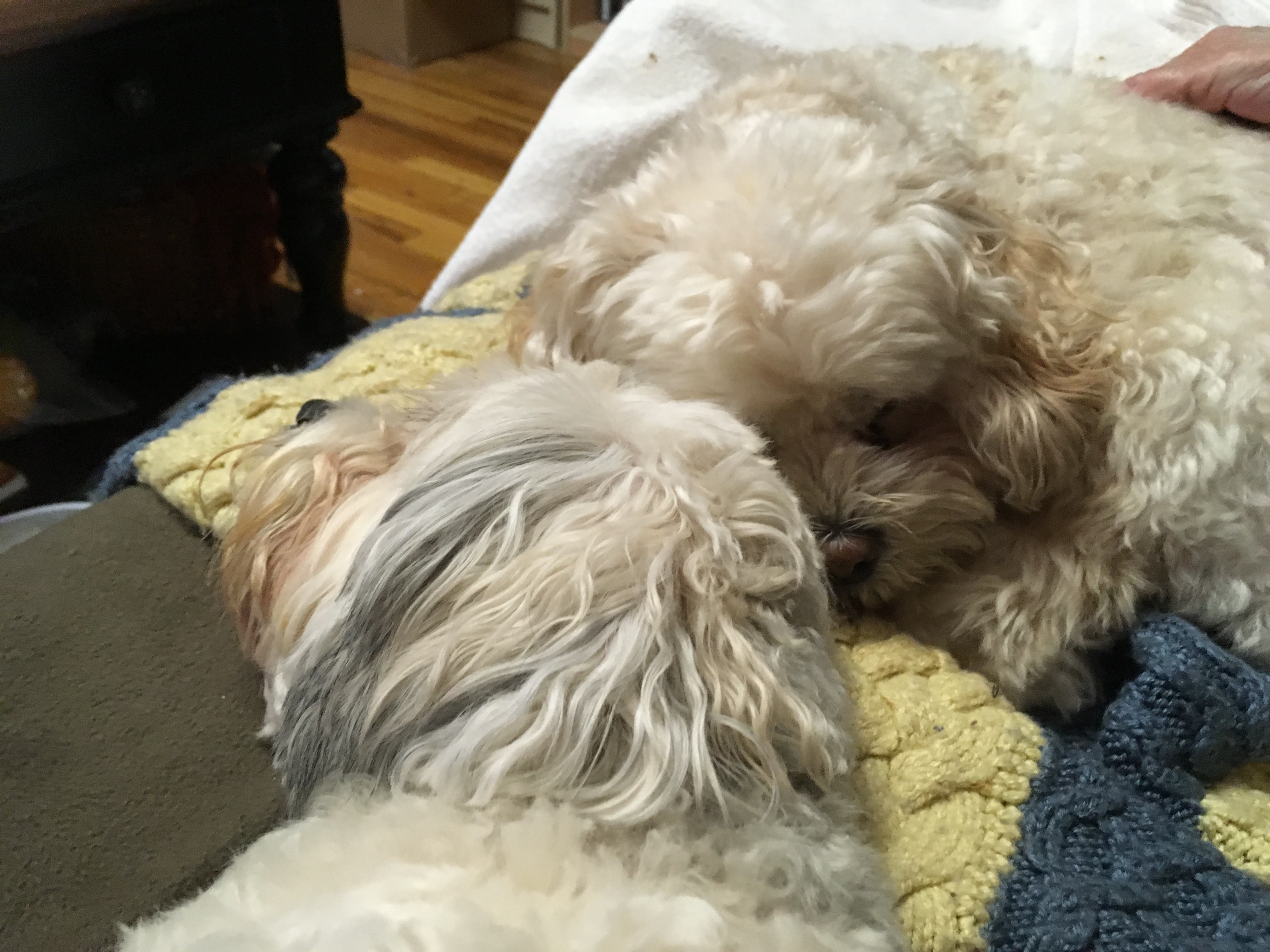
“We’ll chew it for you!”
Unfortunately, there is a pizza place, a really good one, right around the corner from me and I can smell their food every day. I could probably order one of their baked pasta dishes, but I don’t want to, because what I really want are the garlic knots, or a meatball hero, or a mushroom salad, and a crispy artichoke pizza, and, really, I can make a pretty good lasagna on my own.
I can still eat vegetables, even broccoli and cauliflower, as long as I put them in the food processor and blend them to death, and I can have a hamburger, as long as I cut it into toddler-sized bites, but pizza in a blender is no longer pizza, so pizza is not on the menu.
“No pizza bones for how long?”
I’m looking forward to being fully healed and able to eat not only pizza but also bagels and chocolate chip cookies with macadamia nuts, and Twizzlers, and, oh my god, an actual apple! A granny smith apple!
Food is one of the few things in my life that has reliably brought me joy (puppies are wonderful, but they also bark, and demand to go out in the snow, and, you know, expect me to pick up their poop). But I’ve had to be on all kinds of limited diets since childhood: for religious reasons, or financial reasons, or weight and health reasons, and it all sucks.
But I spent almost a week after the oral surgery not eating much at all, because even when I felt hungry, I was just too nauseous to enjoy the food, so I decided that even on this soft food diet, I’m going to try to enjoy everything I can eat. Like Matzo ball soup. I could live on matzo ball soup, really – with the overcooked carrots and potatoes and chicken, and the matzo balls! And it’s not too spicy or acidic or crunchy or chewy. Or ice cream in every flavor! And there’s tuna salad, and risotto, and pasta, and chocolate mousse! There’s a lot of wonderful food to eat and I’m not going to go hungry.
But, still, no pizza.
Harrumph.
“Harrumph.”
If you haven’t had a chance yet, please check out my Young Adult novel, Yeshiva Girl, on Amazon. And if you feel called to write a review of the book, on Amazon, or anywhere else, I’d be honored.
Yeshiva Girl is about a Jewish teenager on Long Island, named Isabel, though her father calls her Jezebel. Her father has been accused of inappropriate sexual behavior with one of his students, which he denies, but Izzy implicitly believes it’s true. As a result of his problems, her father sends her to a co-ed Orthodox yeshiva for tenth grade, out of the blue, and Izzy and her mother can’t figure out how to prevent it. At Yeshiva, though, Izzy finds that religious people are much more complicated than she had expected. Some, like her father, may use religion as a place to hide, but others search for and find comfort, and community, and even enlightenment. The question is, what will Izzy find?
The last weekend in August marked the beginning of Elul, the Jewish month set aside for doing Teshuva, leading up to the Jewish high holidays. Teshuva means different things to different people, but basically translates as repentance, or returning to the path. You are supposed to take this time to look over your behavior from the past year and see where you went wrong, in your treatment of others, or of yourself, and warm up for the big communal repentance Olympics that is the high holidays. So it’s not a fun, happy time, and I just don’t have the energy for more self-flagellation right now.
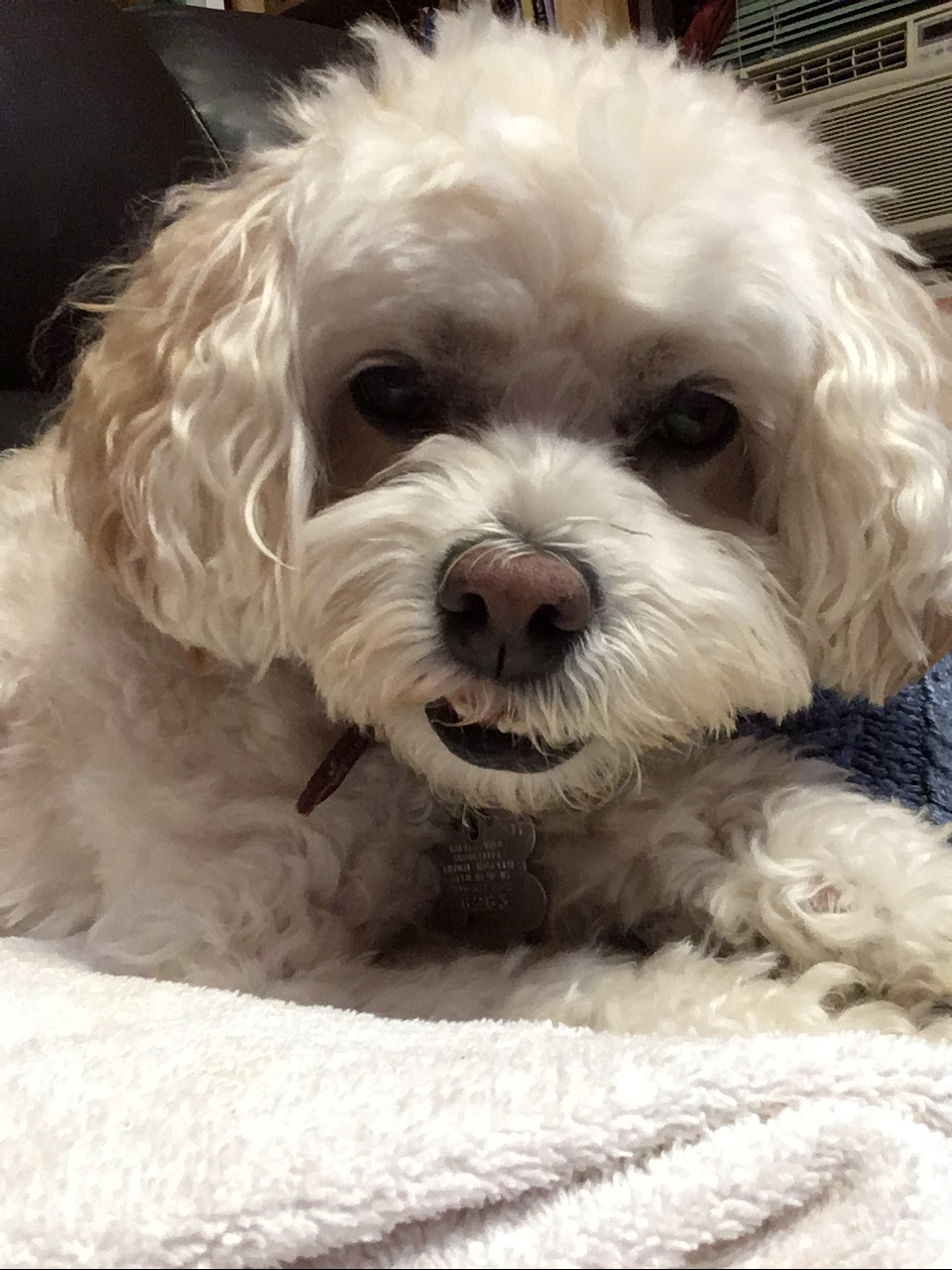
“We’re all exhausted.”
Intellectually, I see the value in a month of self-reflection and taking stock of our lives and what we’ve done wrong and could do better. But emotionally, and spiritually, it feels like I’m beating myself with a hammer after having already been beaten by ten hammers. At some point, being told to blame myself for all of the wrongs done within my community, and in the world at large, feels like overkill.
I would much rather have a month full of peace and kindness, and people telling me how wonderful I am. I want my dreams to be filled with cotton candy trees and happy puppies, but that’s not how it goes in my brain. Most likely I’ll continue to have nightmares accusing me of failing to save puppies and babies, and the trees will all be rotten and dying.
One custom I don’t usually participate in leading up to the High Holidays, but maybe should, is the blowing of the shofar every weekday morning of the month of Elul. The idea is that the shofar, the ram’s horn that sounds like a dying ram calling out to its mother, is expected to wake you up from automatic pilot, the state where most of us spend most of our time. And the hope is, if you hear it a little bit each day, and build your awareness bit by bit, the long shofar calls and deep guilt work of the high holidays won’t feel so overwhelming.
Each shofar, or ram’s horn, is distinct. It has been emptied out and polished, but it still retains the individual character of the animal who wore it. It can be small or big, with one curve or more, each twisted in its own unique way. Like us.
(Not my pictures)
Part of the power of the shofar, for me, is its imprecision. Whereas a musical instrument, like a trumpet, can make more beautiful and melodic sounds, the shofar captures something animal, something deeply human, that we often try to ignore. So we’re not just being woken up by a random loud sound, we are being reminded of our need to cry out for help, and reminded that we are supposed to cry out for help. Maybe listening to the shofar could remind me that repentance doesn’t always have to be about recognizing and correcting my flaws, instead it could be my reminder that needing other people, and asking for help, is a good thing.
“Help! They won’t let me drive the car!”
And, maybe, just maybe, we’re being woken up out of automatic pilot in order to experience joy and hope more fully, instead of just being awake to what’s gone wrong.
But, still, what I really want for Elul this year is peace. I want to rest under my paw paw tree, in a cool breeze, with a pile of books, a sleeping dog or two, and a glass of ice cold chocolate milk. Is that so much to ask?
“We’re ready!”
If you haven’t had a chance yet, please check out my Young Adult novel, Yeshiva Girl, on Amazon. And if you feel called to write a review of the book, on Amazon, or anywhere else, I’d be honored.
Yeshiva Girl is about a Jewish teenager on Long Island, named Isabel, though her father calls her Jezebel. Her father has been accused of inappropriate sexual behavior with one of his students, which he denies, but Izzy implicitly believes it’s true. As a result of his problems, her father sends her to a co-ed Orthodox yeshiva for tenth grade, out of the blue, and Izzy and her mother can’t figure out how to prevent it. At Yeshiva, though, Izzy finds that religious people are much more complicated than she had expected. Some, like her father, may use religion as a place to hide, but others search for and find comfort, and community, and even enlightenment. The question is, what will Izzy find?

After Mom’s emergency second hip surgery, to revise the hip replacement that was put in two months earlier, my oral surgery was rescheduled to late August. I already had my medical clearances in place, and all of the medications I’d need for before and after the surgery, and the oral surgeon had already given me a rundown of what to expect after surgery: like, bleeding from the nose, swelling of the sinuses, bruising on my face, and a possible lisp because the temporary (3D printed) implant would leave a small space between the device and my gums. Oh, and I wouldn’t be allowed to blow my nose, or accidentally sneeze, for three weeks, because that would make the swelling worse.
“I know how to avoid sneezing.”
My biggest fear leading up to the surgery itself, though, was the anesthesia. The surgeon had told me that they wouldn’t decide until the day of the surgery whether I’d be getting sedation or general anesthesia. He was voting for general anesthesia, because it would make his life easier, but I thought sedation might mean I could avoid having a foreign object shoved down my throat, so I was hoping for sedation. When I finally spoke to the anesthesiologist, a few days before the surgery, she told me that I’d have a tube down my throat either way, to protect my airway, and that general anesthesia would be better for the surgeon and easier on my throat. And I’d be unconscious when she put the tube in and took it out, so that might mitigate my fear of choking. I hoped she was right.
Then she asked me, with no warning, if I had access to an adult undergarment, i.e. depends, because if not they could supply one for me when I got there. What?! She said that I might pee under anesthesia and everyone would prefer it, including me and the staff, if I didn’t leave a puddle.
Eek!
First of all, no, I don’t have adult undergarments hanging around on a shelf – except for Cricket’s adorable pink reusable diaper from her incontinence episode, which would just about fit over my hand. Second, how did no one think to mention this to me ahead of time? Or maybe they kept it quiet because they thought this would be the deal breaker. As it is, the adult undergarment became my number one preoccupation for the whole weekend leading up to the surgery – who cares about pain! What if I pee on myself?!
When I met the anesthesiologist in person, she was lovely and friendly and way too energetic for someone who was about to put me to sleep. She gave me the adult undergarment to change into in the bathroom, under my loose clothing (aka pajamas), and then I was whisked into the surgical suite, where my legs were wrapped in anti-blood clot sleeves, and monitors were attached to my fingers, and my hair was covered with a surgical bonnet so it wouldn’t get sticky (?!), and then a needle was put into the back of my hand, and then I have no idea.
I woke up in the same room, with the same people removing the things they’d attached just seconds before (though I found out later that five hours had passed). Most of my thoughts when I first woke up, strangely enough, were in Hebrew. Where’s Mom? What happened? When can I go home? I couldn’t actually speak yet, because my mouth was filled with gauze, and my throat was rough, and I had ice packs wrapped around my face, but I found myself translating everything into English anyway, as if they could hear me and answer me. The closest I came to being able to communicate was a grunt or two and a thumbs up or down, though as I was leaving in my wheelchair the surgeon decided to give me a fist bump.
I don’t really remember the trip home, except that Mom brought out her rarely-used walker and our neighbor, the nurse, to help me walk from the car up to the apartment. I spent the rest of the evening in front of the TV, changing out the bloody gauze until my mouth stopped bleeding (mostly), and going to the bathroom every twenty minutes (I couldn’t find an explanation for the excess peeing online, especially since I could barely sip enough water to take my pain meds, but it receded along with the excess bleeding).
I didn’t sleep much that first night, because my nose kept running – the surgeon said it was fluid from my sinuses, and blood, rather than traditional snot, but either way it made it hard to breathe – and I had to refreeze the ice packs for my face constantly, and my mouth hurt, and every time I moved my head it all hurt even more. I was able to take the dogs out the next morning, though, wearing a loose face mask to try and cover my swollen cheeks, but I managed to forget my house keys and had to ring the doorbell for Mom to let us back in anyway.
The pain was so much worse than I’d been expecting, so I had to give in and take some of the oxycodone I’d been prescribed, but mostly I survived on ibuprofen and ice and the coziness of my puppy pile.
To make things worse, it turned out that my Mom, who had been having trouble breathing over the weekend and assumed at first that it was just an allergy thing, went to the doctor on my first day post-surgery and started treatment for a possible case of Pneumonia. The next day she went for a chest x-ray, which ruled out pneumonia, which meant that on my second full day post-surgery I was driving Mom to the emergency room so they could rule out a blood clot. She stayed in the hospital overnight, getting all kinds of tests, and was told that she had fluid in the right lobe of her lungs and some kind of hardening of the lung tissue, which would be investigated further with a Bronchoscopy (under general anesthesia, a week later, just to keep things fun).
The next day, while Mom was still finishing up her tests at the hospital, I drove myself back to the surgeon’s office to have my temporary implant put in. By then my cheeks were starting to deflate and had turned all sorts of interesting colors, but my face mask allowed me to feel largely invisible, until I had to take it off to be examined by various assistants. There was a lot of sitting and waiting, between examinations, and then the surgeon screwed in the temporary implant, using what seemed to me like a tiny Allen wrench. He made sure to tell me not to swallow anything during the procedure, which was helpful, because when he was finished screwing everything in place there was still one tiny screw sitting on my tongue.
When I got home, I wrapped my face in ice again (they gave me a cool little headband that wraps around my head, with pockets for the ice packs, which was much more comfortable than holding ice packs on my face with both hands), and I watched the recording of my online Hebrew class a day late, so jealous of everyone on the screen. Mom came home with updates on her hospital stay and then it was nap time, for everyone, puppies especially.
“Sorry, Mommy. No room for you.”
Each day the pain and swelling has receded a bit more, and I’ve started to figure out how to chew with my new teeth, and how to deal with the temporary lisp (ignore it). The freezer is filled with bought and homemade soft foods, like soups and casseroles, and, of course ice cream, so there’s a lot to look forward to. And when the permanent implant comes, in a few months, it’s supposed to fit better than the temporary one (eliminating the lisping issue), and be made of stronger material (to allow me to eat more than just soft food), so if I can make it through the next few months with some self-esteem left, I should be okay long term.
And pretty soon, I’ll be back in front of the classroom, with no time to worry about how weird I look or sound, because the kids will have so many more important things to focus on, like: He pulled my hair! She stole my favorite pencil! Can I go to the bathroom, even though I just went five minutes ago and I’m definitely not looking for an excuse to wander around the building, please?!
Wish me luck!
“Are you going away again?!
If you haven’t had a chance yet, please check out my Young Adult novel, Yeshiva Girl, on Amazon. And if you feel called to write a review of the book, on Amazon, or anywhere else, I’d be honored.
Yeshiva Girl is about a Jewish teenager on Long Island, named Isabel, though her father calls her Jezebel. Her father has been accused of inappropriate sexual behavior with one of his students, which he denies, but Izzy implicitly believes it’s true. As a result of his problems, her father sends her to a co-ed Orthodox yeshiva for tenth grade, out of the blue, and Izzy and her mother can’t figure out how to prevent it. At Yeshiva, though, Izzy finds that religious people are much more complicated than she had expected. Some, like her father, may use religion as a place to hide, but others search for and find comfort, and community, and even enlightenment. The question is, what will Izzy find?
There were so many things about the oral surgery that worried me: I was worried about the pain, and the anesthesia, and being out of commission for a couple of days, which meant leaving Mom to take care of the dogs, even though she was still recovering from her second hip surgery. And I was worried about how I would look, with the bruises on my face and the temporary 3D printed implant. And I was worried about the idea that they would be putting screws into my cheek bones, through my sinuses. How could that not cause problems? I wouldn’t even think of piercing my nose or lip, and now they were going to pierce my sinuses?!
But I knew I had to do it anyway, because just since the surgery had been scheduled even more of my teeth had become obviously loose (rather than just looking loose in my x-rays).
“No, Mommy. Just no.”
But the one thing I was looking forward to about the surgery, other than having a new set of strong, healthy, upper teeth, was that I wouldn’t have to wear my nightguard anymore. I’ve worn the same nightguard since my early twenties, when a periodontist told me that I grind my teeth every night while I sleep. I wasn’t sure how he could tell, but I assumed he was right. My dentist revised the nightguard once, without commenting on how impressive it was that this same piece of plastic, created by the periodontist a million years ago, was still holding strong.
I’m only finding out now, per Google, that I was supposed to be doing a monthly deep cleaning of the darned thing. I always brushed it with toothpaste and rinsed it and dried it before putting it away in its case (though now I’m also finding out that my toothpaste might have been too abrasive. Oops.). But I’d never heard about doing a monthly deep cleaning with denture cleanser, or alternating half hour soaks in hydrogen peroxide and vinegar. But then again, the article that told me all of this also said that a nightguard should last an average of five years, so… maybe I was better off without the deep cleaning after all.
“Hygiene is overrated.”
It’s still possible that I will need a nightguard for my new teeth, once I get the permanent implant in a few months, but it won’t be the same one I’ve had all these years. And even though I will not miss this nightguard, I still feel like I need to come up with a satisfying ritual to say goodbye to it, instead of just tossing it in the garbage. It deserves my respect, if not my love, for watching over me every night and helping me keep my teeth in place as long as possible. The idea of ritual slaughter came to mind, even though the nightguard is not a living thing, because the temptation to hit it with a hammer, or chop it into tiny pieces with a cleaver is very high. But I also like the idea of burying it, like you would do with a ritual object you can no longer use. The problem with that idea is, one, the nightguard is plastic and won’t degrade underground, and two, if I bury it in the backyard, the raccoons might dig it up and then I’ll see it on someone’s porch one morning, after the raccoons have tried it on and realized it didn’t work for their teeth.
“What?!!!”
But even if a ritual burial/destruction is impractical, maybe there’s a blessing I could say before throwing the nightguard out. Like, Thank you, nightguard, for keeping my teeth safe lo these many years. Now your work is done and you can take your long needed rest. But, again, anthropomorphizing a piece of plastic feels kind of creepy.
Maybe instead, I could thank the periodontist who made it? Or the dentist who revised it? Or the inventor who came up with the idea of a nightguard in the first place? I’m realizing that I rely on many different inventions to keep me functioning like a semi-normal person: my glasses, and orthotics, and painkillers, and anti-depressants, on top of the nightguard and now the new implant. And there are so many other inventions that make my life possible: like air conditioners, and washing machines, and indoor plumbing (!!!), that did not exist for my ancestors a thousand, or a hundred, or even fifty years ago. So, maybe this should be my blessing: Thank you to all of the people who have worked hard to make our lives healthier, safer, and more comfortable. I hope you were paid well for your work. And, may I never have to see this little piece of plastic ever again. Amen.
“Amen.”
If you haven’t had a chance yet, please check out my Young Adult novel, Yeshiva Girl, on Amazon. And if you feel called to write a review of the book, on Amazon, or anywhere else, I’d be honored.
Yeshiva Girl is about a Jewish teenager on Long Island, named Isabel, though her father calls her Jezebel. Her father has been accused of inappropriate sexual behavior with one of his students, which he denies, but Izzy implicitly believes it’s true. As a result of his problems, her father sends her to a co-ed Orthodox yeshiva for tenth grade, out of the blue, and Izzy and her mother can’t figure out how to prevent it. At Yeshiva, though, Izzy finds that religious people are much more complicated than she had expected. Some, like her father, may use religion as a place to hide, but others search for and find comfort, and community, and even enlightenment. The question is, what will Izzy find?
When I first received a jury questionnaire in the mail, back in the spring, I wrote in the space provided about my various health issues and why it would be difficult for me to manage a full day of jury duty, let alone several days of a trial, and asked to be excused. When I didn’t hear back from them with a request for more information, I thought I’d done enough to be let off the hook. But the jury summons came anyway, on the same day that I’d gotten clearance from the Pulmonologist for my oral surgery, and the summons was dated for the week of the surgery itself.
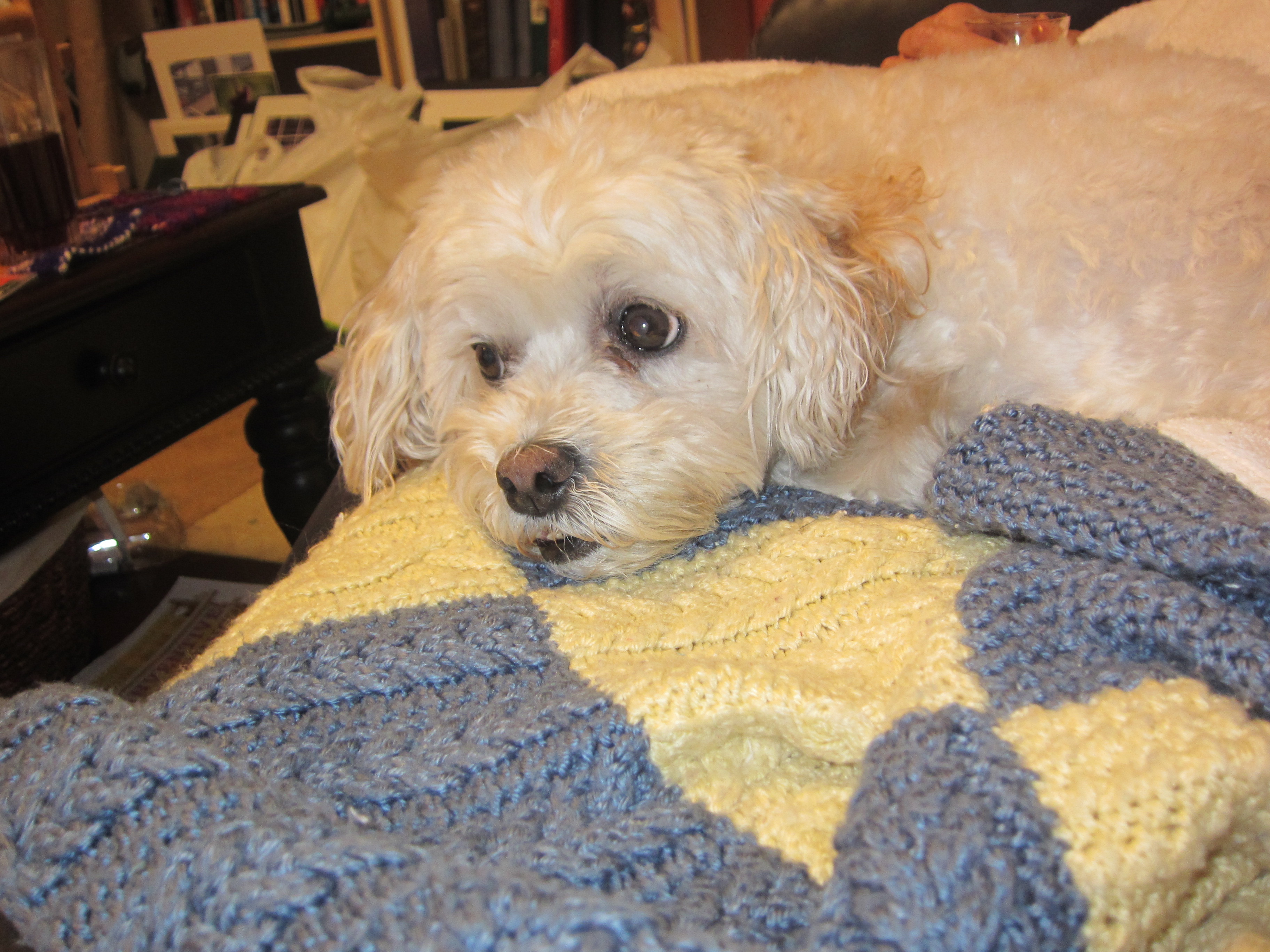
“Oh, come on, people!”
I was able to postpone the summons for a few weeks, but I didn’t even try to get out of it completely; partly because I felt guilty trying to get out of jury duty, and partly because I didn’t want to go through the humiliation of trying to prove to my doctor that my disabilities are significant. I’d gotten out of jury duty a while back with a doctor’s note, when they were going to send me to Brooklyn (an hour and a half trip each way, by train, in the summer), but I had a doctor I trusted back then, and I knew for sure that I wouldn’t have been able to handle that trip, no matter how hard I’d tried. But this time, it was different, or I kept thinking it was.
I told myself that I’d only have to drive twenty minutes each way, because the court complex is nearby, and I knew the route, and even if the weather was disgusting, I’d be inside most of the time, and sitting. And then my surgery was postponed too, with jury duty coming first instead of second, so I really didn’t see any way out of it.
One of the more stressful things about jury duty, in my area at least, is that instead of being told to come in on a specific day, you are put on call for a week, meaning that every day at five o’clock you have to check the website to see if your number has been called for the following day. But I was lucky, this time, because when I checked the website the Friday before my summons week, I found out that I was being called for Monday, which meant I had the whole weekend to prepare: do the food shopping and the laundry, take extra naps, fill up my book bag with all of the things I’d need, and thank god I didn’t have to wait until five o’clock each day, for the rest of the week, to find out if I’d have to go in the next morning.
“But who’s gonna take me out to pee?!”
I feel like I should be one of the people who is actively interested in every part of the justice system, and in doing my civic duty, and I keep thinking that I should use jury duty as a way to research future novels and learn about police procedure and all that. And, beyond that, I feel like jury duty is an obligation, like voting, and I don’t want to be one of the people who lies to get out of jury duty and then laughs about how juries are all made up of the stupid people who can’t get out of it. But I don’t have much energy, and I have a lot of social anxiety issues that make things like this ten times harder than they should be, and, whenever I’m near a police officer or inside of a court building, I think I’m going to be arrested.
My mom has only been called for jury duty once in her life, and, so far, I’ve been called five or six times. I don’t know how I got so lucky. The first time I’d just graduated from college, and I was really nervous, but also kind of excited. I went through the voir dire, where the lawyers ask potential jurors all kinds of questions to see if they’ll be a good juror for the case, and when they asked if I’d ever been the victim of a crime, I had to say, uh, yeah, and the guilty party got away with it. I thought about saying no, just to see what it would be like to be chosen for a jury, but I’m not a good liar. Another time, I vaguely remember that we were given damp sandwiches and bused to another location that looked like a repurposed elementary school, but I was scratched, again, when they got to the victim-of-a-crime question. There was another time when I had to call in each day, for a week, to find out if they needed me, and they never did. That was probably the worst.
“Waiting sucks.”
Even during my short stints at jury duty, though, it’s become clear that the lawyers just aren’t as interesting as the ones on TV, and the cases aren’t as dramatic or convoluted, and there’s almost never a twist ending, which is just disappointing. Instead it’s a lot of sitting around and waiting. If only I could bring one of the dogs with me for company – though there’s a very good chance that Cricket would get me arrested.
I should have asked for a doctor’s note, because I’m just so tired all the time, and because Mom was still recovering from her second hip surgery, and because the dogs needed me, and because I needed to keep the apartment relatively livable, but I was too chicken. So I went.
I packed diligently: phone, phone charger, jury summons, extra mask, book to read for fun, book to read for serious, notebooks and pens, oatmeal in a thermos (with a spoon), gingerale (in case of nausea caused by anxiety), and wet wipes.
I got to the courthouse a few minutes early and found a seat in a corner of the central jury room, which was, thankfully, well air-conditioned and big enough to leave room for social distancing. Most people wore face masks, even though we were allowed to show our vaccination cards to get out of it, and after a little while of sitting there and staring around the room at each other, we watched a few videos: about jury service in New York and about implicit bias (how we fill in a picture when it is incomplete, based on assumptions that may not be true). And then we waited. A bunch of names were called while I played with my phone: sent an email and a text, did some water sorting and some Duolingo. And then we waited some more. I finished reading my book-for-fun (Rhys Bowen’s God Rest Ye Royal Gentlemen) and another group of names were called, and then we waited again. My phone was running out of power, but I was too scared to go wandering around looking for a place to charge it, so I got some writing done, and read some of the serious book (Karen Armstrong’s The Case for God), and then some more names were called and then we waited again. It was getting close to lunch time by then, and my neck and back hurt, and I was wondering if we would be sent to a cafeteria or let out for the hour and a half for lunch, and wishing I could go home and take a nap. And then my name was called. A whole group of us were led into a smaller, less well air-conditioned room, and I was really worried that we would be sent to do a voir dire right away and miss our lunch break altogether, and my headache would keep getting worse and I’d end up crying, or yelling at someone, or getting myself arrested, somehow. And then a non-descript man came into the room with a big pile of papers and told us that the rest of the cases for the day had been settled, and we would be going home early. There were quite a few hoots and hollers and Praise Gods and then we were called up one by one to get our printed sheet confirming that we had completed our jury service. And that was it.
It had rained at some point while we were deep inside the court building, far from any windows, but the air outside still felt wet and thick as I walked across the street to my hot car, but…I was free!
But even as I was driving home, hours earlier than expected, I wasn’t quite able to process what had happened. Time had slowed down so thoroughly in that big, isolated, jury room, with all of the empty spaces filled with anxiety about what might happen next, and not trusting myself to know how to answer the lawyers’ questions if I was called in to try out for jury and worried I would end up on a five week trial because I was too scared to say no. And then, suddenly, I was free, and I was still awake and aware enough to drive home without needing to pull over to rest, and even though I was a little bit shaky with fatigue, I was actually okay.
And then I was home. Mom and the dogs met me at the door and I was able to take a nap in my own room, with puppies for company, and eat whatever I wanted to eat instead of whatever I could fit into a thermos. It wasn’t the easiest day of the summer, but it wasn’t the hardest one either, after all. All summer long there’s been one challenge after another, and even if it hasn’t been easy, each challenge has been met, somehow. And even though I’d much rather not be in survival mode endlessly, it’s good to know that if I need to survive, I can do it. I just hope I won’t get another jury summons too soon, and Mom won’t need another new hip for a while, and things will start to calm down a little bit.
But…I’m not holding my breath.
If you haven’t had a chance yet, please check out my Young Adult novel, Yeshiva Girl, on Amazon. And if you feel called to write a review of the book, on Amazon, or anywhere else, I’d be honored.
Yeshiva Girl is about a Jewish teenager on Long Island, named Isabel, though her father calls her Jezebel. Her father has been accused of inappropriate sexual behavior with one of his students, which he denies, but Izzy implicitly believes it’s true. As a result of his problems, her father sends her to a co-ed Orthodox yeshiva for tenth grade, out of the blue, and Izzy and her mother can’t figure out how to prevent it. At Yeshiva, though, Izzy finds that religious people are much more complicated than she had expected. Some, like her father, may use religion as a place to hide, but others search for and find comfort, and community, and even enlightenment. The question is, what will Izzy find?