Tag Archives: dogs

Cricket’s Ears


Two weeks ago, on Friday morning, we took the dogs to the groomer for their regular appointment. Butterfly’s hair was turning grey around the ears (she’s a white dog) and Cricket’s eyes were disappearing into a mop of hair. My biggest concern, though, was the hair in Cricket’s ears. I’d asked the groomer to pull the matted hair from her ears, every time, but somehow it rarely happened. So this time, I was insistent. Whatever else you do, I said, make sure to deal with her ears.

When we picked the girls up that afternoon, everything seemed fine. Cricket was flapping her ears a bit, but that seemed reasonable given that they’d not only plucked the hair from the inside of her ears, they’d shaved the mats off the outside too, making her look even more like a little lamb. Butterfly started sniffing at Cricket’s ears almost immediately, but it’s something she tends to do, sniffing Cricket’s ears, nose, butt, etc., for secret messages, so I didn’t take too much notice. On Saturday, though, I noticed that Cricket was still flapping her ears. I managed to feel the inside of one of her ears, for a second, and I felt something hard, as if the skin where the hair had been plucked was scabbed. Cricket wasn’t interested in letting me look more closely, though, and I figured it was probably no big deal.

035

“Mommy, why does Butterfly keep sniffing my ear?”

045

Ears mid-flap.

By Sunday afternoon, Cricket was flapping her ears so much that I thought she was going to give herself whiplash, and then I noticed this strange smell. I wasn’t sure if the smell was coming from Cricket, though. In fact, I assumed there was some food in the garbage can that was beginning to rot.

054

flap flap flap!

052

“Mommy, I think Cricket’s ears are going to fly away.”

On Sunday night, after emptying all of the garbage cans to no avail, I was finally able to look directly inside of Cricket’s right ear, and I saw a ring of brown pus, surrounding livid red skin. My stomach dropped, from the guilt, and the smell, and an incredible amount of anger at the groomer, for doing this to Cricket, and for not telling me what she’d done.

At eight thirty Monday morning, when the vet’s office opened, I called and got an emergency appointment. There was just enough time to wake up everyone before we had to leave (Cricket was sleeping on her grandma’s head, and Butterfly was sleeping-guard next to the bed). Cricket was excited, as usual, to go outside without her sister, and get in the car without her sister, and climb behind my head in the passenger seat. But as soon as we got to the vet’s waiting room, she tried to run back out the front door, and failing that, she hid under the bench. Cricket is a terrible patient. The only part of illness she can handle is taking a pill, slathered in peanut butter. Going to the vet and being man-handled? No way.

We were called in quickly, and the vet took one look at her ears and almost gasped. He’s not really a gasper, by nature, but he came close this time. He had to clean out both of Cricket’s ears, with cotton balls and long Q-tips, and then he gave her a shot to calm the redness, and drops in her ears, all with a muzzle on, because she was not handling the stress very well at all. He asked, twice, if we’d rather have her put out during the ordeal, but, knowing Cricket, I thought she’d be even angrier waking up from anesthesia.

The vet gave us ear drops to give Cricket at home, twice a day, and Mom said, of course we can do that. The vet said that if we couldn’t get the drops in her ears, the second best option was to put something else in her ears (at the office) that would last a few weeks. No, we can do it, Mom said, as she looked at Cricket on the stainless steel table, wearing her muzzle, with her eyes bugged out, and clearly imagined a completely different dog.

017

Peanut butter!

020

Peanut butter tongue.

025

“My turn!”

I actually managed to get drops into one of Cricket’s ears, in fifteen attempts, but not in the really bad ear. Cricket bared her teeth at me each time, and swung her head around 360 degrees as if she was possessed by Satan each time I got anywhere near her with the medicine dropper. So we had to go back to the vet, in defeat, the next day, and have him do the second best option. Cricket had to be dragged into the examining room (it’s a good thing the floor is slippery), and then she ran into the corner of the examining room, trying to avoid the reality that she was in the vet’s office, where who knew what horrors could come next. The vet dropped the lotion into her ears in two seconds, before Cricket could build herself up to full hysteria, and then off we went.

The doctor checked Cricket again on Thursday morning, and pulled some more hair out of her bad ear like it was so much fluff. Cricket’s eyes bugged out, and she had to be held still by the vet tech so that she wouldn’t jump off the table, and then the vet told us to come back for one more check-up the following week. I’m not in love with watching Cricket panic as she’s called into the examining room, but I feel like we’re really well taken care of by this doctor, and I wish that we could find a groomer who made us feel the same way. I thought we had, actually. This was the first groomer (after many tries) that Cricket could tolerate long enough to get an actual haircut, and she’s been going there for years.

The thing is, I still don’t understand what went wrong. How come Cricket wasn’t whimpering in pain, or bleeding, right after the grooming? Did they put something on the wound to stop the bleeding and numb the pain, and just not tell us? The other thing is, the scabs were already growing out with new hair in less than a week, and that seems really fast for new growth. The hair inside of the ear is supposed to be plucked at the root, to keep it from growing back so quickly, so, did the groomer shave the inside of Cricket’s ear, and push too hard, shaving off layers of skin?

The vet actually knows Cricket’s groomer and usually trusts her. He said that, from now on, we should come to him every two months to have him remove Cricket’s ear hair, and never let the groomer do it again. I’m sure Cricket will be thrilled when she figures out that she’ll be going to the groomer and the vet on a regular basis for the foreseeable future.

When we got home from the third vet visit of the week, Butterfly had to sniff Cricket all over, to second check his methods and diagnosis, and she seemed satisfied with his work.

I could tell that Cricket was starting to feel better when she scratched her ear against the floor, a sign that her ears were not quite as sensitive anymore. And then she felt so much better that she risked scratching her ear with a paw, though she did sniff the paw afterwards, to check for lingering infection, or just because. She’s like an eight year old boy in a dog costume.


Sitting Shiva


In seventh grade, when I was still new to Orthodox Judaism, the general studies principal at my school lost his mother, and the students were bused, grade by grade, to visit him at his home, where he was sitting Shiva. After the funeral, in Jewish tradition, comes Shiva. Shiva means seven, and the idea is that, for seven days, the mourners remain at home and visitors come to them. Maybe seven days was the limit people could consider taking off from work. Maybe seven days was the limit before people became restless and overwhelmed. If you are very observant, there are countless rules to abide by during Shiva – no shaving, always wear a torn piece of clothing, cover mirrors, sit on lowered seats (boxes are specially made for this purpose), etc. Visitors come at pre-set times, to help make a minyan (ten people) for communal prayer.

It was frightening to imagine that we were supposed to offer comfort to the principal of the school, someone so much more grown up than we would ever be. It was scary just to think of him as someone who might need comfort. And yet, my memory of that day isn’t full of fear and darkness. Somehow, the ritual of the visit, the way we each wished him well as he sat on his low chair and he let us see him be sad, and crying, and smiling too, made the day feel full of light, though it could just be that we happened to be there at the right time of day, so that sunlight was shining in through the windows.

I’ve had to go to a number of funerals and Shiva visits in the past few years, as I’ve become more active in my synagogue and gotten to know the older members. When you make friends with 90-year-olds, funerals become more common occurrences.

A friend of mine lost her father over Passover. His death had been a long process, and in large part she had done her grieving and letting go over the last few years of his life, as she lost pieces of him to illness. The last thing to go was his conviction that he had to stay in order to take care of his wife; that commitment outlasted hunger, even the ability to swallow, by months.

Shiva had to be delayed until after Passover, and then only lasted one day because an unofficial mourning period had already been going on, with friends calling from all over the country for a week. There were so many people at her house that I didn’t know, and I felt out of place and uncool. But then, before the Mourner’s Kaddish, my friend read the eulogy she’d written for the funeral, and as she read it I felt like she was conjuring her father into the room. I could almost see him in the corner, with a bemused expression on his face, wearing his white doctor’s coat and his college tie, and complaining about the driver who cut in front of him on the expressway.

I think that the value of a ritual like Shiva is that it forces you to ask for the things you really need, but maybe don’t think you deserve. When I’m depressed, I lose most of my social skills. But for those seven days, the idea is, your rabbi and friends and family and neighbors are given a schedule for when they can interrupt your isolation. They have a clear mandate to visit you, and bring you food, and pray with you. This is one of the benefits of belonging to a synagogue; there are set practices and communication paths to go by, for everything related to a death in the family, if someone calls and asks what you need, you can tell them. I wish there were more of this for other life events.

There’s a rule that you can’t sit Shiva on Shabbat. If you are three days into Shiva and Friday night comes along, you change out of your mourning clothes and wash and dress and go to the synagogue to say the Mourner’s Kaddish with your community. Maybe the message is that happiness and community will be there waiting for you when you are ready for them, or maybe it’s to remind you that the grief will not last forever, because all around you are people who were in mourning at one time, and now they are singing the prayers and smiling at friends, and one day that will be you too. But I’m not sure if I could bear it, seeing other people’s lives going on all around me, seeing happiness.

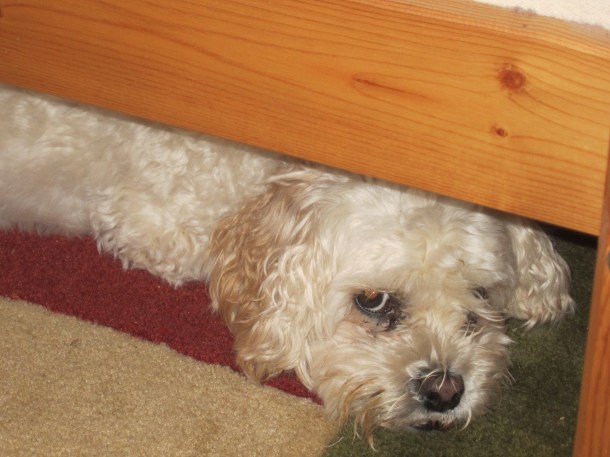
Ideally I’d have a sleep over starting from the moment of loss. I’d have people in sleeping bags in every corner of the apartment to help me through every moment. But then I think, if my mom actually died, I wouldn’t be able to host people at all. I’d be curled up in a ball, with Cricket, under the couch. Butterfly would have to take care of both of us.

IMG_0136

Cricket hides under the couch, a lot.


IMG_0707

Butterfly is very good at offering comfort.

008

But paperwork might be too much for her.

Just like there is no sanctioned way to do a Jewish funeral for a dog, or to say the Mourner’s Kaddish for a dog, there is certainly no Shiva for dogs. Right after my last dog, Dina, died, my mother had a long-scheduled trip and had to leave town for two weeks, so I was home alone with the death, in silence. I cleaned obsessively, and having that mindless physical task to do was helpful, but I think I would have liked it if my friends with dogs could have come over and filled the house with their voices, and their dogs’ voices. Maybe I could have offered up the last of Dina’s dog food as a ceremony, or given away the leftover pee pads. But, in the event, I didn’t know how to ask for company, or accept help when it was offered. Maybe if there’d been a set ritual to follow, I could have forced myself to follow it. It would have been such a relief, to tell my Dina stories, and share my grief, and have people all around me who cared that I had lost someone so important to me.


dina smiles

My Dina

DSCF0318

Grandma’s pretty good at offering comfort too.

The Shul Rat


I grew up going to synagogue (Shul is the Yiddish word for synagogue) every week, starting when I was four years old. Mom would drop me and my brother off at junior congregation on Saturday mornings, and then pick us up an hour later to take us to our afternoon activities (gymnastics for me and computers for him). I liked that the service for the kids was only an hour and in a small sanctuary, and that the leader of the services was kind of a kid himself, in his early twenties and doing bible trivia with us and giving out candy for correct answers. There was something special about being there with only my brother and no parents around. It gave us a chance to take ownership of our Judaism, and our synagogue, and not have it be filtered through anyone else, or through a sense of duty.

I also liked that after services we could wander around the synagogue, until Mom got there, and it was like wandering through the White House without supervision. We’d sneak around and make it feel really mysterious and dramatic. The ceilings were high, and the setting was so formal, and everyone was quiet so as not to disturb the goings on in the main sanctuary. There was also something wonderful about having a community outside of my family, and a building to explore. My extended family was not next door, or down the block; we didn’t even have big family dinners more than once or twice a year, so the synagogue was my sense of family.

I liked the older people at shul. They weren’t always warm, but they paid attention and looked me in the eye. I felt like my best self there. At school I was a good student, but got teased constantly. At dance and gymnastics classes, I was barely keeping up and certainly not a star. At home…eh. But at shul, I mattered.

When I was seven, my father started to go to Saturday morning services regularly, and not long after that, my brother and I stopped going to afternoon activities and just stayed for the rest of the adult services with our father. The main sanctuary was a big deal. There was a high ceiling and stained glass windows, and tapestries on the walls, representing the twelve tribes of Israel. I liked the smell of the prayer books, and the hard covers, and the golden type on the cover. I liked that I knew who was a regular and who was new. I liked having a set seat that I went to every time. I loved when the Torah reader, the mother of one of my brother’s good friends, would sing harmonies, and I could sing along with her, and learn from her.


USAKamSyn

My synagogue was not quite this grand, but I can dream.

For special occasions, like an engagement, bags of candy were made up and thrown onto the bima, and the kids ran up to get as much candy as they could reach. I never see this at my current synagogue. Maybe it’s been outlawed because someone could get hit, or someone could miss out on candy. Better to just have a table full of candy to choose from after the service, they think. Phooey.

bags of candy

Bags of candy! (not my picture)

After my father got involved in the synagogue, we started to go to Friday night services, which were a formal affair. Kids came with their parents, and the cantor sang his complex loops of song, and everyone dressed up.  After the service there was a sit down oneg (dessert and talk) in the social hall. Tables were set up in a u-shape, and tea and desserts were set out. There were always non-dairy brownies with chocolate frosting, and I always ate off the frosting and left the brownies behind. Then the rabbi would hit his teacup with his spoon to start the discussion, and the kids would rush out just in the nick of time. The rabbi resented this, and forced his own children to stay put, but the other adults seemed to understand that kids could not sit through a long and boring discussion so late at night, when there was a whole building to explore.

Sometimes we’d end up sitting in the dark, in the far reaches of the building, looking through the toys left out by the preschoolers, or telling ghost stories. Other times, we made up elaborate games that required running through the building, and hiding under benches in the small sanctuary, and even sneaking up onto the bima in the main sanctuary to see what the rabbi kept in his lectern.

033

“Are there toys at shul?”

010

“Or pizza?”

I would have loved to bring Cricket and Butterfly to shul with me, to run through the halls of the building and play tag and have an excuse to laugh and jump and not be so self-conscious. But I never struggled to feel “spiritual” at shul, it was just there, in the building, in the occasion, in me. I wish every kid had a place like that, where God is infused into the walls of the building and doesn’t have to be spelled out; where history is just there all around you, waiting to be discovered.

Cricket would be more interested in searching for the left over bags of candy, but then I’m pretty sure God is in the candy too.

007

“Candy?”

010

“Candy!”

The Tango Lesson


More than ten years ago now, I went to a group dance lesson at the Brooklyn Museum of Art, because I had to do an attempt at literary reporting for my creative non-fiction class. I was not ready to write non-fiction at that point, and anything that smelled like journalism made me hyperventilate. But I’m a follow-the-rules kind of girl, so I did the assignment.

The first Saturday of each month, the museum opened its doors, free of charge. You could view the exhibits, or watch a movie, but most of us were there for the dance lesson. This week’s dance was the Argentine Tango.

taste4tango.net

picture from taste4tango.net

A crowd had already gathered on the third floor when we arrived. The willing dancers gathered in the center of the floor, around the small circular stage. There was a woman in a conservative black skirt suit, with stiff white wings on her back, and children running through the maze of casually dressed adults. Another group, the circumspect, sat on the steps at the edges of the floor, holding pocketbooks, legs crossed. The last group, the voyeurs, mostly well-dressed twenty and thirty-somethings, leaned over the railings on the floor above.

In the center of the room, the four dance instructors stood on the podium, each facing a corner of the room. The two men wore black suits, one wearing a microphone headset. He welcomed us in a broken stream of words until the microphone was adjusted. The two women wore low cut black dresses and chunky heeled black dance shoes.

“Everyone step to your right,” the man with the microphone said. “Feet should be together – is that true for you?” he asked, and many people looked down at their feet to check. “Step to the left.” Everyone moved in the same direction at the same time, like a dial clicking one notch at a time.

The instructors demonstrated the next steps forward, hugging in the center of the stage as the rest of us tripped over each other trying to imitate them. The next part of the lesson: arm position. “This is the dance of passion,” the instructor said. “So whoever you’re pretending to hold, pretend to hold them in a passionate way.” He paused, then added, “For you youngsters – just hold your arms up.”

The music started. The main instructor, with an eyebrow raised, asked the single dancers to partner up. Two teenage girls with long blond hair and various piercings held onto each other and giggled. A grey haired couple stood side by side, wearing sensible rubber-soled shoes.

A mother danced with her young daughter. An older white man was paired with a little black girl looking for a partner. A little girl danced with her cabbage patch doll.

“The Tango is all about getting to know someone,” the instructor said. A teenage girl in a black dress and high heels pointed to her arm position and said to her boyfriend, in his jeans and ratty t-shirt, “This is my dance space, this is your dance space,” a line from the movie Dirty Dancing. He seemed to know the reference, because the next thing he did was to lean in to her dance space and kiss her.

dirtydancing

from Dirty Dancing

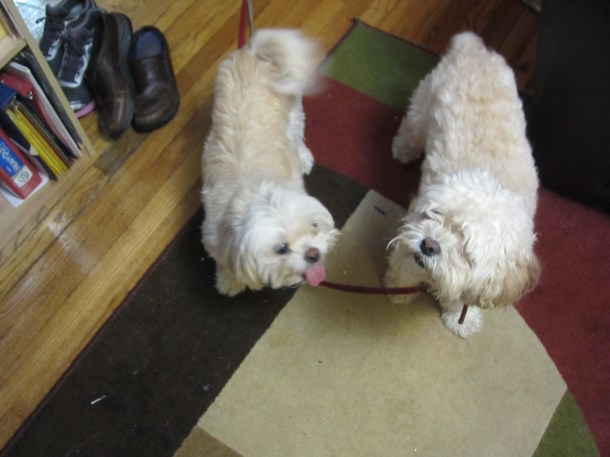
My dogs would never be able to make sense of a Tango, with its sidelong glances and quick flicks and tension. They’re much too straightforward for that, but they have created their own dance forms. Cricket has a “Grandma’s home!” dance that involves a lot of hopping on her two back paws and reaching up into the air with her front paws. Butterfly has an outdoor dance with a lot of skipping and hopping and galloping, before she finally stops to poop. They also have a few partner dances, where they cross leashes and sniff each other and run side by side and then pull apart.

025

Dance with Grandma!

pix from eos 042.jpg

Dance in the leaves!

IMG_1861

Dance in the snow!

IMG_1576

Dance together!

The dance floor at the museum began to look like an oversized game of Twister after a while, with a widening gap between the serious dancing couples and everyone else just playing around, snapping fingers, running instead of dancing, shimmying when that was not what the instructor called for.

A man in a long black coat, black hat, and beard, danced with a woman in a modest red dress on the outskirts of the crowd. He leaned down after a complicated step, and she reached up, to kiss him on the lips. Their teenage son, in the same kind of plain black suit, with fringes dangling out of the corners of his white shirt, wandered through the couples, wind-milling his arms, dancing on his own, twirling his coat like a black dancing skirt.

His parents watched him, but let him be. I noticed the couple because they were obviously Jewish and therefore familiar, but even more than that because they looked so comfortable in their bodies. You could see their relationship in every move they made: the private jokes, the comfortable fit of one hand in another, the playful kiss on the cheek. When I watch Dancing with the Stars, or So You Think You Can Dance, they’re always emphasizing the sexuality and formality of dance, but this was something more real and down to earth; this was like watching a long-married couple do dishes together, or listening in on a gentle disagreement about the color of the curtains.

This is what I love about watching Cricket and Butterfly dance, every move they make is real and expresses something they actually feel in the moment. It’s not formal or theoretical, it’s down to earth and full of life. If I could ever create a dance for myself, that’s what I’d want it to be like, especially if I could include a swirling dance skirt, and a few puppies for good measure.

IMG_0454

And then rest.

Olivia and Dina


Olivia Cole was one of my mom’s good friends in high school. They were both in the theatre group, at their girls’ only school in the city. There were girls of every shade and religion there and none of that mattered. I got the sense that they were in a safe haven in that school, where the limitations placed on other girls in the fifties just didn’t apply to them.

Mom went off to film school in California after that, and Olivia went to RADA, the Royal Academy of Dramatic Arts in London. Then Mom went on to work as a film editor, and got married, and had kids, and found that film work was not on the right schedule for parenting two little kids, and one big one. And Olivia moved out to Los Angeles, married, divorced and won an Emmy.

roots_actors_emmy

Olivia wins an Emmy!

I’d seen Olivia’s picture in the yearbook and heard her name, but I’d never met her myself. And then North and South, the miniseries, came on TV, and I was busily watching Patrick Swayze and listening to southern accents when I saw Olivia. I started screaming and calling for my Mom – Is that her?! And it was. I knew (of) someone who was on TV!

When I was in seventh grade, I got to see her on stage in A Raisin in the Sun, and then I saw her in three episodes of Murder, She Wrote, and a miniseries with Oprah Winfrey. But all of this time I still didn’t know her. I saw her in another play a few years later and she came out to meet us, and I was shy, and she smiled and called me “A tall drink of water” or was it “long” drink of water. Not sure. But she was still a stranger, a mirage even. When she was on stage or on my TV, she wasn’t really Olivia, and I wasn’t sure who she might be in real life. She wasn’t the kind of actress who played herself over and over, she played characters who were nothing like her, except that they used her eyes and her voice. They even changed her body, making her walk, her body language, the shape of her, unrecognizable.

olivia cole - the women of brewster place

Olivia in the Women of Brewster Place.

And then, when I was in my twenties, she came to stay with us. She had to sell her father’s house on the island and Mom offered our apartment as base of operations. Normally Olivia would have stayed in the city with her mother, but this was more convenient, and, more importantly, a chance to catch up with an old friend.

We had Dina then. She was probably ten years old, a black lab mix from the shelter, still in good health, and calmer than she’d been for the most of her life. I was still at my shyest back then (and only a few steps removed from that even now). I think Olivia was the only adult who ever slept over at the apartment (nephews, no matter what they might think, do not count as adults). Olivia was this mix of grand theatrical wisdom and down to earth, plain spoken quiet. And she loved my dog. And Dina loved Olivia.

dina smiles

Dina

Dina did not have many friends. Little children were as frightened of her as she was of them. They would see her black hair and sharp teeth and hide behind their mothers. Dina would see their quick movements, and short stature, and sit down by my leg with her back hair raised up. When people asked if she would bite, I had to say yes, she might do that. She’d tried to bite me, for picking her up when she didn’t want to be moved, for leaving her home when she wanted to come with me.

I took her to therapy with me for a few months, when she was suffering from unbearable separation anxiety, and maybe just knowing where I went without her, knowing what the place smelled like and sounded like, calmed her down. By the time Olivia visited, Dina was doing better, but she was still Dina. So Olivia’s matter of fact and immediate friendship was disarming and surprising to her. She wasn’t used to being liked by strangers. The two of them went for long walks together, down to the beach, keeping stride, breathing together.

IMG_0544

Dina loved to listen to Olivia’s voice.

With people, Olivia was a talker. She had that dramatic raconteur voice, with a touch of her southern Mom and her time in London coming through, and a lot of her time on stage filling out her voice so that even her whispers filled the whole room with a low smoky sound.

I don’t know if Olivia talked to Dina out on their walks, telling her stories of her own dog, Oro, or her trips around the world, or the characters she’d played. Maybe they were just quiet together, breathing in rhythm, walking towards the water and feeling the slight breeze in the air. Whatever it was, they came back content.

Dina had a friend. She didn’t know anything about Emmy awards and Hollywood and pilot season and table readings, all she knew was that this presence had entered her life and offered love of a gentle, fresh, relieving kind.

dina dances

Dina, the dancer.

I have to believe that’s part of what changed things for my Dina. She never became a social butterfly, but something in her anxiety seemed to slow down. As if she’d decided that it was all okay. She didn’t have to get better to be loved, she just had to be.


Olivia Cole is currently in a two-woman play about the Delany sisters, called Having Our Say, in Hartford, Connecticut. If you’re in the area, or plan to be there before April 24th, stop in and see her. She’s magical.

Olivia in Having our say

Olivia in Having Our Say.

This is a review of the play when it was at the Long Wharf theater:http://www.nytimes.com/2016/03/06/nyregion/review-2-sisters-navigate-100-years-of-black-history-in-having-our-say.html?_r=0

Link to Hartford Stage:https://www.hartfordstage.org/?gclid=CLiIobSOh8wCFUokhgodKvYGXA

A Chicken in the Yard

Why did someone throw a cooked chicken, and potatoes, into the woods behind our building where we walk the dogs?

So, one day, we were walking in the backyard of our co-op building, a nice big yard with a hill up into the woods, and Cricket spotted a squirrel, and Butterfly spotted her sister hopping like a bunny rabbit to catch the squirrel, and I let go of Butterfly’s leash (not Cricket’s, because I am not crazy), and Butterfly ran towards the squirrel, and then took a swift left turn towards a section of ivy we usually do not bother to explore. Cricket pulled me up the hill and over to the spot and I saw what I thought was an enormous, pale grey mushroom. I stepped on Butterfly’s leash and held both girls back from the strange thing until Grandma, our nature guide, could take a closer look. She looked at it, touched it with the toe of her shoe, and said, “I think it’s a chicken.”

013

“Of course you can trust me off leash, Mommy.”

I did not believe her. Really, I thought, Mom has not had enough rest lately. What would a chicken be doing in our backyard? On the next walk, I was careful to keep hold of the leashes, and promptly forgot about the strange mushroom in the ivy. But later in the afternoon. After a long nap, I convinced Mom to hold Butterfly’s leash for me, while Cricket tried to drag me to the street to visit the cars up close, and when Butterfly pulled on her leash, Mom let her run free. Instead of running ten feet and finding the perfect pooping spot, as usual, Butterfly galloped the length of the yard, up the hill, around the corner, and into the ivy. By the time Mom caught up to her, Butterfly had her face down in the greenery. Mom pulled the leash and managed to get Butterfly a foot away from the area, and saw that she was eating something. It looked like a potato.

039

The ivy patch, or potato patch.

“A potato?” (This was me, when Mom and Butterfly met me and Cricket half way across the yard, Butterfly looking back at her ivy patch with longing.)

“A potato. And it was definitely a chicken, not a mushroom, probably split down the middle and flattened with a brick.”

“A cooked chicken?”

“And potatoes.”

“Why did someone throw a cooked chicken and potatoes into the woods?”

Mom could not answer this for me, though she had a suspicion that it was the same woman who throws huge chunks of French bread on the lawn to choke the birds.

IMG_0770

“But Mommy, I want the bread!”

I held both leashes while Mom took an extra bag from her pocket and used it as a protective glove with which to remove the chicken and potatoes from the woods, so that the girls would no longer be drawn to it as if it were, well, chicken.

Unfortunately, Butterfly was able to find a potato hiding under the ivy the next morning, and stood around chewing it ostentatiously in front of me at seven o’clock in the morning when I didn’t have the energy to fight with her. And Cricket found another potato that afternoon, which inspired her grandma to search through the ivy more carefully for any other leftovers.

We seem to be safe now. And I say it that way because, almost immediately, when I was told it was a chicken and not a magically appearing mushroom of unusual size, I started to think that someone was trying to poison my dogs. We’re the only ones who seem to go up there – because that’s where the managers told us to go since we insist on not walking the dogs in the street four times a day. And Cricket is kind of annoying, and some of the grass in front of our building has clearly been peed on, so maybe someone has a grudge against my dogs and wanted to hurt them and what better way than to cook up an entire chicken, and potatoes, and inject them with poison, and throw them in the path of my babies.

IMG_0090

“I am not annoying.”

My paranoia started to wear off after a few days, when it was clear that my dogs were not dying. I had to remind myself that some people are just weird. Some people throw their dinner into the woods, for the magical fairies (aka raccoons) to enjoy, instead of into the garbage cans in the basement in well tied black garbage bags.

Both dogs still rush over to that spot in the ivy to check if any new snacks have arrived, and Cricket has decided that there may also be snacks hidden in the adjacent leaf pile, and insists on shoving her nose in as deep as possible, and burrowing, every time she has a chance.

037

Cricket’s leaf pile (there are no potatoes in there, that I know of).

It makes me wonder if I’ve been failing as a dog Mommy all of these years, by NOT burying treats in the yard for them to find on their walks.

pix from eos 041.jpg

“Chicken!”

Color War

When I went to sleepaway camp as a kid (for five summers, eight weeks at a time) the worst thing that I had to endure was color war. Each bunk, and each age group in the entire camp, was split down the middle. Even the counselors in my own bunk could be on the opposing team. We were either white or blue, and almost all of the competitions that made up the war were fought against the kids we saw every day. There were swim competitions and foot races and trivia contests and ultimate Frisbee. We had to learn songs to cheer for our side, and wear t-shirts with our team colors. And at the end of the war there was a huge tug of war with the whole camp pulling on one or the other side of the rope.

I’m not sure what the purpose of color war was meant to be, maybe a team building exercise, or a chance to compete at the activities we’d just been doing carelessly each day before that, but the unintended consequence, or at least I hope it was unintended, was that we got to feel what it would be like to have to fight with our friends and neighbors, and it was awful.

By my last summer, I actively campaigned against not only my own involvement in color war, but its existence altogether. At thirteen, I could finally articulate the pain in the fact that my counselor, my mommy-substitute for two months, would be actively rooting against me for at least 24 hours. It was shattering.

It would be like splitting my family in half, with Grandma and Butterfly on one team and Cricket and I on the other, and every meal we ate, every TV show we watched, would be a battleground. Cricket would lose her mind.

anger

“Grr!”

This is what I’ve been thinking about lately, with the American presidential election in its long swing through hell. There are two teams, that’s it, and it’s a fight to the death to see who gets to represent each team, even if no one, really, can represent 50% of the country to anyone’s satisfaction.

In a multiparty system like Britain’s parliamentary system, smaller parties can win seats in the parliament and have influence in governing. A party that wins 20% of the votes in a multi-party system, will get 20% of the seats in the legislature, and a voice in parliament. In a two party system like we have in the United States, we can still have third parties, and have had many of them, but they rarely gain traction. Why? Because in winner-takes-all elections, the 20% a third party may be able to muster doesn’t win them any power. This is why Bernie Sanders is running as a Democrat, despite being an Independent, as well as a Democratic Socialist.

Americans seem to be comfortable with our two party split, our black and white dichotomies, not to put too fine a point on it. There are many people who’d like to make the next division Christian versus Moslem, as if everyone in the world is either one or the other. But that assumes that all Christians are one, and all Moslems are one, and that everyone else doesn’t exist. That’s what you have to do to create this two team system. You have to whitewash, or blackwash, everything.

The dichotomy between Republican and Democrat has never been more extreme in my lifetime than it is right now. During the Bill Clinton era, the constant complaint was that both parties were so centrist that choosing one over the other was just about brand loyalty and nothing deeper than that. Today, it’s a deep divide.

I think I’d be more comfortable with proportional representation, just because it fits my world view better. Let me fight with the people I’m actually in disagreement with, instead of a whole team of people who have to be loyal to each other no matter what they actually believe in.

Except, at least with the two party system, Trump has to won a majority (or if there’s a third party candidate by November, a plurality) of the votes in order to get into power. In a multiparty system he could win just 20% of the vote and at least have some power – and I would have to deal with that. Though it’s hard to imagine someone like Trump being interested in that kind of power. He’s an all or nothing kind of guy.

Another benefit of the two party system is that outliers like the Ku Klux Klan, who may still be a presence in certain states, cannot elbow their way into either of the big parties and get to power in the country overall. But, maybe that’s also part of the problem – most of the country had no idea these outliers were there. We didn’t know that there were going to be so many Trump supporters bubbling up, because until they reached a critical mass they were invisible in our winner-takes-all system.

But, I like the idea that in a family, even if there are certain people with more power, the minority voices – like Cricket’s and Butterfly’s – still get heard and still have a vote. They may not have the final vote, or the most heavily weighted vote, but they still count in the delegate math. Maybe Butterfly would be in the “food, glorious food” party, advocating for extra meals and extra treats. And Cricket would be in the “I want to play” party, advocating for extra outings and more interactive time with her people. They could work together on certain tasks, helping each other reach their goals, as long as they are both satisfied by the outcome. And on other issues they wouldn’t work together, but might find common cause with Grandma (“let’s go to the beach”), or with me (“snacks in front of the TV would be nice”). It’s a more flexible system, and allows people to be more honest about their beliefs and motivations.

IMG_1860

“Grandma! It’s time for gardening!”


45 - and salty

“Grandma, aren’t you thirsty?”

008

“Food!”

The Brain

I worked hard at gymnastics as a kid, and could barely lift myself up onto the low bar, or walk across the high balance beam. I practiced all the time, but I could never do a back walkover, or hold a handstand for the requisite ten seconds. My body is not smart in that way. My body feels like a group of people who are shouting to each other over mountaintops miles apart. It’s as if the communication system between my various body parts is crunchy and static filled, instead of clear and smooth.

Cricket, on other hand, is an athlete. If she were human instead of canine, gymnastics coaches would be clamoring for her. She’s compact (aka small), and she can run fast and jump high and stretch into unreasonable positions, just like a world class gymnast. I would not send her into rhythmic gymnastics (with the ribbon, and the ball, and the hoop, etc.), because she cannot be trusted with toys, but artistic gymnastics, especially floor work, would be ideal. Butterfly would love to run around the edges of the mat, ready with a bowl of water, or some paw chalk, when her sister needed it.

IMG_0199

Cricket can fly!

IMG_1159

No, really. Butterfly is my witness.

IMG_1574

Butterfly has to work on her flexibility to keep up with Cricket.

The lack of clear communication in my body has always disappointed me. I am in awe of dancers who can speak, and sing (!), with their bodies, never needing words to tell a story. I feel almost mute, physically, and it really bothers me.

My social work internship for next year will be with traumatic brain injury patients. Some will have motor difficulties, speech and reading difficulties, and pain, but all will have some kind of dysfunction in the connections in their brains. Even if every distinct brain region is working fine, the communication between the areas will be muddled in one way or another, and I think that being able to see the varieties of this will be good for me. I have never been diagnosed with a TBI, even a mild one, but while the brain can be shaken up physically, it can also be shaken up emotionally, with similar results.

I took a class called Brain and Behavior a few years ago and was fascinated by the idea that you could identify specific brain areas where certain types of information are processed. There is a biological basis for the things we consider ephemeral and wispy, like emotions, and knowing more about the brain gives more weight to all of those things people have pooh poohed for years as silly and unprovable. Studying the impact of brain injuries on different areas of the brain helps us understand how much who we are, and how we behave, is physiologically caused.

The work I will, eventually, be doing at my internship, comes after the physical therapists, and occupational therapists, and speech therapists have done as much as they can to stabilize the TBI patients, but I will get a chance to observe their work, and I’m very interested in seeing the different methods people have come up with to try and retrain our bodies and brains. With one kind of injury, practicing speech patterns and walking skills can really bring you back up to close to normal, but with another injury, no matter how hard you practice, the brain connections just aren’t there and can’t retain the information. There’s some relief in the idea that you could know which goals are reachable with hard work, and which ones are just not possible.

I can watch Cricket and Butterfly walking next to one another and see clearly how their different physiques control and limit how they walk. Butterfly will never be as flexible as Cricket is, because her rib cage is too big and her legs are too short. And Cricket will never “walk like a girl” because her hips are slim and refuse to sway. Butterfly’s brain can’t begin to imagine the number of horrible dangers Cricket believes are right outside the apartment door, and Cricket’s brain cannot fathom the Zen-like calm that Butterfly feels when she hears bird song in the distance.

IMG_1576

See, they’re completely different.

I wish I could accept my own limitations for what they are, but I still hold onto the dream of plasticity, that my brain will change and grow over time and allow me to be something more. It’s not impossible, actually. Someday, Cricket’s brain might rewire itself inexplicably and allow her some peace.

IMG_0137.JPG

Wouldn’t that be wonderful?

The Baby Next Door


My next door neighbor is pregnant and due at any moment. The last time I saw her she was on her way out for a walk, to try and shake the baby loose, but I’m pretty sure he’s still in utero. She and her husband are going to be first time parents, and they have all of the new furniture and rabid anxiety to show for it. They’ve had parents and siblings and nieces and nephews traipsing in and out of the apartment for months, offering help and advice and a chance to practice their parenting skills. The two year old niece who cried 24 hours a day was especially good practice. Cricket survived the experience quite well, I think.

IMG_0090

“I survived, barely.”

But I am worried about how Cricket will react to having a baby next door full time. I hope that she will be protective of the baby, rather than frightened by him. I hope that she will see the baby as a fount of wonderful new smells, rather than a source of unpredictable noise and movement. Butterfly will, inevitably, want to lick the baby and I’m not sure if that will be allowed. I have my fingers crossed that my offers to babysit will be taken seriously, and that Cricket’s presence will not count against me. Our downstairs neighbor is a pediatric nurse, though, so if they’re choosing between us, I’m pretty sure she wins. Though I do spend more time at home, so I have availability in my favor.

IMG_1139

That tongue was made for licking.

IMG_0875

“I’m a sweetheart, Mommy. I don’t know what you’re worried about.”

When the most recent child visited next door, Butterfly took up her spot on the mat by our front door, and listened to the child’s voice, mesmerized. It’s possible that she thinks babies know all of the mysteries of the world, and if she just listens long enough she will absorb all of that wisdom. Or maybe she can smell them from across the hall; the mix of poopie diaper and sticky jam hands must be intoxicating. Maybe our neighbors will only ask Butterfly to babysit, and I will have to stay home with Cricket while she grumbles under the couch.

IMG_3243

Butterfly is a very good listener.

IMG_0995

“Do babies like duckies?”

I don’t usually get to be around babies, and I feel the loss. People talk about a biological clock, as if the pull towards having children starts and stops at a given time, but my clock has always been ticking. I never actively chose to be single or childless. There are so many people, especially nowadays, who have made those choices consciously and are satisfied and happy with their lives, but that’s not me. I would have liked to be a full time mom. I would have liked to put all of my research efforts into figuring out my own children, and all of my fight into making their lives better. I just wasn’t up to it in time.

I used to babysit as a teenager, for friends of the family, starting when their first born was only a month old. I was there for just an hour or so during the day to begin with, learning how to bottle feed him and change diapers. I babysat for him, and his younger brother, for a few years, until they got a live in babysitter to watch both kids so their Mom could go back to work. Most of what I remember about babysitting was staring into the pantry, looking for cookies. I even drank tea when I was babysitting, even though I never drank tea in real life. I was very good at reading Thomas the Tank Engine books, but less expert at the diapering business. As soon as I was told that boy babies will pee at you, I developed a face averting/arm guarding/diaper-as-pee-shield routine that slowed the whole process down.

I only did a little bit of babysitting when my brother’s first child was born, and that was me and Mom together, so she could be in charge of diapers and messier tasks, and I could teach Benjamin how to sing, and help him with his bizarre baby yoga poses. Most of the baby sitting I do now, with my brother’s four kids, is just hanging out, being an alternative to those bossy parents, and playing with trains and computers and other fun stuff. I don’t have to force them to brush their teeth, or keep them from drowning in the bath tub, thank god.

But I’d really like to have some baby time again. The incredible high of being able to make a baby smile, or just getting locked in baby eye contact for a moment, is unforgettable. Cricket also thinks she could be good at babysitting. She would be very good at keeping an eye on the baby and alerting sleepy parents to any incipient emergencies: like a dropped bottle, a stab of gas pain, a serial killer trying to get in through the window, or, you know, birds passing by.

IMG_1829

“Birds!!!!!!”

The Three Echos


Three of the four of us had to have echocardiograms recently. Butterfly had hers first. She’s an old hand at doctor visits at the clinic, and always tries to bolt when we get near the front door, but her doctors are friendly, and the women at the front desk think she’s adorable, even though she’s too anxious to take the treats they offer her. Butterfly has to have an echo every six months, to keep an eye on her prolapsed valve and enlarged heart, and she does not enjoy the experience.

IMG_1249

“Are we leaving yet?”

As soon as we checked in and sat down in the waiting room, my mostly non-shedding dog released hair all over my jacket and drooled on my shoulder and tried not to pee on the floor. She was curious about the other dogs sitting in various states of terror around her: the three month old Labrador who couldn’t contain her enthusiasm; an eighty-pound brindle Pit Bull who was hyperventilating under his owner’s legs; a cat hiding in her carrier. But the Chihuahuas seemed reasonable to her, and the floor itself was a potpourri of odoriferousness. She went adventuring for a few minutes at a time, and then asked to be picked back up for emotional refueling before making her next attempt to survey the territory.

IMG_0161

Butterfly believes that all floors must produce kibble, like the floor at home does.

She went in for her echo in the arms of a vet tech, trusting and blank. She trained herself to accommodate humans many years ago, living in the puppy mill, and still uses her old coping skills, pretending-she-is-not-where-she-is, as they slather cold goop on her chest and probe for pictures of her heart.

It is not surprising that her heart has been damaged, or that her heart is bigger than it is supposed to be. I could have told you that without all of the fancy equipment. After the test, her cardiologist came out to tell me that she was the same as she’d been six months before – with a leaky valve and an enlarged heart and no need, yet, for medication.

He couldn’t see on her pictures that she has learned how to chase squirrels and run like the wind and jump for chicken treats. He couldn’t know that she has developed a full range of expressions, and only once in a while falls back into her blank stare of old. But he believed me when I said so, and he was happy for her, and for me.

pix from eos 056

“I’m dancing!”

My echo was a different kind of experience. I’ve had a few in the past, and hated them all. One in particular, was both humiliating (changing into and out of the flimsy robe with the door half open and strangers walking by) and painful (half an hour of rib bruising pressure). This new doctor was specially recommended, and requested, by the new pulmonologist who is trying to figure out the possible causes for my shortness of breath.

The paper “gown” I had to wear was not much of anything, and the tech this time was male. In my three previous echo’s I’d only had female techs and assumed that was the norm. Stickers were placed above each breast and on my abdomen, and then wires attached. I was told to roll to my left, away from the tech, which was a relief.

I could hear the whoosh whoosh whoomp sounds of my heart coming from the computer behind me, but it was hard to concentrate because the probe was pressing hard against my breast bone. I could feel a black and blue mark forming and could only grit my teeth and tell myself it would be over soon. Whoosh whoosh whoomp, whoosh whoosh whoomp.

Because of the position I had been placed in for the test, on my left side with the probe at my chest and the tech leaning over my body, it almost felt like I was being hugged. It wasn’t sexual or disturbing. I did not expect this feeling at all. His hip and waist were pressed against my back, so that he could comfortably reach over and take the sound pictures of my heart. And despite the pain of the probe on my chest, the pressure of his arm over my side was a relief. I felt safe. I sensed no danger, no inappropriate or confusing energy from his body, just presence.

The doctor came in to look at the pictures, then, and he said that my leaky valve was, pfft, not much, and if you use an expensive machine like this you’re bound to see “something” but that doesn’t mean that “something” really means anything. He was annoyed that anyone would come for an echocardiogram and have a boringly normal heart to show him. Pffft. You’re fine, go home.

And normally, that dismissal is what would stay with me, but instead, this time, it’s the hug; the closeness and security of a stranger next to me. I don’t know what to make of it except to file it in the back of my mind, under surprising, and good.

Mom’s echo was the third in the series. She gets them regularly, though not as often as Butterfly, ever since her “minor” heart attack more than fifteen years ago now. It did not seem minor to me, or to her, at the time. The only explanations given were a leaky mitral valve and “stress”, which my doctor-brother pooh-poohed. The result, though, was that she started to take much better care of her health, and found a less stressful job, closer to home. The regular echos, and stress tests, and blood tests, are another thing she has accepted and rarely complains about, at least to me. I asked if it hurt. No. Or if it was humiliating. No. Or if the wait was long. No. She and Butterfly share this capacity, for going somewhere else in their minds when they need to not be with their bodies. It’s a skill I do not have.

Cricket has no such skill either. If she needed an echo they’d probably have to knock her out, like they do for an x-ray. Thank God, her heart is fine. Normal whoosh, normal whoomp. I know, because she likes to suffocate me in the morning, with her chest close enough for me to hear the sound pictures without any fancy equipment at all.

Pffft.

We’re all fine.

030

Grandma and Cricket, whoosh whoosh whoomp.

001

Whoosh whoosh whoomp.