Tag Archives: exhaustion

Back to School

            For my first day back teaching, I was a whirling dervish of energy. I followed along with the Israeli teenager who led us in a TikTok style dance; I taught Hebrew through Movement, which involved a lot of standing up and sitting down and walking, walking, walking; and then I taught my two classes and met (most of) my new students, which meant a lot more standing and dancing and crazy hand gestures and funny breathing exercises. At the time, I was sure I was going to be fine. I mean, it’s not like I was running around the building, or doing pratfalls for laughs (like my students).

            But a couple of hours after I got home, my body started to stiffen and the pain began to set in. By the next morning, I could barely move.

“Hey! I can’t move either!”

            It took me a few days to recover. And, if possible, the second day of teaching was even more challenging. So now, I’m scared. I’m not sure if this physical response is worse than last year’s, or if I just got out of the habit of feeling like I’d been run over by a truck a few times a week. And I’m frustrated, because I spent the whole summer trying to build up strength and endurance in the hopes that I would start the new school year feeling more resilient, and, at the very least, it didn’t work.

            It was wonderful to see my students from last year, and to meet the new kids and hear their unique stories and start to untangle all of the drama among them (this will clearly take all year). And I can see a lot of interesting discussions and tons of silliness in my future, but there’s a voice in the back of my head warning me, you may not last the whole year.

            The fact is, I know I will do everything I can to be there for my students and to live up to all of my commitments – but it’s going to be harder, and it’s going to hurt.

            A few weeks ago, my therapist said, in passing, that my disease/disorder/undiagnosed chronic illness, is degenerative. She didn’t say, “it may be degenerative,” she said “it is.” For many years, she didn’t even believe that there was anything physically wrong with me. She was convinced that all of the pain and exhaustion was psychological, and therefore hard work in therapy would fix everything. But after decades of intensive therapy, and obvious progress in my mental and emotional heath, my physical issues have only worsened, and, finally, her theory of the case had to change.

            But there are so many things I still want to do! I want to teach more, not less. I want to write more, and meet more people, and travel, and dance, and sing. I was really hoping that this summer’s home-made physical therapy regimen was going to make a difference, and I’m so disappointed that it hasn’t helped. To be fair, it’s possible that without all of that work over the summer I would have been in even worse shape for the start of the school year. But for many years now, I’ve been trying everything I could think of: every medication and supplement doctors have suggested, and every exercise and treatment and strategy I could find. But I’m going to have to accept that it’s possible that this is as good as my health is going to get, and find a way to deal with that.

            But really, I don’t wanna. I want to throw a tantrum and scream and kick the floor and just cry. It seems to make my students feel a whole lot better, so, maybe it’s the next thing I should try. It couldn’t hurt! Much.

” I love a good tantrum!”

If you haven’t had a chance yet, please check out my novel, Yeshiva Girl, on Amazon. And if you feel called to write a review of the book, on Amazon, or anywhere else, I’d be honored.

            Yeshiva Girl is about a Jewish teenager on Long Island, named Isabel, though her father calls her Jezebel. Her father has been accused of inappropriate sexual behavior with one of his students, which he denies, but Izzy implicitly believes it’s true. As a result of his problems, her father sends her to a co-ed Orthodox yeshiva for tenth grade, out of the blue, and Izzy and her mother can’t figure out how to prevent it. At Yeshiva, though, Izzy finds that religious people are much more complicated than she had expected. Some, like her father, may use religion as a place to hide, but others search for and find comfort, and community, and even enlightenment. The question is, what will Izzy find?

Passover is Almost Here

I’m not in the mood for Passover this year, especially because my health has been getting worse and Passover is one of the most preparation heavy holidays on the Jewish calendar, not just because you have to change your entire diet for a week (Matza instead of leavened bread, or anything with leavening in it, or anything with beans or corn or rice in it, if you are of Ashkenazi descent and Orthodox), but you also have to clean the whole house to make sure there’s no leavened bread hidden behind the sofa or between the cushions (Cricket likes to bury her treats for later), and then you have to find a Seder to go to and/or cook for a Seder.

“Wait a minute, were you watching me hide that piece of bread?”

            For most of my adult life I’ve been Passover-averse, in large part because my father made a mess of it. As a little kid, I loved Passover, especially going to Seders at my grandfather’s house (Mom’s father). But as my father became more religious he decided that everything my brother and I had been taught about Judaism was wrong. His new rules were demeaning and punitive and took the joy out of all the holidays, but especially Passover, which, if the rules are followed rigidly, can be something of a nightmare. As an adult, it took me a long time to even be able to walk into a synagogue, let alone go to services again. And even after we joined our current synagogue, eleven years ago, and I started to go to services every week, I still mostly pretended that Passover was just another week of the year. But as a synagogue school teacher, I can’t ignore it, because I have to teach it.

Part of me wishes I had the time to teach my students about Passover the way I learned it as a kid at my Jewish Day School. In first grade, we learned Echad Mi Yodea (Who Knows One?) in Yiddish, and each year we had a model Seder and learned tons of songs and prayers and stories and traditions. And then classes ended a few days before Passover so we could be home to help with the special food shopping, and changing over the dishes, and searching for chametz (leavened bread, like bread crumbs or cereal) with a kit we got from school, made of a small white paper bag, a feather, a wooden spoon, and a candle. The search for chametz is a kid-friendly ritual done in the dark on the night before the first Seder, where the adults hide little piles of chametz for the kids to find (with a candle to see by, and a feather and spoon for collecting the chametz into the paper bag, and then the whole kit is burned), all to symbolize the official transition from a house full of chametz to a house that is kosher for Passover.

Not my picture

            I’d love to share these rituals with my students, but I can’t figure out how to do it in our small classroom and the few minutes we have available between all of the other things they need to learn. I’m hoping that some of the girls in my class will come to the Women’s Seder at the synagogue, which is kind of like a grown-up Model Seder, with all of the handwashing and singing and blessings and rituals you could ask for. It’s scheduled ahead of Passover on the assumption that the actual family Seders will require women to do the cooking and cleaning and serving and therefore not really get the chance to focus on the meaning of the holiday itself. And because it’s a Seder for women, the pronouns in the blessings will be changed (because in the traditional blessings the pronouns are all male), and we will consider the female characters in the story who have generally been left out, and we’ll eat food prepared by someone else and sing songs written by women.

            If I had the energy, and the time, and the money, I would love to have a Model Seder with my students, where we could try dishes from Jewish communities around the world: like Moroccan Dafina stew, and Italian fried artichokes, and Turkish leek meatballs, and especially Ethiopian Matzah made with chickpea flour. And then we could try out different kinds of rituals, like the way the Ethiopians break their dishes before Passover (to avoid any chance of having chametz in their food over Passover), and some Sephardi Jews hit each other with scallions to simulate the way the slaves were beaten (well, maybe not that one), or the tradition where the Seder participants carry a heavy bag around the table to remind them of the burdens of slavery. And then, of course, the kids would obsess together over what they should ask for from their parents as rewards for finding the hidden piece of Matza (the Afikomen) at their own Seders.

“What will you give me for this Matzah thing?”

            That’s what I’d like to do, but I don’t have the classroom time to do it. And, more importantly, I really don’t have the energy. When I’m not in school with my students lately, I’m generally home in my pajamas, resting, or at least trying to. To be honest, I’ve spent most of my time recently binging past seasons of the Great British Baking Show on Netflix (because I finally have access to all of the seasons I missed after they moved from PBS to Netflix in the States).

            If I get a magical spurt of energy before Passover, I might do some vacuuming and search through the couch cushions for Cricket’s hidden crumbs, but once synagogue school goes on vacation, it’s likely that I will spend most of the holiday just resting, and hoping that that will be enough to give me the strength to finish out the synagogue school year with my kids.

            And, really, if I can do that, I’ll be happy.

If you haven’t had a chance yet, please check out my Young Adult novel, Yeshiva Girl, on Amazon. And if you feel called to write a review of the book, on Amazon, or anywhere else, I’d be honored.

            Yeshiva Girl is about a Jewish teenager on Long Island, named Isabel, though her father calls her Jezebel. Her father has been accused of inappropriate sexual behavior with one of his students, which he denies, but Izzy implicitly believes it’s true. As a result of his problems, her father sends her to a co-ed Orthodox yeshiva for tenth grade, out of the blue, and Izzy and her mother can’t figure out how to prevent it. At Yeshiva, though, Izzy finds that religious people are much more complicated than she had expected. Some, like her father, may use religion as a place to hide, but others search for and find comfort, and community, and even enlightenment. The question is, what will Izzy find?

All Those Cooking Shows

            I’ve been watching a lot of cooking shows lately (mostly in Hebrew, as language practice) but I haven’t been doing much cooking, to Cricket’s great frustration. I am a messy cook, and as I chop, many pieces of red pepper and carrot and sometimes even chicken land on the floor right in front of her, where she is, conveniently, waiting. Instead, I am microwaving frozen meals, and all she can do is fight with her sister for the leftover sauce in the bowl (Cricket always wins).

“It’s all mine!”

            It’s not that the cooking shows aren’t inspiring. In fact, I feel like I should be making long lists of ingredients to search for, and printing out recipes for Shakshuka with eggplant and Kibbeh, or five kinds of Chummus, and instead I’m eating oatmeal for breakfast, and peanut butter and jelly sandwiches for lunch, and anything I can warm up from the freezer for dinner (unless I’m lucky and Mom does the cooking, but she is not a messy cook, sorry Cricket).

“Harrumph.”

            I should at least be ordering out from Wild Fig (a Turkish restaurant with multiple locations nearby), or buying readymade Falafel or Bourekas from the international supermarket, but I’m not doing either one, and I’m not sure why.

            My first theory for why I was struggling was that most of the recipes, like the shows, are in Hebrew and measure in grams, which makes them largely incomprehensible. So I went online to look for similar recipes in English and found a treasure trove on Jamie Gellar’s site (she’s an orthodox, kosher cook who covers a wide range of styles of cooking, including Israeli).

But now I have a pile of new recipes that I have no energy to make.

            I don’t think it’s depression that’s holding me back, if only because once I take my afternoon (or morning) nap my moods are pretty good, even if my energy level still stinks. But there’s something about knowing how little energy I’m likely to have tomorrow, or next week, that has changed my calculations for what kinds of plans to make, if any.

“Plan to take a nap.”

            I’d like to believe that I’ll be able to do some cooking over the summer, when I won’t need all of my energy for teaching, but there’s also a long list of writing projects and exercise goals and doctor visits and household tasks that I need to catch up on over the summer, and even then, we don’t have air-conditioning in the kitchen to make it bearable, just a fan that tends to read between 80 and 95 degrees all summer long.

But I keep watching these cooking shows and wishing I could just walk down the hall to the kitchen and make an Israeli salad, or bake my own pitas on the top of the stove. I need to believe that something will improve soon so that I’ll be able to use all of this inspiration to actually make plans and follow through on them, or else I’m afraid I’ll get so stuck in my reality that I’ll forget how to hope for more.

Some links:

From Jamie Geller – Machane Yehuda Recipes (in English) (10 min.) https://youtu.be/lgjdy7VQJ0I

From Piece of Hebrew (with English subtitles) A SABICH recipe (14:18) https://youtu.be/nY29TRUh_MY

From Anachnu Al HaMapit with chef Michael Solomonov in Philadelphia (mostly in English with Hebrew subtitles) (53:15)https://youtu.be/EH-WpezAOTg

If you haven’t had a chance yet, please check out my Young Adult novel, Yeshiva Girl, on Amazon. And if you feel called to write a review of the book, on Amazon, or anywhere else, I’d be honored.

            Yeshiva Girl is about a Jewish teenager on Long Island, named Isabel, though her father calls her Jezebel. Her father has been accused of inappropriate sexual behavior with one of his students, which he denies, but Izzy implicitly believes it’s true. As a result of his problems, her father sends her to a co-ed Orthodox yeshiva for tenth grade, out of the blue, and Izzy and her mother can’t figure out how to prevent it. At Yeshiva, though, Izzy finds that religious people are much more complicated than she had expected. Some, like her father, may use religion as a place to hide, but others search for and find comfort, and community, and even enlightenment. The question is, what will Izzy find?

The New School Year

            I’m the only teacher wearing a mask this year at synagogue school, so far. And I know that part of the reason I chose to keep wearing it is because I’m self-consciousness about my teeth, post-surgery, but mostly it’s because I wear a mask to go to the supermarket, and the doctor, and the dentist, and the drug store, and it seems odd to take the mask off just when I’m faced with a room full of children. I don’t want to get sick, and even more important, I don’t want to get Mom sick, especially after the breathing issues she’s been having this summer.

            I have even less energy than I had when school ended last spring, but I’m hoping that that’s a temporary result of the oral surgery, just like the numbness and tingling on the right side of my face, and that I’ll start feeling better soon. I don’t think my exhaustion shows in the classroom, though, because I tend to go into performance mode, spending two hours making weird noises (we all pretended to be shofars on day one!), and acting things out, and making funny faces (which probably go unnoticed under the mask, now that I think about it). I definitely feel the pain later, but in the moment, when the adrenaline takes over, I feel like I can do pretty much anything.

“I can fly!”

            The rest of the time, my mind is still full of noise: worrying about my health, and Mom’s; worrying that I’m a terrible teacher/friend/daughter/human; worrying that I will always be in debt, and always be disabled, and always be worried.

            Mom has been feeling better, thank God, but now she’s so busy that when I want to whine about one thing or another I have to wait until she’s done with her physical therapy/board meeting/photography exhibit/quilting meeting just to get a word in. Harrumph.

“You must listen to me.”

            But, really, it was so exciting to meet my new students! And I have so many ideas for how to teach things more clearly this year, and to add more music and fun and creativity to my classroom. I’ve learned so much from my fellow teachers, and from the kids and the teenage teacher’s aides, and I hope I’ll be a better teacher this year as a result. But no matter how much I plan ahead, as soon as class starts I feel like I’ve been shot out of a cannon, and my feet don’t touch the ground until I leave the building and take off my mask. That’s when my brain kicks back in and I start to remember all the things I meant to do, and all of the things I actually did, and my head starts to spin and the pain and exhaustion start to seep in, and I feel lucky to make it home safely before I can’t stand up straight anymore. But even then, sitting on the couch for hours trying to recover, incapable of doing anything else, I still love my job.

            Crazy.

“Yep. She’s crazy.”

If you haven’t had a chance yet, please check out my Young Adult novel, Yeshiva Girl, on Amazon. And if you feel called to write a review of the book, on Amazon, or anywhere else, I’d be honored.

            Yeshiva Girl is about a Jewish teenager on Long Island, named Isabel, though her father calls her Jezebel. Her father has been accused of inappropriate sexual behavior with one of his students, which he denies, but Izzy implicitly believes it’s true. As a result of his problems, her father sends her to a co-ed Orthodox yeshiva for tenth grade, out of the blue, and Izzy and her mother can’t figure out how to prevent it. At Yeshiva, though, Izzy finds that religious people are much more complicated than she had expected. Some, like her father, may use religion as a place to hide, but others search for and find comfort, and community, and even enlightenment. The question is, what will Izzy find?

Physical Exhaustion


The level of exhaustion I can reach is hard to explain to people. Sometimes I seem fine. I can dress up and go out into the world and function well. The adrenaline gets me through, but then I go home and collapse, and I can barely imagine doing it all again, until I do. But each time, the exhaustion gets worse and the recovery time takes longer. Other people my age have three, four, even five times the schedule I have, and they would look at my life and think I was the luckiest person in the world, with so much downtime. I know that people, even those close to me, believe that I am overstating the problem, and that when I have to work five days a week I will be able to do it. But I’m really scared that they are wrong.

The other day, I saw a performance of a tap dancing troupe called The Red Hot Mamas, made up of women from age 59 to 87, and instead of being inspired, I felt like a loser. I would fall on my head if I tried one of the dance routines they were doing, with such obvious energy and enthusiasm. I used to love my tap classes (when I was four years old), and the sound of the taps when they hit the hard floor. None of these women were breathing hard or struggling for balance, but I would have fallen off the stage in the middle of my first high kick.

I feel guilty for being unwell, without even a diagnosis to name what’s wrong with me. I feel like I’m being lazy, and melodramatic, and should just get up off my ass and join a tap dance group. And I don’t really understand why I can’t.

I am jealous of Cricket’s great joy in running, and sniffing, and playing, as if every trip outside is her first. And I am in awe of Butterfly’s stubbornness. When she thinks a task is beyond her abilities, or wishes, she just stops. She doesn’t go along just because I want her to. She says, no, I’m tired, I’ll wait for you here. When it’s raining, she says, I don’t need to walk all the way down the block just because that’s what Cricket wants to do. I’ll stand here under the awning.

butterfy-with-hair-stand-up

“Nope, Mommy. You can’t make me do anything.”

img_1126

“Superpuppy!!!!!”

I wish I could do what the dogs do and nap between every activity. But when I take a nap, I wake up disoriented and still exhausted, and they wake up ready for adventure, or at least for snacks. Cricket generously tries to share her enthusiasm with me, however misguided her methods may be (scratching my face and blocking my airway are not pleasant ways to wake me up, Cricket).

img_1860

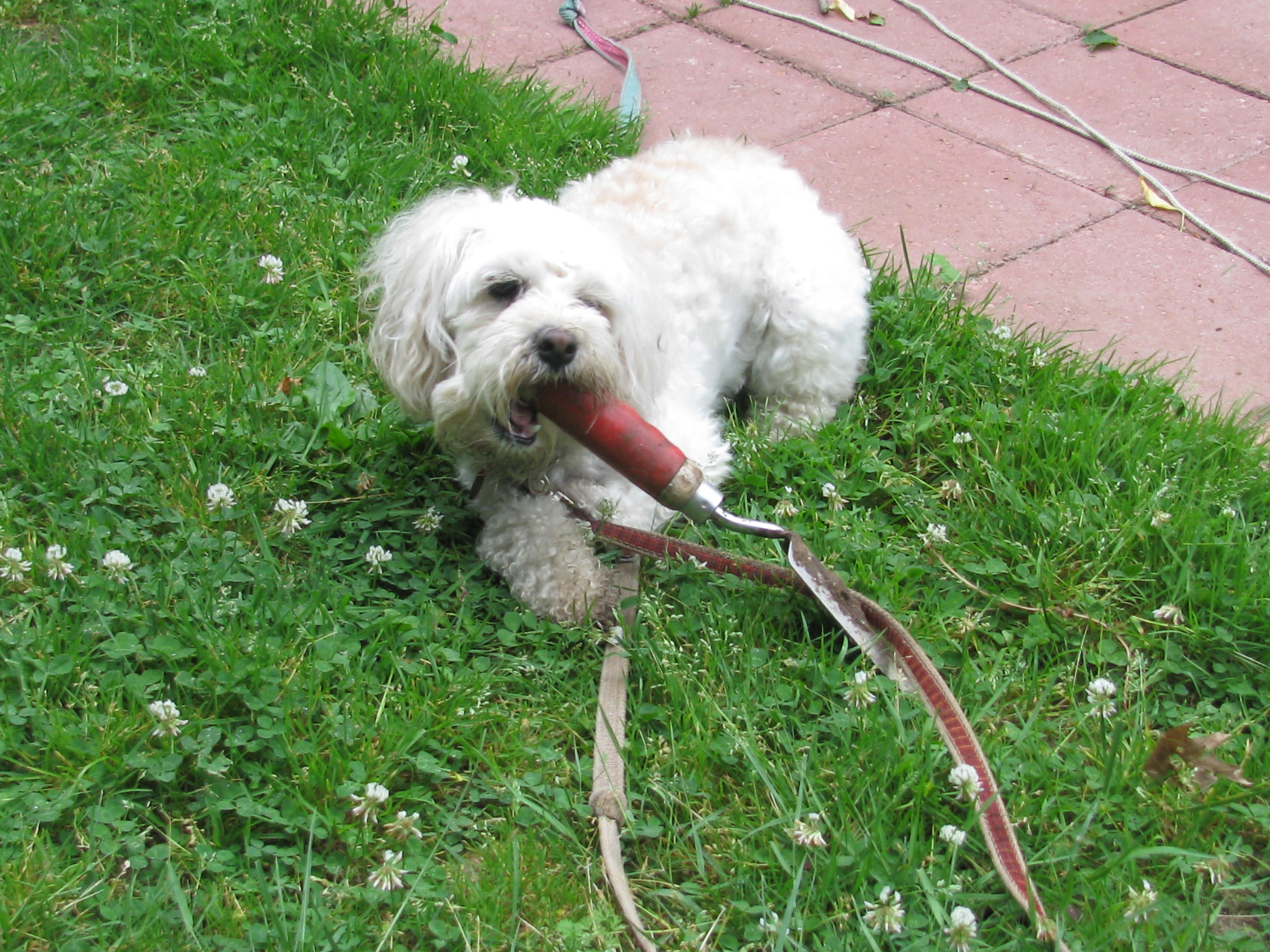
“It could be worse, Mommy. I could wake you up with my gardening toys.”

The fact is, the adrenaline that gets me through the day takes forever to leave my system, and until then I feel exhausted and hyper all at once, and constantly afraid that I won’t get my work done in time. I barely finish my school work for one week, when I’m already two days behind for the next week’s assignments. Unfortunately, working my fingers to the bone with typing, and note-taking, and revising, does not burn many calories. This is very disappointing.

I need a break. I want to read a novel. Heck, I want to write a novel. I want to bake, or go food shopping without a list. But there are all of these deadlines to meet, and expectations and obligations to live up to. I feel like someone has pushed me off a cliff, thinking I would fly, but all I can do is fall. And those crash landings really hurt.

Maybe what I need to do is to follow the dogs’ lead and cover my body with a coat of fluff, so at least the landings would be a little bit softer. That could work, or I could just cover myself with my cozy winter blanket and take a long nap with the puppies by my side, and hope that when I wake up, I’ll start to feel better.

img_0355

“Sleep well, Mommy.”

img_0482

Fingers and paws crossed.

A Study of Sleep


I had to do a sleep study for the new Pulmonologist. He did breathing tests, and x-rays, and walking-while-breathing tests, and inhaling-vile-stuff-while-breathing tests, and then he wanted a sleep study to see if sleep apnea was causing my exhaustion and shortness of breath. Each new doctor has his own set of tests you have to take, it’s their thing, and if you want them to take anything you say seriously, you have to jump through all of their hoops. I’d done a sleep study years ago that came out normal, but he wanted to check again.

I was really anxious that this new sleep study, which would be done at home, would be like the ambulatory EEG, which involved having a video camera pointed at me at all times, and wires glued to my head. But there was no video camera or glue this time, thank God. I had to wear monitors, but they were small and wrapped around my chest and abdomen with elastic, and a nasal cannula was stuffed into my nostrils, and there was a monitor on my wrist and middle finger to keep track of the oxygenation of my blood. It wasn’t especially humiliating, though neither of the dogs chose to sleep near me that night. I’m sure that was just a coincidence.

The results of the sleep study were, as I’d expected, normal. I do not have sleep apnea. The thing I don’t understand is, if you are going to study sleep to try to discover more about my overall health, why would you only focus on a limited area like sleep apnea? Isn’t there anything else about sleep that is worthy of attention?

I have always had trouble with sleep. Even as a kid, I would wander around, go to my Mom, visit the bathroom a few times, and then stare at the ceiling and count the circles in the asbestos tiles for hours. Every creak of the house made me worry about monsters under the bed. But even now, even when I get to sleep on time and wake up on time, I still don’t feel rested.

The dogs are champion sleepers. Cricket can pull a blanket off the couch and smush it into cozy nest for herself on the floor and take a short daytime nap any time she pleases. Butterfly will find one of the stuffed toys, anywhere Cricket has left it on the floor, and stretch out for nap right next to it. Cricket can stretch into all manner of unimagined yoga poses to vary her sleep style and keep it interesting.

003

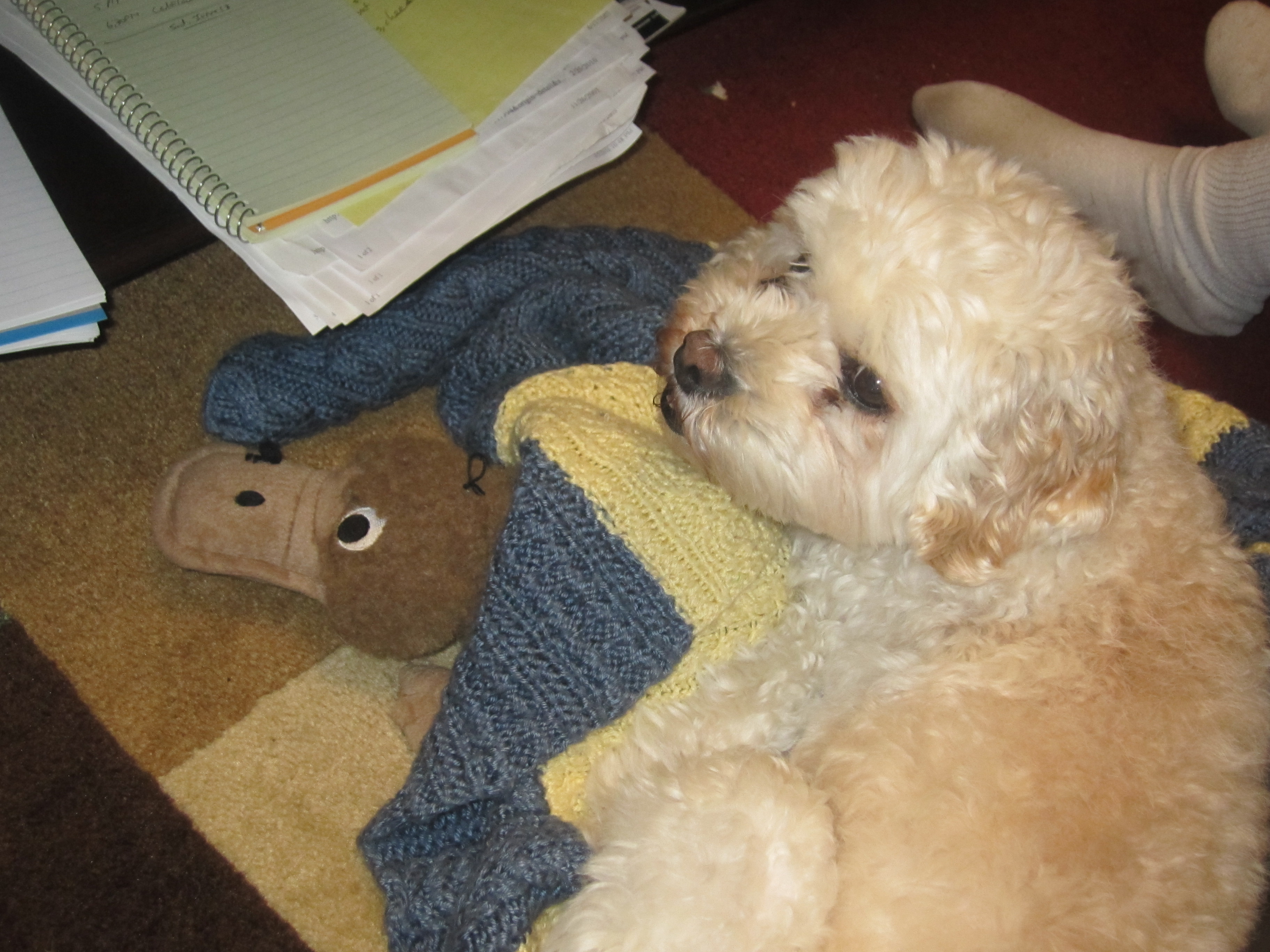
“Platypus needs this blanket more than you do, Mommy. “

020

Two toys are better than one.

In fact, the dogs change sleep positions very frequently. I think I do this too, except that I don’t have as much room for variation as they do. I’ll turn over, or kick my blankets away, or curl up, or stretch out, but they actually move from place to place and alter the whole landscape of sleep. I only sleep on my bed, but they can sleep on my bed, on the hard floor, on their pet beds, on carpets, on couches, under couches, chin on a shelf, or chin on my leg. But no matter how they sleep, or when or where they sleep, the dogs wake up raring to go, and ready to go outside and pee, and then ready to eat, and then ready to get back to sleep. They can wake up and fall asleep so quickly!

002

Platypus is a very accommodating sleep partner.

012

But so are my shoes.

008

Cricket can’t decide which bed to sleep on.

010

Or maybe she should sleep on the floor.

It seems like the sleep study should have looked at some of the practical issues of sleep. Maybe along with the heart rate monitors and oxygen concentrations monitors and such, they could have asked me questions, like, was I too hot or too cold? Did I wake up during the night? Did I have bad dreams, or nightmares? Did I feel rested in the morning? But they don’t want to know if I kick or turn a lot when I sleep, or if I’m in pain when I wake up. They don’t want to know about problems they don’t know how to solve. All they want to know is if my breathing is interrupted when I sleep, because they have a machine for that.

Maybe if each doctor took a more detailed interest, in each area of testing, they could have figured out something by now. But instead they choose the easiest thing, for them, and the hardest thing for me, and come up with nothing. I bet if Cricket could read medical journals, she’d have me fully diagnosed by now. She could use Butterfly to monitor my skin temperature, and flavor, overnight, and she herself could test my reflexes with her patented Jump-On-Mommy-While-She’s-Still-Sleeping test. Both dogs watch me very carefully, and I’m sure if they could write they’d fill many notebooks with all of their trenchant observations. And yet none of my doctors have asked for their input in making a diagnosis.

Phooey.

025

Diagnostic exam in process.

002

Cricket consults with Butterfly before delivering her diagnosis.