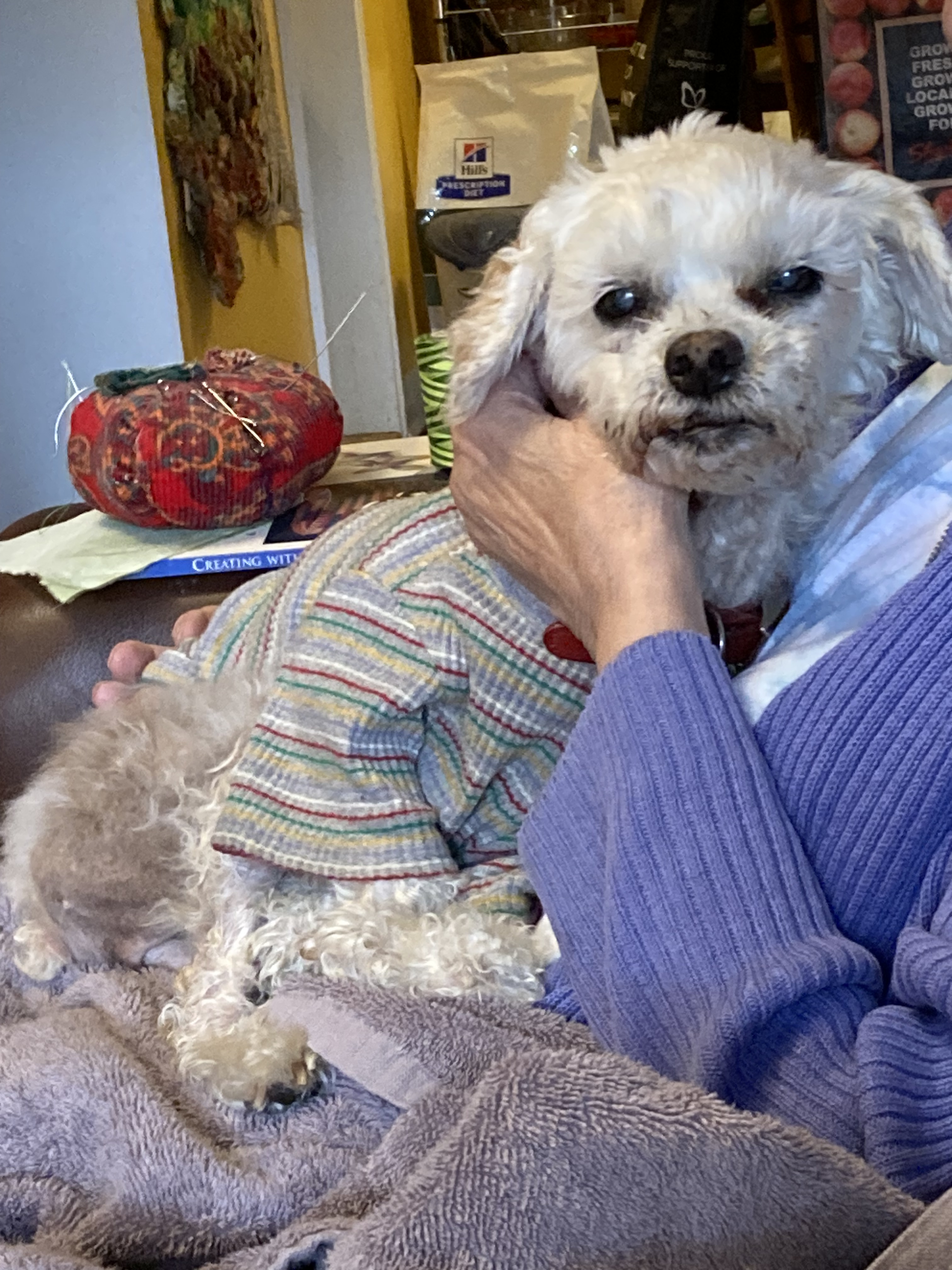
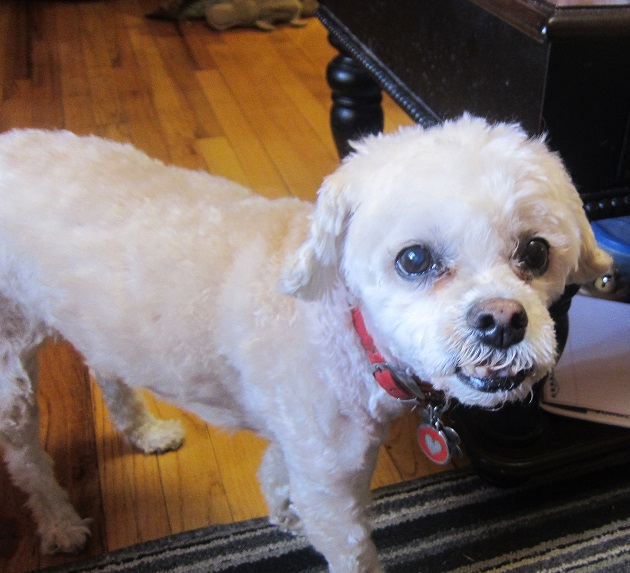
A few weeks ago I was afraid Cricket was on the edge of life, diagnosed with kidney disease, struggling to walk, knocking into things. We started giving her subcutaneous fluids on the off chance that it would help extend her life, and it’s actually working. Though in order to give her the fluids we have to medicate her with a combination of gabapentin and ACE, which makes her woozy for hours. At times, she seems like a wraith, her feet slipping out from under her, not even protesting when the needle slips under her skin.
Ideally, she would have gotten used to the whole procedure by now, and she wouldn’t try to pull off the muzzle, or lift up her head to get away from the needle. Ideally, I’d never have to give her any calming meds at all and she would just accept the fluids as a necessary evil and get it over with and get back to living her life. But then she wouldn’t be Cricket, and all of this effort is to make sure she gets to be Cricket for as long as possible.
“Oh, I can be even more Cricket-y. Just wait.”
Every day, at the beginning of all of this, I was afraid she was going to die overnight, and when she actually woke up in the morning, and ate her breakfast, I was surprised, and afraid to be hopeful. But with each day she seems to improve a little bit. The meds make her into a rag doll, yes, but then the next morning, after she’s slept it off, it’s like she’s been brought back to life, refilled with her fluids and her spirit, and ready to sniff the whole world again.
It’s still nerve-wracking to watch her skin fill up with the fluids. I even worry sometimes that her neck is going to explode (I’ve seen too many movies), and I worry that I’m going to put the needle in the wrong place and puncture something vital. I was worried for a while that I was inserting the needle the wrong way and causing scar tissue to form because I could feel these quarter-sized bumps under her skin and I was afraid I would run out of loose skin and not be able to give her the fluids anymore, but then the bumps started to dissolve, and that worry, at least, went away. So much of this is trial and error and the circumstances seem to change every day. It feels like a magic trick each time she wakes up in the morning and walks and barks and eats and acts like herself, but a magic trick that is unreliable and hard won.
I’ve been thinking about my friend Teddy, the miniature poodle, who died from kidney disease a few years ago. His death came as a surprise, at least to me. He hadn’t been diagnosed with the disease ahead of time, and by the time they caught it he was too far gone to be helped by fluids or anything else. When Cricket was diagnosed I was afraid it would be the same thing, and every day, even though I knew her case was different, I expected the same results.
Some days are better than others. Every once in while she has a bad night, her breathing is shallow, she pees on the floor because she can’t get to the wee wee pad in time, or she’s not up to climbing the stairs, but other days she seems to be getting better, growing stronger, and enjoying her life.
I was telling myself that I just needed Cricket to reach her sixteenth birthday, but now that she’s accomplished that goal, I need more. I need to feel like I did everything I could possibly do for her. I need to not have any regrets, and not feel like if only I had been stronger or smarter or kinder or more loving, she would have lived longer.
I’m also doing my best to make sure Ellie doesn’t feel left out, and gets extra hugs and scratchies and treats to make up for all of the attention her sister is getting. But when Cricket feels better she goes back to taunting Ellie, so then I feel guilty for taking such good care of Cricket and, at the same time, I feel guilty for not taking good enough care of her.
“If I keep my eyes closed she won’t bother me. Right?”
The thing is, Cricket isn’t giving up. She doesn’t think sixteen years is enough, even if each day is a little harder than it used to be. And if she’s going to be this stubborn, then I guess I’m going to have to be stubborn too.
If you haven’t had a chance yet, please check out my Young Adult novel, Yeshiva Girl, on Amazon. And if you feel called to write a review of the book, on Amazon, or anywhere else, I’d be honored.
Yeshiva Girl is about a Jewish teenager on Long Island, named Isabel, though her father calls her Jezebel. Her father has been accused of inappropriate sexual behavior with one of his students, which he denies, but Izzy implicitly believes it’s true. As a result of his problems, her father sends her to a co-ed Orthodox yeshiva for tenth grade, out of the blue, and Izzy and her mother can’t figure out how to prevent it. At Yeshiva, though, Izzy finds that religious people are much more complicated than she had expected. Some, like her father, may use religion as a place to hide, but others search for and find comfort, and community, and even enlightenment. The question is, what will Izzy find?
Cricket has kidney disease. She had a really bad day recently: she fell down the stairs when she was coming in from a walk, and had to be carried up and down the rest of the day. By the next morning, she was back to herself, climbing the stairs and eating her breakfast and barking at the UPS guy, but we took her to the vet anyway and he checked her out and took blood and the next morning he called to say it was her kidneys, but he’d need a pee sample to know if she also had an infection. I had to follow her around all day with a ladle, collecting a teaspoon of pee at a time and storing it in the fridge until we had enough to bring to the vet. Thank god, Mom didn’t take the picture she threatened to take of this particular activity. The results: no infection, but very watery pee, confirming kidney disease, so we’d have to go back to the vet and learn how to give her sub-cutaneous fluids once a day. With a very big needle.
“I hate needles!”
Cricket only weighs 9.5 pounds now, down from her original 14 pounds, and she looks like a naked chicken from the neck down, but she still has her rebellious spirit. So as soon as I knew I would have to put a needle under her skin every day, I started searching everywhere for her muzzle. We’d never actually used it before, but we had it somewhere, just in case, because she is a biter. I finally found the muzzle hidden behind her old harnesses and winter sweaters in the hall closet, and she let me put it on her, for a moment, before she started trying to pull it off.
At our next appointment, the vet demonstrated how to hang the fluid bag on the door, and hold Cricket still, and pull up the extra neck skin like a tent and insert the needle, and Cricket calmly let him do all of this. We watched her neck swell up like a balloon, which he said was totally normal, and then he removed the needle and pinched the skin so that the fluid wouldn’t spritz out. Then he showed me how to change out the old needle for a new one, easy peasy. By the time we got home, Cricket was feeling so good that she skipped down the lawn on her way to the front door.
My first attempt at giving her the fluids myself, the next morning, went almost as easily as when the vet did it, even with the big needle and the bite-prone Cricket, but on the second day, she rebelled. She bared her teeth at me, and pulled away from the needle, and then she bit me, three times. I tried again later in the day and managed to get the needle under her skin and a small ball of fluid in her neck, before she bit me again.
“You bit me first!”
On the morning of day three, we tried giving her food during the procedure, to keep her distracted, but she turned the bowl over and spread the food all over the floor and hopped over it to get away from the needle. So, in desperation, we gave her a quarter of a doggy valium, and waited. An hour later I was able to put the muzzle on her, and insert the needle under her skin, and give her the rest of the fluids she should have had the day before. The only problem was that we had no more doggy valium. So off to the vet we went to get more medication, and incidentally, to make sure it was okay for her to take it every day. It was, but even that small amount of ACE (the doggy Valium) made her stumble around and wiped her out for the rest of the day.
“It helps to have somewhere to put my head.”
A week after starting the fluids, we took her to the vet for another round of blood tests, to see if the fluids were helping, but when the doctor called the next morning, it turned out that her kidney numbers were worse. He told us to keep doing the fluids, with some added B vitamins, and he gave us Gabapentin to try instead of the ACE, to see if the combination would give her more good days. He had no prediction for how much time she has left. He just told us to keep an eye on her eating habits, and if she doesn’t eat for three days in a row then that would mean she’s suffering and it will be time to let her go.
We tried the gabapentin to no effect, so we went back to the ACE, but decided to give it, and then the fluids, at night, so that she could sleep it off and wake up feeling better, and that seems to be working better for her.
I don’t have high expectations, but I’d like for her to enjoy the end of her life as much as possible, and I’d really like to have a little more time.
“Where’s the rest of the chicken?”
If you haven’t had a chance yet, please check out my Young Adult novel, Yeshiva Girl, on Amazon. And if you feel called to write a review of the book, on Amazon, or anywhere else, I’d be honored.
Yeshiva Girl is about a Jewish teenager on Long Island, named Isabel, though her father calls her Jezebel. Her father has been accused of inappropriate sexual behavior with one of his students, which he denies, but Izzy implicitly believes it’s true. As a result of his problems, her father sends her to a co-ed Orthodox yeshiva for tenth grade, out of the blue, and Izzy and her mother can’t figure out how to prevent it. At Yeshiva, though, Izzy finds that religious people are much more complicated than she had expected. Some, like her father, may use religion as a place to hide, but others search for and find comfort, and community, and even enlightenment. The question is, what will Izzy find?
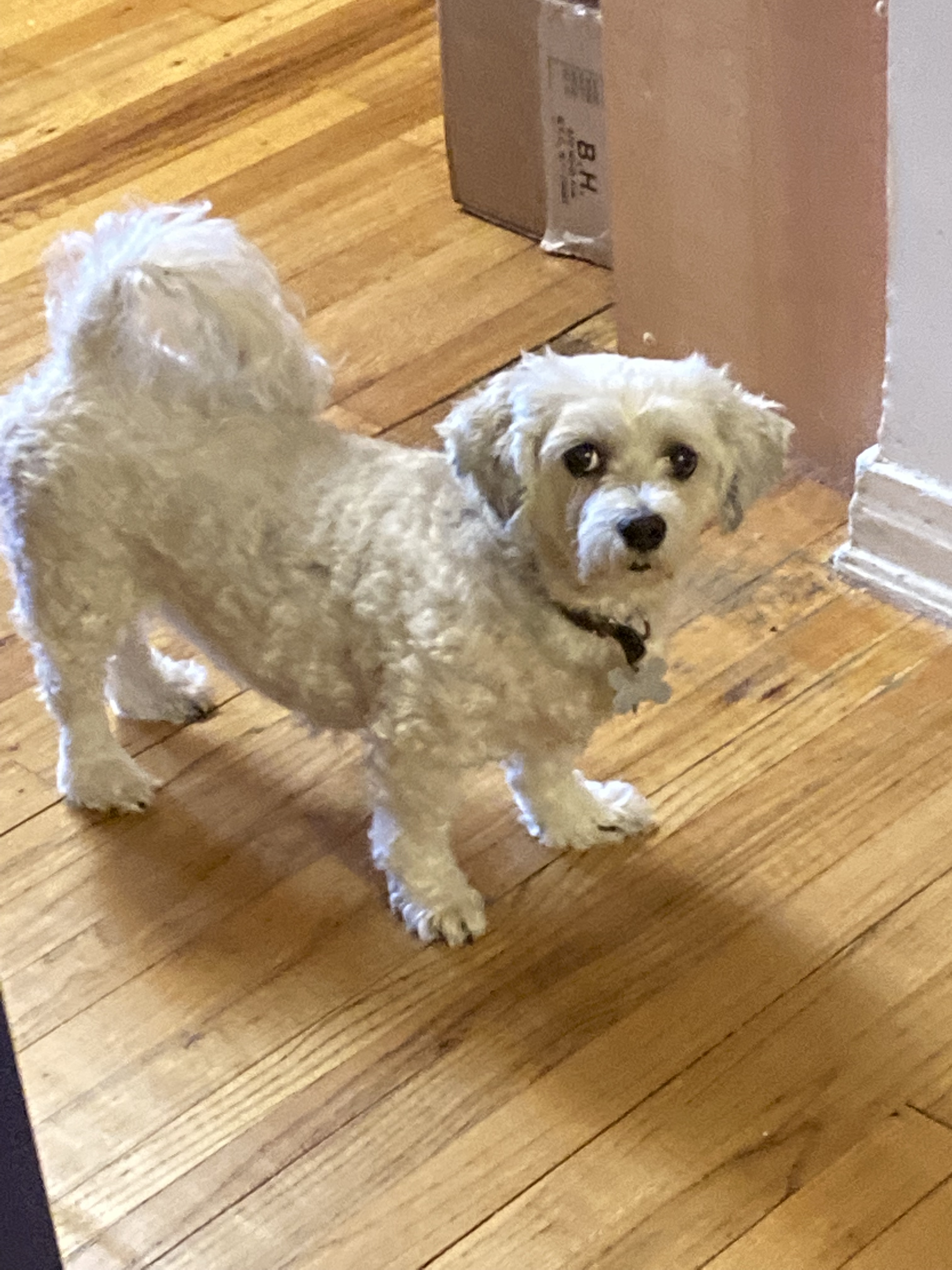
We were in a car accident a few weeks ago. I didn’t write about it at the time because Mom was shaken up and didn’t want her aunt to worry.
Mom has been losing feeling in her feet for a few years now, and going to all of the doctor visits to try to figure out why and how to stop it, but nothing has worked. It has mostly impacted her balance, because she can’t feel the ground as well through her shoes, so more often than not, when she takes the dogs out for a walk, she goes out in her socks or bare feet.
“We go outside barefoot all the time. What’s weird about that?”
For some reason, that evening, on our way to synagogue, she wore a pair of shoes she hadn’t worn in a while, and very early in the drive she realized her mistake, because she was having trouble feeling the brake pedal, but when I suggested that she pull over and let me drive, she said no, she was fine.
But she wasn’t fine, and at a crucial moment, when she thought she was stepping on the brake, it turned out that she wasn’t.
She could have had another career as a race car driver, so even without brakes Mom was able to maneuver through traffic to get to safety, with only minor damage to another car, but our little red Honda was basically totaled, not so much because the accident was terrible, but because the car had so many miles on it that the insurance company thought it wasn’t worth doing all the necessary repairs.
Mom was in a daze after the accident, overwhelmed that she’d been the cause of it and frightened that the numbness in her feet might take away her independence. But as the days passed she decided that it really was that one pair of shoes, and with thinner soles she could still feel the brake pedal and drive as well as before. At least for now.
We were both fine, physically, and to my surprise I really didn’t have much of a post-traumatic stress response like Mom did, so I did most of the driving, and emptied all of the gardening tools and grocery bags and random detritus out of the old car before the garage took it away. Thank God, Mom was up to making all of the phone calls with the garage and the insurance company and the rental car company.
“I hate phone calls.”
As soon as we found out that the insurance company didn’t want to repair the Honda, we started to look for a replacement, and since Mom has been wanting a car that’s easier to get in and out of for a while now, she had a good idea of what she wanted. We went to the nearby Subaru dealer and found a lightly used charcoal grey Subaru Crosstrek, which also has some safety features we didn’t have in the Honda. It’s a good car, and comfortable, and has lots of trunk space, and the driver’s seat can be maneuvered every which way, to give Mom the best possible control over the pedals and view of the road, but it’s not red.
And there’s this deep sense of loss. The little red Honda Civic has been part of our family for a long time, and I’m used to her. Switching to the rental car, a white KIA, with a push button start and rearview camera and lots of bells and whistles, took some adjustment, and the car didn’t smell like dogs and wet dirt from Mom’s gardening adventures, so it really was a stranger.
I’m pretty sure the trunk of the new car will be filled with gardening equipment within the first few days, and there will be dog treats stuck into the cushions, and it will start to smell right. And it will be a relief to know that Mom can keep her independence and feel, and be, safer. And the car only has 25,000 miles on it, so we’ll probably be able to keep it for a long time, until it too becomes like family. But the loss is real. Things are changing.
“We don’t like change, Mommy.”
If you haven’t had a chance yet, please check out my Young Adult novel, Yeshiva Girl, on Amazon. And if you feel called to write a review of the book, on Amazon, or anywhere else, I’d be honored.
Yeshiva Girl is about a Jewish teenager on Long Island, named Isabel, though her father calls her Jezebel. Her father has been accused of inappropriate sexual behavior with one of his students, which he denies, but Izzy implicitly believes it’s true. As a result of his problems, her father sends her to a co-ed Orthodox yeshiva for tenth grade, out of the blue, and Izzy and her mother can’t figure out how to prevent it. At Yeshiva, though, Izzy finds that religious people are much more complicated than she had expected. Some, like her father, may use religion as a place to hide, but others search for and find comfort, and community, and even enlightenment. The question is, what will Izzy find?

For a few weeks, recently, my mother was worried about me. Okay, she’s always worried about me, but more worried than usual, because my blood pressure was high. My blood pressure has been relatively high since December, but my primary care doctor wasn’t especially worried, so I ignored it. But then I went to the gastroenterologist, to finally see about my first colonoscopy, he said I’d need an okay from the cardiologist before he could move forward; so I went to the front desk and made an appointment with a cardiologist in the same office, where the wait is approximately an hour and a half and the doctor generally ignores whatever I say.
But while I was waiting for that appointment to arrive, my blood pressure (measured on a home blood pressure monitor), kept going up and up, especially the bottom number. And Mom said I couldn’t wait for my scheduled appointment and instead made me an appointment with her own cardiologist, for the next morning.
“I could ignore you without all the waiting!”
I got up early and grumbled as she drove me to the doctor’s office, and then I grumbled through the tech taking my blood pressure four times, twice on each arm, and then through an especially thorough EKG, and then there was an Echocardiogram in another room and blood tests in a lab down the hall. I was exhausted from the whole ordeal, but I had to go to work afterwards, so I grumbled as much as I could at home and then switched into teacher mode on the drive to the synagogue and tried not to grumble for the rest of the day.
“Unsuccessful, Mommy.”
The next day, after tests showed I didn’t have a blood clot or heart damage, the cardiologist prescribed a diuretic and told me to call my gynecologist to see if she could change or just stop my birth control pills (prescribed for Polycystic Ovarian Syndrome and painful periods), because they could be raising my blood pressure and adding to the risk of blood clots.
I started the diuretic the next day, and stopped taking the daily birth control pills, and after a week, my blood pressure was back to normal, but I was dizzier than usual, and in more pain and still dealing with all of the other long term issues no one has been able to explain (headaches and dizziness and exhaustion and muscle pain and intermittent walking problems and nausea and belly pain).
Then I had to go for more blood tests and an echo stress test (which is a beast of a combination, with a treadmill and a thousand wires and a torture device rammed into my rib cage at random intervals), and I was told that my Normetanephrine and Aldosterone numbers were off kilter, both related to the adrenal glands in some way, and a possible cause for the high blood pressure, and I’d need to see an Endocrinologist and a Nephrologist for further testing. No, wait, not an Endocrinologist but a Gastroenterologist, but not the Gastroenterologist doing the colonoscopy…oy. So I had to put off the colonoscopy, which means I’ll have to go for an extra consult closer to the colonoscopy or else the insurance won’t cover it, and then there’s the new Gastroenterologist, who is hopefully the right doctor and not a miscommunication, and then I may still have to go to a Nephrologist, and who knows how many tests and appointments will come from all of that, or if I even have an issue with my adrenal glands, or if it’s at all related to the rest of my symptoms or yet another tangent.
And, yes, I know I have to do all of it, of course. But I’m so tired, and I’m in more pain than I was before, and I still have to teach, and the weather is getting warmer, which makes everything worse, and… I clearly have a whole lot more grumping to do before this is over.
Harrumph.
“Harrumph.”
If you haven’t had a chance yet, please check out my Young Adult novel, Yeshiva Girl, on Amazon. And if you feel called to write a review of the book, on Amazon, or anywhere else, I’d be honored.
Yeshiva Girl is about a Jewish teenager on Long Island, named Isabel, though her father calls her Jezebel. Her father has been accused of inappropriate sexual behavior with one of his students, which he denies, but Izzy implicitly believes it’s true. As a result of his problems, her father sends her to a co-ed Orthodox yeshiva for tenth grade, out of the blue, and Izzy and her mother can’t figure out how to prevent it. At Yeshiva, though, Izzy finds that religious people are much more complicated than she had expected. Some, like her father, may use religion as a place to hide, but others search for and find comfort, and community, and even enlightenment. The question is, what will Izzy find?
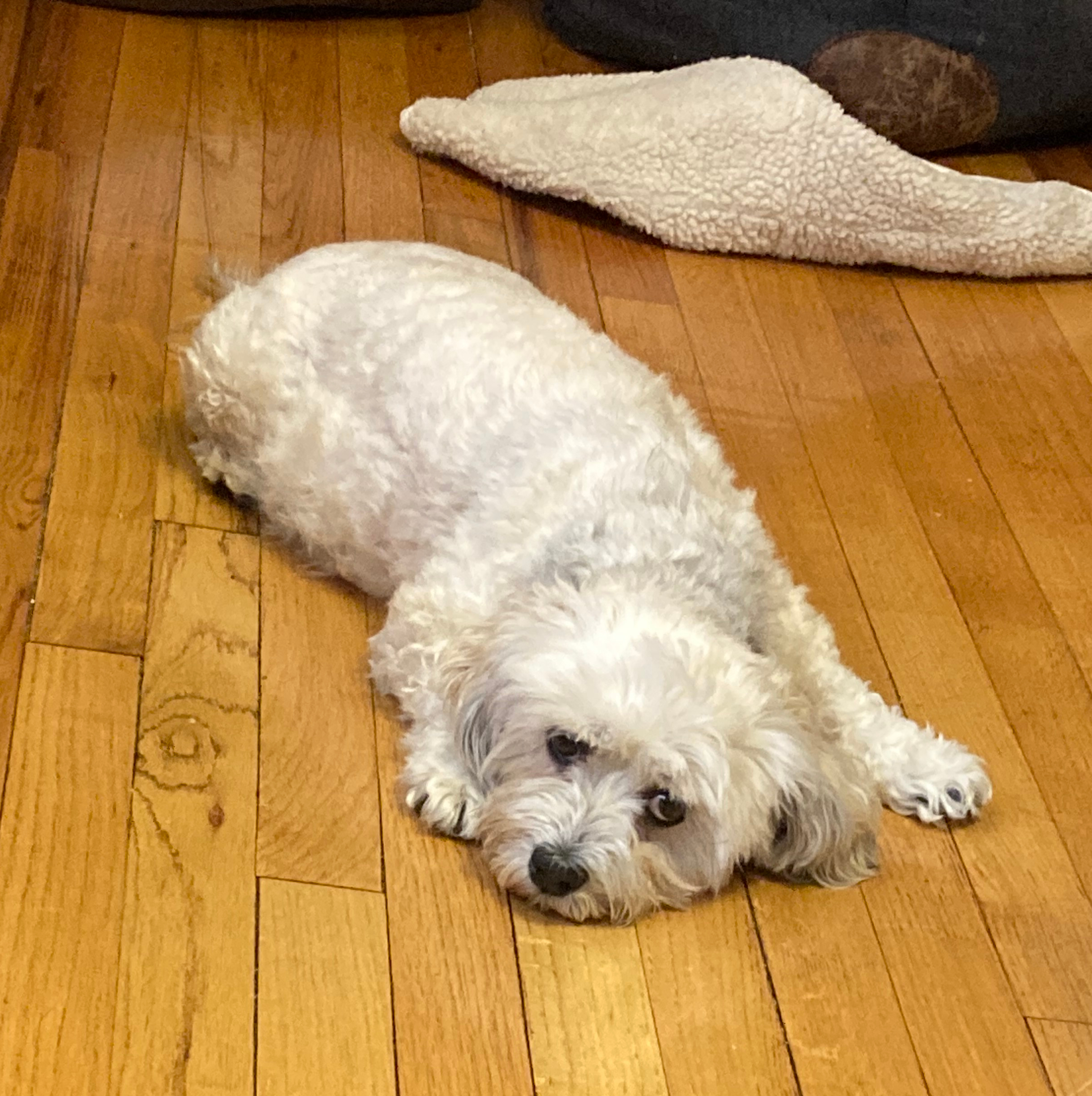
I’m trying to get back to exercising, in small bites. For months, each time I tried to get back on track after a particularly bad flare, I would return to my previous exercise routine: forty-five minutes on the recumbent bike, twenty minutes of physical therapy exercises for my neck and upper back, and ten minutes of yoga stretches. And then I’d be exhausted and wouldn’t even think of trying again for another week. And then, when I was recovering from oral surgery, and I knew I didn’t have the energy for any of those things, let alone all of them, I just stopped trying to exercise altogether. But that didn’t work for me either. I started to feel stiffness and pain returning to my neck and upper back in ways I’d thought I was done with, and, even more worrisome, I was often out of breath just from walking the dogs. It became especially obvious when I had to sing for hours at a time with the choir, during the High Holiday services at my synagogue, and I’d have to skip notes here and there just to breathe. I’d noticed the breathlessness months before, too, when I was still able to do my regular exercise routine three days a week, but at least back then I could tell myself that I was doing something to fix it.
“Breathe like me, Mommy!”
So, I started with breathing exercises, two minutes a day, to gradually build back my breath capacity for singing. And then I went looking for some short exercise videos on YouTube, and I found a bunch of five and ten minute Yoga videos and re-found a five minute Tai Chi series I’d done a few years ago, and started with those.
The problem is, I get obsessive. I ended up spending hours searching for more videos, and thinking I should try all of them, instead of just sticking with one or two. And then I got overwhelmed by all of the videos that came up on YouTube, promising weight loss/tightened facial muscles/removal of all anxiety/release of all trauma, in minutes. I’m so vulnerable to those promises, because I hate how long it takes to make progress, and I hate how circuitous the route to healing has to be, and I hate how confused I get, and I hate how easily I can get off track until I can’t even remember which track I was on or why. But after watching a bunch of those videos I felt even worse about myself, because they were telling me that the effort I’ve put into healing has been wasted, and I could have done it all in a matter of weeks if I’d just bought into this or that program from the beginning.
“Oh please.”
And then I was watching an hour-long Yoga video and berating myself for not even trying to do all of the exercises and the noise in my head became extreme, and mean, and persistent, and exhausting.
And the reality is, I can’t do all of those things. And there is no magic cure for trauma or chronic illness. But I can do five minutes of Tai Chi, or five minutes of standing Yoga, and two minutes of breathing exercises, or even four. And I’m doing those things. And if I keep it up, I will be able to do a little bit more and a little bit more. And that is always how it has worked for me, and I know that, even if I hate it. So it’s back to small bites, for me, and one step at a time.
Harrumph.
“We like BIG bites!“
If you haven’t had a chance yet, please check out my Young Adult novel, Yeshiva Girl, on Amazon. And if you feel called to write a review of the book, on Amazon, or anywhere else, I’d be honored.
Yeshiva Girl is about a Jewish teenager on Long Island, named Isabel, though her father calls her Jezebel. Her father has been accused of inappropriate sexual behavior with one of his students, which he denies, but Izzy implicitly believes it’s true. As a result of his problems, her father sends her to a co-ed Orthodox yeshiva for tenth grade, out of the blue, and Izzy and her mother can’t figure out how to prevent it. At Yeshiva, though, Izzy finds that religious people are much more complicated than she had expected. Some, like her father, may use religion as a place to hide, but others search for and find comfort, and community, and even enlightenment. The question is, what will Izzy find?
I had a doctor’s visit scheduled for this past week at a hospital in Philadelphia called CHOP, Children’s Hospital of Philadelphia, which is kind of embarrassing. All of the paperwork for my visit included references to “the child” this and “the child” that, and I am, of course, an adult. I worried that somehow they’d missed that detail in my medical history and when I walked into the hospital they’d be horrified that I was so tall. But, I was told that this was the place to go for a possible mitochondrial disorder, so this is where I’d have to go, no matter my age.
This particular adventure started back in March, when I heard from the geneticist that I had some genetic variations that needed to be looked into, and she gave me referrals to a neuromuscular specialist (to check out a possible LMNA disorder, in the Muscular Dystrophy family), and to CHOP (for a possible Mitochondrial disorder). The appointment with the Neuromuscular specialist was easy to schedule, but the process of getting an appointment at CHOP took at least a month, because they had to collect all of my records from various doctors and hospitals to see if they really wanted to take on my case, and, of course, they needed pre-approval from my insurance. Eventually, they sent me a welcome letter telling me that I’d have two appointments on a Wednesday in July, one at nine in the morning with the lab, and one at ten thirty to see the head of the Mitochondrial medicine department. The idea of going to Philadelphia for a doctor’s appointment, a three hour trip each way, was already overwhelming, but to have to be there at nine in the morning?
“Don’t worry, Mommy. I can wake you up in the middle of the night if necessary.”
Mom said we could go the day before and stay over at a hotel to make things easier, but it sounded so expensive and complicated to me (Do we bring the dogs? Would Cricket actually stay calm in the hotel room while we were at the hospital? Could Cricket survive being boarded, even with her sister for company? Would we drive or take a train?), but Mom was confident that it would all work out; and it was still only April at that point, so the specific plans could wait.
And then Mom went to the orthopedist and found out that she needed a hip replacement, immediately, and we fell into the whirlwind of pre-op testing and surgery and recovery. Even then, Mom was still convinced that she’d be well enough to make the trip to Philadelphia, so we focused on getting her well and continued to put off planning the trip.
My appointment with the neuromuscular specialist, about forty-five minutes away, came up a few weeks ago, the week after Mom’s post-surgical check up with the orthopedist (which went great!), so Mom wanted to test her strength and come with me. I drove, and held doors, and watched Mom maneuvering her cane like an oar, and Mom listened carefully to the doctor to make sure I didn’t miss anything important. The doctor was very thorough, and thoughtful, and put me through a lot of physical exercises and questions and said, eh, I don’t think you have an LMNA disorder (no muscle-wasting, no falling eyelids, and no to a lot of other things on her list), but she was optimistic about my upcoming trip to CHOP, and said she thought a Mitochondrial disorder could be a better fit for my symptoms.
I was proud of myself for managing the drive and the doctor visit, and for not being too bothered that yet another doctor and diagnosis had fallen through, but Mom was exhausted by the trip, and by the next day she’d realized, very reluctantly, that she wouldn’t be able to come with me to Philadelphia, even if we did the whole thing by train and boarded the dogs for two days. So I would be making the trip alone.
“Why can’t I go on the train with you?”
I know it shouldn’t be such a big deal for an adult to travel to another state alone, but for me it’s a lot; both because of the inevitable physical exhaustion of the trip and because of the anxiety that floods my brain when I try to manage new situations. So Mom called CHOP for help finding a nearby hotel, and to find out how long my appointments would be so that we could plan the trip home. She made the reservation for me and printed out maps and looked into transportation options for getting from the hotel to the hospital and from the hospital back to the train station. And then we heard from the doctor’s office that, actually, I didn’t have to be at the hospital early, because they wouldn’t know which tests I’d need ahead of time. My only appointment would be at 10:30 AM with the doctor, so we re-planned the trip for a single day, starting at 5:30 in the morning, and cancelled the hotel reservation.
I ordered the Amtrak tickets and studied the schedule for the Long Island Railroad, and wrote up a packing list, and put all of my papers together in one folder. I was still worried that I’d miss something the doctor said, or miss a train, or just get lost wandering through a strange city, but even more than that, I was afraid that nothing would come of this doctor visit, like all the others, and the resulting hopelessness, on top of the exhaustion of the trip, would wipe me out. But I was determined to go anyway.
And then, the Monday afternoon before my Wednesday appointment in Philadelphia, I got a call from the hospital saying that the original doctor had to cancel, but the replacement doctor could do a virtual appointment that same morning. A virtual appointment? As in, I wouldn’t have to go to Philadelphia at all?!
“Yay!”
The woman I spoke to on the phone couldn’t explain why I was suddenly allowed to have a virtual appointment, when they’d told me two or three months earlier that it would be impossible, but I agreed to the change immediately. I couldn’t think it all through at that moment, though, because I had an appointment with the oral surgeon in an hour.
But after I got back from the oral surgeon, with thoughts of general anesthesia and swelling and bruising and 3D printed teeth swirling in my head, I started to worry that maybe CHOP had changed my appointment to a virtual one because they’d decided that I didn’t have a mitochondrial disorder, and therefore there was no point in seeing me in person.
I spent the next day canceling train tickets and looking into possible refunds (nada) and starting to finally feel the relief at not having to get on four, or was it five, or six, different trains in one day. And then I got the email with the link to my virtual doctor visit and did all of the pre-visit check-ins and I finally realized that Mom would be able to be there for my appointment after all, and so would Cricket and Ellie, and a lot of the anxiety that had built up over months finally started to dissipate.
At 9:30 Wednesday morning, I logged on, with Mom and Ellie sitting next to me and Cricket grumbling from her bed on the floor. First, I met the program director, and she was very nice and took some more family history and explained my genetic test results in more detail, saying that I had a rare mutation, as in, no one else in the database had the same mutation on that particular gene (though the database is far from complete). And then she told me about the tests they wanted to do (which I could do at home and send in), and she asked Mom if she’d be willing to get tested as well, to give them a more detailed sense of my genetic background. And then the doctor joined the visit. He did an abbreviated physical through the screen (look left and right, turn your head left and right, show your hands, back and front, and walk to and from the computer), and then he told me that it’s unlikely that I have a mitochondrial disorder, though an LMNA disorder would be an interesting possibility. But do the tests anyway, just in case.
I wasn’t surprised, though Mom and my therapist were both surprised and disappointed, having spent months telling me that this would finally be the breakthrough. For me, it was just one more doctor visit that ended with a ho hum instead of an answer, but at least I got to stay at home, in the air-conditioning, with Mom and the dogs. And it saved Cricket the trouble of having to spend the whole day worrying that I’d been captured by space aliens or enslaved by fire-breathing dragons, or whatever it is she worries about when her people are away. We were also able to celebrate her fifteenth birthday as a family and watch her eat all of her birthday hamburgers until she was well and truly satisfied (don’t worry, Ellie didn’t go hungry either).
Cricket and Ellie are my shining reminders that life can always get better, even when your body isn’t working the way you want it to, or your hair is something of a mess. They know that life will always be full of things that are worth looking forward to. Though not always hamburgers in particular.
“Why not?”
If you haven’t had a chance yet, please check out my Young Adult novel, Yeshiva Girl, on Amazon. And if you feel called to write a review of the book, on Amazon, or anywhere else, I’d be honored.
Yeshiva Girl is about a Jewish teenager on Long Island, named Isabel, though her father calls her Jezebel. Her father has been accused of inappropriate sexual behavior with one of his students, which he denies, but Izzy implicitly believes it’s true. As a result of his problems, her father sends her to a co-ed Orthodox yeshiva for tenth grade, out of the blue, and Izzy and her mother can’t figure out how to prevent it. At Yeshiva, though, Izzy finds that religious people are much more complicated than she had expected. Some, like her father, may use religion as a place to hide, but others search for and find comfort, and community, and even enlightenment. The question is, what will Izzy find?
Sometime in the midst of prepping for Mom’s hip surgery, Duolingo announced that I was in the running for the semifinals, of something. I spend some time every day on Duolingo, practicing my Hebrew and French, learning Spanish or German or Yiddish. I’m sure that part of my language learning adventure has been about wanting to feel smart and impressive, but first and foremost I’m fascinated by what languages can teach us about who we are and how we understand ourselves. I don’t practice each language every day, some days I do a little of a few different languages, some days I do a deep dive into one of the languages, sometimes I just do enough to keep my streak alive for another day.
But then there was this tournament. It wasn’t hard to get into the semifinals: I just had to do the same number of lessons I usually do every day. And even getting into the finals didn’t take much extra effort. But once I was in the finals I started to feel pressure to spend hours each day earning points, by studying old lessons and learning new ones. By then, Mom was home from the hospital, and struggling. I was basically on call 24/7 to make sure she took the right medications, at the right times, and had enough to drink and food, if she could stand to eat, and I was also taking care of the dogs and the apartment and the laundry and the shopping.
“But we’re so easy!”
And, at first, the extra time spent on Duolingo was a relief, a chance to think about something other than life and death and pain and all of the ways I was failing my mom, and all of the ways I was failing in life overall. I won eighty points with one lesson – I must be a genius!!! But as the week of the finals went on, and the pressure grew, I was on my cellphone so much that it kept running out of power. I usually don’t notice how much battery is left on my phone, I just put it on its charger when I go to sleep and it takes care of itself, but now it needed to be charged multiple times a day. I was doing Yiddish lessons in between trips to the laundry room, and Spanish lessons while the tea was steeping, and French and German when I had free time and would normally be trying to write, or read. Every time I saw my name fall down to, say, twentieth place, when only the top fifteen would win, I felt like a failure. I had to push harder, do more, and win! I didn’t even know what I might win if I made it into the top fifteen, but it said that the top fifteen would be winners and I wanted to be a winner!
“I’m already a winner.”
The dogs handled the early days of Mom’s recovery really well, thank God. Ellie was her usual sweet self, sleeping on the floor of Mom’s room, sending good vibes throughout the day and night, and knowing to come to me for food or trips and let Mom rest. Even Cricket did better than I had expected. She (mostly) listened when she was told to stay off Mom’s lap, or away from her feet when she was walking slowly down the hall. There was one bad night, though, when she didn’t listen. I found out in the morning that, using her good leg, Mom had kicked Cricket off the bed, and Cricket flew across the room, losing her tags halfway across the floor (I reattached the tags the next morning, pressing extra hard with the plyers so that at least if she went flying again she’d still have her identification on her).
“Harrumph.”
By the weekend of the Duolingo finals, Mom was starting to feel better, not needing me to be on call as much, and my obsession with my placement in the Duolingo rankings became constant. By midday, Sunday, I was in 16th place, one spot away from the winner’s circle, but the whole thing was becoming tedious and I was starting to hate learning languages, which is not like me at all. The only time I could get any perspective was when my phone ran out of power and I was forced to take a break while it was on its charger. I was still able to walk the dogs, and clean, and cook, and make tea when necessary, so there were a few minutes here and there when I wasn’t on my phone, trying desperately to keep up, but not many.
By early evening I had made it into thirteenth place and I thought it was safe to take a break to make dinner, and eat dinner, since the competition would be ending at 11 PM. But when I looked at the rankings again, an hour later, I was back down in sixteenth place. I sat with Mom in the living room, supposedly watching TV, but really trying to earn enough points to get back into the winner’s circle. It was about 10:40 PM and I was still about one hundred points from fifteenth place – winner! – when the battery ran out and my phone shut off. I had seen the warnings that I was low on power, twenty percent left, ten percent left, but I was too busy to stop and charge it, and I was sure I had enough to make it through the end of the tournament, and I was wrong.
At 10:40 PM, I knew that even if my phone charged quickly, I’d still be too far behind to make up the points by 11. Each point I earned would be matched, at least, by the guy in fifteenth place, and he would always be at least a hundred points ahead of me. I wasn’t sure if the people ahead of me in the rankings had more free time, more competitive spirit, better strategy, or if they just had Duolingo Plus, the paid version, which makes it much easier to earn a lot of points at once, but I knew I was out.
So, I finally let go. I put my phone on its charger, and took the dogs out for their last walk of the day, and brushed my teeth, and tried to accept defeat. Some small part of me felt guilty for giving up, telling me I could have switched over to the Duolingo site on my computer and at least tried to earn the last one hundred, two hundred, three hundred points, however unlikely success might be. But I didn’t do that. I just made my overnight oats for breakfast, took my evening meds, and watched the clock as the last few minutes ran out on the Duolingo tournament.
I was already planning this essay by then – because the extremeness of my behavior around this meaningless tournament worried and intrigued me. I could stand back, finally, and wonder if I was specifically vulnerable to this obsession because of the helplessness of watching Mom struggle to recover from her surgery. Or if maybe there’s something in my brain in general that can’t tell the difference between what’s important and what isn’t important, and I truly believed that winning this tournament could change my life in some significant way.
Mom had a much better way of distracting herself. For Mother’s Day, before the surgery, when I was searching through Amazon for something Mom might like, I found a butterfly kit. I’d never heard of such a thing, but Mom loved the idea, and then spent half a day looking for the right one (not the one I’d found), and it arrived a few days before the surgery. She set it up in her room, and read diligently through the instructions for how to take care of the caterpillars, and their habitat. Luckily, there wasn’t anything I needed to do for them while Mom was in the hospital, because I was too busy cooking and cleaning and freaking out, to have made sense of more instructions.
And when Mom came home and was dealing with all of the pain and discomfort of recovery, she watched the caterpillars creating their chrysalises, and she fed them and cared for them, and when the butterflies started to emerge, Mom was starting to feel better, and by the time Mom was ready to start walking outside with the physical therapist, it was time to hang the butterfly habitat outside on a tree, and open the zipper, and let the new butterflies find their way out into the world.
The metaphor of the whole thing really resonated, for both of us (though Mom was disappointed that the butterflies flew away so quickly after their transformation). The presence of these creatures, transforming in her room, gave her something hopeful to look at every day. Even if she never intended the butterflies to be such a clear metaphor, some unconscious part of her brain knew what she would need and sought it out.
And, for whatever reason, my mind sought out the Sisyphean task of trying to win a Duolingo tournament I could never win.
There was such relief when the tournament was finally over, even though I’d ended up right outside of the winner’s circle in sixteenth place. I was able to look away from my phone again and realize that Mom really was feeling better, and moving better, and ready to make her own tea again, the way she actually liked it. And I was finally able to go back to my other obsession: watching endless episodes of Murder, She Wrote, and basking in Jessica Fletcher’s ability to decipher clues and solve murders and believe in herself despite constant criticism. In a way, Jessica Fletcher is the butterfly version of my caterpillar self, and watching her gives me hope that someday I might come out of my chrysalis and really be able to fly.
At the same time, Cricket started to realize that her Grandma wasn’t in as much danger anymore, and decided to resume her regular habits: including her insistence on sitting on her Grandma’s lap and barking her demands as persistently and loudly as possible. She made it clear, in her own way, that there was more to life than winning a Duolingo tournament, or even watching episodes of Murder, She Wrote, and it would require me to get up and take her and her sister outside to look for the butterflies.
If you haven’t had a chance yet, please check out my Young Adult novel, Yeshiva Girl, on Amazon. And if you feel called to write a review of the book, on Amazon, or anywhere else, I’d be honored.
Yeshiva Girl is about a Jewish teenager on Long Island, named Isabel, though her father calls her Jezebel. Her father has been accused of inappropriate sexual behavior with one of his students, which he denies, but Izzy implicitly believes it’s true. As a result of his problems, her father sends her to a co-ed Orthodox yeshiva for tenth grade, out of the blue, and Izzy and her mother can’t figure out how to prevent it. At Yeshiva, though, Izzy finds that religious people are much more complicated than she had expected. Some, like her father, may use religion as a place to hide, but others search for and find comfort, and community, and even enlightenment. The question is, what will Izzy find?
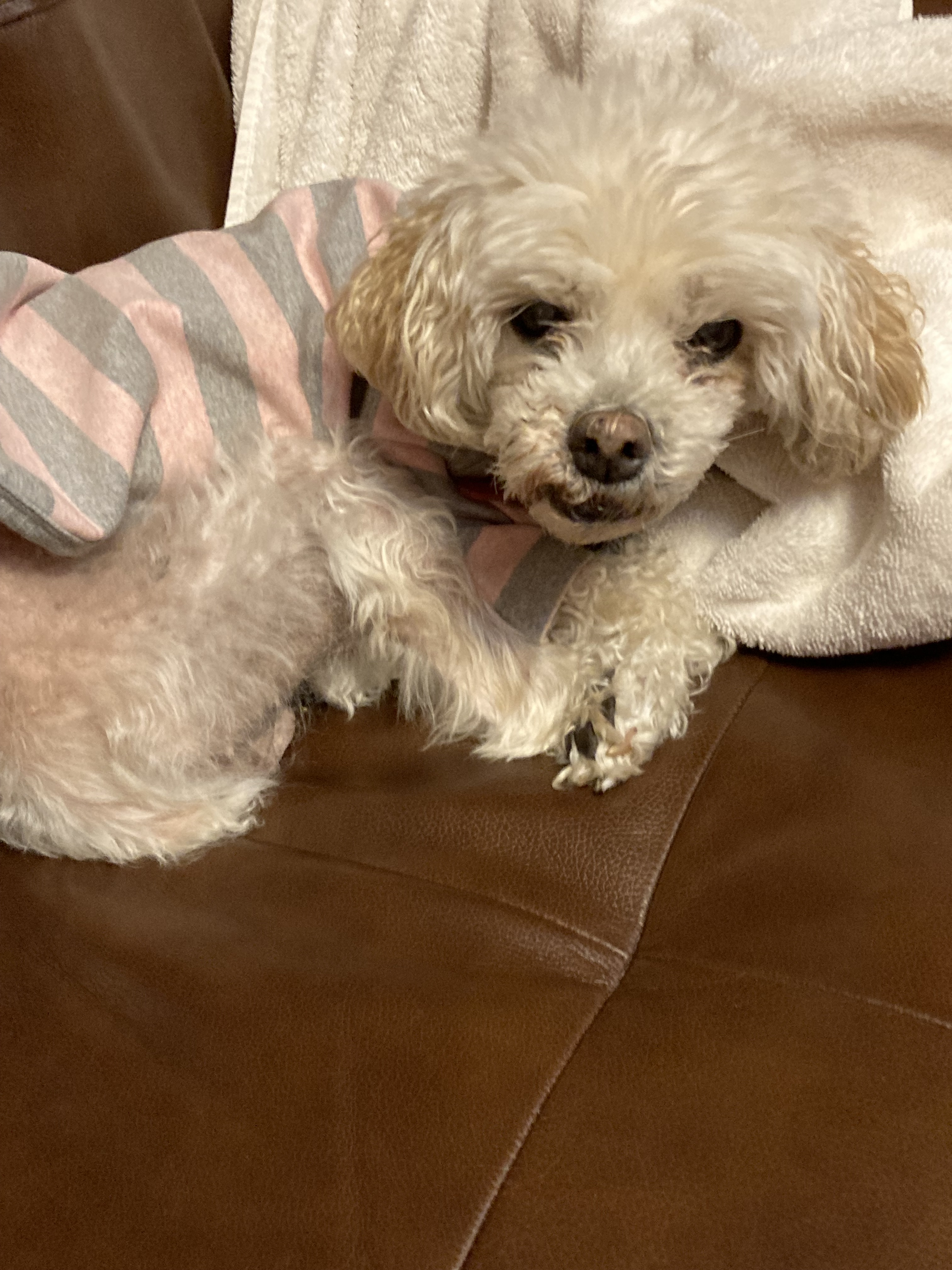
About a year ago I had to go to a Gastroenterologist, both because I was experiencing belly pain and nausea (still am) and because my Cardiologist was impatient for me to schedule my first colonoscopy. The gastro took my concerns seriously and when he saw a note in my chart from a Rheumatologist saying that I have a clinical diagnosis of Ehler’s Danlos (a connective tissue disorder), he referred me to a geneticist to see what type of Ehler’s Danlos I have, because certain types can make a colonoscopy dangerous, and he didn’t want to take any unnecessary risks.
It took a while to get an appointment with the geneticist, and then it took a while for the first set of results to come back, which were inconclusive, and then it took a lot longer for a more comprehensive set of tests to be performed.
“That sounds exhausting.”
I finally heard from the geneticist in March, and she said that there were a few genetic mutations (see, I AM a mutant!). Most of my genetic test results came back as “variant of uncertain significance,” because they’ve recognized mutations on certain genes (related to Connective Tissue disorders and mitochondrial disorders, in my case) but are not yet sure what those mutations signify. There was also a “likely pathogenic variant” on the LMNA gene, something I’d never heard of and had to google extensively. The geneticist referred me to a neuromuscular specialist to look into a possible LMNA-related disorder, and sent me for more tests see if I might have a mitochondrial disorder, based on the variants of uncertain significance, and it turned out that there was something there, so she also referred me to a hospital that specializes in mitochondrial disorders.
I am not used to doctors taking me seriously, or even taking my test results seriously, so I haven’t quite taken in the idea that there might be a name for what I have, and doctors who are willing to try and treat it. I’m still worried that this will be another dead end and I’ll be back on the doctor roller coaster by the fall, with no validation and no treatments to show for it.
The LMNA thing is still mostly a mystery to me (my brother, the doctor, had never heard of it), but the research I’ve read says that pathogenic variants on the LMNA gene can cause diseases like: muscular dystrophies, dilated cardiomyopathy, premature aging disorders, and a bunch of other diseases I’ve never heard of. There could be a connection between the LMNA variant I have and the scoliosis that runs in my family (on my mother’s side). There could also be a connection between some of my muscle weakness and walking problems and heart murmur and all of this, but the research I was able to find was mostly about much more serious disorders related to the LMNA gene variants and didn’t sound, overall, like what I’ve been experiencing all these years.
My research on mitochondrial disorders came a lot closer to fitting my situation, though, with a list of possible symptoms like: exercise intolerance, muscle weakness, shortness of breath, and severe exhaustion. Type 2 Diabetes can also be a symptom of a mitochondrial disorder, and that runs on my father’s side of the family, and has always been a concern for me.
Mitochondrial disorders cause cells to have trouble metabolizing proteins, so the body doesn’t get adequate oxygen or energy, and instead produces lactic acid and other organic acids that can be toxic to the body. If I do have this, I have a mild version (compared to children who show signs in infancy), which would explain why it’s been hard to diagnose.
The hospital that specializes in mitochondrial disorders has already requested a lot of my previous medical records, including MRI’s and spinal tap results. I’m not sure what else they will need in order to determine a diagnosis, but the articles I’ve read have mentioned muscle biopsies as likely next steps, and they may also want me to redo scans, or even, god forbid, redo the spinal tap which sent me to the hospital last time around.
Miss Butterfly held my sock ransom until I came home
It makes sense that mitochondrial disorders are hard to diagnose, because symptoms can range from mild to severe, involve one or more organs, and can occur at any age. Symptoms can include: poor growth; muscle weakness or pain, low muscle tone, and exercise intolerance; vision or hearing problems; learning disabilities or developmental disabilities; autism spectrum disorder; heart, liver or kidney disease; gastrointestinal disorders, swallowing difficulties, diarrhea or constipation, vomiting, cramping or reflux; diabetes; increased risk of infection; neurological problems (seizures, migraines, strokes); movement disorders; thyroid problems; respiratory problems; lactic acidosis; and dementia.
There’s also no known cure for these disorders, just experimental treatments to help reduce symptoms, including vitamins and supplements like: Coenzyme Q10, B complex vitamins, Alphalipoic acid, L-carnitine, Creatine, L-arginine; and exercise, rest and physical therapy. They also say to avoid alcohol (check), cigarettes (check), extreme temperatures (I try), lack of sleep (hmm), Stress (hmm) and MSG (which could explain why I have developed a bad reaction to the Chinese food I used to love.)
“I’ll eat your Chinese food for you.”
So it looks like I will be spending the summer being examined again, with who knows what potential results. The geneticist also made sure to give me an appointment for next year, in case none of these diagnoses pan out. She said that the genetics field is discovering new things every day, with more sensitive tests coming soon, and more research on how gene mutations influence different diseases. So I will probably see her once a year until they are able to figure out what’s going on with me and how to treat it.
Wish me luck!
“Good luck, Mommy!”
If you haven’t had a chance yet, please check out my Young Adult novel, Yeshiva Girl, on Amazon. And if you feel called to write a review of the book, on Amazon, or anywhere else, I’d be honored.
Yeshiva Girl is about a Jewish teenager on Long Island, named Isabel, though her father calls her Jezebel. Her father has been accused of inappropriate sexual behavior with one of his students, which he denies, but Izzy implicitly believes it’s true. As a result of his problems, her father sends her to a co-ed Orthodox yeshiva for tenth grade, out of the blue, and Izzy and her mother can’t figure out how to prevent it. At Yeshiva, though, Izzy finds that religious people are much more complicated than she had expected. Some, like her father, may use religion as a place to hide, but others search for and find comfort, and community, and even enlightenment. The question is, what will Izzy find?
The most recent embarrassing symptom of my autoimmune/connective tissue/who-knows-what disorder was a wound on my lip that refused to heal. Actually two. The first one was on the right side of my lower lip and lasted at least three weeks, and as soon as it healed another one opened up on the left side. I can’t even explain the frustration I felt when, after less than a day with actual normal skin, a new wound opened up.
“You looked really weird, Mommy.”
This would have been fine, though, if every time I was in the view of other human beings I was wearing a face mask, but I teach online once a week, and take a Hebrew class online twice a week, and I was supposed to record another choir video, so it was been an exercise in holding my head at funny angles, rejiggering the lights, and trying not to feel embarrassed when my still bleeding lip, or any of the many different scabbing stages, were visible. Only one of my students mentioned it, and I’m assuming that everyone else was either being polite or not actually paying attention to me (which is more likely).
“Were you saying something?”
The oral pathologist said the lip wounds were probably caused by a combination of the Lichen Planus (an autoimmune disease that impacts the inside of my mouth and also my lower lip for some reason), and the way the face masks keep moisture in, and the steroid gel I have to use to control the Lichen Planus (which barely works, but successfully thins my skin). He wasn’t concerned, though. He was also unconcerned that there was an ulceration on the side of my tongue, and raw red skin on the inside of each cheek, and gum irritation that will lead to more and more problems in the future (his nurse joked that I should save my money for all of the dental work I will need – Ha ha! So funny!), all of which has made eating a painful experience for quite a while now. But other than that, sure, no big deal.
The thing is, if I could just be sanguine about my symptoms and accept them as a passing experience, maybe I’d be okay. But instead, I end up feeling like these symptoms are proof that I am a disgusting and unlovable creature. I feel like a throwback to biblical times, when Miriam (the sister of Moses and Aaron) was punished with a skin disease for being a gossip. I’ve been putting off teaching my synagogue school students about Tzara’at – the skin disease Miriam, and others, were supposedly punished with for their “bad speech,” because I really don’t want to risk them thinking this lip thing is going to happen to them too. And, really, I don’t want to risk convincing myself that there’s something to that argument. I mean, if gossip caused skin disease none of us would have any skin left!
“What?!”
As soon as my lip healed – mostly – I rushed to do my choir recordings before a new wound could open up, and I made it with one day to spare before the deadline (I really did not want to explain why I would need more time). And instead of worrying about my lip, I was able to worry about the glare on my glasses, and the break in my voice when I had to move from the lower notes to the higher notes, and the flyaway hairs escaping from all sides of my ponytail, etc., which was a relief.
I don’t know what my next weird symptom might be, because it’s generally unpredictable, and I’m not so evolved as a human being that I can be blasé about symptoms that impact how I look. But for now, I’m going to make the most of the feeling of freedom that comes from being able to turn my head from side to side while I’m on screen, and eat salty food without fear of excruciating pain, and knowing that if I fall into the depths of despair in the next few days it will be about something other than how I look on Zoom.
“I think I look pretty good.”
If you haven’t had a chance yet, please check out my Young Adult novel, Yeshiva Girl, on Amazon. And if you feel called to write a review of the book, on Amazon, or anywhere else, I’d be honored.
Yeshiva Girl is about a Jewish teenager on Long Island, named Isabel, though her father calls her Jezebel. Her father has been accused of inappropriate sexual behavior with one of his students, which he denies, but Izzy implicitly believes it’s true. As a result of his problems, her father sends her to a co-ed Orthodox yeshiva for tenth grade, out of the blue, and Izzy and her mother can’t figure out how to prevent it. At Yeshiva, though, Izzy finds that religious people are much more complicated than she had expected. Some, like her father, may use religion as a place to hide, but others search for and find comfort, and community, and even enlightenment. The question is, what will Izzy find?
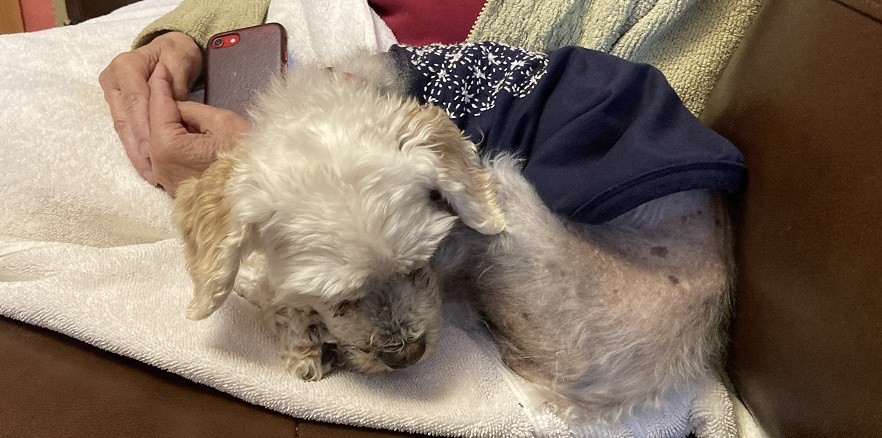
The defining story of the Jewish people is the story of the Exodus from Egypt. The children of Israel were slaves in Egypt for hundreds of years, and when they finally escaped one of the first things they did (at Mount Sinai) was to proclaim that there would have to be a rest day every week. And, yes, the way the Hebrew Bible is written, it’s God who tells them what the Ten Commandments are, including the commandment to keep the Sabbath day as a day of rest, but even if we believe that it’s coming directly from God and not from the people themselves, the people had a choice, to embrace the new rules or forgo them, and they chose to take them on. Imagine what having a full day of rest every week would have meant to a people who had only known life as slaves? Setting aside a full day of rest meant that, for at least one day each week, their time and their priorities were their own. We think of a day of rest as a logical necessity, because of the body’s need for rest, but that day off also creates more space in our own minds, for our hopes and dreams and plans, instead of just thoughts related to work and getting by.
I like to think of Shabbat as a time to sit and listen carefully to those quiet voices inside of us, the ones we can barely hear during the busy work week, so that we can put ourselves back together and bring our full selves back with us into our daily lives. Shabbat is a chance to heal the wounds of the week, especially the times when we’ve pushed through, despite hunger or exhaustion or pain, and never bothered to apologize to ourselves for the harm done.
“How dare you!”
But even in the United States, where we supposedly have a five day work week, with two days off, many people still work on the weekends, or set that time aside for chores and errands. Maybe they go to a prayer service, or have a family dinner, but they don’t spend a full day (and certainly not two days) napping or reading or taking nature walks; instead, they spend the time ticking things off their to-do lists. I’ve found that most people find the idea of rest, especially for a whole day, uncomfortable. Which means that the ancient Israelites knew what they were up to; they knew that rest is essential to living a full life, and that we would have to be commanded to do it.
“You need to be commanded to nap? Humans are weird.”
But even with my deep appreciation for rest, I still don’t feel like I make enough use of Shabbat each week. Part of the problem is that creating a day of rest takes effort. Shabbat is supposed to be a mini holiday every week – a mini Chanukah or Christmas or Passover – and that means a lot of planning, and cooking, and inviting, and cleaning, and dressing up. It sounds crazy to say that I am too tired for Shabbat; too tired to rest. But I am too tired to create the right circumstances for my soul to rest and recharge, instead of just my body.
Another block to making the most of Shabbat is that I don’t really feel like I deserve a special day of rest each week, given the amount of rest I need, and take, during the work week. I feel like I should be making up for all of that laziness by doing chores on the weekend.
And then there’s the biggest block of all: my memories of celebrating Shabbat as a kid. Before my father became more religious, when I was four, five, six, and seven, Shabbat was a good day. My brother and I went to Junior Congregation – an hour of Bible trivia and songs and prayers with the rest of the kids and with one not-so-grown up adult – and then, if we could sneak into the Social Hall after the maintenance guys had set up the tables, we could steal brownies while the adults were busy praying in the big sanctuary. And then I’d go to gymnastics with my best friend, and then me and Mom and my brother would get meatball heroes from the tiny Italian sub shop on the way home. It was pretty great.
“Meatball heroes, yes. Bible trivia? Not so much.”
But then my father became more religious, starting when I was about eight years old, and instead of meatball heroes and gymnastics, my brother and I went from Junior Congregation in the little sanctuary straight into the big sanctuary with the adults, and then to the Kiddish in the Social Hall, where the adults drank Slivovitz and ate gefilte fish and herring and talked for what seemed like hours. We were able to eat a few more brownies, but it didn’t seem worth the trouble. And when we finally got home, we weren’t allowed to watch TV for the rest of the day, or even get homework done. The boredom was mind numbing, except for the times when we played Trivial Pursuit as a family, which were brutal. At that point in my life, the best part of Shabbat was the end.
I gave up on celebrating Shabbat entirely in my twenties, going to therapy and writing workshops and shopping trips on Saturdays, because it was easier to think of it as just another day than to wrestle with the fish hooks of the past, the memories that cut so deep into my skin that it’s hard to pull them out without damaging my internal organs. And even after joining our current synagogue, nine years ago, and consistently going to Friday night services each week, I still couldn’t find a comfortable way to bring Shabbat home with me.
But I want to be able to find some peace each week. I want there to be a day set aside where I can put down my big bag of anxieties and truly rest and recharge. But while I know people who are good at dissociating from their feelings, who can even be specific in which of their feelings and memories to “put on a shelf” and out of their minds, for a time, I can’t do it. My internal shelves are not well constructed, so the nasty things keep falling back into consciousness, often in dreams or nightmares, or just in triggers throughout the day that I can’t control or ignore.
“The shelves are falling! The shelves are falling!”
So I’m left with all of my memories and emotions and internal conflicts, even on Shabbat, and no amount of challah, or grape juice, or matzah ball soup, seems to be able to overcome that. Except, if I look back at the beginning of this essay, the purpose for Shabbat that I came up with wasn’t to be happy and carefree, it was to take the time to put your whole self back together, to take ownership of your time, and your internal life, so that when you go back to your daily working life you can bring your whole self with you. Maybe, on those terms, I’m doing Shabbat pretty well after all. Maybe the real problem is that I expect my version of Shabbat to match what I’ve seen in other people’s homes. Maybe it’s not so much that I’m flawed and broken beyond repair, but that my expectations of myself just don’t fit me. And maybe, my goal for Shabbat each week should be to gradually change my expectations of myself until they match the person I actually am. Maybe if I can do that, some peace will follow.
If you haven’t had a chance yet, please check out my Young Adult novel, Yeshiva Girl, on Amazon. And if you feel called to write a review of the book, on Amazon, or anywhere else, I’d be honored.
Yeshiva Girl is about a Jewish teenager on Long Island, named Isabel, though her father calls her Jezebel. Her father has been accused of inappropriate sexual behavior with one of his students, which he denies, but Izzy implicitly believes it’s true. As a result of his problems, her father sends her to a co-ed Orthodox yeshiva for tenth grade, out of the blue, and Izzy and her mother can’t figure out how to prevent it. At Yeshiva, though, Izzy finds that religious people are much more complicated than she had expected. Some, like her father, may use religion as a place to hide, but others search for and find comfort, and community, and even enlightenment. The question is, what will Izzy find?