I’m loving my new Hebrew class! The Purple level is much more challenging than the previous levels, but in a great way, with more interesting content and vocabulary and homework and conversations. The teacher is fantastic, not just because he knows how to do weird tech stuff like broadcasting announcements to all of the breakout rooms at once, but also because he’s able to keep track of all of our stories and quirks and make sure we are all seen and heard and made part of the flow of the class.
“But what about me?”
The only problem, if there is one, is that I am surrounded by classmates with much more Hebrew fluency than I have. But surprisingly, I don’t really mind. I thought I would prefer being at the top of a lower-level class, but instead I feel energized by how much more there is to learn, and how much more there is to look forward to.
The homework at the purple level is also a lot more fun. We used to just translate sentences, from Hebrew to English or English to Hebrew, to practice our new vocabulary, but in Purple we do something called Field Research, where we take three of the words we learned in class that day and look up blog posts or articles or memes using those new words, then screenshot and post them to our class WhatsApp group. Being me, I spend a lot of time searching, reading dozens of posts until I find something that makes me laugh, or cry, so not only is it fun, but it also forces me to read a lot more Hebrew than I otherwise would have.
My favorite homework, though, and the one that challenges me the most, is when we are given a random topic and told to record ourselves speaking off the cuff in a short voice note, no editing allowed. For now, I tend to talk around the holes in my vocabulary, as if I’m avoiding land mines, but my braver classmates jump right in and bring up new words for us to learn in the next class. We also get to know each other really well, from family stories, pet peeves, and random trivia that would never come up in the course of normal conversations.
Possibly because of the voice note practice, or maybe because I’m just like this anyway, I’ve been talking to myself a lot in Hebrew lately, telling myself stories from my day and then rushing to Google Translate with a list of words that I now need to know how to say in Hebrew. I am, at least, willing to be more adventurous in my Hebrew speaking when I am only talking to myself. Hopefully, one day, I will have the confidence to just start speaking in public, with no plan for where I will end up.
Somehow, we’re already halfway through this semester, and I am not happy about that at all. We have a short break for Passover, and then Holocaust Remembrance Day, Israeli Memorial Day, and Israeli Independence Day, which all come in a clump, and that will give me an opportunity to feel some of the impending grief at the loss of the class and then dive back in for relief. But I know that when this class really ends, I’m going to resent it. I already feel bad for our next teacher (of course, I’ve already signed up for the next class), because there will be a lot for them to live up to.
“I’d be a great teacher! You’d be barking in no time!”
If you haven’t had a chance yet, please check out my novel, Yeshiva Girl, on Amazon. And if you feel called to write a review of the book, on Amazon, or anywhere else, I’d be honored.
Yeshiva Girl is about a Jewish teenager on Long Island, named Isabel, though her father calls her Jezebel. Her father has been accused of inappropriate sexual behavior with one of his students, which he denies, but Izzy implicitly believes it’s true. As a result of his problems, her father sends her to a co-ed Orthodox yeshiva for tenth grade, out of the blue, and Izzy and her mother can’t figure out how to prevent it. At Yeshiva, though, Izzy finds that religious people are much more complicated than she had expected. Some, like her father, may use religion as a place to hide, but others search for and find comfort, and community, and even enlightenment. The question is, what will Izzy find?
We finally took Tzipporah to our groomer for the first time, a few weeks ago. I was nervous about how she would manage being with strangers, but other than a small panic attack when the groomer got to her front paws (she told us to pre-medicate Tzipporah with doggy Xanax next time), she did surprisingly well. The best part is that I can see her eyes again, and that means I can see how much her facial expressions have changed since she first came home. She looks curious and interested now, instead of frightened and exhausted.
“I see you. Mommy!”
I was so inspired by how well Tzipporah did at the groomer, that I brought her to therapy with me the next day, to show off her new haircut and to test her ability to sit in the car by herself (instead of with Grandma holding her). She survived the short trip by flattening herself on the backseat, totally unlike Cricket’s habit of climbing every which way while I was driving (though I’m still planning to get a car harness for her, just in case), and then she sat on my lap during therapy, and listened intently to what ended up being a long conversation about how freakin’ cute she is.
And, yes, she is still spending most of her time marinating in her bed, but she’s usually awake now and looking around intently for clues about her new world. She even twists around in her bed to watch me when I leave the room, or, God forbid, leave the apartment altogether. She still hasn’t barked, but she makes the most of her soft voice, waking us up in the morning with her persistent cry, like a tiny car alarm. She’s usually looking for Grandma, to give her breakfast or a treat, but sometimes she even comes looking for me, and then she waits until she’s made eye contact and then runs back to the living room, expecting me to follow.
After her success with the groomer, I decided to move her food and water bowls halfway to the kitchen, rather than near her bed, to encourage her to walk around more often. And I even added toothbrushing into her daily routine (she loves the chicken flavored toothpaste!), and she seems to be tolerating the indignity quite well.
“Wait, that was toothpaste?!”
As the weather warms up, the next big challenge will be teaching her how to tolerate walks. She still looks at the leash like it’s a boa constrictor about to strangle her, and when I try to put her on the ground out in the yard, she shakes, so there’s a lot of work ahead. Maybe she’ll have to take some doggy Xanax for walks, as well as for the groomer. In my imagination, I see her running along the beach in the wind, and playing with Kevin-the-Golden-Doodle in the backyard, the way Cricket used to do (except without the violence), but that might be asking too much. We’ll see.
I’m trying to moderate my expectations and just be happy whenever she makes progress, but then I worry that I haven’t challenged her enough or given her enough opportunities for growth. With that in mind, I brought one of Kevin’s squeaky tennis balls into the apartment one day, hoping the smell of him would interest her. I threw the ball a few times, and squeezed it to make it squeak, but Tzipporah just watched intently, with no signs of wanting to participate. She hasn’t quite figured out that life is supposed to be interactive, instead of a movie to be watched from the cozy seats, but I have the same problem, so really, who am I to criticize?
“These are the best seats in the house!”
If you haven’t had a chance yet, please check out my novel, Yeshiva Girl, on Amazon. And if you feel called to write a review of the book, on Amazon, or anywhere else, I’d be honored.
Yeshiva Girl is about a Jewish teenager on Long Island, named Isabel, though her father calls her Jezebel. Her father has been accused of inappropriate sexual behavior with one of his students, which he denies, but Izzy implicitly believes it’s true. As a result of his problems, her father sends her to a co-ed Orthodox yeshiva for tenth grade, out of the blue, and Izzy and her mother can’t figure out how to prevent it. At Yeshiva, though, Izzy finds that religious people are much more complicated than she had expected. Some, like her father, may use religion as a place to hide, but others search for and find comfort, and community, and even enlightenment. The question is, what will Izzy find?
Starting in elementary school, and now in my online Hebrew classes from Tel Aviv, I’ve been learning Modern Hebrew, the version of the language spoken in Israel today, and it is much more my speed than Biblical Hebrew. The last time I studied Biblical Hebrew, if I ever really studied it, was back in high school, and for the most part I found it impenetrable. The text was most often translated by our teachers, including the six or seven commentaries we would read for each sentence. I mean, sure, if we’d had mysteries written in Biblical Hebrew, I might have paid more attention, but reading through the laws in Leviticus word by word, a sentence or two per day, did not capture my attention.
“Oy. Leviticus.”
But recently, I’ve been making a point of reading along in Hebrew, during Bible study sessions at my synagogue, as someone else reads the English translation out loud, and I’ve started to notice some of the differences between Modern Hebrew and Biblical Hebrew, and to understand why it was all so hard to understand when I was a kid. I’ll find myself reading along, mostly understanding the Hebrew words and feeling pretty good about myself, and then suddenly a word that is clearly in the future tense in the Hebrew will be translated into the past tense in the English, or a word that I was sure I understood from Modern Hebrew will be given an entirely different connotation, and I’ll be lost all over again.
Even though it’s all Hebrew, the gap between Biblical and Modern Hebrew is at least as wide as the gap between today’s English and Shakespeare’s, but probably wider. There were only 8,000 or so attested Hebrew words in the Bible, including words borrowed from Akkadian (used by the Assyrians and Babylonians) and Egyptian and Greek. Today, there are over 100,000 words in Modern Hebrew, including loan words from all of the different cultures Jews have lived in for millennia, including Arabic and English and German and Spanish and Russian and Persian and on and on. In the interim, along with the added vocabulary, the grammar, and syntax, and even pronunciation have also changed, by a lot.
Actually, Hebrew was only the spoken language spoken in ancient Israel until sometime before the Common Era, when Aramaic took over. And then, after the destruction of the second temple in Jerusalem, in 70 CE, most of the Jewish population was scattered around the world, and each community spoke the language of their new homes. Biblical Hebrew was still used by the rabbis in their commentaries on the Hebrew Bible, though, and by Jews in general during prayer and study, and as a result, the word count of written Hebrew grew to 20,000 or so, including many words borrowed from Aramaic and other neighboring languages. And then the Medieval sages added another 6,500 words, while writing their own commentaries and sacred poetry.
Eventually, in the 1800’s, a movement to revive spoken Hebrew began, with some Jewish writers using Hebrew to write secular literature, instead of just keeping Hebrew in the study hall or the synagogue anymore. Eliezer Ben Yehuda codified this new version of Hebrew in the early 1900’s, and when the Modern State of Israel was created, Hebrew was chosen as the national language. And today, Modern Hebrew is evolving much more quickly, but it is still the same language. Some words that were used in Biblical Hebrew have been replaced in daily usage with new words in Modern Hebrew, but they still exist. You can even use the older words in your everyday life and be understood, but you will sound kind of like an English speaker reciting Shakespeare as you order your coffee.
The most important discovery, for me, in researching Biblical Hebrew, was the Conversive Vav. This was the mystery that started the whole thing: how are verbs that are written in the future tense in Biblical Hebrew suddenly transformed into the past tense in the English. I found a bunch of long, drawn out, incomprehensible explanations for how the Conversive Vav is used, but suffice it to say that when it shows up it can change future tense into past tense and past tense into future tense. Like magic. In Modern Hebrew, if you find the letter Vav in front of a Hebrew word, it usually means “and,” and if you see something written in the future tense, it remains in the future tense, no hocus pocus allowed.
You can, of course, go much deeper into studying Biblical Hebrew, to the point where you can even date when the different books of the Hebrew Bible may have been written, or figure out which parts of each story may have come from a previous era and were then added into a more recent re-telling of the story. My rabbi is fascinated by all of this stuff, and I’m happy to let him do the work of figuring it out so I don’t have to.
I am not a linguist, or a grammarian, or even a very good speller, but I am fascinated by the idea that a language is a living thing, that changes as the people who speak it change. I still much prefer Modern Hebrew to the Biblical version, but I love that I get to visit my ancestors and hear their particular dialect each time I open the Hebrew Bible. Who knows what future generations will be able to learn about us when they read through our writings? A lot depends on what they will have access to: they could be reading non-fiction histories, or true crime, or young adult science fiction, or page after page of shopping lists from the height of the egg-price crisis. And what they read, and the way they interpret it, will determine who they think we were and what they learn from us.
I often wonder what the rabbis chose to edit out of the Hebrew Bible along the way, and why. I bet my ancestors wrote their own version of shopping lists, and wrote all kinds of other things the rabbis didn’t think we needed to know, for one reason or another. Just imagine, there could be a treasure trove of ancient Biblical fan fiction, or diaries of young girls complaining about the horror of animal sacrifices and all of the chores they had to do around the farm, all buried in a cave somewhere in Israel, waiting to be discovered. If anything like that comes up, I may have to rethink my resistance to learning Biblical Hebrew. Only time will tell.
“How many languages do I have to learn to live in this house?!”
If you haven’t had a chance yet, please check out my novel, Yeshiva Girl, on Amazon. And if you feel called to write a review of the book, on Amazon, or anywhere else, I’d be honored.
Yeshiva Girl is about a Jewish teenager on Long Island, named Isabel, though her father calls her Jezebel. Her father has been accused of inappropriate sexual behavior with one of his students, which he denies, but Izzy implicitly believes it’s true. As a result of his problems, her father sends her to a co-ed Orthodox yeshiva for tenth grade, out of the blue, and Izzy and her mother can’t figure out how to prevent it. At Yeshiva, though, Izzy finds that religious people are much more complicated than she had expected. Some, like her father, may use religion as a place to hide, but others search for and find comfort, and community, and even enlightenment. The question is, what will Izzy find?
We don’t know what set it off, but Tzipporah was sick for a week. One afternoon she had a loose poop, and the next poop was even more liquidy, and the next was all liquid, and then she was vomiting, in her bed. Right away, I was having flashbacks to the last few months of Cricket’s life, when she was suffering from kidney disease and we had to spread wee wee pads everywhere. But I tried to stay calm, and when I gave Tzipporah her first bath-at-home, and she hated it, the energy with which she fought off the washcloth and the water made me hopeful. And then we gave her some Pepto Bismol, enrobed in peanut butter, to see if we could stop the flow in its tracks, and she ate the newly crunchy peanut butter gleefully, and then threw it all up. The next morning, she didn’t eat her breakfast at all, so we called the animal shelter’s clinic and they gave us an emergency appointment. Tzipporah needed to have her butt washed one more time before her appointment, which she hated, again, and then we wrapped her in a towel and brought her to the car.
“I don’t feel so good.”
She sat shaking in my arms in the waiting room at the clinic, leaning her head under my chin to hide. When we were called into the examination room, she let me place her on the exam table, but she stayed as close to me as possible, and then, when the vet came in to examine her, she tried to climb me like a tree. But she survived, and even let me hand her off to the vet tech, who took her away for blood tests and an x-ray, and then brought her out to us in the waiting room wrapped in a wee wee pad, because she’d had another accident during the x-ray.
I held her close and whispered to her and scratched her ears, and she started to relax. And I realized that somewhere along the way Tzipporah has decided that I am her Mommy. There was no one moment that clinched it for her, as far as I could tell, it was just a gradual realization that I can be trusted to feed her, and wash her, and comb her hair, and to comfort her when things go wrong.
When we were called back into the exam room, the vet told us that there was nothing in the blood tests to worry about, except some small elevations caused by stress, but the x-ray showed that Tzipporah’s large intestine was swollen, which could be a sign of a blockage, or not. The vet wanted us to come back the next day for a follow up x-ray, hopefully to find that the swelling had reduced, but if not, she said, we might need to think about surgery. She sent us home with a few medications (all in liquid form, in case Tzipporah still wasn’t up to eating solid food), and a lot of anxiety.
When we got home, I gave Tzipporah yet another bath while Mom cooked up her newly prescribed bland diet (boiled chicken and rice), and then we gave her the prescribed appetite stimulant and she gobbled up her lunch and even let me give her the rest of her meds, sort of. And then she and Mom rested while I went out to teach.
Tzipporah happily ate her dinner later that night, and there was no more vomiting, but she did continue to have diarrhea overnight. The next morning, we were only allowed to give her a little bit of food to go with her meds, because the doctor wanted the second x-ray to be as clear as possible. And then I gave her yet another half-bath and we were off to the vet again.
These visits to the animal shelter clinic, the same one where we used to take Butterfly (our first puppy mill mama), were bringing up a lot of grief and fear, and it was hard to remember that this was probably just a blip, not an illness, yet, and not fatal. When Butterfly came to us, she was eight years old and had significant health issues, so we spent a lot of time in and out of that clinic, especially towards the end of her life, almost five years later. That clinic was a god-send, honestly, and helped us keep Butterfly for much longer than we’d ever have expected, but the grief has never really faded. And watching Tzipporah, another puppy mill mama, going into those same exam rooms, was a lot.
Miss Butterfly
Tzipporah’s second x-ray was better than the first one, with signs that the inflammation was passing, but the vet said to keep an eye out and if she vomited again, we should take her to the emergency vet for an ultra-sound, all of which sounded terrifying and expensive. Thank God, Mom had thought ahead and bought health insurance for Tzipporah the day we adopted her, which, after a deductible, would give us 80% of the cost back.
Before we left the clinic for the day, two vet techs gave Tzipporah subcutaneous fluids and a B12 shot (which also reminded me way too much of Cricket’s final months), and the doctor prescribed another medication to add to her cocktail, and we went home.
Miss Cricket
I spent the rest of that day doing laundry (both dog beds, a whole pile of towels and blankets and toys, and all of the clothes I’d worn to the vet and while giving Tzipporah her many baths), and Tzipporah spent the rest of the day eating and sleeping.
By the next day, there were no more signs of diarrhea or vomiting. It still took her a few more days for her to get back to normal (AKA running down the hall to beg Grandma for chicken treats), and even longer for us to stop watching her anxiously, but we eventually began to add some kibble back into her diet, and she had the energy and presence of mind to toss the kibble out of the bowl and focus in on the chicken and rice.
The whole experience was overwhelming, especially because of the memories it brought up, but something good came out of it too: when Tzipporah was sick and needed help, I had to help her, whether she liked it or not. I’d been so careful with her through her first few months with us, because I didn’t want to re-traumatize her, and I wanted to give her time to acclimate to life with people, and because I was afraid of making mistakes. But when she was sick, I stopped worrying about all of that and gave her the care she needed, and she responded by leaning on me, and asking to be picked up, and looking to me for reassurance. She’s still suspicious of me, of course, but she seems to understand that I can be trusted. I’m also realizing that I was probably too careful, worried that she would reject me or worried that I would love her and lose her too soon. Cricket and Ellie’s deaths last year, within months of each other, left a deep mark on me, and I think some part of me was holding Tzipporah at arm’s length, just like she was holding me at paw’s length for her own reasons.
Cricket and Ellie
But she looks at me now, and communicates in her own unique way, and even recognizes me as a particular person, who she might even like. We still don’t know what set all of this in motion, maybe a stray piece of chocolate or a dropped pill or something else she managed to find on the floor during her nightly wanderings. But whatever it was, it passed, and she seems more confident in the aftermath. And I think we’re more confident too, and willing to be more proactive with her, even when she looks at us with suspicion. It’s still a work in progress, and we still have a long way to go, but we’re finally getting somewhere, and she even seems to be a little bit happy to be here. Sometimes.
“But only sometimes, Mommy.”
If you haven’t had a chance yet, please check out my novel, Yeshiva Girl, on Amazon. And if you feel called to write a review of the book, on Amazon, or anywhere else, I’d be honored.
Yeshiva Girl is about a Jewish teenager on Long Island, named Isabel, though her father calls her Jezebel. Her father has been accused of inappropriate sexual behavior with one of his students, which he denies, but Izzy implicitly believes it’s true. As a result of his problems, her father sends her to a co-ed Orthodox yeshiva for tenth grade, out of the blue, and Izzy and her mother can’t figure out how to prevent it. At Yeshiva, though, Izzy finds that religious people are much more complicated than she had expected. Some, like her father, may use religion as a place to hide, but others search for and find comfort, and community, and even enlightenment. The question is, what will Izzy find?
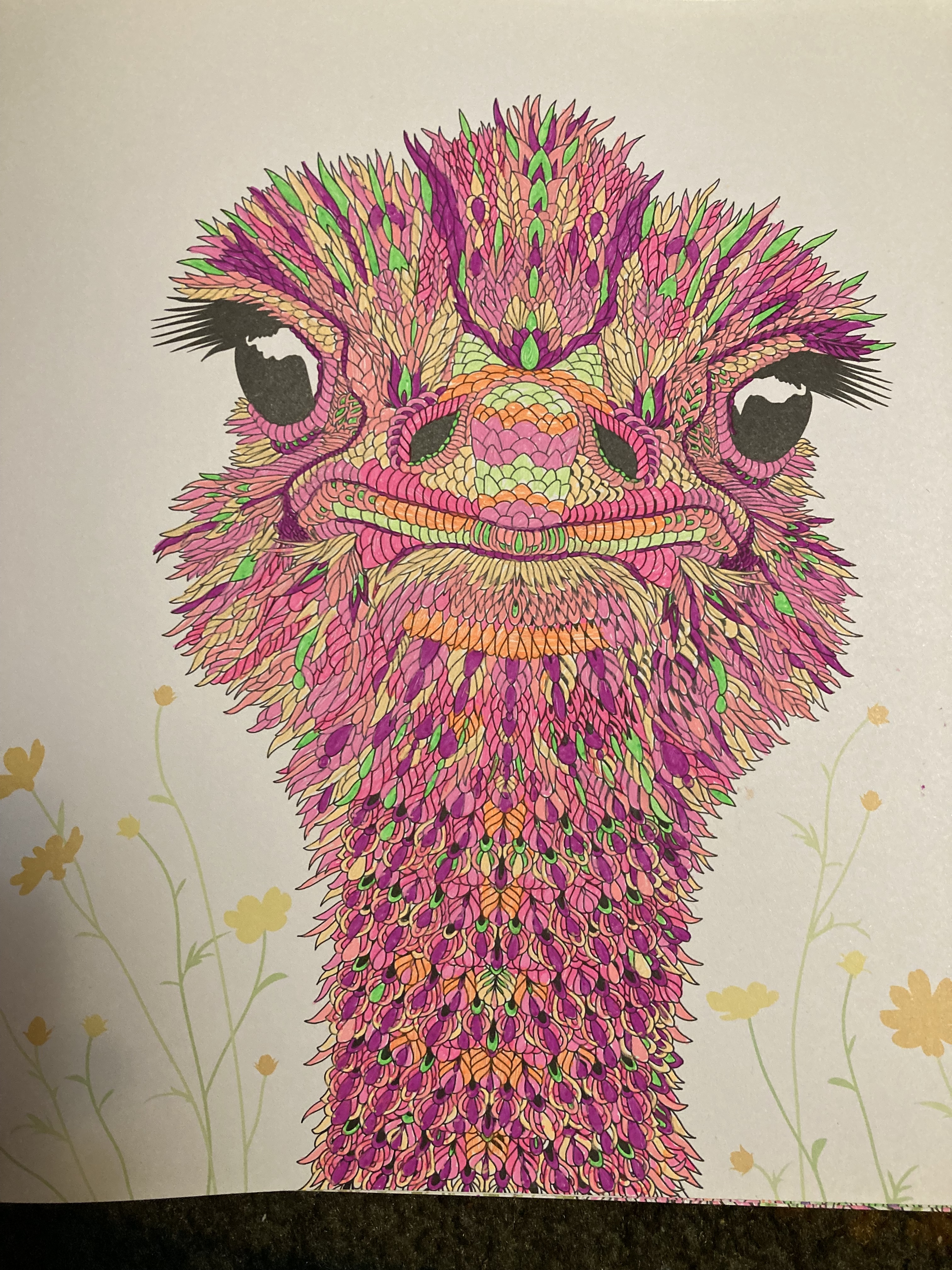
I have been coloring a lot lately. In coloring books. They are “adult” coloring books, so the designs are more complicated and intricate than my old Little Mermaid coloring books, but I’m struggling to stay within the lines just like I used to as a kid, and I feel silly for needing to do this instead of creating something of my own from scratch. I used to knit and crochet as a way to calm down, but I haven’t had the mental energy to focus on a project like that. When I received a handful of gift cards for Chanukah, from my students, I decided to buy coloring books and markers, as a way to de-stress. And they worked. I’ve always needed distractions like this to help with anxiety, but since the presidential election in the United States, and then even more so since the inauguration of our current president, the anxiety in the air and the onslaught of news each day has been overwhelming me.
I haven’t been writing much about our current political climate, in the United States, in Israel, or in the world at large, because there’s too much to process each day, even each hour sometimes, and I feel like I have nothing to add that hasn’t been said a hundred times already. I’m frightened, and overwhelmed, and feeling helpless, and all of the suggestions for how to take action have overwhelmed me even more, because they assume I have resources (like energy and money) that I don’t have.
So, I color. I’m on my third coloring book, and I’ve graduated from simple markers to gel pens in every shade. I started with pictures of animals in general, then birds in particular, and then I moved on to abstract designs. I’ve also been watching tons of Hallmark and Hallmark-like movies on YouTube, and the combination of the movies and the coloring have been helping, somewhat.
I’m still writing and teaching and going to my Hebrew classes and taking care of Tzipporah and going to doctors’ appointments and listening to podcasts and Israeli music and forcing myself to watch and read the news, but I’m depending more and more on my hours of coloring each day to help me organize my brain, following the lines someone else has created and trying to figure out which colors will make the patterns become clear to me.
I wish I was up to doing something more. I wish I could get more writing done each day, or knit a few sweaters, or go out into the streets, or just fix the world snip snap, but this seems to be what I can do for now. It feels selfish to spend money on pens and coloring books instead of sending that money to various organizations supporting reproductive rights or immigrants’ rights or children in Ukraine, but I can’t help anyone else when I feel so lost. I wake up feeling like everything is out of control and the world is breaking apart like pieces in a kaleidoscope, and then I turn on a Hallmark movie and open a coloring book and I feel a little bit more together and a little bit more capable of doing the things I need to do.
I don’t know how everyone else is coping. Maybe there are even people who don’t feel stressed at all by the current state of affairs, though I don’t know them. People keep telling me that we just have to survive through the next four years, but I don’t have confidence that I will survive four years of this, or that this will only last four years, and that level of fear makes it hard to plan ahead. If the rules change every day, and I have no idea what the new rules will be, it’s hard to believe that I will ever be able to play the game. I remember this feeling from my childhood, where the only way my father could feel safe and secure was if he pulled the rug out from underneath me, or someone else. His security and mine existed on a seesaw, and that’s how it feels with our current president, that the things that make him feel better will inevitably make me feel worse.
I wish I could fix this, or go back in time to prevent it somehow, or create a world of my own that I could crawl into and avoid the news completely, but I don’t know how to do any of those things. So, I color, and I get by, and that’s the best I can do, for now.
Tzipporah prefers naps to coloring.
If you haven’t had a chance yet, please check out my novel, Yeshiva Girl, on Amazon. And if you feel called to write a review of the book, on Amazon, or anywhere else, I’d be honored.
Yeshiva Girl is about a Jewish teenager on Long Island, named Isabel, though her father calls her Jezebel. Her father has been accused of inappropriate sexual behavior with one of his students, which he denies, but Izzy implicitly believes it’s true. As a result of his problems, her father sends her to a co-ed Orthodox yeshiva for tenth grade, out of the blue, and Izzy and her mother can’t figure out how to prevent it. At Yeshiva, though, Izzy finds that religious people are much more complicated than she had expected. Some, like her father, may use religion as a place to hide, but others search for and find comfort, and community, and even enlightenment. The question is, what will Izzy find?
I am starting a new semester of online Hebrew classes, and I’m excited, but also anxious. I’ve been back in these classes since the summer, with renewed energy and purpose after a long break, and all of that effort has paid off, because I am moving up to Purple, the highest level. One of the things I love about Citizen Café, the school where I take my Hebrew classes, is that instead of offering three levels (beginning, intermediate, and advanced) like most language classes for adults, they are continually adding levels so that each student can start and continue in a class that is suited to their real abilities, without being too challenged or too comfortable. I cannot explain their color wheel, though, which starts with Red and Orange and, for now, ends with Purple, and makes stops along the way in Lime, Pink, and Turquoise.
I spent six semesters at the Indigo level, the second to highest level, where there are multiple semesters worth of content to help build vocabulary and fluency, but also a lot of repetition. During my sojourn in Indigo, I kept hoping that they would create a new level, between Indigo and Purple, so I wouldn’t have to keep going over the same material, or move up to the final level, which feels so, I don’t know, final, but no such luck. Eventually, my teachers decided that I was getting too comfortable in Indigo and needed to move up to Purple for a new challenge, and I agreed with them, but now I feel like I’m being thrown into the deep end without my water wings.
From what I hear from friends, purple level is a different animal. The content changes each semester, depending on what the students in each class are interested in, and there are people who have been at the purple level for a dozen semesters or more, to make up for not having anyone in their outside life to speak to in Hebrew. I’m one of the few students at the advanced levels at this school who has never actually been to Israel, let alone lived there, and I worry that I will be intimidated by my classmates who either live in Israel now or have visited many times in the past. At some point soon, I’m sure the school will figure out that if I belong in Purple, then there really should be at least one more level above Purple for the really advanced students. And then they’ll have to come up with a new color to add to their color wheel, like ultra-violet, or maybe chartreuse.
I’m sure that, originally, when they were teaching classes in person in cafes around Tel Aviv, they assumed their students would only stay for a few semesters, since they’d already done their official six months in Ulpan (when you move to Israel, you take a six-month Hebrew course subsidized by the government). They probably thought that all their students would need was some practice and fine tuning and then they’d be ready to get a job and continue to work on their Hebrew with their new Israeli friends, but the reality is that Hebrew is really hard to learn, and most Israelis are too busy, or too impatient, or too terrible at grammar themselves to be of much help. And most people want to be able to do more than just read road signs or buy cherry tomatoes at the Shuk, they want to be able to watch (and understand) the news, or read novels at the beach, or scream at their friends over loud music at a party and actually know what’s being said back to them. So, the school grew.
But something else also happened along the way. Once the school went online, during covid, they found out that they had a lot of potential students who didn’t live in Israel at all. Suddenly there were students from around the world who wanted to learn Hebrew before moving to Israel, or so they could speak Hebrew with their Israeli wife’s family, or chat with their grandkids over Zoom. And then there were people, like me, who wanted to speak Hebrew for a million reasons other than moving to Israel. There are a lot of us who are fascinated with Hebrew for reasons of culture, ancestry, community, connection, family and on and on, rather than just wanting to be able to navigate the bus routes from Jerusalem to Tel Aviv.
I am still, usually, the only person in my classes who has never been to Israel, though. And hopefully, someday soon, I will be able to afford a trip, but for now, I’m doing my best to travel there in my mind, and on Zoom, and it is bringing me a lot of satisfaction, and a lot of joy, and just a little bit of crippling anxiety.
“I understand anxiety, new Mommy.”
If you haven’t had a chance yet, please check out my novel, Yeshiva Girl, on Amazon. And if you feel called to write a review of the book, on Amazon, or anywhere else, I’d be honored.
Yeshiva Girl is about a Jewish teenager on Long Island, named Isabel, though her father calls her Jezebel. Her father has been accused of inappropriate sexual behavior with one of his students, which he denies, but Izzy implicitly believes it’s true. As a result of his problems, her father sends her to a co-ed Orthodox yeshiva for tenth grade, out of the blue, and Izzy and her mother can’t figure out how to prevent it. At Yeshiva, though, Izzy finds that religious people are much more complicated than she had expected. Some, like her father, may use religion as a place to hide, but others search for and find comfort, and community, and even enlightenment. The question is, what will Izzy find?
All of the recent rhetoric, and actions, on mass deportation of migrants in the United States has made me think about what I believe is right, or wrong, or complicated, around the issue of immigration. There are people who believe that there should be no borders at all, and that all deportations are wrong, and there are others who think that anyone who speaks Spanish instead of English while in the United States should be on the ICE deportation list, no matter what their citizenship status may be. I know I don’t agree with either of those extreme points of view, but I’m not sure what I do believe.
We have a tendency to simplify and generalize in our public discourse, relying on pithy sayings that can fit in a hashtag or on a protest sign, instead of having in-depth discussions about what we believe is right. And especially now, when we are being told that the only solution to illegal immigration is to hunt down anyone with questionable status, guns blazing, in hospitals and schools and houses of worship, it is even more important to take a breath and take responsibility for figuring out who we are and who we want to be, and why.
I teach the Book of Leviticus in synagogue school, so I spend an unreasonable amount of time marinating in the Hebrew Bible and what it has to say about who our ancestors were, and where they went wrong, and which lessons they did and didn’t learn from those mistakes. So, when I am confused about a moral issue, the Hebrew Bible is one of the first places I look for edification (other than Hallmark movies, of course). And we are reminded over and over again in the Hebrew Bible that we were strangers in Egypt, and therefore we should be compassionate to others in the same position. It is said so many times that we almost don’t hear it anymore, like we miss the birds chirping outside our windows, or the nagging inner voice telling us to exercise, because it is just so ubiquitous. And, to be honest, I’m not sure I ever spent much time thinking about what it means to be kind to the stranger, or even who qualifies as a stranger in our modern, globally connected world.
But in a recent bible study session, my rabbi told us that even though the word Ger in the Hebrew Bible is often translated into English as “stranger,” it actually meant something more like “sojourner” in biblical times, and referred to someone who was a migrant from somewhere else, without land of his own in ancient Israel.
We are told, in Leviticus 19:34-35: “When strangers reside with you in your land, you shall not wrong them. The strangers who reside with you shall be to you as your citizens; you shall love each one as yourself, for you were strangers in the land of Egypt.”
So, first of all, don’t wrong the stranger. Don’t do anything to the stranger/sojourner that would be abhorrent to you, like making them into your slave, or stealing from them, or hurting or killing them. Basically, recognize that the laws of good behavior are not nullified in your interactions with the stranger as if they are less than human. But why tell us to treat the stranger as if he is a citizen? If there’s not supposed to be a difference between how we treat a citizen and a non-citizen, then why not just say, treat everyone the same?
In fact, the Hebrew Bible has a separate law for how we should treat someone who isn’t a stranger. In Leviticus 19:18, it says: “Love your neighbor as yourself,” or in another translation, “Love your fellow human being as you love yourself.” If there’s no difference between a stranger and a neighbor, why are the two laws stated separately?
If we assume that every word in the Hebrew Bible is there for a reason, which not everyone assumes, but hear me out, then just like “stranger” really refers to a sojourner or non-citizen, maybe the “neighbor” or “fellow human being” here refers to the opposite of the stranger/sojourner, AKA a citizen. So, we are being given guidance on how to treat a fellow citizen and on how to treat a non-citizen.
Before settling in the land of Israel, the ancient Israelites were wanderers, and slaves, so they knew about being sojourners in other lands more than they knew about being landowners. And once they owned land, they needed to learn how to treat each other all over again, and how to treat outsiders, given these new blessings and responsibilities. But as their past experiences started to fade from their everyday thoughts, they had to actively remind themselves that they didn’t want to be the kind of landowners they’d known in the past. They wanted to retain their empathy for the outsider, without losing the rights and freedoms they had so recently won for themselves.
One of the important things to remember about the sojourners in ancient Israel, is that they were not bound by all of the same laws as the Israelites (like keeping kosher, or celebrating the Sabbath, or giving of the produce of their land to the Levites, or to the widow or orphan), though they were bound by certain laws that applied to everyone equally (Don’t kill, steal, etc.).
But if the sojourner is so different from the neighbor, why do the laws about how to treat them sound so similar? Or do they? Further along in the Hebrew Bible we get a little more detail on how we are supposed to treat the stranger/sojourner. In Deuteronomy 10:18-19, it says: “[God] upholds the cause of the fatherless and the widow, and befriends the stranger, providing food and clothing. You too must befriend the stranger, for you were strangers in the land of Egypt.”
Here we are being told to befriend the stranger (which is pretty vague), and to supply food and clothing to the stranger, the way one would for anyone else in the community who is in need. This suggests that we’re not being told to treat the stranger the same way we would treat a fellow citizen, but rather to be generous to the stranger in the same way we would be generous to anyone in our own community who is in need, specifically, someone who lacks food or clothing. It’s interesting, and maybe significant, that the law doesn’t mention offering shelter to the stranger, which I would have thought of as a primary need, especially for someone without land of their own.
In ancient Israel, those who owned land were members of the twelve tribes of Israel. Period. These are people who, maybe like us, were worried about losing the property and the rights and the freedoms they had so recently won. And they were struggling with their competing desires to keep what was newly theirs and to be generous to those who were not as lucky.
As I often remind my synagogue school students, we don’t have laws in the Hebrew Bible for things we would already do without being told. And I think the two laws, for how to treat the sojourner and how to treat the neighbor, are a way to remind us that both our relationships with our fellow citizens and our relationships with non-citizens will be complicated, and that we will make mistakes, and we will struggle to know what is right or fair, and we will struggle with our own greed and generosity. We need these laws to remind ourselves that we should still strive to treat everyone with respect, especially if they are different from us, or have different status from us. And, maybe more importantly, we need to be reminded that being a stranger is not a character flaw, or a status below that of other human beings. The reality of needing to leave home in order to survive is a vulnerable state to be in, and usually reached through no fault of one’s own, like the Israelites having to leave the land of Isreal during a famine and travel to Egypt. We may not be obligated to the migrant to the same degree as we are obligated to our fellow citizens, but we are still required to see them as people who need and deserve our respect and generosity.
We are struggling with all of this in the United States right now. We are struggling both with how to treat our fellow citizens, when they are different from us, in gender, sexuality, religion, race, culture, belief systems, etc., and how to treat sojourners in our land, those who are here legally or otherwise. We are not sure we can afford to be generous, financially or emotionally, even with our own communities, let alone with outsiders.
And the fact that there are separate laws for the neighbor and the stranger in the Hebrew Bible tells me that my ancestors understood that struggle. They knew that everyone wouldn’t be treated the same, and that maybe they couldn’t, or even shouldn’t, always be treated the same. We are human beings, after all, and we will never be perfect, whatever that is. But there’s also a clear sentiment among the ancient Israelites, at least in their published works, that no matter how flawed and imperfect we may be, we should always be striving to do better, rather than worse.
Right now, it feels like we, as a collective, are doubling down on our deepest fears about the other. And it’s important to recognize that these fears are deep and pervasive and sometimes even accurate. The impulse to protect ourselves, even at the expense of someone else, will always be there within us, and is not, in itself, wrong or evil. It just is. The question is, can we survive and thrive if we feed only the most frightened parts of ourselves? Can we, maybe, also feed the more generous, compassionate, curious, and empathetic parts of ourselves as well, and let them help us make our decisions about who we want to be and what we want to do? Our ancestors believed that if we made an effort, we could do both: take care of ourselves and take care of others. And I’d like to believe that they were on to something.
“I am a stranger in a strange land, too. But I think I like it here.”
If you haven’t had a chance yet, please check out my novel, Yeshiva Girl, on Amazon. And if you feel called to write a review of the book, on Amazon, or anywhere else, I’d be honored.
Yeshiva Girl is about a Jewish teenager on Long Island, named Isabel, though her father calls her Jezebel. Her father has been accused of inappropriate sexual behavior with one of his students, which he denies, but Izzy implicitly believes it’s true. As a result of his problems, her father sends her to a co-ed Orthodox yeshiva for tenth grade, out of the blue, and Izzy and her mother can’t figure out how to prevent it. At Yeshiva, though, Izzy finds that religious people are much more complicated than she had expected. Some, like her father, may use religion as a place to hide, but others search for and find comfort, and community, and even enlightenment. The question is, what will Izzy find?
Since we bought our Subaru Crosstrek (used) a year and a half ago, it has needed to be jump started at least eight times. The most recent episode required twenty minutes of charging before the car would start. The maintenance guy at our co-op, whose truck was charging our car’s battery and who loves my mom (because they like to chat about gardening and plumbing and all kinds of things I don’t understand), insisted that we take it back to the service center for a diagnosis. Again.
“Oy.”
The last time we’d gone to have the car checked, for the same problem, they told us that the car and the battery were fine, and the problem was that we were probably leaving a light on in the car without realizing it, or that we weren’t driving the car frequently enough, so if we were more careful and made sure to start the car at least every other day, the car would be fine.
The next time after that when the car wouldn’t start, we called Triple A, and the service guy told us that what we really needed was a new battery, because the one that came with the car was now too old to hold a charge, and luckily, he could sell us one on the spot. He also told us that we could get a battery charger of our own, so we wouldn’t have to call for help the next time. So, we bought the battery from him, and ordered the car charger online, and hoped for the best.
And, not many weeks later, we had the chance to use the new battery charger, and then again, but then it didn’t work, and we had to have the car charged by our maintenance man at the Co-op.
So, there we were, back at the service center, not feeling especially hopeful and worrying that we would be told there was no real problem, again, or if there was a problem, there would be no solution and we’d have to get another car. But this time, either the service team did a more thorough work up on the car, or the guy who came out to explain the work to us was better at his job, because he actually made sense. He told us that: 1) our new battery was too small for the car, and each time the car had been jump started the battery had worn out even more, so now it was barely able to hold a charge, and 2) all of the electronics in the car were fine, but cars like this, with a lot of computer elements, drain the battery more than older cars and need to be driven at least 20 to 30 miles per week to keep the battery charged (mileage rather than frequency was what mattered, he said).
We asked a lot of questions to make sure we understood the situation, and to make sure he understood that we’d been told something different at the previous visit, and we agreed to buy a new (full-sized) battery, and to put the car on an exercise regimen.
From what I understand now, the reason we’d never had these problems before was: 1) we used to have two people driving the car and therefore it got enough mileage without effort, and 2) our previous cars didn’t have anywhere near as many electronics, and therefore they didn’t wear out the battery as quickly.
I don’t understand why it took a year and a half for someone to tell us all of this, and I’m crossing my fingers that we’re on the right track now, and we won’t need a jump start someday soon, though I’m keeping the charger in the car, just in case.
I’m also thinking I should buy, or make, a special exercise journal for the car, with colored highlighters and happy face stickers, to keep the car on track with its new exercise routine. And I’m wondering if cars require treats for learning new behaviors, like people and dogs do. I mean, not chocolate, or chicken treats, of course, but…something. More importantly, I myself will need some hefty rewards for all of the extra driving I will have to do. Ideally, the car would be able to go out for drives on its own, or maybe there could be a special gym filled with car treadmills that we could send the car to once a week. Because I really hate driving, and even extra chocolate wouldn’t be enough to make me happy about all of this. I may have to plan trips to distant specialty food stores, for more exotic, high value treats, to keep myself on track. But, if this actually works, and I don’t have to jump start for months at a time, it will be worth all of the extra effort. So, here’s hoping this problem is finally behind us. Fingers, paws, and wheels crossed.
(found this car treadmill online)
If you haven’t had a chance yet, please check out my novel, Yeshiva Girl, on Amazon. And if you feel called to write a review of the book, on Amazon, or anywhere else, I’d be honored.
Yeshiva Girl is about a Jewish teenager on Long Island, named Isabel, though her father calls her Jezebel. Her father has been accused of inappropriate sexual behavior with one of his students, which he denies, but Izzy implicitly believes it’s true. As a result of his problems, her father sends her to a co-ed Orthodox yeshiva for tenth grade, out of the blue, and Izzy and her mother can’t figure out how to prevent it. At Yeshiva, though, Izzy finds that religious people are much more complicated than she had expected. Some, like her father, may use religion as a place to hide, but others search for and find comfort, and community, and even enlightenment. The question is, what will Izzy find?
We decided to cancel our subscription to Netflix recently, since we haven’t been watching it very much and it’s our most expensive monthly subscription. So, of course, as soon as we scheduled the end date, for not-quite-a-month away, I started to panic and look through every Netflix recommendation to add anything to my list that I might ever want to watch, just to make sure I wouldn’t miss anything. Surprisingly, or not, I didn’t find that many shows I needed to binge, except for what seems like an endless supply of heartfelt, limited series from South Korea that I can barely distinguish from one another just based on the descriptions; and, really, I could never watch all of them, or even the first episode of each one, before our Netflix subscription ends; though I will probably try.
My one-month trial of Prime Video (Amazon), last month, was probably what taught me that I could do without Netflix, and also that I could binge an enormous number of shows in a short period of time, if I was really motivated.
Lately, I’ve been much more interested in watching shows on MHZ, an international streaming channel that we subscribed to for the year, to try it out. It’s filled with French murder mysteries and Italian and German and Danish and British and Israeli shows of all kinds. I still watch regular cable and broadcast shows too, though I tend to record the shows so I can watch them on my own schedule and fast forward through the commercials. I wish there was a way for cable and all of the streaming channels to come as one package, and be more affordable, because it’s a blessing to have so many options, but we are paying top dollar for that blessing.
In the past week or so, I’ve been trying to rush through what’s left of my Netflix watchlist, even before the deadline, so I can get back to watching MHZ, and maybe rewatching my latest favorite French murder mystery series, The Art of Crime.
I am not an art historian. In fact, for my whole life I’ve suffered from some kind of learning disability that makes it impossible for me to focus on a painting for more than five seconds at a time, or to stay conscious and upright in a museum at all. And yet, this mystery series, set in the art crime unit of the Paris police, hooked me. I was surprised both by how many of the artists I was already familiar with, and how unfamiliar I was with the stories behind the paintings.
The Art of Crime centers around a police officer named Antoine Verlay, who transfers into the art crime unit after being fired by his old boss for insubordination (I think he punched him, but don’t quote me), and he has no background at all (seemingly) in art so he needs help from Florence Chassagne, an art historian who works at the Louvre. Florence, or Mme. Chassagne as he continues to call her season after season, while she calls him Captain Verlay, is sort of flighty, literally falling to the ground with severe bouts of unexplained vertigo when the series begins. And her father, who is also an art history expert, is batty, and is one of the primary reasons why Florence is in psychoanalysis on a regular basis. Captain Verlay, on the other hand, has no interest in art, or therapy, and is impatient and very much the gritty cop, with no time for flights of fancy. Cue the fireworks. Except, their journey together is so much more nuanced than that, and sweet, and vulnerable.
Along the way, I’ve been learning all kinds of interesting things about the art world that I would never have sought out on my own, and Florence’s childlike joy in art, and the artists who create it, has been making me think that a museum might not be the worst place in the world, though I’m still not convinced.
One of my favorite parts of the show is when Florence has her gossipy chats with long dead painters, which could have just been a silly gimmick but has turned out to be deeply moving, and insightful, and, most of all allows me to see the artworks as an extension of the artist’s real world, rather than a pretentious gloss painted on top of it. There’s also the physical comedy in the show, and unrequited love and awkwardness, along with the satisfaction of solving puzzles and finding the bad guy. I’ve watched all seven current seasons of the show and am waiting impatiently for season eight, which can’t arrive soon enough.
While I’m waiting for season eight of The Art of Crime, though, I still have a ton of other MHZ shows to try out, and a blog reader shared a link to the first two seasons of The Paris Murders (in French, without subtitles), so I have plenty of shows to keep me, and my dictionary (and/or Google Translate) very busy, until I get to see Captain Verlay and Mme. Chassagne again.
“Je parle francais maintenant.”
If you haven’t had a chance yet, please check out my novel, Yeshiva Girl, on Amazon. And if you feel called to write a review of the book, on Amazon, or anywhere else, I’d be honored.
Yeshiva Girl is about a Jewish teenager on Long Island, named Isabel, though her father calls her Jezebel. Her father has been accused of inappropriate sexual behavior with one of his students, which he denies, but Izzy implicitly believes it’s true. As a result of his problems, her father sends her to a co-ed Orthodox yeshiva for tenth grade, out of the blue, and Izzy and her mother can’t figure out how to prevent it. At Yeshiva, though, Izzy finds that religious people are much more complicated than she had expected. Some, like her father, may use religion as a place to hide, but others search for and find comfort, and community, and even enlightenment. The question is, what will Izzy find?
“In my dreams, all my stuffies are real, but they never steal my chicken treats.”
If you haven’t had a chance yet, please check out my novel, Yeshiva Girl, on Amazon. And if you feel called to write a review of the book, on Amazon, or anywhere else, I’d be honored.
Yeshiva Girl is about a Jewish teenager on Long Island, named Isabel, though her father calls her Jezebel. Her father has been accused of inappropriate sexual behavior with one of his students, which he denies, but Izzy implicitly believes it’s true. As a result of his problems, her father sends her to a co-ed Orthodox yeshiva for tenth grade, out of the blue, and Izzy and her mother can’t figure out how to prevent it. At Yeshiva, though, Izzy finds that religious people are much more complicated than she had expected. Some, like her father, may use religion as a place to hide, but others search for and find comfort, and community, and even enlightenment. The question is, what will Izzy find?