Tag Archives: pets

Cricket Bites


Cricket is a biter. She has been a biter since she was a puppy, and now that she’s 12 years old, I don’t see it changing. We were warned that Cockapoos could bite – though the warning came after Cricket came home from the breeder, and from an unreliable source, so, not especially helpful.

puppy in November 010

She ate most of this pumpkin before we knew what was happening.

Cricket bites when she’s scared, angry, overexcited, etc. She resents any attempt to brush, comb, or clean her hair (though groomers have been able to do it, when she’s medicated). For her first two years, I worked hard at trying to condition Cricket to grooming at home. It was a long ritual, with lots of chicken treats and very gradual steps, and it was never, ever successful.

puppy in November 001

“You’re killing me, Mommy.”

puppy in November 039.jpg

“I kill you back!”

When the groomer left a small mat on one of Cricket’s ears, during a grooming visit a few months ago, I got nervous, because Cricket has very cottony hair, prone to knotting up if we’re not careful. I even took out the round-edged scissors to try to remove the small mat before it could grow. Cricket didn’t appreciate that, of course, and I decided to keep my fingers for a while longer. That meant that, at her most recent grooming, after the mat had grown and spread to both ears and her face, Cricket faced the indignity of being shaved down to the nubs. Her head is surprisingly small without all of the fluff, and she looked a bit like a tiny alpaca, with her naked ears and prominent nose, and big, wide open eyes.

IMG_1066

Escaping from the groomer’s house!


The thing is, at this point, I’m done battling with her about her hair. I’m done risking life and limb to save her from another bad haircut, that she will, of course, blame on me. She is a senior citizen in the dog world, and this is the best she’s going to be. I may have better luck cleaning her up once she loses a few more teeth, though. That’s something to look forward to, and since she has resisted every attempt at tooth brushing, with every kind of special doggy toothbrush and chicken flavored toothpaste, she won’t keep all those sharp little teeth forever.

anger

The immediate problem is that she has convinced Ellie that any attempts at home grooming are the equivalent of death threats, and Ellie has fluffy ears and a long fluffy tail that need regular combing to avoid mats. Ellie doesn’t bite, Thank God, but she does run away from me, or give me those puppy dog eyes that seem to say, Mommy, why are you hurting me? Aren’t I a good girl? Which really is worse than a dog bite in terms of long lasting damage to the soul.

032

“Cricket says you’re trying to kill me.”

I think we need to come up with something like a miniature carwash for dogs, where the dog is harnessed in and washed and brushed and dried without any human fingers put at risk. I mean, sure, the actual haircut would still have to be done by professional, but in between, the carwash could keep the girls from smelling like pee, and covering their faces with snot. And, I would be able to keep all of my fingers. Wouldn’t that be great?

004

“No, Mommy. I don’t think so.”

003

The poor miniature alpaca doesn’t think so either


If you haven’t had a chance yet, please check out my Amazon page and consider ordering the Kindle or Paperback version (or both!) of Yeshiva Girl. And if you feel called to write a review of the book on Amazon, or anywhere else, I’d be honored.

Yeshiva Girl is about a Jewish girl on Long Island named Izzy. Her father has been accused of inappropriate sexual behavior with one of his students, which he denies, but Izzy implicitly believes is true. Izzy’s father decides to send her to a co-ed Orthodox yeshiva for tenth grade, out of the blue, as if she’s the one who needs to be fixed. Izzy, in pain and looking for people she can trust, finds that religious people are much more complicated than she had expected. Some, like her father, may use religion as a place to hide, but others search for and find comfort, and community, and even enlightenment. The question is, what will Izzy find?

Ellie’s Magic Carpet


For a year now, Ellie has struggled to jump up onto the living room couch. It seemed odd, since she can easily jump up onto my bed, which is significantly higher off the ground, but Mom pointed out that there is a rug surrounding my bed, and no rug next to the couch (because when Ellie first moved in she peed through the rugs in the living room and hallway to the point where we were afraid to replace them).

028

“Oops.”

But it’s been a year, and we were at Costco recently and saw a (very) cheap area rug that would fit right in front of the couch. It wouldn’t be a terrible loss if the flood of pee returned to wash it away, but, maybe, we thought, it could be the magic trick to allow Ellie to jump up onto the couch instead of needing the Mommy elevator (that would be me) every time.

I was not especially optimistic: one, because Ellie still pees on the exercise mat in my room on occasion, and two, because I didn’t really understand Mom’s logic about wood floor versus rug as effective transport up to the couch. But it was worth a try.

We got home from Costco too exhausted to set up the new rug (this is a constant. I always look forward to going to Costco and I always come home feeling like I ran a marathon in cement shoes), but later in the day Mom set out the area rug, trapping it in place under the coffee table (or whatever you call a low table on wheels that sits in front of the couch and holds all kinds of miscellaneous tchotchkes).

At first, Ellie didn’t seem to notice the new rug. She saw Cricket sitting up on the couch and came over to me, as usual, with her front paws up in the air, asking for the Mommy elevator. But Mom said not to lift her up. “Encourage her to do it herself,” Mom said, sounding loving and sweet despite the horrible cruelty she was asking me to carry out.

032.JPG

“But why, Mommy?”

I got distracted by something (dinner, TV show, news alert, whatever) and then noticed that Ellie was stretched out next to me on the couch, with Cricket looking extra grumpy next to her.

003

“Harrumph.”

And that was it. The magic carpet had done its job! Ellie has been up and down, with no help from me, dozens of times since then. She still can’t figure out how to jump up onto Grandma’s bed – which is no higher than mine and surrounded by a fluffy rug – but I think that has more to do with Cricket’s dirty looks. It is, after all, Cricket’s bed. She kindly allows Grandma to sleep on it, out of noblesse oblige, but that courtesy clearly does not extend to her sister.

There have been no pee puddles on the new rug so far. It’s possible that Ellie has finally figured out that wee wee pads and carpets are not the same thing. Now if only that knowledge could extend to exercise mats…We’ll have to see how things develop.

I might also have to carry a piece of rug with me to place next to the car, so that Ellie will remember that she can jump onto the backseat by herself. Usually she only jumps in after she’s seen her sister doing it, but maybe the rug could work its magic there too.


In the meantime, I started to think that this metaphor might fit me too. Just like Ellie only needed one extra, small step to allow her to make a big step forward, something to help her feel a bit more secure and supported, would the same trick work for me?

006

Will it work for Platypus?

I’ve been struggling with the social work job search ever since I passed my licensing exam in the spring. I’ve written cover letters and sent out resumes like a good girl, but inside I’m terrified that someone will actually offer me a job, or even an interview, and call my bluff. This next step just seems too enormous to me. Internships and classwork and graduation and the licensing exam were all big things, but they seemed doable. This next jump feels more like jumping off a cliff.


But after watching Ellie’s transformation into a jumping bean, I started to think about what could serve as my area rug, or magic carpet, to make the next step in my life seem more possible. And then I got an email from one of the rabbis at my synagogue, asking if I’d be interested in teaching in the synagogue school this fall. They’d only need me for two hours a week, to teach Hebrew language and Jewish holidays, and I thought about it, for maybe a second, and wrote back: Yes!!!!

249.jpg

“Yes!”

I couldn’t believe I’d written that, and I was even more shocked when I went in for my meeting with the rabbi and couldn’t stop smiling. Teaching? Me? Children?


It’s only two hours a week, so that explains some of the doable-ness, but I think the real magic is that the job is at my synagogue. That’s my safe place. I’ve always been able to do things there that feel impossible everywhere else.

Of course, after I accepted the job, the anxiety flowed in and I started feeling like I had to write out all of my lesson plans for the year within the first twenty-four hours, and all of my internal monsters had to have their say: about what could go wrong, and how badly I could fail, and who would hate me, and on and on. But, surprisingly, but I still wanted to do it. How strange!

067

“Very strange.”

It’s possible that some part of me is thinking that this two hour a week job will be instead of a part-time/twenty-hour a week job in social work, but I think it’s more that a deal has been struck internally, if I can have this, then you can have social work. I didn’t even know I wanted to do this, or that I could do it. Just like Ellie didn’t know she needed an area rug to get up onto the couch.

I don’t know where any of this will lead, and it’s possible that I will need a few more metaphorical area rugs to get to the long term goal of becoming a therapist, but now I think they might actually be out there, waiting for me to be ready for them, or waiting for me to imagine them into existence.

We’ll have to see. But for now, I really need to memorize the Alephbet (Hebrew alphabet) song, and practice my Hebrew print writing, and figure out what a lesson plan might be. Wish me luck!

If you haven’t had a chance yet, please check out my Amazon page and consider ordering the Kindle or Paperback version (or both!) of Yeshiva Girl. And if you feel called to write a review of the book on Amazon, or anywhere else, I’d be honored.

Yeshiva Girl is about a Jewish teenager on Long Island, named Izzy. Her father has been accused of inappropriate sexual behavior with one of his students, which he denies, but Izzy implicitly believes it’s true. Izzy’s father then sends her to a co-ed Orthodox yeshiva for tenth grade, out of the blue, as if she’s the one who needs to be fixed. Izzy, in pain and looking for people she can trust, finds that religious people are much more complicated than she had expected. Some, like her father, may use religion as a place to hide, but others search for and find comfort, and community, and even enlightenment. The question is, what will Izzy find?


The Slow Fast Day


The summer when I was ten years old I lived in the bunk behind the bunk, at my sleepaway camp. My bunk was added on behind the popular girls’ bunk for our age group; they had a lot of light and windows and a porch facing the public, and we were hidden in back, invisible. There was a thin wall separating the two bunks, and we had to listen to the soundtrack of Footloose all summer long through that wall.

There was a girl in my bunk who was sort of my friend, but mostly not. She was the one I’d made fun of the summer before, in my aborted attempt to fit in with the popular girls, and our friendship was on a teeter totter. She was pretty, but strange, and from different evidence over the years – promiscuous behavior at a young age, severe memory lapses, a changeable personality – I realized later that she was a sexual abuse victim, like me. That could explain why I was drawn to her, even though she was often mean to me. She could say awful things, or ignore me for large swaths of time, despite the itsy bitsy size of the bunk we lived in together, and I still accepted her friendship when it was offered.

180

“I understand.”

And then came Tisha B’Av. The Ninth day of the month of Av, on the Jewish calendar, commemorates the destruction of the first and second temples in Jerusalem, in 586 BCE and 70 CE. Over time the fast day has come to represent a long list of catastrophes in Jewish history, maybe because we need more relatable grief to hold onto, like method actors, in order to effectively mourn the loss of two temples we’d never seen, and a kind of life that none of us had ever experienced, with high priests, and animal sacrifices, and all Jews living in one place.

Tisha B’Av is regarded as the saddest day on the Jewish calendar, but generally goes unnoticed in the liberal Jewish world, except in Jewish summer camps, like the one I went to for five summers as a kid. For one full day, from sunset to sunset, we were prohibited from eating or drinking, washing or bathing (aka, no swimming). Fasting is a tool used by all kinds of religious and spiritual practitioners, because it works; depriving the body of food starves the brain of needed Serotonin, creating a neurochemically induced state of depression. Kids under thirteen are supposed to be excused from fasting, but most of us did it anyway.

The summer when I was ten years old, we trekked to the other side of camp and to sit on the basketball court in the dark when Tisha B’Av began. We sat on the ground, by bunk, with a single candle in the middle of each circle, and we listened to the older kids chanting the book of Aicha (Lamentations) in Hebrew. It was haunting, and sad, even though no translation of the text was offered. The next morning we went to services again, all together as a camp for the only time all summer, but then the rest of the day stretched out before us with no distractions, no food to eat, and no activities to keep us busy. Our counselors were felled by the fasting and most likely by the lack of caffeine, because no food or drink also means no coffee, and they didn’t have the energy to sit with us and talk with us and offer comfort.

That year we were all hanging out in our tiny bunk, to escape the heat, bored to death. All of our negative feelings were let loose in the bunk with no safe place to lock them away, and we just lived in the undifferentiated soup of our emotions for hours. Maybe that darkness, and the desperate desire to do something to disperse it, explains what happened next.

I don’t know where our counselors were, but the girl in my bunk who was sort of my friend and sort of not, decided that I needed a haircut. That was the summer when one of the girls had brought Judy Blume’s Forever to camp, and let everyone borrow it. It was the first book we’d ever read with a sex scene in it, and people were reading it in hushed voices, after dark, with flashlights. The brink-of-puberty thing left me open to a lot of criticism: for my bland clothes, my plain brown hair, my lack of makeup, etc. For some reason, this girl focused all of her frustration on me that afternoon, and offered to cut my hair, to make me look presentable. I don’t know if it was hunger, fatigue, or humiliation, but I agreed to stand over the sink in the bathroom while she parted my hair into bunches and started chopping inches off from the bottom.

IMG_1323

“Eeeek!!!!!!”

Our senior counselor appeared at the entrance to the bathroom when only one bunch was finished. She screamed at both of us, outraged that we would do such a thing on a holy day. Haircut Girl dropped the scissors and walked out of the bunk with a shrug. I stood still, looking in the mirror, feeling guilty for not knowing all of the rules for Tisha B’Av, and guilty for going along with something I didn’t want to do, and guilty for accepting Haircut Girl’s assessment of me as so far below her. Guilty and ashamed and lonely and depressed; it all seemed to resonate with the character of the fast day, and the shame and guilt of the Jewish people for so upsetting God that he would have to destroy our Temple, twice.

My counselor sat me at the picnic table outside of our bunk and put my uneven hair into a French braid to hide the damage, somewhat, until she could finish the haircut herself after sunset. She had to have known that there was an element of bullying in the haircut, but I think she was also confused that I’d gone along with it. She didn’t understand why I’d say yes to such a thing, and I couldn’t explain it without humiliating myself even further. It matters that the girl cutting my hair was the one I’d made fun of the previous summer, mimicking her in front of the popular girls before I realized I never wanted to do that again. Maybe I felt like I owed her the chance to humiliate me in return, except that she didn’t seem to remember any of it. She barely remembered that we’d lived in the same bunk the previous summer. Or at least that’s what she said.

Towards the end of that summer our age group had a talent show, and Haircut Girl asked me to do a dance routine with her. I’m pretty sure I was a last minute replacement when her preferred dance partner dropped out. She would have looked around our tiny bunk and reluctantly accepted that I was the one most likely to agree to do it, because I loved dancing. I would have gone to dance classes every day in camp, if they’d given any dance classes at my camp. I danced unconsciously most of the time, instead of walking, and it’s possible that that played a role in my less-than-cool reputation.

We did our dance routine to “Let’s Hear It for the Boy,” from Footloose, since we’d been listening to the soundtrack all summer. I don’t remember the performance itself, but I do remember the magic of being able to match my steps to her steps as we rehearsed next to our bunk. Did we sing out loud? Or lip sync during the performance? I don’t remember. Were we better friends when it was over? Nope. But for a couple of days we were dancing to the same music, and even smiling at the same time, though probably not at each other.

And yet, I prefer to remember the fast day, despite all of the pain involved. For that one day, each summer, everyone was more real, with all of their light and all of their darkness visible. It wasn’t comfortable, or fun, but it was cathartic. If a fast day hadn’t already existed in the middle of the summer, we’d have had to create something like it ourselves, just to relieve the pressure of keeping up appearances, if only for a moment.

295

“Phew.”

If you haven’t had a chance yet, please check out my Amazon page and consider ordering the Kindle or Paperback version (or both!) of Yeshiva Girl. And if you feel called to write a review of the book on Amazon, or anywhere else, I’d be honored.

Yeshiva Girl is about a Jewish girl on Long Island named Izzy. Her father has been accused of inappropriate sexual behavior with one of his students, which he denies, but Izzy implicitly believes is true. Izzy’s father decides to send her to a co-ed Orthodox yeshiva for tenth grade, out of the blue, as if she’s the one who needs to be fixed. Izzy, in pain and looking for people she can trust, finds that religious people are much more complicated than she had expected. Some, like her father, may use religion as a place to hide, but others search for and find comfort, and community, and even enlightenment. The question is, what will Izzy find?


Finding Noom


I was on Weight Watchers for more than a year, and I did really well with it early on, but at a certain point I couldn’t make any more progress. I still stayed with it for another six months, though, asking for more help and trying different strategies, until I eventually gave in to the ubiquitous ads for the Noom app and switched allegiances.

On Weight Watchers there are zero point foods that you can eat in unlimited quantities; that’s what made the diet so easy to follow for so long. Whenever I was hungry, even if I’d run out of points for the day (foods are given point values instead of calorie counts on WW), I could just eat any of the zero point foods, and there were tons of them. But in the end, those zero point foods were the problem. I was eating too much.

017

“What does ‘too much food’ mean?”

Noom is, basically, a calorie counting program in the form of an app. There are daily lessons in psychology, and creating small goals to change your eating habits for the long term, but the overall intention of the program is to help you stay within your assigned calorie limit. You are assigned to a virtual group, with a group coach, where you’re supposed to discuss the daily lessons and assignments and any insights that come up along the way. Then there’s a goal specialist who tries to help you come up with your own particular goal for each week – something suggested by the daily lessons, or the group, or just whatever you’ve been struggling with, like emotional eating or peer pressure or planning meals.

I wasn’t sure about the program at first, so I kept my Weight Watchers account, and as soon as I started counting calories again, the hunger returned. Hunger is a dangerous feeling for me, because I’ve dealt with anorexic tendencies more than once in my life. On the one hand, I want to eat everything in sight to fill the empty space, and on the other hand, I feel righteous and pure for feeling the hunger and not giving in to it. There’s a strange high that comes from extended starvation, but in my experience that high leads to severe health consequences, and big weight gain when you inevitably start to eat again. I can’t risk going through that again, so I have to be careful. But I survived that first week on Noom, without too much drama, so I decided to stick with it and put Weight Watchers aside for a while.

I’d love it if Noom could help me make more progress on my underlying eating disorder issues, because while being on Weight Watchers allowed me to lose weight, it didn’t require me to confront my thought distortions around food or body image. Noom, if it’s going to work, is going to have to address my food panic, and internal arguments over what I do and do not deserve, and so much more, hopefully in a very gradual and manageable way, so that I don’t feel overwhelmed.

IMG_0254

“I’m already overwhelmed.”

I already wish there were more interaction with the goal specialist on Noom, because what I really need is the one-on-one help. I have my own real-life therapist, but food and weight issues have never been her strength. She understands the issues intellectually, but not personally, and not with huge amounts of compassion. It would be like going to my brother for help with math – he’d just do the problem for me, speed through the solution, and then look at me like I’m speaking Swahili when I say I still don’t understand. How could you not understand? It’s simple!

            The thing is, I like to overeat. I liked the big bowls of yogurt, or soup, or sliced peaches with fat-free whipped cream I was eating on Weight Watchers. I would make a pot of vegetable soup, or turkey chili, filled with mostly zero point foods, so that I could eat as much as I wanted and never have to worry about serving sizes. I ate so many canned peaches that I developed a low grade allergy to them, but they were a zero point food so it still took me months to stop eating them!

045

“Mmm, more peaches.”

Big portions give me the sense that there will always be enough, and I’ve always worried about not having enough: whether it was food, or love, or money, or time. I’m obsessive about making sure that I have more pens and notebooks and toner and printer paper than I need, and I like to go to Costco for huge bottles of vitamins and a year’s worth of paper towels, just in case. I get nervous when I’m reading the last pages of a novel, and have no new novel on deck, because, who knows? The library might be closed, or they may not have a book I want I read! And I panic in May when the official TV season ends, even though they’ve learned to stagger their start and end dates a bit so there will be shows to watch over the summer (never enough though!).

I’m really not a fan of finding out that everything I want to accomplish in life requires me to confront myself and work through my limitations, because some of my limitations are really intransigent. It would be like expecting Cricket, at age twelve, to overcome her fear of bath time. Are you insane?! Water is terrifying!

015

“Water is terrifying!”

            But, here I go, down the calorie-counting path again, hoping to find fewer monsters hiding behind the shrubbery this time. Wish me luck!


If you haven’t had a chance yet, please check out my Amazon page and consider ordering the Kindle or Paperback version (or both!) of Yeshiva Girl. And if you feel called to write a review of the book on Amazon, or anywhere else, I’d be honored.

Yeshiva Girl is about a Jewish teenager on Long Island, named Izzy. Her father has been accused of inappropriate sexual behavior with one of his students, which he denies, but Izzy implicitly believes it’s true. Izzy’s father then sends her to a co-ed Orthodox yeshiva for tenth grade, out of the blue, as if she’s the one who needs to be fixed. Izzy, in pain and looking for people she can trust, finds that religious people are much more complicated than she had expected. Some, like her father, may use religion as a place to hide, but others search for and find comfort, and community, and even enlightenment. The question is, what will Izzy find?


YG with Cricket

“Well, what?!”

Writing Our Own Blessings


There’s a long list of blessings in the Jewish tradition, most of which are over food. The official purpose of saying blessings in Judaism, according to Wikipedia, is to acknowledge God as the source of all blessings, and to transform everyday actions and occurrences into religious experiences. There are blessings on giving charity, and hearing thunder and seeing lightning, on smelling a fragrance, or seeing a rainbow (though that last one is focused on blessing the memory of the covenant between God and the Jewish People, which isn’t really what’s exciting about rainbows). There are blessings for seeing the ocean, or the blossoming of trees, or undergoing a medical procedure, or crossing an ocean, or being released from prison. There are blessings you’re supposed to say each morning, to thank God for straightening the bent, and releasing the bound, and opening the eyes of the blind, and “making me a man.” There is an alternate blessing for women to say, but, spoiler alert, it’s not equivalent to the blessing for men. There are blessings on seeing a miracle, and on receiving good or bad news, and then there’s the blessing thanking God for not making me a Goy (non-Jew), which I just refuse to say.

puppy in November 005

“Hey, what’s that about?”

My question is: are these existing blessings sufficient to fill our needs? Every blessing in the canon was written by a human being, at a certain time and for a certain purpose. If the blessings we say throughout the day impact how we feel about our lives, it only seems fair that we should have some control over what they will be. I want to feel empowered to say the blessings that mean something to me, today, and not be stuck repeating what generations of men have seen as worthy of gratitude.

First of all, I want to be able to alter existing blessings when they don’t work for me. For example, I would change the blessing over rainbows so that it focuses on the beauty of a rainbow, or on the hope that leprechauns and gold coins will appear at the end of it. And since I can’t say the thank-god-I’m-a-man blessing and I refuse to say the thank-god-I’m-not-a-Goy blessing, I need to find alternatives. Maybe, thank God people are all different so we don’t get bored with all of the sameness, or, thank God I am the specific person I am, whoever that may be.

puppy-in-october-017.jpg

“That sounds much better.”

I like the idea of spontaneously expressing gratitude when good things happen, even if those good things don’t fit into some universal pattern. Ellie might say Thank you God for giving me a mommy who knows that I want chicken right now. And Mom might say, Thank you, universe, for this little bird who landed on my window sill to eat the leftover matzah from Passover that the other birds ignored. And for me, Thank God I have enough pens and yellow narrow-ruled legal pads to write down all of my random thoughts.

157

“Did you say chicken?”

            I feel strongly, though, that we should be allowed to acknowledge that life is complicated, and that I can feel more than one thing at a time, without cancelling out the gratitude. I’d call these the “Thank you, but…” blessings, as in, Thank you, God, that I can still walk, even though my hips ache on rainy days, and I have to take pain killers and wear orthotics in all of my shoes; thank you for helping me tolerate people who disagree with me, even though they are still, clearly, wrong; thank you for giving me a nervous system that is extra sensitive to smells and sounds and feelings of all kinds, even though it makes me feel awful half the time; thank you for the joy I feel when I hear a bird singing outside my window, but, you know, it’s five o’clock in the morning and I’d rather be sleeping. And of course, thank you, God, for this piece of chocolate, but next time could you make it Godiva?

            I also want blessings that can acknowledge pain as part of my life: Thank you God for seeing me in my pain, accepting me as I am, and knowing that I am doing my best; thank you God for making it rain on a day when I feel like crying; thank you God for sitting next to me in the muck and not being in such a hurry to leave; Thank you for hearing me when I’m angry and sad and confused, as much as when I’m happy and inspired; Thank you God for teaching me the power of kvetching; blessed art thou, oh lord, our god, ruler of the universe, for not giving a f**k that my hair is a mess today.

003

“Stop talking about my hair!”

            And I need some aspirational blessings, to help me imagine that things can improve: may we, one day, remember what it’s like to wake up to actual birds chirping instead of to twitter alerts; may God, or the force, be with me during my exam so that I don’t forget everything I learned in a fog of anxiety; may we all learn to hear one another with empathy and compassion, even when we do not understand.

            And last but not least, because it’s the category we usually think of when we think of blessings, I need some more blessings that celebrate wonder and gratitude, like: a blessing for every time I see a new tree or bird or flower; a blessing on making a new friend, or having an “aha” moment. A blessing for pushing myself one centimeter further into a stretch, or being able to stand up again after sitting on a low chair, or having enough tissues during allergy season. A blessing for practicing a musical instrument, or taking medication that actually works, or reading a good book, or having a nice phone call, or receiving a kind email. A blessing for the ability to think for myself, and a blessing for the miracle that is chocolate mousse.

But I still have a lot of questions about blessings, and the role they play in our lives. Why do some people find deep meaning in saying blessings all day long, and others find it tedious? Is there still value in saying blessings even if you don’t believe in God? Is there a right way or a wrong way to say a blessing, and if I say the “wrong” blessing will it make me feel worse?

The dogs seem to say blessings throughout their day, like when Cricket sighs a deep sigh as she stretches herself out across Grandma’s lap, or when Ellie flies off the steps to chase a squirrel. They haven’t told me who they say their blessings to, or if they believe in God or some other universal force, and I have no idea if there are words attached to the blessings they mutter to themselves all day long, but it makes them happy. I can see how meaningful it is to them, to acknowledge, with a sound or a smile or a stretch, how wonderful they feel when they smell chicken in the air, or when they scratch their backs on the rug. They are fully present in the moment and acknowledge their gratitude, but also their disappointment and grief, all at the same time. Taking that extra second to acknowledge it all seems to really work for them.

272

“Aahhh.”

284

Some blessings don’t need words.


I wonder if there is a collection of blessings that dogs have access to that helps them find the exact right thing to bless, because I could use something like that. But, unfortunately, I’m pretty sure they didn’t find any of their blessings in a prayer book. They just know what they are feeling, and feel free to say it to whoever might be listening. That seems like a good place to start.


If you haven’t had a chance yet, please check out my Amazon page and consider ordering the Kindle or Paperback version (or both!) of Yeshiva Girl. And if you feel called to write a review of the book on Amazon, or anywhere else, I’d be honored.

Yeshiva Girl is about a Jewish girl on Long Island named Izzy. Her father has been accused of inappropriate sexual behavior with one of his students, which he denies, but Izzy implicitly believes is true. Izzy’s father decides to send her to a co-ed Orthodox yeshiva for tenth grade, out of the blue, as if she’s the one who needs to be fixed. Izzy, in pain and looking for people she can trust, finds that religious people are much more complicated than she had expected. Some, like her father, may use religion as a place to hide, but others search for and find comfort, and community, and even enlightenment. The question is, what will Izzy find?


Cricket and Ellie

Cricket and Ellie have been together for almost a year now, and I think it’s been a long year for Cricket. She wasn’t convinced that she needed a new sister, and she will never acknowledge that having Ellie with her has lowered her anxiety level a few decibels (but it has).

003

“I don’t need no sister!”

It was luck that we got the call about Ellie on Cricket’s 11th birthday, last year, and were able to pick her up the following day. I’d like to believe that Ellie was, in a way, Cricket’s birthday present, but Cricket didn’t see it that way, especially because, in the turmoil, we forgot to have a celebration with Cricket’s favorite foods (peanut butter, red bell peppers, olives, and, of course, chicken). We tried to make up for it with a week full of chicken, for both of them, but Cricket remembered the slight.

010

“I remember everything.”

I worry that if we celebrate Ellie’s Gotcha Day, right after Cricket’s 12th birthday, Cricket will feel neglected, or resentful. I mean, more than usual. But Ellie deserves to be celebrated too. She’s found her place in the world, through trial and error, and luck, and quite a lot of therapy, just like me.

179

“What are you looking at?”

From the beginning, Ellie has come to therapy with me once a week. My therapist insisted that Ellie should come, not so much for my sake, or even for Ellie’s really, but because my therapist likes having dog patients. She misses her own dogs during the day, now that she works from an office building instead of from home. But it turns out that I like bringing Ellie with me, because it’s the one time of the week when she sits on my lap. At home she prefers to stretch out nearby, on the floor, on the couch, or on the bed, but in therapy she needs more contact. And if I have to talk about something particularly painful I can cuddle with her for comfort, or talk about her as a break from the tension, just for a little while. And therapy has been good for Ellie too. She’s been gradually learning self-calming techniques, and realizing that she has a safe base to return to (me), which allows her to spend more and more time exploring the office. Recently, she even built up the courage to go over to my therapist directly, which she never did early on (though my therapist clearly cheated by bringing in cheese). It’s Ellie’s one hour per week when she gets to go out alone with Mommy, while Cricket stays home with Grandma, and she seems to look forward to it, and know where we’re going, though, really, it could be all about the cheese.

134

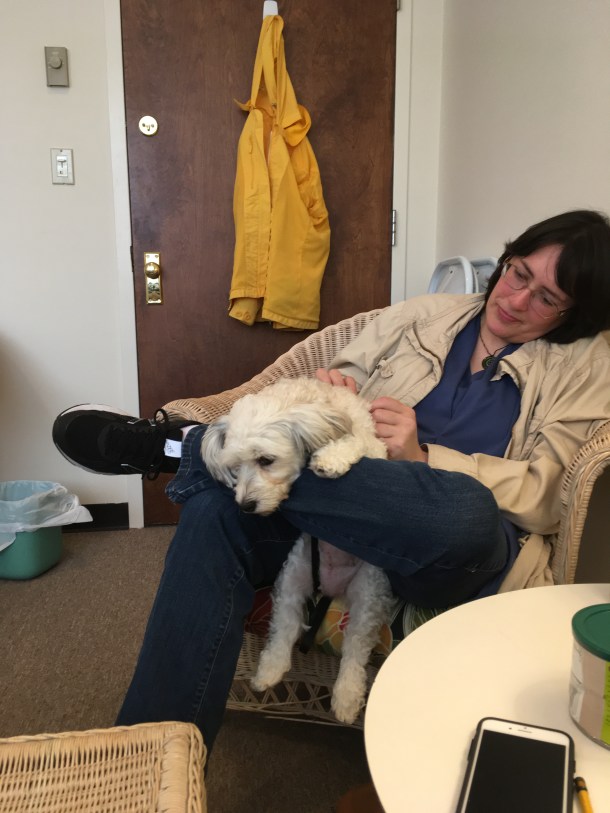
Ellie in therapy: thinking deeply.

I brought Cricket along with us to therapy one day, when my Mom had her quilting group in the city, and Cricket seemed forlorn at the thought of being left home alone. Cricket used to go to therapy with me herself, when she was a puppy, so she was thrilled to see her therapist again; so thrilled that she peed on the rug three times, and used the furniture, and my therapist, as a jungle gym, and then stole a chocolate-filled candy from the coffee table. All of this while Ellie sat calmly on my lap, bewildered.

Cricket does not believe that she is going to be twelve years old. Yes, she’s had occasional back trouble, and she takes CBD oil each morning to relieve general aches and pains, but she thinks she’s still a puppy, and the fact is, she is still as smart and stubborn as ever. I can see that she has slowed down over time, but that’s only because she used to be a raging speed demon and now she’s not dragging me down the street, as much. In her trip to therapy she forgot her age completely and went back to acting like the puppy she used to be: raging speed demon, excitement peeing, and all. I can’t afford to replace the office carpeting, though, so Cricket will be staying home from now on.

278

“Harrumph.”

Cricket is still clearly the boss around here. If there’s a plate on the floor, Ellie will run for it, until she sees Cricket out of the corner of her eye, and then she backs off and waits for permission, from Cricket, to lick up the leftovers. Though, Ellie has occasionally ignored her sister’s rules and elbowed for space, when there were scratchies on offer, but not too often.

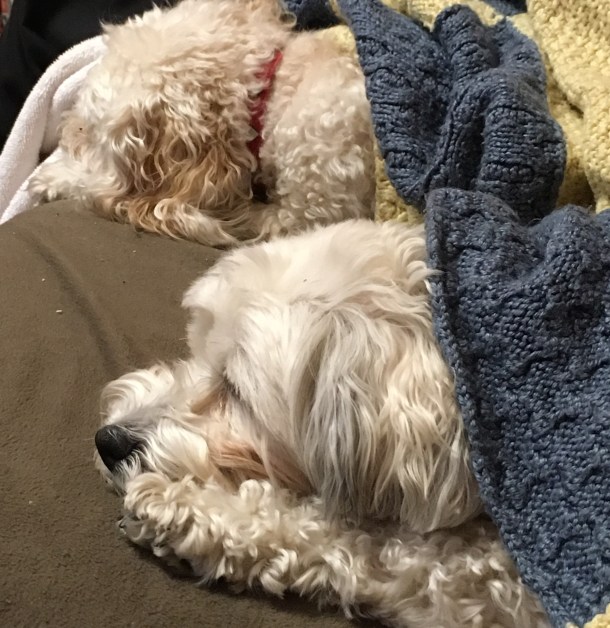
Ellie generally sleeps in my room, because Cricket won’t allow her up on Grandma’s bed, though Ellie has no problem sharing my bed with Cricket. They often take their afternoon naps with me, each staking out her own territory and stretching out. Ellie has tried to get Cricket to play with her, doing a play bow, or running circles around her out in the yard, but Cricket just gets confused. Cricket can play by herself, or with a human, but she doesn’t understand dog to dog play. It’s just too weird for her.

We will have to find a way to celebrate Cricket’s 12th birthday, and Ellie’s Gotcha day, and their sisterhood, all at once, in a way that Cricket will enjoy. Ideally, I would buy six or seven roasted chickens and hide them strategically around the backyard for the girls to find, but, there are other animals around here, and our yard isn’t fenced in, and, it’s possible that there is such a thing as too much chicken, even for my girls.

I’ll have to keep thinking about this. But in the meantime, I’m going to celebrate the fact that Ellie has made her way into our hearts, and made our world a warmer, happier, funnier place. And if Cricket wants to pretend that she’d be better off as an only dog, panting and shaking with separation anxiety each time we leave the apartment, she can certainly hold on to her illusions. But I know the truth.

261

“Shut up.”

If you haven’t had a chance yet, please check out my Amazon page and consider ordering the Kindle or Paperback version (or both!) of Yeshiva Girl. And if you feel called to write a review of the book on Amazon, or anywhere else, I’d be honored.

Yeshiva Girl is about a Jewish girl on Long Island named Izzy. Her father has been accused of inappropriate sexual behavior with one of his students, which he denies, but Izzy implicitly believes is true. Izzy’s father decides to send her to a co-ed Orthodox yeshiva for tenth grade, out of the blue, as if she’s the one who needs to be fixed. Izzy, in pain and looking for people she can trust, finds that religious people are much more complicated than she had expected. Some, like her father, may use religion as a place to hide, but others search for and find comfort, and community, and even enlightenment. The question is, what will Izzy find?


I Had a Cold


A couple of weeks ago, Mom came home from a day out in the city with a cold. It was brutal. The canine nurses and I worked around the clock to help her out of the sea of snot, and listened to an enormous amount of grumbling and whining (which is only fair, since Mom listens to a lot of grumbling from all of us on a daily basis). Of course, after Mom recovered, the cold passed on to me. I’d been dealing with allergies for weeks by then, so it took a while for me to recognize when it switched over, but when I found myself desperately searching for a new tissue box at four AM, I got the message.

IMG_1035.JPG

“Why are we awake?”

There’s something about a cold that, even as it wipes me out and makes me feel like I’m drowning and suffocating and clearly the most afflicted person on earth, I also feel like, but, it’s only a cold! I should still be getting stuff done!

This delusion could have something to do with years of hearing my brother say that it wasn’t fair that I got colds so often, and therefore got to stay home from school. One time he got Chicken Pox over winter break, and missed no school at all, and then, of course, little sister got sick the day we were supposed to go back to school. I heard a lot about how lazy I was, and how unfair it was that I got extra time with Mommy, and so many bowls of matzo ball soup.

So, deep into the cold, I started to obsess about what I should do if I finally get a job and then get a cold. Should I go to work anyway? At one of my internships we were told to never come in when we were sick; at the other internship, people came in to work with every imaginable germ and shared generously, on the assumption that it was more responsible to come in than to cancel appointments.

My brain went on and on, telling me how lazy I was for not running a marathon in the middle of the night, since I was up anyway, and created endless scenes of how one or another illness would get me fired from my imaginary job, and I would never be able to support myself, and I would suffer and struggle and fail for the rest of my days.

So, it was a few long, sleepless nights.

And then, as I started to recover from the cold, I found out that my friend’s son had pneumonia. It’s really hard to nurse a good case of self-pity for a cold when a little boy across the country has to deal with pneumonia. Though I still made the effort.

Now that I’m feeling better, I’ve been watching the dogs, in case either of them starts to have a drippy nose, or bad cough. I don’t even know if dogs can catch colds from humans. I’ve seen them eat tissues, but never sneeze into them.

IMG_1078

“What? It’s fiber.”

I’m not sure the dogs even noticed that I was sick, to be honest. It’s not like I’m a bundle of energy the rest of the time, and I still took them for walks (loading my pockets with tissues and sucking candies first, of course), and shared my food (I mean, it was chicken soup, how could I not share it?). They spent a lot of their time napping next to me and staring at me when I blew my nose (possibly because it woke them up). And they looked longingly at my Dayquil and Nyquil capsules, certain they were some new form of candy.

IMG_0913

“Candy?”

018

“Chicken?”

I don’t know of any way to avoid getting colds if you spend time around other humans, so I’m going to have to accept that getting sick will be a regular obstacle in my working life, and I will have to come to grips with the fallout, whatever it may be. I think the deeper fear the cold set off is that I will spend the majority of my working life dealing with the same disabling health issues I’ve dealt with during school and all of my writing-at-home years. And it will suck.

My next priority will be to learn how to not catastrophize at the smallest bump in the road, but the dogs are no help. They believe that the world is ending each time their people leave the house for five minutes; just imagine the horror when they find out I plan to go to work? For hours at a time!!!!

017

“What?!!!!!!”

If you haven’t had a chance yet, please check out my Amazon page and consider ordering the Kindle or Paperback version (or both!) of Yeshiva Girl. And if you feel called to write a review of the book on Amazon, or anywhere else, I’d be honored.

Yeshiva Girl is about a Jewish girl on Long Island named Izzy. Her father has been accused of inappropriate sexual behavior with one of his students, which he denies, but Izzy implicitly believes is true. Izzy’s father decides to send her to a co-ed Orthodox yeshiva for tenth grade, out of the blue, as if she’s the one who needs to be fixed. Izzy, in pain and looking for people she can trust, finds that religious people are much more complicated than she had expected. Some, like her father, may use religion as a place to hide, but others search for and find comfort, and community, and even enlightenment. The question is, what will Izzy find?


Going to sleepaway camp


Each summer, for five years in a row, starting when I was nine-years-old, I went away to a Jewish sleepaway camp for eight weeks. Me and Mom and my brother spent weeks ahead of time buying everything on the camp list: collapsible drinking cup, soap dish, seven pairs of shorts and shirts and underwear and so on, flashlight, bathing suits, flip flops, beach towel. And a trunk. We only had to buy those once, for the first summer, and then store them in the attic during the school year: a huge treasure chest-like box to fill with all of our stuff. Oh, and labels, everything we owned needed a name tag.

A few days after school ended for the year, in the last week of June, Mom drove me and my brother, and our trunks, to a nearby synagogue to catch the bus to camp. The bus ride itself was an orientation. First there was the sharp pain of watching Mommy stand in the parking lot, waving, as we drove further and further away. Then there were the bus songs – 99 bottles of beer on the wall, If I had a hammer, etc. We had counselors on our bus with us, to keep order and manage any traumas along the way, and I met my first new friend on the bus up to camp. She was blond and pretty and bossy, just like my best friend from home, and she started to talk to me right away and asked me to sit next to her on the bus. My brother proceeded to ignore me, almost entirely, as he would continue to do for the next eight weeks.

When we reached camp, we met up with our own counselors, and walked across campus to our bunks, while the maintenance men loaded our trunks and dropped them off on the porch of each bunk (after unloading each trunk we stowed them under the bunk for the summer). The counselors had to come out and meet each bus, and car, when their campers arrived, so back at the bunk we either had a junior counselor or our peers for company, which was not quite enough. I wasn’t really prepared to be away from my Mom, or to manage so many new relationships at once. The saving grace would be the daily schedule, there was almost always something we were supposed to be doing, just not on day one. We also had no TV and very few books, and this was long before smartphones, so socializing was our entertainment.

The blond girl from the bus turned out to be the most popular girl in our age group, and we were in the same bunk, so I was sort of initiated into the popular group right away. I had no idea what to make of that. They were sort of a girl posse, and one of the other new recruits was a nine-year-old outlaw, planning all kinds of trouble for the posse to get into. I was still me, though, and it became clear that I didn’t quite fit in with my new friends. I didn’t have the right clothes, or the attraction to danger, and I didn’t know how to flirt with boys. At first it was exhilarating to be with them, because finally I wasn’t the outcast, the way I was at school, and I wasn’t picked on (too badly). But then they started expecting me to be mean, to make fun of other girls and not just behind their backs, but to their faces.

IMG_0917

“Harrumph.”

I did it once, without realizing how awful it would feel until I was in it up to my knees. I was a good mimic (I still am, just ask Cricket), and they liked to have me play this and that character, like the male counselor with silly dance moves, or one of the boys who wiped his nose with the hem of his shirt, constantly. I loved the attention! I loved getting the laughs! And then they asked me to do an impression of one of the other girls who was sort of on the outs with the group at that moment. And I did it, because she had such obvious body language and her vocabulary was so specific and I could see the whole performance in my imagination without even trying. I felt like a super star, until I realized that she was suddenly there too, and instead of laughing with me, the other girls were sneering at her and using me as a weapon against her.

I stopped, but it was too late. I tried to apologize, but all that accomplished was getting me kicked out of the cool group; the other girl certainly didn’t forgive me.

I was alone for a few days, but then some new kids came for the second month (in the early years of camp we could choose to come for both months, first month, or second month), and I made some new friends. They were nicer and quieter and preferred playing jacks to getting into trouble. I got a few splinters because the floors of the bunks weren’t perfectly sanded, but there was something reassuring and satisfying about playing jacks. If you played fair and didn’t cheat and didn’t show off just because you were a better player, people stuck around.

img_0987.jpg

Friendship is a good thing.

I went to camp for four more years, but I was never put in the same bunk with the cool girls again, and they barely even looked at me, except for the blond girl from the bus. Every once in a while she’d look over at me with something like regret, but then she’d look back at her friends and shake it off and go back to her popular life.

And yet, I liked being at camp. I liked my less than popular friends. I liked always having something to do and someone to talk to. And if there was also loneliness and conflict and disappointment, well, I had that at home too, and at least at camp I felt normal. I had the same problems as everyone else: sunburn, sand in my shoes, friendship drama, cardboard pizza, too many chores, and homesickness. I think, if we could have had a bunk dog, and if my Mom could have visited every weekend, I’d have wanted to stay all year long.

img_1068.jpg

“I could be the camp dog!”

If you haven’t had a chance yet, please check out my Amazon page and consider ordering the Kindle or Paperback version (or both!) of Yeshiva Girl. And if you feel called to write a review of the book on Amazon, or anywhere else, I’d be honored.

Yeshiva Girl is about a Jewish girl on Long Island named Izzy. Her father has been accused of inappropriate sexual behavior with one of his students, which he denies, but Izzy implicitly believes is true. Izzy’s father decides to send her to a co-ed Orthodox yeshiva for tenth grade, out of the blue, as if she’s the one who needs to be fixed. Izzy, in pain and looking for people she can trust, finds that religious people are much more complicated than she had expected. Some, like her father, may use religion as a place to hide, but others search for and find comfort, and community, and even enlightenment. The question is, what will Izzy find?


The Onset of Air Conditioner Season


The onset of air conditioner season, and allergy season, seemed to merge this year, at least, here on Long Island. I’m used to sneezing, and having itchy eyes, despite daily allergy medication, and I knew the heat would be a problem for me, because it’s a problem every year, but this year it all added up to more than the sum of its parts, as a kind of conflagration under my skin. The allergies were worse. The heat, even the tiniest bit of it, made it hard for me to breathe. And then there was the pain, in too many places at once. Still in my neck and left shoulder, still in my lower back, right hip, knees and ankles, but also in my right shoulder, right forearm, and breast bone, making it hard to move around much, or breathe deeply, or rest comfortably.

IMG_1035

“Huh, we’re pretty comfortable.”


At first I thought it was all caused by depression, that I was having a somatic response to the stress of the job search. There’s always been a disturbing fluidity between my physical and psychological symptoms, making it hard to identify what’s going on, or what kind of treatment might help. But I noticed that I felt significantly better later in the day, as the air cooled and the inflammation receded, somewhat.

The flare, if that’s what it was, lasted about two weeks, and then I woke up one morning and I was able to breathe, and exercise, and even shave my legs! The dogs barely noticed the changes in the weather, or in me, and they seemed to enjoy chasing all of the allergens drifting in the air that were knocking me out like baseballs to the head.

040

“Yummy, yummy allergens!”

In the end, I went back to my normal level of disability, and was even able to focus enough to send a long essay to a few literary magazines. In the process of choosing where to send that piece, I looked through my list of submissions over the past few years, including the queries I sent to 78 agents, over a two year period, for a single novel. I didn’t realize how persistent I’d been in trying to get that novel out into the world. I thought I’d given up too easily. I keep thinking I’m giving up too soon, being too meek, and lazy, but it turns out that I haven’t been giving myself enough credit. The novel that was rejected by 78 agents is still sitting in my computer, waiting for the next revision, for which I already have substantial notes. And Yeshiva Girl, which spent a year or two looking for an agent, and then six years looking for a publisher, still found her way out into the world, because I persisted.

YG with Cricket

“What, this tasty paper thing?”


The pain, fatigue, and depression are bad, sometimes, but they pass, and I manage to push myself back on track, every time. I have to keep reminding myself that I’ve never given up, and there’s no reason to start now, even if, for a little while, the best thing to do is just to rest next to my air conditioner, with some soft pillows, and feel whatever I feel.

The dogs don’t seem to mind the company.

258

If you haven’t had a chance yet, please check out my Amazon page and consider ordering the Kindle or Paperback version (or both!) of Yeshiva Girl. And if you feel called to write a review of the book on Amazon, or anywhere else, I’d be honored.

Yeshiva Girl is about a Jewish girl on Long Island named Izzy. Her father has been accused of inappropriate sexual behavior with one of his students, which he denies, but Izzy implicitly believes is true. Izzy’s father decides to send her to a co-ed Orthodox yeshiva for tenth grade, out of the blue, as if she’s the one who needs to be fixed. Izzy, in pain and looking for people she can trust, finds that religious people are much more complicated than she had expected. Some, like her father, may use religion as a place to hide, but others search for and find comfort, and community, and even enlightenment. The question is, what will Izzy find?

From the Earth to the Moon

Mom and I left my childhood home when I was twenty-three-years-old. She was in the process of divorcing my father, but he didn’t plan to leave the house. Mom’s lawyer wanted her to stay in the house until the divorce was final, to avoid any penalty for “abandonment,” but I was clearly struggling. I’d finished college, but I couldn’t figure out how to move forward in any direction. My therapist spoke to Mom’s lawyer and said something along the lines of, if she stays she will die, so we left.

We had to find a place to live that we could afford, and that would accept Dina, our then eight-year-old black Lab mix. Mom had to get a new job in the city to afford the move, and I had to be on disability, because I really couldn’t function, and money had to come from somewhere, and it was not going to come from my father.

Dina

Dina, at the old house


Mom was scared, but I was paralyzed. I don’t think anyone other than Mom really understood that, at the time. Even my therapist thought I should be able to do more, or at least she told me I could, maybe to push me.

It was all humiliating and terrifying and confusing. I had lived in the same house for twenty-three years, seeing my father every day, and suddenly I was living somewhere new and never seeing my father at all. I thought he might try to call, or write, or even stalk me, but he didn’t. I could hear his voice calling up the stairs in the middle of the night, but it wasn’t real, just a hallucination.

We found a half a house to rent, where Mom could use the front yard to plant whatever she wanted. That was her way of healing. Mine was watching TV. I would break up my day with television shows, forcing myself to write until one show came on, and then exercise until the next one, and then walk Dina, and make dinner, all on my TV schedule.


I wasn’t in school, I didn’t have a job, but I went to therapy twice a week and spent hours every day writing through all of the pain – picking apart my dreams, going through my memories from each year of my life, trying to excavate each molecule of pain and confusion so that I could find a way forward. It was, in its way, a full time job.

My one blissful escape was a miniseries that started to air on HBO as soon as we moved into the apartment, on Sunday nights, called From the Earth to the Moon, starring and co-produced by Tom Hanks. It told the story of the Apollo program at NASA in the 1960’s and 70’s (I had remembered Steven Spielberg as being a part of it, but Wikipedia says I was wrong). I thought of Tom Hanks and Steven Spielberg as my two ideal dads. I was always looking for good fathers, my whole life, and I needed them extra at that moment.

from the earth to the moon

The analogy of striking out from the solid ground of earth out to the unknown of the moon resonated with my situation. I had to believe there was something out there, something worth finding. I was out in the middle of space, with so few landmarks to tell me where to go, and there was Tom Hanks, experiencing the same things. And succeeding.

I’d never been much of a space or science nerd, though Star Wars was an important touchstone for me, and I’d never thought much about the moon or astronauts or NASA. I didn’t want to be a daredevil pilot, or an engineer, or a scientist, and I wasn’t fascinated by space shuttles or computers. But I watched each episode and absorbed the sense of wonder that came through the TV screen. It was such a relief to spend time with people who believed in the future and the next small step forward. For a little while, each Sunday night, I felt like I was living on their life support machine, and it was enough to get me through. It was just enough.

As the weeks passed, I learned small things, like how to breathe in the smell of honey in the air when I walked Dina around our new neighborhood; how to smile at the librarian when she smiled at me as I checked out books at my new library. Every lesson was a small step, sometimes invisible even to me, but it was enough to keep me going, even when I didn’t think I could ever leave the apartment, or answer the phone, or talk to a stranger.

rachel and dina walk

Me and Dina walking by the water

I knew that people would not understand what was wrong with me, because I kept hearing people say that I wasn’t trying hard enough, and that I could do more if I weren’t so selfish and lazy. If only my mom would expect more of me; if only I would pull myself up by my bootstraps, if only I would lower my expectations, I would be alright. But they were wrong. I was doing what I could do.

The shame I felt, being twenty three and non-functional, was overwhelming. I’d already felt awful for not graduating from college until I was twenty two, because I had dropped out of two or three schools before I was able to stick to one for four years. But shame was a lifelong thing for me, and it just shape-shifted to fit whatever I thought was wrong with me at the time.

Dina and I were a good pair, because she had all kinds of fears too. She had severe separation anxiety, and fear of small children and most moving objects. She’d had false pregnancies on a regular basis until we left my father’s house and finally had her spayed (my father wouldn’t allow it). The two of us took long, exhausting walks up and down the hills of our new neighborhood, and then huddled together indoors for mutual support. We even walked to therapy together, maybe three miles, so that we could each work through our own issues. She ended up living to sixteen years and two months old, incredible for a dog of her size, and with her long list of psychological disorders, and it gave me hope. The moon is still out there, waiting for me, and you never know, I might reach it one day.

dina smiles

Dina, later in her life, and happier

If you haven’t had a chance yet, please check out my Amazon page and consider ordering the Kindle or Paperback version (or both!) of Yeshiva Girl. And if you feel called to write a review of the book on Amazon, or anywhere else, I’d be honored.

Yeshiva Girl is about a Jewish girl on Long Island named Izzy. Her father has been accused of inappropriate sexual behavior with one of his students, which he denies, but Izzy implicitly believes is true. Izzy’s father decides to send her to a co-ed Orthodox yeshiva for tenth grade, out of the blue, as if she’s the one who needs to be fixed. Izzy, in pain and looking for people she can trust, finds that religious people are much more complicated than she had expected. Some, like her father, may use religion as a place to hide, but others search for and find comfort, and community, and even enlightenment. The question is, what will Izzy find?