Tag Archives: Jewish

The Harmony


When I was eight years old or so, I started going to Saturday morning services in the big sanctuary at my Conservative synagogue. Most of the children in our synagogue went to junior congregation on Saturday mornings, for an hour of prayers and trivia games, meant to fit in between morning cartoons and afternoon gymnastics or computer classes. My brother and I went from the short children’s services in the tiny blue sanctuary, to the long adult services in the cavernous, stained-glass spectacle of the big sanctuary. And we loved it, or at least I loved it. The prayers were more complex, the congregants were happier to be there; but, for me, most of all, there were the harmonies.

295

Harmony, like this.

We had a female Torah reader, along with our male cantor, who sat with us in the congregation, except for when she had to go up to chant the Torah. When I was older, she taught me how to chant from the Torah for my Bat Mitzvah, and taught me the different chant for the Haftorah, and for the reading of the Megillah on Purim, but every week, during Saturday morning services in the big sanctuary, she taught me that there was such a thing as harmony. I learned by singing along with her, and somehow it made the songs sound deeper, and truer, and more complete. More than thirty years later I still sing her harmonies without a second thought.

This year, I finally sang with the choir at my synagogue, as an alto, during the High Holidays. The fasting and prayer and atonement, and the endless standing, of the long day of Yom Kippur is meant to be the final lap of the marathon; the gasping, I-don’t-know-if-I’ll-survive, final effort to change course before the rest of the year begins. But it’s not the repentance, or the fasting, or the standing that makes Yom Kippur powerful for me. In fact, if it were only that I would feel dimmed and darkened by the holiday. No, it’s the communal effort of it all, and the way we create energy and joy together, all of us participating – singing, reading, opening the ark, dressing the Torah, carrying it; for some, just the act of coming into the sanctuary to be with the community for hours at a time.

We read poetry and prose during the services at my synagogue, to dig into the crevices and corners of the prayers that we might otherwise ignore as we push our way through the service. This year we read part of an essay by a Reconstructionist Rabbi named Sandy Eisenberg Sasso, called Soul-AR Eclipse, about how we absorb so much of our loved ones that when they die they don’t totally leave us. I believe this. I’ve taken in so much from the people around me, some good for me, some not so good, but they’ve become so much a part of me that even when they are far away, they seem close by.

011

Butterfly

dina smiles

Dina

And I think that’s what happened this year as I was singing with the choir. This woman who hasn’t been in my life for many years, was standing right next to me, even singing through me. I felt like an eight-year-old again, singing harmonies, and filled with awe for the music, and the all-of-us. So many years ago she taught me that music can connect us, and help us to express the all-of-it, not just the happiness or the devotion, but everything we feel and can’t find any other way to say. I couldn’t name the feeling at the time, but I felt such relief singing those harmonies, knowing that music could be a conversation, even within myself.

Towards the end of Yom Kippur I went up onto the bima to read a poem by Linda Pastan. I didn’t know why I’d chosen that poem, except that it was one of the shorter readings available, until I read the last lines to the congregation and finally heard the words fully:

“When my griefs sing to me

From the bright throats of thrushes

I sing back.”


And I realized, yes, that’s what I do. I sing back. I sing in conversation with grief. I sing in response to grief. No matter what, I sing. And I’ve been doing it for a very long time.

003

Cricket sings too!

If you haven’t had a chance yet, please check out my Young Adult novel, Yeshiva Girl, on Amazon. And if you feel called to write a review of the book, on Amazon, or anywhere else, I’d be honored.

Yeshiva Girl is about a Jewish teenager on Long Island, named Isabel, though her father calls her Jezebel. Her father has been accused of inappropriate sexual behavior with one of his students, which he denies, but Izzy implicitly believes it’s true. As a result of his problems, her father sends her to a co-ed Orthodox yeshiva for tenth grade, out of the blue, and Izzy and her mother can’t figure out how to prevent it. At Yeshiva, though, Izzy finds that religious people are much more complicated than she had expected. Some, like her father, may use religion as a place to hide, but others search for and find comfort, and community, and even enlightenment. The question is, what will Izzy find?


Nonbinary Hebrew


I’ve been told, for years, that things are never all black or all white, but shades of gray in between. And I believe that. But I didn’t consider that these shades of grey could be applied to gender as well. The subject came up recently at my synagogue, when the clergy added their preferred pronouns onto their email signatures. None of the clergy members identify as nonbinary, but there are young people in the congregation who do, and this addition was meant as a sign of respect for them.

This is all new to me, and I’m still not sure I understand why someone would identify as nonbinary, rather than seeing themselves as a woman with some traditionally masculine qualities, or a man with some traditionally feminine qualities. But I realized quickly that I would need to think about this in more depth now that I’m teaching in the synagogue school, because Hebrew is a gendered language, like Spanish and French, and there are no clear ways to refer to a person who is nonbinary. Even if none of my students identifies as nonbinary yet, they may have family members who do.

English, surprisingly, is a much more egalitarian language than most, and nonbinary individuals have taken to using the pronoun “they” to describe themselves. The flexibility of the language, and the constant additions that have made English so hard to learn have also made it more capable of meeting our needs as society evolves. Hebrew, on the other hand, is an old language based in a male-dominated culture. If there is one man in a group and the rest are women, we have to use the Hebrew word for “men,” period. If a group of children is equally mixed between boys and girls, we have to use the Hebrew word for “boys” to describe the whole group, because there is no non-gendered word for “children.” This gender preference shows up in all of the Hebrew prayers, which led me to the obvious conclusion, growing up, that God must be a Man.

067

“That’s ridiculous.”

When I first read some Hebrew blessings written in female language, a few years back, I felt wildly uncomfortable. It just sounded so strange! And I’m not the only one who found the change uncomfortable, and unsustainable. Women have been trying to push the Hebrew language into more gender equality for decades, without much success.

This whole topic feels prickly and uncomfortable for me, because I default to male gender words in Hebrew without thinking twice. I automatically say boys or men, or refer to male doctors or teachers. And even when I say or write “I” sentences, as part of my refresher Hebrew lessons, I default to male verbs automatically, because it doesn’t occur to me that I might be talking about myself.

281

“What about dog words? Is Hebrew all people-centric too?”

I decided to search online to see how other people have been addressing this issue and I found a few articles about a student at the University of Colorado at Boulder who worked with their Hebrew professor to come up with a possible non-gendered addition to the Hebrew language. The two of them were inspired by the introduction of gender neutral terms in Spanish (though I haven’t come across these in my Spanish lessons so far, and only recently heard the term “Latinx” to refer to people of Latin American descent without referring to gender). The system the teacher and student came up with adds a neutral gender pronoun to Hebrew, and a way to construct gender neutral conjugations, at least in the present tense.

This new system has been controversial, and people have found it hard to learn. It’s also not the only attempt to address this problem. A Jewish summer camp in the States (not the one I went to) came up with another gender neutral term, specifically for “Camper,” in Hebrew, though they don’t seem to have gone further than that into adding new conjugations. It’s hard to know if either of these ideas will generalize to society at large, or if a new system will be inspired by them, or if none will take off at all.

And the fact is, it’s been hard for me to get used to using the word “They” to refer to an individual, in English, so I can’t imagine the discomfort Hebrew speakers must feel at being told to learn a whole new system in order to speak their own language correctly. But if we leave things as they are, with no gender neutral terms, where does that leave the people who feel like neither gender describes them? How can they ever feel accepted if they can’t be referred to correctly by their communities?

244

“Now you know how I feel. You keep calling me a dog. It’s rude.”

As a society, we make so many assumptions and have so many expectations about ourselves that are attached to gender. Would that change if we all used gender neutral language? Would we lose something that makes our lives meaningful by referring less often to gender? I don’t know. I’ve always considered myself female, and despite whatever discomfort I have with societal expectations of women it still seems like an accurate description of how I experience my gender. But it intrigues me to think about this question, of how much might be roiling under the surface of this dilemma of language. How much of our lives have actually been determined by the language we use to describe ourselves? And what kinds of surprises might we find if we take some small steps towards change?

YG with Cricket

If you haven’t had a chance yet, please check out my Young Adult novel, Yeshiva Girl, on Amazon. And if you feel called to write a review of the book, on Amazon, or anywhere else, I’d be honored.

Yeshiva Girl is about a Jewish teenager on Long Island, named Isabel, though her father calls her Jezebel. Her father has been accused of inappropriate sexual behavior with one of his students, which he denies, but Izzy implicitly believes it’s true. As a result of his problems, her father sends her to a co-ed Orthodox yeshiva for tenth grade, out of the blue, and Izzy and her mother can’t figure out how to prevent it. At Yeshiva, though, Izzy finds that religious people are much more complicated than she had expected. Some, like her father, may use religion as a place to hide, but others search for and find comfort, and community, and even enlightenment. The question is, what will Izzy find?


The Bird’s Visit

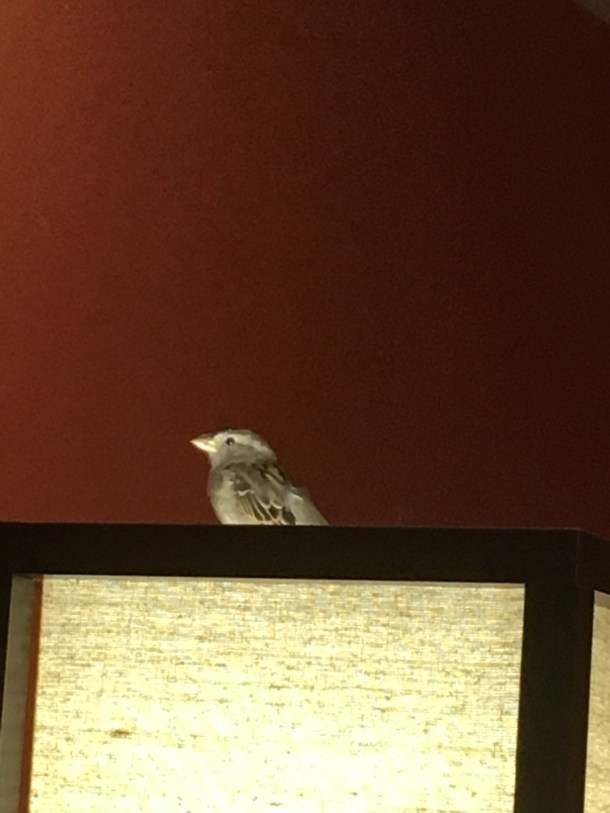
During the days between Rosh Hashanah and Yom Kippur (the Days of Awe) a bird came to visit my apartment. She showed up midday on Saturday; she was just there when I came back in from walking the dogs, flapping her wings against the inside of the living room window, inches away from the space where she must have accidentally come in (there’s a space next to the air conditioner that Mom uses to give the neighborhood birds their snacks). I tried to show the bird the exit, as gently as possible, but she ignored me.

IMG_1218

“I’m staying.”

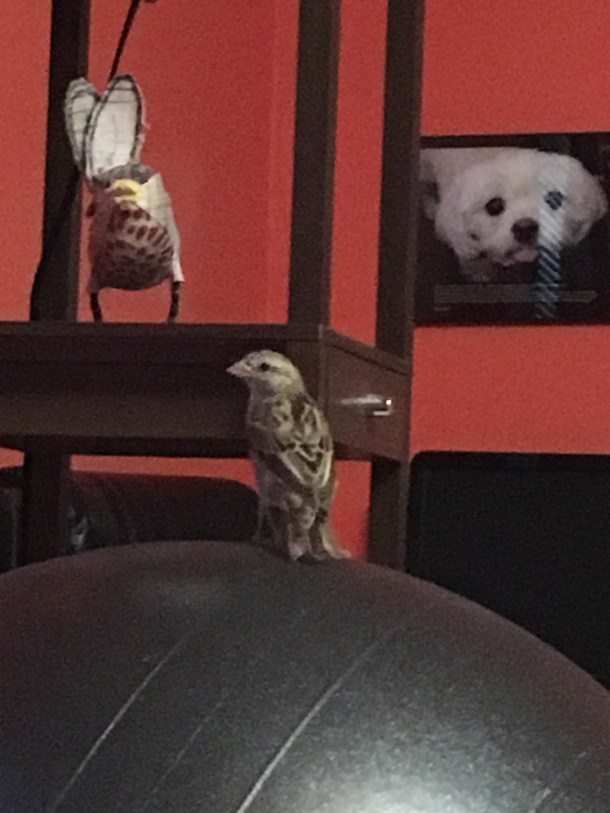
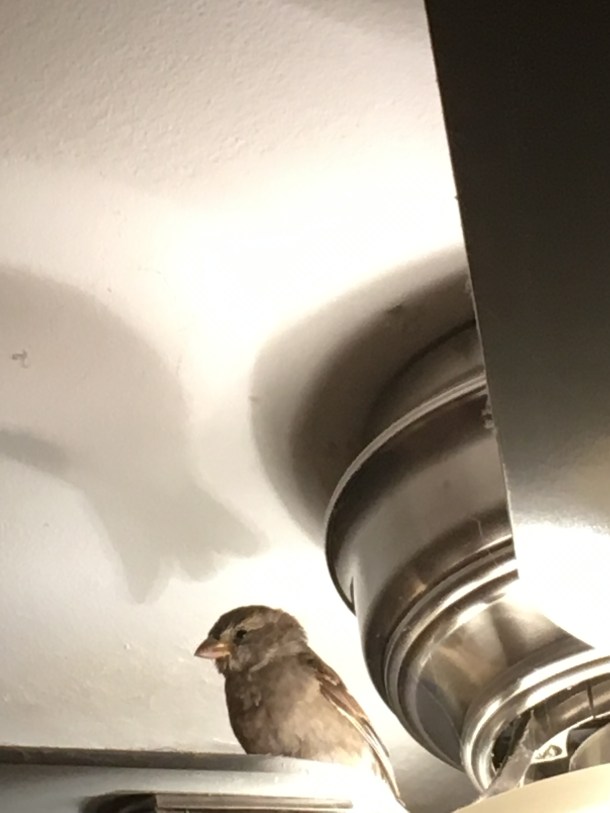
I, of course, took pictures of her flying around the apartment, from light fixture to curtain rod to picture frame, thinking she would be leaving at any moment. And when I left to pick up Mom from the train (she’d been out quilting with friends for the day), I was sure the bird would be gone when we returned. But she was still there, and Mom said that she was a (female) house sparrow, based on her size and markings.

We put a few pieces of challah on the window sill in the living room, to show her the way back outside, but the bird picked up each piece of bread and flew it to her safe place (a wooden loom on top of Mom’s bookcase) and ate in peace. Then she took a nap, head curled into her neck, half hidden behind the living room curtain.

sparrow sleeping cropped

Sleeping birdie.

We were sure she would be gone by morning, after her meal and a long nap indoors, but she woke me up at seven thirty the next morning with a big squawk. She had ventured out of the living room at some point and found her way into my room. And decided she needed company; and that her company should be awake.

sparrow with stuffed animals

“Something is very wrong with these animals.”

When we all decamped to the living room for breakfast, and the CBS Sunday morning show (Mom watches the whole show just to see the moment of nature at the end), the bird followed. She was very entertaining. She flew back and forth from the kitchen to the dining room to the living room, doing her own version of dog zoomies. She shared Mom’s breakfast (Mom got a picture of the bird eating challah on the kitchen counter), and pooped in all kinds of new places.

IMG_1268

“Don’t poop on me, Birdie.”

Later, the bird even followed me into the bathroom when I went to take a shower (I didn’t notice she was there until too late, but she was kind enough to wait for me on top of the medicine cabinet instead of hanging out in the shower with me. Small favors). Cricket was waiting right outside the bathroom door afterward, horrified.

IMG_0930

“Aaaaack!!!”

By the thirtieth hour of the bird’s visit, Mom was getting worried. She’d reached out to her cyber community and was reminded of the health risks of having a wild bird in the house, because of the poop she seemed to drop any and everywhere. So we removed all traces of food from the kitchen counters, and even got rid of the bread for the outdoor birds. But the bird decided to try the kibble left in the dogs’ bowls, and then she checked the living room floor for any crumbs the dogs might have left behind. Cricket started to notice the invasion at that point, because it was one thing to have a bird flying around in the light fixtures, but something completely different to have a bird calmly walking along the floor, trying to share her food. Cricket’s food is sacrosanct, just ask Ellie.

281

“It’s true.”

IMG_1272

“Now where did that fluffy monster hide the treats?”

When it was time to go to sleep for the night, the bird set herself up on her wooden loom again, and she was still there the next morning, though she was kind enough not to wake me up this time. I do prefer to sleep as late as I can.

IMG_1280

Butterfly watching over Birdie’s meeting with Canada bird.

I was seconds away from naming her (Tzippy, short for Tzipporah, Hebrew for female bird) when the bird finally left. Mom plugged the hole next to the air conditioner with a tissue, to discourage her from coming back in, but the bird seemed to have finished her visit by then and didn’t return. There had been a lot of extra squawking outside the windows that morning, maybe from her family or friends, telling her that she needed to come back out to the real world.


The depression I felt after the bird left was pervasive. I felt like we’d exiled her. Yes, she pooped everywhere, and didn’t clean up after herself; and yes, she woke me up too early in the morning; and yes, Cricket was getting annoyed with her. But she made me feel special, just by being there. She made me feel chosen.

There’s a moment in the prayer service at my synagogue where we put our arms around each other to say the Priestly Blessing, as a way to celebrate family and community ties. It took me a few years to get used to all of the touching and closeness involved in that blessing, but for the forty-some-odd hours while the bird was staying with us, I felt like she was holding out her wings to be included in our little family group: singing the blessing with us, arm in arm.

And I felt blessed, and full of awe. We focus so much on self-examination and looking for the sins we need to atone for during the High Holiday season, but the bird reminded me that sometimes there’s nothing to atone for. Sometimes your assessment can tell you that you are on track and you are loved, and that you deserve the visit of a little bird to remind you that every day can be full of awe, if you pay attention.

IMG_1247

Bye bye Birdie.


If you haven’t had a chance yet, please check out my Young Adult novel, Yeshiva Girl, on Amazon. And if you feel called to write a review of the book, on Amazon, or anywhere else, I’d be honored.

Yeshiva Girl is about a Jewish teenager on Long Island, named Isabel, though her father calls her Jezebel. Her father has been accused of inappropriate sexual behavior with one of his students, which he denies, but Izzy implicitly believes it’s true. As a result of his problems, her father sends her to a co-ed Orthodox yeshiva for tenth grade, out of the blue, and Izzy and her mother can’t figure out how to prevent it. At Yeshiva, though, Izzy finds that religious people are much more complicated than she had expected. Some, like her father, may use religion as a place to hide, but others search for and find comfort, and community, and even enlightenment. The question is, what will Izzy find?


I Seem To Be a Teacher


The same week that I started teaching at synagogue school, I also ran a writing workshop on blessings at my synagogue. The combination allowed me to see very clearly how much easier it is to teach adults, and how much trouble I seem to have gotten myself into.

Things were a bit chaotic on the first day of synagogue school, because we only had partial class lists (most families register late, but the kids show up on the first day anyway), and the building was still a construction site, and, oh yeah, I’d never done anything like this before in my life!

It’s important to say that afterschool synagogue school is a unique set of circumstances: even the most well-behaved kids hit four o’clock and lose their minds; they can’t sit still; they have an enormous amount to say after keeping quiet most of the day; and they don’t really have room in their brains to fit in any more information. Desks are for climbing, other children are for bothering, and there’s a competition for who can say the nastiest things to the teacher – which would be me. It’s a joy!

I drove home after my first two hours of teaching in a state of shock. I felt like I’d been hit by a truck. On top of the chaos, the classroom was too warm, and early on, I realized I would not be one of those teachers who stands the entire time. But I didn’t vomit or faint, so that was a plus.

257

The girls were vicariously exhausted.

And, despite some rough spots, I actually did some real teaching (I know, because without realizing it the kids repeated things I’d said in week one when they came back for week two. They would be horrified to know this, so don’t tell them). The second day with the kids went much better than the first. We even came up with some ways to manage their extra energy: like standing behind their desks when they couldn’t sit still anymore, dance breaks, and even a little bit of Pachelbel Canon in D (“Ugh! Classical music!”), helped them get through it.

The blessings workshop, with the adults, two days later, was like a walk in the park on a cool day compared to synagogue school. We had ten people around the table, and everyone participated, and shared their blessings, and listened to everyone else with interest. The workshop was based on a post I did on the blog a few months ago (or the post was based on the work I was doing to build the workshop), with prompts for different categories of blessings, and an overall intention to help empower people to trust their own voices along with the voices of tradition. It went well enough that now I have to prepare for a new workshop on blessings leading up to Passover. I have six months, so I’m not too worried, yet.

281

“I’m worried for you.”

The thing is, the one career I was sure I didn’t want was teaching. It’s not that I expected to be bad at it, exactly. No, the real problem was that my father was a teacher, and I was afraid to be anything like him; or accused of being like him. My father was accused, multiple times, of inappropriate sexual contact with his students, so the idea of teaching and of going to jail seemed tied together in my mind from very early on. When people told me to get a PhD, in something, and become a professor, or teach writing after I got my MFA, I said no. I was too scared. What if I was accused of hurting someone? What if I actually hurt someone? What if I said the wrong thing? Or failed to be a good enough teacher? In my mind, I could go to jail for boring my students, or raising my voice, or just being in a bad mood, because my father’s paranoid ramblings at the dinner table suggested that that’s the kind of thing he’d done wrong, if anything. Even after I understood that my father was truly guilty of a crime, and had caused real harm to his students, I couldn’t uncross the wires in my brain around teaching.

Unfortunately, I never had a chance to see my grandfather in the classroom. He taught high school Consumer Education, and was the principal of an afterschool Hebrew school, but he died at age eighty, when I was eight years old, and he wasn’t in good health for the last years of his life, so his teaching was just a story I was told, not an experience I could draw from.

And yet, people kept telling me I’d make a good teacher, or even assumed that I already was a teacher (I’m something of a know it all), and I couldn’t shake the idea that this was the path not taken. When the chance to teach synagogue school came up a lot of internal bells started ringing, telling me that I had to at least try.

The dogs have offered to help me test out some of my ideas, and they keep reminding me that chicken treats are great motivators and that leashes are very reassuring (though I’m pretty sure that wisdom won’t translate especially well to human children). On the other hand, they are great at comforting and distracting me when I get home. They’ve always been wonderful at reminding me that I am loved.

249

“I love you, Mommy!”

244

Cricket is thinking about it.

I’m still overwhelmed with too many ideas for what to teach, and how to teach it, and I can’t fit even a quarter of my ideas into my actual classes. And I’m still comparing myself too much with other teachers, and feeling less than. But I am, slowly, developing more realistic expectations of myself. It will take some time to learn about classroom management, and how to not take the kids’ comments personally. But for now I seem to be teaching, and sometimes even enjoying it. And, maybe someday, I might even be good at it.

067

“Really?”


If you haven’t had a chance yet, please check out my Young Adult novel, Yeshiva Girl, on Amazon. And if you feel called to write a review of the book, on Amazon, or anywhere else, I’d be honored.

Yeshiva Girl is about a Jewish teenager on Long Island, named Isabel, though her father calls her Jezebel. Her father has been accused of inappropriate sexual behavior with one of his students, which he denies, but Izzy implicitly believes it’s true. As a result of his problems, her father sends her to a co-ed Orthodox yeshiva for tenth grade, out of the blue, and Izzy and her mother can’t figure out how to prevent it. At Yeshiva, though, Izzy finds that religious people are much more complicated than she had expected. Some, like her father, may use religion as a place to hide, but others search for and find comfort, and community, and even enlightenment. The question is, what will Izzy find?


A Summer of Singing


At the first official choir rehearsal for the Jewish High Holidays (Rosh Hashanah and Yom Kippur, starting Sunday night, September 29th), I received a loose-leaf full of music from the choir director. Most of the other choir members have been there for years (some for over thirty years), so while they mostly had to show up at rehearsals and sing, I had to take my loose-leaf home and study. Even the songs I thought I knew had to be relearned, because I was used to singing the melody with the congregation, and now I was singing the harmony with the other altos.

IMG_1035

“Do you really have to sing that again?”

The music kept repeating in my head all summer long. I knew my brain was doing this to be helpful, so that I could learn what I needed to learn in a hurry, but it meant that I was drowning in melancholy music for months. I couldn’t even escape it while I was sleeping.

The dogs are probably sick of hearing about repentance and atonement, but they seemed to like finally being able to participate in synagogue services, in their own way, in their own home. When the summer rehearsals started, I spent a lot of time being mute and grumpy, because I couldn’t sing along. But after months of studying I’ve learned most of the songs, and even figured out how not to be completely distracted by the other voices around me.

img_0510

Except for Cricket’s voice. That still distracts me.

Starting in September we had choir rehearsals once a week, and by then I knew most of the music, though some things were still beyond me, especially the songs where the altos just sing the oohs and ahhs in the background (it’s so hard to learn the music without words to hang the notes on!). There are a few pieces of music that still confound me, especially one that requires us to sing ten notes on one word, over and over again. I get three notes in and then shut my mouth and wait.

249

“I’ll sing for you, Mommy!”

Unfortunately, no one seems to have noticed all of the progress I’ve made, even though I make a point of singing out when I know what I’m doing. Maybe they think it was as easy for me to learn all of the music, or they forgot that I’m new to the choir altogether. I was kind of hoping for some praise; you now, gold star stickers to put on my loose-leaf, something like that. Maybe someday.

One very lucky break is that our temporary conductor is one of the altos, so she has been able to help us out with finding notes and some much needed attention. She also has her own interpretive dance style of conducting that’s really easy to follow, so that even when I’m looking down at the music and can only see out of the corner of my eye, I can understand what she’s telling us.

54 - wow, what's next

“I bet I could lead a choir!”

For the High Holidays, the choir will be sitting on a raised platform, in our newly redone sanctuary, and I am not looking forward to that. I’m used to being mostly invisible in the crowd at the high holidays, able to be grumpy or tired or whatever I am in relative obscurity. But this year I will be on public view, so I may have to put on a happy – or at least normal – face. This is also when I start to wish I’d lost more weight already, and bought a whole new wardrobe, and maybe had plastic surgery, because otherwise I just look like me. We don’t even get to wear robes to hide behind.

The biggest downside of being in the choir is that I can’t sit with Mom during the services. Hopefully she’ll be able to sit near the choir area, so that I can roll my eyes at her discreetly during the services. I think it might be frowned upon if I actually took out my cellphone to text my ongoing commentary during the services, but it might come to that. I mean, these are long services, and I have a lot to say!

017

“Do you? We never noticed.”

I’ve made some friends among the altos, though, so I should be able to nudge someone and whisper when something especially ridiculous happens. Which, of course, it will. With a new sound system, and echoing acoustics, and everyone stuffed together in one big room trying to express all of the repentance and atonement and misplaced guilt of a whole year, laughing fits are inevitable.

I wish you all a Shana Tovah U’Metukah (a good and sweet new year) with as much laughter as possible!

Happy New Year!

295


If you haven’t had a chance yet, please check out my Young Adult novel, Yeshiva Girl, on Amazon. And if you feel called to write a review of the book, on Amazon, or anywhere else, I’d be honored.

Yeshiva Girl is about a Jewish teenager on Long Island, named Isabel, though her father calls her Jezebel. Her father has been accused of inappropriate sexual behavior with one of his students, which he denies, but Izzy implicitly believes it’s true. As a result of his problems, her father sends her to a co-ed Orthodox yeshiva for tenth grade, out of the blue, and Izzy and her mother can’t figure out how to prevent it. At Yeshiva, though, Izzy finds that religious people are much more complicated than she had expected. Some, like her father, may use religion as a place to hide, but others search for and find comfort, and community, and even enlightenment. The question is, what will Izzy find?



The Last Summer at Camp


During my last summer at sleep away camp, at age thirteen, we had a strange outbreak of mosquitoes. We weren’t allowed to go in the lake for two weeks, and the mosquitoes were in pretty much every breath of air we breathed. I don’t know if it was an early case of West Nile Virus or something else they didn’t bother to explain, but I had to sleep in jeans and a sweatshirt, in ninety degree weather, to try to keep the mosquitoes at bay.

IMG_0887

“That sounds bad. I’m worried about this story.”

It was already a very, very bad summer for me. I’d begged to stay home, or better yet, go to California. I had this idea about California that wasn’t based on anything I can remember, except that it wasn’t home. I think my best friend at the time had been talking a lot about going to California for some reason, and she either went to California, or to Israel that summer, to visit family.

IMG_0917

“Oy. It’s getting worse.”

I was deeply depressed, irritable, anxious, and uncomfortable 24 hours a day. I’d lost weight (this was pre-anorexia, so I was normal thin, not skinny yet), and had some pretty outfits, and I’d assumed this would make me happy, but it actually made things worse.

Sex was everywhere in camp. There were a lot of rape accusations (all true as far as I could tell, but not taken seriously by the counselors, who were eighteen and nineteen years old, or the administration, who had no excuse). There was a lot of dating and flirting and coupling. I would not have been able to tell you why it was all so awful to me at the time. I couldn’t explain why I felt so thoroughly under attack. I’d had some memories of the sexual abuse by then, in vague images and awful feelings, but I didn’t know what it was, or what to do with it.

My parents came up on visiting day and I was sure they were going to take me home, but instead, my father announced that they were going to Israel in a few days and wouldn’t be back until it was time for me to come home from camp. And I couldn’t go with them. I screamed and cried and he took a picture of me, inconsolable (he framed it and put it up in the downstairs hallway in our house, where it stayed for years).

067

“Told ya.”

After the mosquito drama, or before it maybe (time was confusing that summer), the counselors took my age group on an overnight campout on a hill. It was coed, with the counselors down at the bottom of the hill, out of ear shot. None of this had been made clear ahead of time. There was at least one rape that night, but I only knew about it because it happened to a friend of mine. I have no idea what else happened, but we were a group of thirteen year old boys and girls without supervision, so I can guess. Someone stepped on my hand in the middle of the night, and no one seemed to notice when I screamed.

No one listened when I ranted about the campout for the next few days, because everyone else seemed to think that a coed sleepover for thirteen-year-olds was totally fine. I was the prude and the hysteric. And the fact is, I couldn’t explain why I was so angry about it when no one else had a word to say, except for the girls who whispered in my ear about rape, on the hill, and on other days and at other times, but refused to go to the administration, or to let me go for them.

None of the rapes, or attempted rapes, happened to me. I barely even touched a boy all summer. But the lack of concern from the adults enraged me. The counselors suggested that my problem was that I was too mature for my age group, and that was why I was so uncomfortable. My opinion was that I needed to walk home from camp, even if it took the rest of the summer. But I was too afraid, and had no money, and that made me feel powerless.


When a twelve-year-old girl was sent home because she had accused two boys of forcing her to give them blow jobs – and no one believed her, because, How can you force someone to give a blow job, really it’s the boys who were raped – I realized I was never going back to that camp.

And it was a terrible loss. The thing is, I’d never really been safe anywhere else. I was sexually abused at home and at my childhood best friend’s house. I was bullied at school. Camp was the one place that felt normal, where I could work through the kinds of painful experiences that everyone else had to go through too. It wasn’t a great joy, but it was a place where I had learned how to make friends, and set boundaries, and argue, and swim. But once sex became an issue, for me and for my peers, camp was no longer safe for me, with my abuse history. Maybe if they’d had better policies in place for how to handle problematic behaviors, or if the counselors were better trained, or if the adults had taken on more of an oversight role, things would have been different. But maybe not.

032

“I’m sorry, Mommy.”

Usually Mom drove to camp to pick me up at the end of the summer, but this time she arranged for me to go home with another Mom from our area and two of her daughters, because of her late return from Israel with my father. I felt really sick to my stomach on the drive, but I didn’t know the Mom or the girls well enough to say anything. When I finally got home I ran upstairs and barely made it to the bathroom in time, throwing up in the sink. I kept throwing up for the next two days, and by the time school started a week and a half later, I wasn’t eating much at all. My body felt like it had been filled with poison, and I didn’t want to risk adding more. Within weeks I was basically anorexic, and that seemed to help keep the poison at bay. By then I didn’t just want to be skinny anymore, I wanted to be invisible.


51WewBFUZ5L._AC_US218_

If you haven’t had a chance yet, please check out my Amazon page and consider ordering the Kindle or Paperback version (or both!) of Yeshiva Girl. And if you feel called to write a review of the book on Amazon, or anywhere else, I’d be honored.

Yeshiva Girl is about a Jewish girl on Long Island named Izzy. Her father has been accused of inappropriate sexual behavior with one of his students, which he denies, but Izzy implicitly believes is true. Izzy’s father decides to send her to a co-ed Orthodox yeshiva for tenth grade, out of the blue, as if she’s the one who needs to be fixed. Izzy, in pain and looking for people she can trust, finds that religious people are much more complicated than she had expected. Some, like her father, may use religion as a place to hide, but others search for and find comfort, and community, and even enlightenment. The question is, what will Izzy find?

 

The Slow Fast Day


The summer when I was ten years old I lived in the bunk behind the bunk, at my sleepaway camp. My bunk was added on behind the popular girls’ bunk for our age group; they had a lot of light and windows and a porch facing the public, and we were hidden in back, invisible. There was a thin wall separating the two bunks, and we had to listen to the soundtrack of Footloose all summer long through that wall.

There was a girl in my bunk who was sort of my friend, but mostly not. She was the one I’d made fun of the summer before, in my aborted attempt to fit in with the popular girls, and our friendship was on a teeter totter. She was pretty, but strange, and from different evidence over the years – promiscuous behavior at a young age, severe memory lapses, a changeable personality – I realized later that she was a sexual abuse victim, like me. That could explain why I was drawn to her, even though she was often mean to me. She could say awful things, or ignore me for large swaths of time, despite the itsy bitsy size of the bunk we lived in together, and I still accepted her friendship when it was offered.

180

“I understand.”

And then came Tisha B’Av. The Ninth day of the month of Av, on the Jewish calendar, commemorates the destruction of the first and second temples in Jerusalem, in 586 BCE and 70 CE. Over time the fast day has come to represent a long list of catastrophes in Jewish history, maybe because we need more relatable grief to hold onto, like method actors, in order to effectively mourn the loss of two temples we’d never seen, and a kind of life that none of us had ever experienced, with high priests, and animal sacrifices, and all Jews living in one place.

Tisha B’Av is regarded as the saddest day on the Jewish calendar, but generally goes unnoticed in the liberal Jewish world, except in Jewish summer camps, like the one I went to for five summers as a kid. For one full day, from sunset to sunset, we were prohibited from eating or drinking, washing or bathing (aka, no swimming). Fasting is a tool used by all kinds of religious and spiritual practitioners, because it works; depriving the body of food starves the brain of needed Serotonin, creating a neurochemically induced state of depression. Kids under thirteen are supposed to be excused from fasting, but most of us did it anyway.

The summer when I was ten years old, we trekked to the other side of camp and to sit on the basketball court in the dark when Tisha B’Av began. We sat on the ground, by bunk, with a single candle in the middle of each circle, and we listened to the older kids chanting the book of Aicha (Lamentations) in Hebrew. It was haunting, and sad, even though no translation of the text was offered. The next morning we went to services again, all together as a camp for the only time all summer, but then the rest of the day stretched out before us with no distractions, no food to eat, and no activities to keep us busy. Our counselors were felled by the fasting and most likely by the lack of caffeine, because no food or drink also means no coffee, and they didn’t have the energy to sit with us and talk with us and offer comfort.

That year we were all hanging out in our tiny bunk, to escape the heat, bored to death. All of our negative feelings were let loose in the bunk with no safe place to lock them away, and we just lived in the undifferentiated soup of our emotions for hours. Maybe that darkness, and the desperate desire to do something to disperse it, explains what happened next.

I don’t know where our counselors were, but the girl in my bunk who was sort of my friend and sort of not, decided that I needed a haircut. That was the summer when one of the girls had brought Judy Blume’s Forever to camp, and let everyone borrow it. It was the first book we’d ever read with a sex scene in it, and people were reading it in hushed voices, after dark, with flashlights. The brink-of-puberty thing left me open to a lot of criticism: for my bland clothes, my plain brown hair, my lack of makeup, etc. For some reason, this girl focused all of her frustration on me that afternoon, and offered to cut my hair, to make me look presentable. I don’t know if it was hunger, fatigue, or humiliation, but I agreed to stand over the sink in the bathroom while she parted my hair into bunches and started chopping inches off from the bottom.

IMG_1323

“Eeeek!!!!!!”

Our senior counselor appeared at the entrance to the bathroom when only one bunch was finished. She screamed at both of us, outraged that we would do such a thing on a holy day. Haircut Girl dropped the scissors and walked out of the bunk with a shrug. I stood still, looking in the mirror, feeling guilty for not knowing all of the rules for Tisha B’Av, and guilty for going along with something I didn’t want to do, and guilty for accepting Haircut Girl’s assessment of me as so far below her. Guilty and ashamed and lonely and depressed; it all seemed to resonate with the character of the fast day, and the shame and guilt of the Jewish people for so upsetting God that he would have to destroy our Temple, twice.

My counselor sat me at the picnic table outside of our bunk and put my uneven hair into a French braid to hide the damage, somewhat, until she could finish the haircut herself after sunset. She had to have known that there was an element of bullying in the haircut, but I think she was also confused that I’d gone along with it. She didn’t understand why I’d say yes to such a thing, and I couldn’t explain it without humiliating myself even further. It matters that the girl cutting my hair was the one I’d made fun of the previous summer, mimicking her in front of the popular girls before I realized I never wanted to do that again. Maybe I felt like I owed her the chance to humiliate me in return, except that she didn’t seem to remember any of it. She barely remembered that we’d lived in the same bunk the previous summer. Or at least that’s what she said.

Towards the end of that summer our age group had a talent show, and Haircut Girl asked me to do a dance routine with her. I’m pretty sure I was a last minute replacement when her preferred dance partner dropped out. She would have looked around our tiny bunk and reluctantly accepted that I was the one most likely to agree to do it, because I loved dancing. I would have gone to dance classes every day in camp, if they’d given any dance classes at my camp. I danced unconsciously most of the time, instead of walking, and it’s possible that that played a role in my less-than-cool reputation.

We did our dance routine to “Let’s Hear It for the Boy,” from Footloose, since we’d been listening to the soundtrack all summer. I don’t remember the performance itself, but I do remember the magic of being able to match my steps to her steps as we rehearsed next to our bunk. Did we sing out loud? Or lip sync during the performance? I don’t remember. Were we better friends when it was over? Nope. But for a couple of days we were dancing to the same music, and even smiling at the same time, though probably not at each other.

And yet, I prefer to remember the fast day, despite all of the pain involved. For that one day, each summer, everyone was more real, with all of their light and all of their darkness visible. It wasn’t comfortable, or fun, but it was cathartic. If a fast day hadn’t already existed in the middle of the summer, we’d have had to create something like it ourselves, just to relieve the pressure of keeping up appearances, if only for a moment.

295

“Phew.”

If you haven’t had a chance yet, please check out my Amazon page and consider ordering the Kindle or Paperback version (or both!) of Yeshiva Girl. And if you feel called to write a review of the book on Amazon, or anywhere else, I’d be honored.

Yeshiva Girl is about a Jewish girl on Long Island named Izzy. Her father has been accused of inappropriate sexual behavior with one of his students, which he denies, but Izzy implicitly believes is true. Izzy’s father decides to send her to a co-ed Orthodox yeshiva for tenth grade, out of the blue, as if she’s the one who needs to be fixed. Izzy, in pain and looking for people she can trust, finds that religious people are much more complicated than she had expected. Some, like her father, may use religion as a place to hide, but others search for and find comfort, and community, and even enlightenment. The question is, what will Izzy find?



Writing Our Own Blessings


There’s a long list of blessings in the Jewish tradition, most of which are over food. The official purpose of saying blessings in Judaism, according to Wikipedia, is to acknowledge God as the source of all blessings, and to transform everyday actions and occurrences into religious experiences. There are blessings on giving charity, and hearing thunder and seeing lightning, on smelling a fragrance, or seeing a rainbow (though that last one is focused on blessing the memory of the covenant between God and the Jewish People, which isn’t really what’s exciting about rainbows). There are blessings for seeing the ocean, or the blossoming of trees, or undergoing a medical procedure, or crossing an ocean, or being released from prison. There are blessings you’re supposed to say each morning, to thank God for straightening the bent, and releasing the bound, and opening the eyes of the blind, and “making me a man.” There is an alternate blessing for women to say, but, spoiler alert, it’s not equivalent to the blessing for men. There are blessings on seeing a miracle, and on receiving good or bad news, and then there’s the blessing thanking God for not making me a Goy (non-Jew), which I just refuse to say.

puppy in November 005

“Hey, what’s that about?”

My question is: are these existing blessings sufficient to fill our needs? Every blessing in the canon was written by a human being, at a certain time and for a certain purpose. If the blessings we say throughout the day impact how we feel about our lives, it only seems fair that we should have some control over what they will be. I want to feel empowered to say the blessings that mean something to me, today, and not be stuck repeating what generations of men have seen as worthy of gratitude.

First of all, I want to be able to alter existing blessings when they don’t work for me. For example, I would change the blessing over rainbows so that it focuses on the beauty of a rainbow, or on the hope that leprechauns and gold coins will appear at the end of it. And since I can’t say the thank-god-I’m-a-man blessing and I refuse to say the thank-god-I’m-not-a-Goy blessing, I need to find alternatives. Maybe, thank God people are all different so we don’t get bored with all of the sameness, or, thank God I am the specific person I am, whoever that may be.

puppy-in-october-017.jpg

“That sounds much better.”

I like the idea of spontaneously expressing gratitude when good things happen, even if those good things don’t fit into some universal pattern. Ellie might say Thank you God for giving me a mommy who knows that I want chicken right now. And Mom might say, Thank you, universe, for this little bird who landed on my window sill to eat the leftover matzah from Passover that the other birds ignored. And for me, Thank God I have enough pens and yellow narrow-ruled legal pads to write down all of my random thoughts.

157

“Did you say chicken?”

            I feel strongly, though, that we should be allowed to acknowledge that life is complicated, and that I can feel more than one thing at a time, without cancelling out the gratitude. I’d call these the “Thank you, but…” blessings, as in, Thank you, God, that I can still walk, even though my hips ache on rainy days, and I have to take pain killers and wear orthotics in all of my shoes; thank you for helping me tolerate people who disagree with me, even though they are still, clearly, wrong; thank you for giving me a nervous system that is extra sensitive to smells and sounds and feelings of all kinds, even though it makes me feel awful half the time; thank you for the joy I feel when I hear a bird singing outside my window, but, you know, it’s five o’clock in the morning and I’d rather be sleeping. And of course, thank you, God, for this piece of chocolate, but next time could you make it Godiva?

            I also want blessings that can acknowledge pain as part of my life: Thank you God for seeing me in my pain, accepting me as I am, and knowing that I am doing my best; thank you God for making it rain on a day when I feel like crying; thank you God for sitting next to me in the muck and not being in such a hurry to leave; Thank you for hearing me when I’m angry and sad and confused, as much as when I’m happy and inspired; Thank you God for teaching me the power of kvetching; blessed art thou, oh lord, our god, ruler of the universe, for not giving a f**k that my hair is a mess today.

003

“Stop talking about my hair!”

            And I need some aspirational blessings, to help me imagine that things can improve: may we, one day, remember what it’s like to wake up to actual birds chirping instead of to twitter alerts; may God, or the force, be with me during my exam so that I don’t forget everything I learned in a fog of anxiety; may we all learn to hear one another with empathy and compassion, even when we do not understand.

            And last but not least, because it’s the category we usually think of when we think of blessings, I need some more blessings that celebrate wonder and gratitude, like: a blessing for every time I see a new tree or bird or flower; a blessing on making a new friend, or having an “aha” moment. A blessing for pushing myself one centimeter further into a stretch, or being able to stand up again after sitting on a low chair, or having enough tissues during allergy season. A blessing for practicing a musical instrument, or taking medication that actually works, or reading a good book, or having a nice phone call, or receiving a kind email. A blessing for the ability to think for myself, and a blessing for the miracle that is chocolate mousse.

But I still have a lot of questions about blessings, and the role they play in our lives. Why do some people find deep meaning in saying blessings all day long, and others find it tedious? Is there still value in saying blessings even if you don’t believe in God? Is there a right way or a wrong way to say a blessing, and if I say the “wrong” blessing will it make me feel worse?

The dogs seem to say blessings throughout their day, like when Cricket sighs a deep sigh as she stretches herself out across Grandma’s lap, or when Ellie flies off the steps to chase a squirrel. They haven’t told me who they say their blessings to, or if they believe in God or some other universal force, and I have no idea if there are words attached to the blessings they mutter to themselves all day long, but it makes them happy. I can see how meaningful it is to them, to acknowledge, with a sound or a smile or a stretch, how wonderful they feel when they smell chicken in the air, or when they scratch their backs on the rug. They are fully present in the moment and acknowledge their gratitude, but also their disappointment and grief, all at the same time. Taking that extra second to acknowledge it all seems to really work for them.

272

“Aahhh.”

284

Some blessings don’t need words.


I wonder if there is a collection of blessings that dogs have access to that helps them find the exact right thing to bless, because I could use something like that. But, unfortunately, I’m pretty sure they didn’t find any of their blessings in a prayer book. They just know what they are feeling, and feel free to say it to whoever might be listening. That seems like a good place to start.


If you haven’t had a chance yet, please check out my Amazon page and consider ordering the Kindle or Paperback version (or both!) of Yeshiva Girl. And if you feel called to write a review of the book on Amazon, or anywhere else, I’d be honored.

Yeshiva Girl is about a Jewish girl on Long Island named Izzy. Her father has been accused of inappropriate sexual behavior with one of his students, which he denies, but Izzy implicitly believes is true. Izzy’s father decides to send her to a co-ed Orthodox yeshiva for tenth grade, out of the blue, as if she’s the one who needs to be fixed. Izzy, in pain and looking for people she can trust, finds that religious people are much more complicated than she had expected. Some, like her father, may use religion as a place to hide, but others search for and find comfort, and community, and even enlightenment. The question is, what will Izzy find?


Yom Daled


On Wednesdays at my Jewish sleepaway camp, when most of the kitchen staff took the day off, we made our own sandwiches, right after breakfast (egg salad, tuna, peanut butter and jelly), and tossed them, and some pieces of fruit, into a black garbage bag to be kept in the fridge for later. The scary part was that we had to tell our counselor what kind and how many sandwiches we wanted, so that two delegates could stay late with her and make the sandwiches. And then during lunch I had to sit there with everyone in my bunk knowing that I’d asked for two peanut butter and jelly, plus an egg salad sandwich. I wanted more sandwiches than a pre-teen girl was supposed to want. I was always hungrier than I was supposed to be. I could eat three bowls of cereal at breakfast, but at least no one was announcing it to the whole room. It’s possible that the other girls ate as much as I did, but they hid it better.

IMG_1035

“Did you say sandwiches?”

Wednesdays were called Yom Daled, or day four, because everything had to have a Hebrew name in camp. I’m not sure why it was Yom Daled, which is the fourth letter of the Hebrew Alphabet, instead of Yom Revi’i, which literally means “the fourth day” in Hebrew. This is a mystery I may never unravel. The other days of the week weren’t named after Hebrew letters, though. In fact, I think we just called them Sunday, Monday, and Tuesday, like everyone else.

Anyway, Yom Daled was meant to be a break from our regular schedule of sports and arts & crafts and swimming and Hebrew classes. We went on day trips, off campus, a couple of times each summer, but otherwise it was up to our counselors to create an “experience.” Like the time they set up a trip to Russia, in the auditorium, and taught us about the Refuseniks (Russian Jews who weren’t allowed to leave Russia). I remember waiting on a long line to get my imaginary passport, and then having it ripped out of my hands (paper cut!) on another line. And I remember feeling like I was wearing a tattered woolen coat, and still shivering, even though in real life I was in a t-shirt and shorts, and sweating to death.

We learned a song that day called “Leaving Mother Russia,” written by a group called Safam, and inspired by Natan Sharansky. I don’t remember singing the song at any other time, but the chorus has stuck with me for thirty years: we are leaving mother Russia, we have waited far too long, we are leaving Mother Russia, when they come for us, we’ll be gone.

Another time, they set up the whole camp as if it were the State of Israel, and we visited a shuk (a marketplace), and had to haggle over prices, in Hebrew, and then we made pitas on a hot stone, and, of course, we had hummus and falafel and Israeli salad for lunch.

010

“I’m sure I like falafel, Mommy.”

On another day, in a different summer, we learned about terrorism. Our counselors lined us up in chairs and had us pretend to be on a plane hijacked by Palestinian terrorists. It was an interesting thing to see our counselors interpret their roles as terrorists; some tried to make us understand the sorrow and pain of losing their land, and the hopelessness of being refugees under the control of strangers; others played their roles with anger and violence and scared the crap out of us.

We also spent a day learning about cults, because it was a hot topic on college campuses that year, and our counselors wanted to prepare us for being tempted to give up our individuality and free will, or something. They didn’t do a very god job of explaining how cults were different from religion or camp, though. I was used to being brainwashed in each new environment I went into, having to buy in to a new set of beliefs, and having to give up things that mattered to me just to fit in. I wasn’t sure how different a cult would be, maybe just in intensity rather than in spirit.

We went on hikes at least once per summer, and it was always exhausting and too hot, but we couldn’t opt out. By the end of each hike dozens of kids were claiming health issues and trying to cadge lifts back to camp with the counselors who had driven to the lunch spot, bringing the food and supplies. I never bothered to beg for a ride, for some reason, even though I hated every second of the steaming walk back to camp.

132

“That sounds exhausting, Mommy.”

I don’t remember a lot of our day trips off campus, though there was one memorable trip to New York City. We went to an art museum (I have no idea which one) and to something called The New York Experience, where we sat in seats that shifted around as if we were on the subway, and then fog blew in our faces. Once we were back outside on the street, I realized that I was closer to home than I was to camp, and all I’d have to do was get to Penn Station, and then catch a train home. Except, I had no cash, and I wasn’t really sure I wanted to go home, though I did wish I’d known ahead of time that we’d be in the city, so I could have called my mother and asked her to meet me.

Another day trip was to Mystic Seaport, where we went on a ferry ride and saw a shipping museum, where they showed us a lot of boats-inside-glass-bottles. But then it started to rain and we couldn’t do the rest of the outdoor stuff, so they took us to see a movie. The choice was between Bull Durham and Who Framed Roger Rabbit, and since Bull Durham was R-rated, they chose to make us watch a movie about an animated rabbit, and his animated, non-rabbit, cheating wife, and murder, lots of murder.

For dinner on Yom Daled, the few kitchen staff who stayed on campus would do a barbecue, setting out piles of hamburgers and hotdogs, and watermelon and chips, for us to eat outside. I don’t remember any vegetables, but there may have been pickles. The barbecues were for whoever was on campus in time, and we could start and finish whenever we wanted and sit wherever we wanted, instead of at our assigned tables. We held our paper plates on our laps, and ate with plastic utensils, surrounded by bugs, but I couldn’t always find someone to sit with, and it reminded me of eating lunch at school, just hoping someone would be willing to sit next to me.

IMG_0913

“I’d sit next to you for a burger.”

You know, there’s something to be said for returning to routine, and schedules, and assigned seating, where you know what’s expected of you, and you’re not tempted to hop a train home, and know you won’t have to eat by yourself.

yeshiva girl with dogs

If you haven’t had a chance yet, please check out my Amazon page and consider ordering the Kindle or Paperback version (or both!) of Yeshiva Girl. And if you feel called to write a review of the book on Amazon, or anywhere else, I’d be honored.

Yeshiva Girl is about a Jewish girl on Long Island named Izzy. Her father has been accused of inappropriate sexual behavior with one of his students, which he denies, but Izzy implicitly believes is true. Izzy’s father decides to send her to a co-ed Orthodox yeshiva for tenth grade, out of the blue, as if she’s the one who needs to be fixed. Izzy, in pain and looking for people she can trust, finds that religious people are much more complicated than she had expected. Some, like her father, may use religion as a place to hide, but others search for and find comfort, and community, and even enlightenment. The question is, what will Izzy find?

Musicals at Camp


My brother was recently in a community theater production of HMS Pinafore (by Gilbert and Sullivan), singing his heart out, playing for laughs, and even doing choreography! It was awesome! But watching him have so much fun on stage reminded me of how bad my stage fright turned out to be – worse and worse as I got older, instead of better and better.

IMG_0679

“Food always helps me when I’m anxious.”

At my Jewish sleepaway camp we did a musical every summer. My first year in camp we did Cats, in Hebrew (someone had the job of translating all of these musicals into Hebrew for us, which sounded like hard work at the time, but now sounds like a lot of fun). I think our bunk did a small dance number, in cat costumes. The next year we did You’re a Good Man, Charlie Brown, and I had a duet with a boy. I was Lucy, standing in my psychologist-is-in stand (foreshadowing my future), but my duet partner couldn’t remember his lyrics, so I did most of the duet myself, either whispering his lines to him, or singing them out loud myself when he whispered back, “huh?” I don’t remember being scared, even with the whole camp watching and listening to me in my blue booth. It was something of an out-of-body experience, though, because I don’t remember the rest of the show, or the rehearsals, just that moment in my booth, singing out to the crowd.

The next year we did The Sound of Music, but just as separate songs, not the whole show. I had solos in two songs that year. We learned our second song the morning of the show – So Long, Farewell – but from this one I only remember the rehearsals and nothing from the show itself.

I don’t think we had auditions for any of those early shows. Maybe my facility with Hebrew got me those roles, now that I think about it, though I’d like to believe it was because of my voice, or at least my memory for lyrics.

It was when I was twelve years old, my fourth summer at camp, that I balked. I went up onstage for the audition and I couldn’t make any words come out of my mouth. It was horrifying. I’d been taking voice lessons at home, and I’d been in an after school acting club, and those three musicals at camp already, but on that day I almost threw up on stage from nerves instead of singing, and then I ran out of the auditorium. They cast me in the chorus with a bunch of other kids who didn’t really want to be in the show, and we sang a couple of songs from the fifties, behind the soloists, as part of a musical revue.

IMG_0523

“Run!!!!!!”

I didn’t even bother to audition the following summer, when our age group did Grease, though I do remember being very jealous of the new girl who came in and snagged the lead role her first summer. She had a smoky alto, and a lot of confidence, and actually had chemistry with our male lead (who was the lead every year, if I’m remembering correctly, because he had a pure tenor and everyone liked him).

It was much more fun to go to the shows the other age groups put on, than to be in one myself, which should have been a clue that I didn’t really want to be an actress, but I didn’t take the hint. I even went to an Artsy day camp the next summer, dancing and singing and acting all day, every day, for two months. I kept expecting my fear to go away, but it refused to budge. And then I went to summer acting classes, when I was sixteen, and even signed up for The Actor’s Studio in the city, after dropping out of college that fall, but I had a severe panic attack on the first day and ended up in the bathroom, hyperventilating and crying, before the end of the first class. That was the final death knell for my career on stage.

It’s a big deal that I joined the choir at my synagogue this year, and have performed in public twice already. It’s a small step forward, but a good one. I don’t see myself doing community theatre any time soon, given the flashbacks of terror I felt while my brother was on stage, even though he himself was having a great time. But at least I’m not throwing up anymore. That’s progress.

IMG_1068

“I want to be on stage, Mommy! I’d be great!!!!”

If you haven’t had a chance yet, please check out my Amazon page and consider ordering the Kindle or Paperback version (or both!) of Yeshiva Girl. And if you feel called to write a review of the book on Amazon, or anywhere else, I’d be honored.

Yeshiva Girl is about a Jewish girl on Long Island named Izzy. Her father has been accused of inappropriate sexual behavior with one of his students, which he denies, but Izzy implicitly believes is true. Izzy’s father decides to send her to a co-ed Orthodox yeshiva for tenth grade, out of the blue, as if she’s the one who needs to be fixed. Izzy, in pain and looking for people she can trust, finds that religious people are much more complicated than she had expected. Some, like her father, may use religion as a place to hide, but others search for and find comfort, and community, and even enlightenment. The question is, what will Izzy find?

yeshiva girl with dogs