Tag Archives: pets

Talking in Circles


As a child, I was taught in my Jewish school that we are not allowed to write the name of God (G-d) full out, or else we are taking God’s name in vain. You can’t even spell the Hebrew version of Yahweh out loud; you have to replace some of the letters with safer letters. Often, orthodox Jews will replace any name of God with “Hashem,” which means “The Name.” It’s similar to the He-who-must-not-be-named business in the Harry Potter books, except that we were avoiding saying the name of the ultimate good rather than the ultimate evil. Part of it is an attempt to retain the power, the specialness, of the name of God. Just like in Harry Potter, the fear is that if you say the name of He-who-must-not-be-named (Voldemort, ahem) too frequently, you’ll forget to be afraid of him.

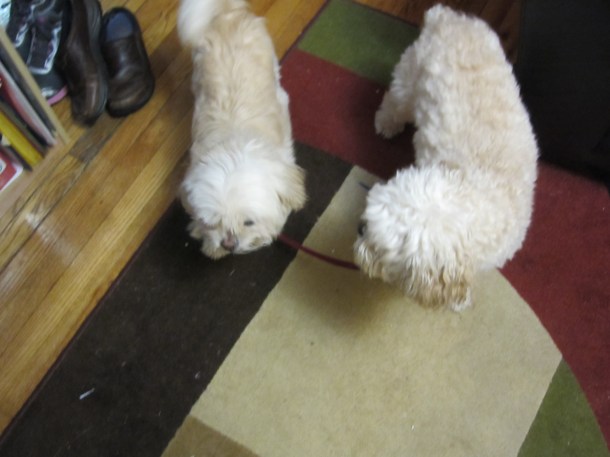
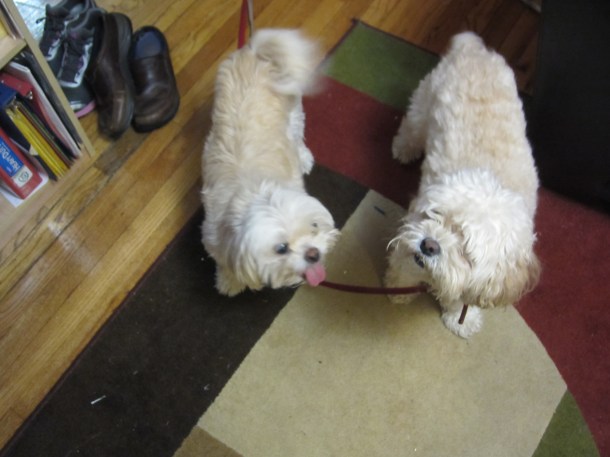
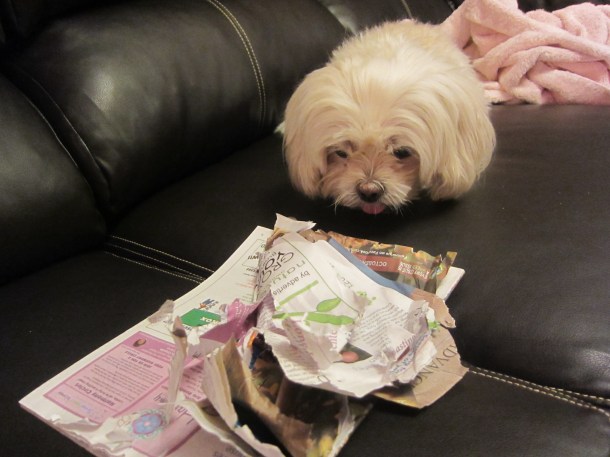
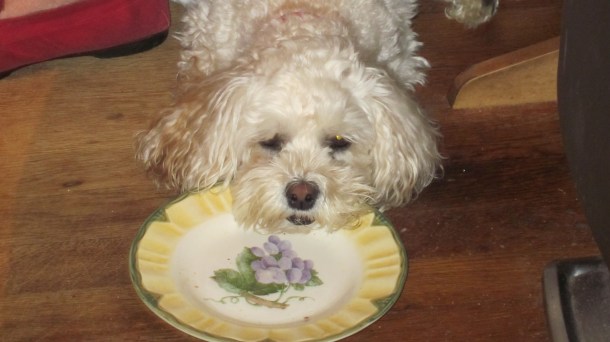
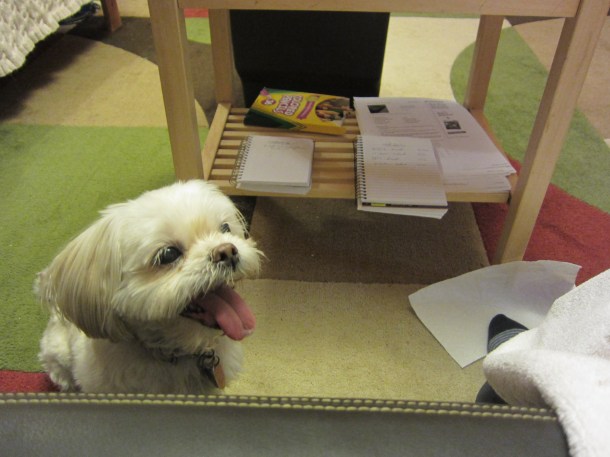
All of this makes me think about how hard it is for humans to say what we mean. In our intention to avoid hurting someone else’s feelings, or to avoid criticism, we often end up being polite, or vague, and therefore, being misunderstood. I love that dogs are direct. I may not always like what they have to say (or when they choose to say it), but at least I know what’s going on with them. Cricket is very clear when she is angry at me for withholding the extra treats she demands. Butterfly is also very direct, and never uses big words. If she barks, it either means she wants to eat what you are eating (and is convinced that Cricket, because she can jump up onto the couch, will have first dibs), or she needs to go outside. If she flattens herself on the ground, she wants to be picked up. If she smiles, it’s because she is actually happy (most likely because food is anticipated). If she licks your hand, she wants to be scratched. If she’s wary, she backs away. If she’s really scared, she shivers (at the vet’s office or during a storm, usually). She’s not vague, or blurry, or sly. And because she’s so clear, her needs are easy to meet.

IMG_1248

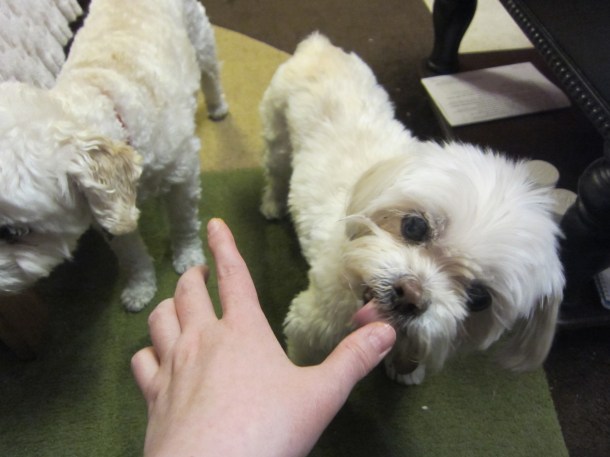
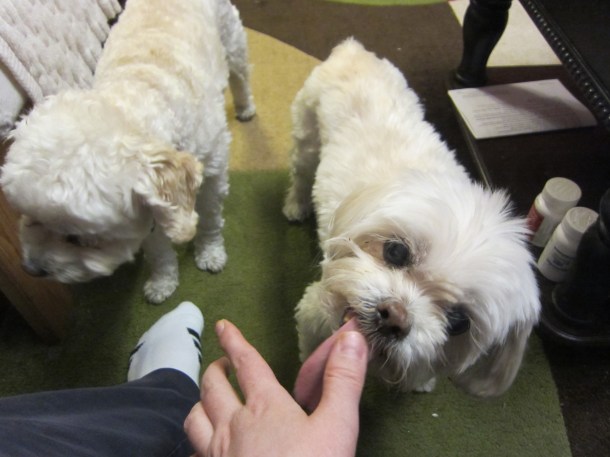
Butterfly wants scratchies!

IMG_0724

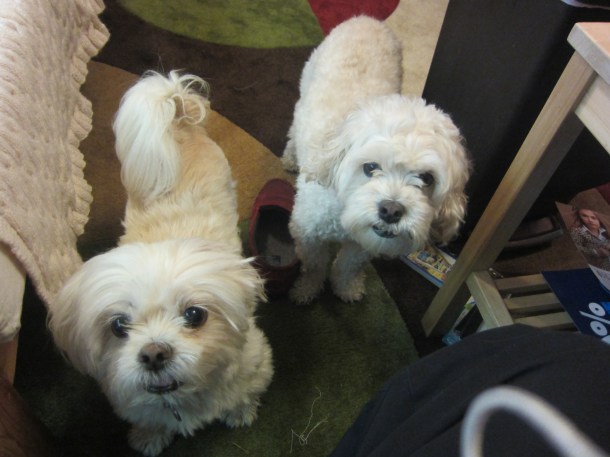
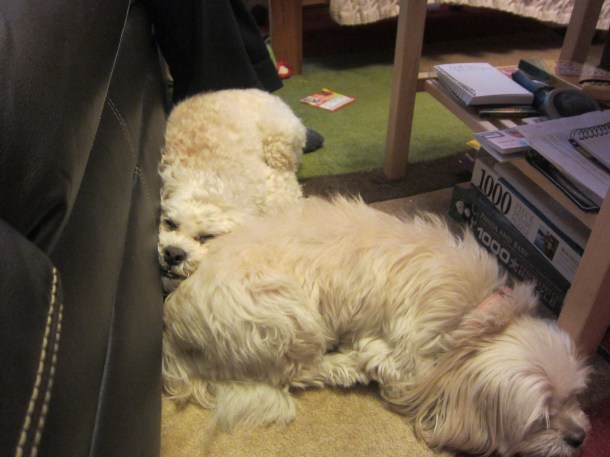
Cricket is grumpy.

IMG_0418

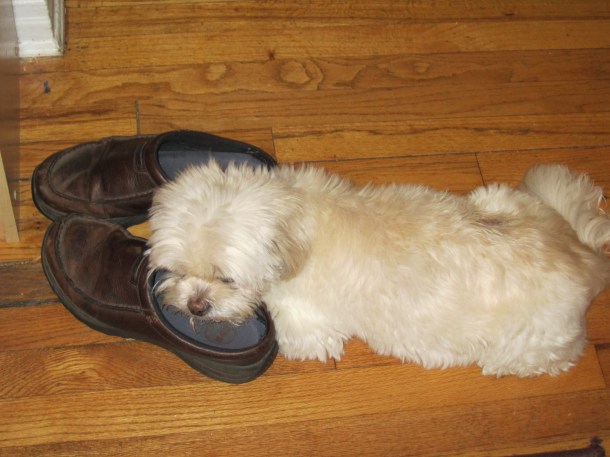
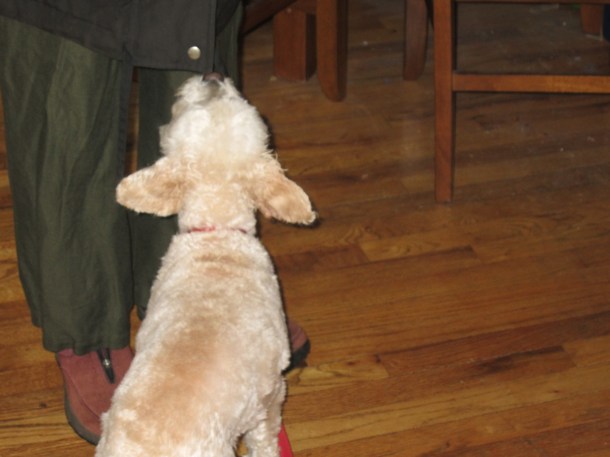
Those are my shoes Butterfly is sitting on. I can’t imagine what she’s trying to say.

IMG_0313

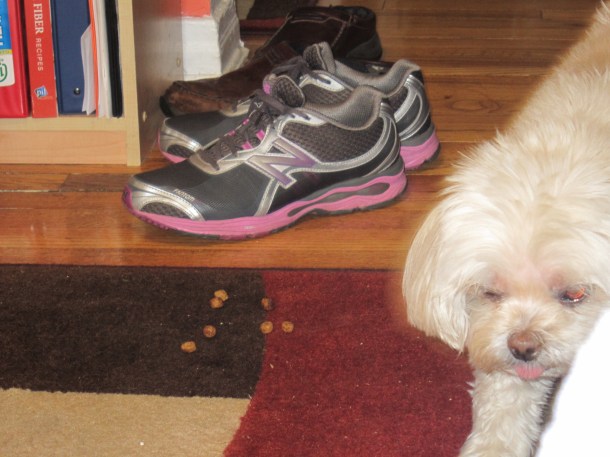
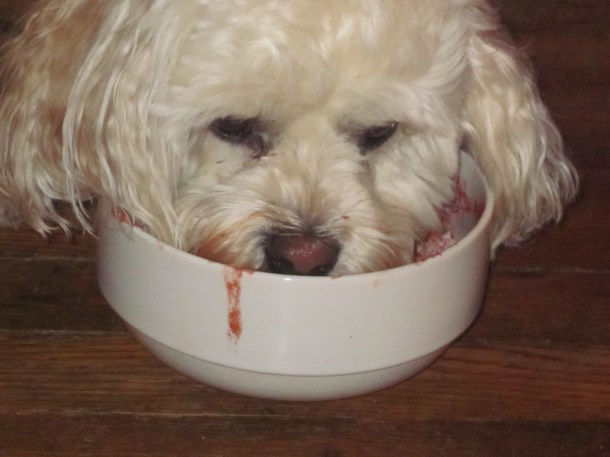
“Feed me!”

A lot of the time, though, people are vague because they really don’t know what they are feeling, or how to express it clearly. I find myself asking question after question of people who think they’ve been clear and clearly were not. I’m often in the position of wanting to scream, “What the @#$% are you trying to say?!” But I rein myself in. Mostly. I will try to ask a question or two, or ten, to help them get to their point. Sometimes they do not realize that they are wandering, or being unclear. Sometimes they are as frustrated as I am, and believe that I should just understand them without their help. Sometimes they know exactly what they mean, but English is their second language, behind the jargon of their profession, and we both remain un-elucidated.

My rabbi, at times, throws in a word that he assumes everyone knows, like Hapax legamenon – which means, a word that appears only once in a text, like the Bible. He momentarily forgets that we were not all in rabbinical school with him, where that word came up all the time and was so useful! I have an automatic allergy to words like that, because I hated sitting at the dinner table as a kid and being the only one who didn’t understand what was being said, especially after my brother started to study vocabulary words for the SATs. But my rabbi thinks each one of these words is like a jewel, a gift! And he tosses them into conversation with glee. I am considering preparing a glossary for new members of the synagogue with words he uses often, like: prolegomenon, apotropaic, apocopation, merism, inclusio, and, of course, hapax legamenon. He is, in most ways, exceedingly down to earth, but those particular words of his profession just make him delusionally happy.

But, some people use jargon intentionally to keep others out of the club. In certain professions (academics, medicine, and law come to mind), you spend a great deal of your time learning the language of the profession before you can ever be trusted to think your own thoughts. This bothers me. I mean, sure, it’s good to be precise, and when you go into more depth on a particular subject it helps to have vocabulary with you to light up the dark, but does it have to be so alienating to outsiders? To what end?

Cricket understands every word I say, or do not say. She has especially become a master of the ellipsis, so that I can’t even leave the important words unsaid, because she knows I was going to say them anyway. I wonder what she would do with the rabbi’s rabbinical school jargon. She probably wouldn’t let him off the hook, the way the humans do. She would have at least a few more questions for him. He says that dogs can’t come to Bible Study because some congregants may have allergies, or deep-seated fears of canines, but I wonder. Maybe he’s just afraid that Cricket will stand on the table, barking insistently, “but why?!” And he won’t have a handy dandy hapax legamenon with which to answer her.


IMG_0510

“But why?”


Butterfly’s Heart


Butterfly started coughing about a month ago. It was only on occasion and seemed to be in response to her rawhide chews, so I stopped giving both dogs those treats. But the coughing continued; it was a sort of hacking sound, like there was something stuck in her throat and she was trying to cough it up.

005

“Mommy, Butterfly sounds funny.”

I was concerned because it was the one question her cardiologist always asked me when he gave me the results of her twice yearly echocardiograms: has she been coughing? Even if her heart looked the same since her previous visit, he asked about coughing, and I always said no, she wasn’t coughing much. She’d sneeze here and there, or cough when she tried to swallow too much kibble at once, but, no, coughing was not one of her things. He never really explained why he was asking, and after the first three times I stopped asking him.

So when I noticed that she was coughing almost daily, I got scared, and made her an appointment with her regular vet. I thought it could just be allergies, and that I was getting hysterical for no reason, but really, I was afraid her heart disease had progressed.

I’ve worried about losing Butterfly since the first day we brought her home, because not only was she already eight-years-old, but she had a heart murmur they’d just noticed when we adopted her. They hadn’t heard it when they were removing her bad teeth, or excising a lump under her armpit. If they’d noticed the heart murmur, the staff said, she wouldn’t have been out on the floor and up for adoption – she’d have been in a special foster program for heart patients. So I was very lucky that they hadn’t noticed.

IMG_2762

My Lucky Day!

Butterfly’s vet did a chest x-ray that showed no changes to her heart to go along with the coughing, but she said she wanted to try Butterfly on a heart medication anyway, to increase blood flow, and see if that would help. She said that the coughing could be caused by her enlarged heart pressing on her trachea, making it more difficult for her to swallow. But that was just a guess, really. Possible side effects of her new medication would be lowering of blood sugar and listlessness, but I already do blood sugar tests for her diabetes, so it wouldn’t be an extra burden.

Fortunately, or not, there was no significant change in her blood sugar readings, and no sign of listlessness. But, she’s still coughing, three or four times daily in short bursts. She coughs a little bit when she wakes up, she coughs a little bit when she eats, she coughs a little for no reason I can see. Her mood and energy level are still great, though, and she eats and drinks and runs and pees and poops like normal. And she’s loving the twice daily doses of peanut butter. But there’s the coughing.

008

“Peanut butter?”

026

“Yummmmmmmmmmmm.”

We have to go back to the vet and see what she says about the heart medication and the coughing. Maybe we’ll have to try a different kind of medication. Maybe she’ll tell us to redo the echocardiogram before the six month mark to make sure it really is her heart that’s causing the cough. But I’m worried. Butterfly came home as an eight-year-old puppy mill survivor, with a questionable heart, and then developed diabetes within her first year with us, so there’s always been a ticking clock over her head. I make sure to revel in her presence as much as I can and make sure that I don’t miss anything of the life she has left – but I still worry every day, and I picture my life without her as a barren wasteland. I need Butterfly to live to her full expected life span of twelve to fourteen years, but more would be better. She’s at eleven and a half now.

015

My baby.

I’d like to find out that the coughing is something unrelated to her heart, like, maybe she’s trying to learn how to talk and this is the first step, or she’s decided to store kibble in her throat for later, and it’s more difficult than she expected, or maybe it’s just allergies. That would be wonderful.

pix from eos 006


The End of the First Year


I finished my first year of graduate school in social work, but I still feel anxious, as if there’s some assignment I forgot to do. I did not get all A’s this year, for the first time in forever, and that’s been hard to accept. I did all of the assigned work, and more, but there was some essential disjunct between the work required of me and the way my mind works. I just felt at odds with it all year, but not in a self-righteous or confident way, more like, every once in a while they started speaking in a language I couldn’t understand, and I felt like a moron.

It’s not just a question of jargon, where, once I learned what they meant by certain words, I could catch up. It was something in the way they wanted me to think that just didn’t click for me, and I’m scared that this gulf will remain throughout the next two and a half years of school, and then out into the professional world, and I will never feel quite right in this profession.

I don’t know if the dogs noticed that I was in school this year, because most of the work was done online. They can’t tell the difference between schoolwork and the writing I actually want to do. Or if they can, they haven’t told me. The real difficulty, for them, will come in August when I start going to my internship two or three days a week, and I’m not home for their midday walk. Hopefully, Grandma will be home for lunch and they will not notice the difference, but naptime may be delayed and that will, of course, be horrifying.

IMG_0325

“Delayed?”

IMG_0436

“Seriously?”

Now that I’m free to return to my own writing for the summer, though, it feels like I’m jumping off a cliff. Fiction is unfamiliar terrain again, after being immersed in academic writing all year. I’ve heard people call it code switching, when you talk (or write) differently depending on your audience, but I don’t transition easily, and part of me is afraid that if I let myself fall back into fiction this summer, I’ll have to relearn a whole year’s worth of tropes when school starts again in August.

It doesn’t help that I’ve been collecting so many rejections for my writing over the past few years. The rejections, and the reality they laid bare, that my writing could not be relied on as my career, is what led me to social work school in the first place. But being in school feels like I’m validating those rejections, and saying that I never was that good to begin with. And I’m afraid that if I write something I’m proud of, I’ll want to send it out, to literary magazines and agents, and it will be the same horror all over again. I hate that the publishing industry has gotten me so defeated that I’m afraid to write any more novels. I’m angry that I can’t see a way forward, and to protect myself I seem to have shut myself down.

I’ve been working on blog posts, of course, and articles for my synagogue newsletter, which have given me an opportunity to practice my interviewing and research skills, and to get to know people better and offer something to my community. But I want to write novels. I want to be a writer, not a social worker, not a reporter, not a do-gooder. I want to tell MY stories. The gulf, between my social worker self and my writer self, is getting wider instead of smaller, and my resentment at becoming a social worker is growing.

I need to find a way to survive the process of becoming a social worker, because I really do want to help people; I want to hear their stories and find ways to relieve their anxiety and confusion, at least a little bit. I want being a social worker to develop into something (almost) as satisfying as being a dog mom. I mean, sure, I get annoyed when the girls wake me up early from a nap, or bark incessantly and refuse to tell me why, but mostly I feel shaped and calmed by taking care of them. It’s a set of rituals and a relationship that I rarely take for granted, and I rely on them heavily for my sense of self, and structure, and love.


IMG_0995

IMG_0876

The oxytocin rush alone is staggering.


Thin Skin


Butterfly has bumps all over her body. She’s an eleven and a half year old Lhasa Apso, and the doctor says these bumps are normal for her age and breed. One of the bumps is like a tiny pink mushroom growing from her neck. Some of the bumps are small and rounded, above her tail, under her ear, at her hip. But one of the bumps looks like a cauliflower, and it bleeds every once in a while. It may simply be that her taller bumps get nicked when she goes to the groomer, or she scratches them, or bangs them into things accidentally, but from the very beginning, I worried about it. Butterfly’s skin is a light pink, with brown age spots hidden under her white hair, which, along with her bumps, is only really visible when she has a bath and her hair becomes translucent for a moment. I used to count her bumps obsessively before each vet visit, to report on any changes, and find out if this or that one was suddenly going to kill her.

021

Butterfly’s big bump.

The fact is, though, despite her bumps and heart problems and diabetes, Butterfly is pretty hardy. She doesn’t sprain her ankles or tweak her back or whine when she gets her twice daily blood tests and insulin shots, and her feelings don’t get hurt easily. She doesn’t like having her hair messed with though; that’s something she learned from Cricket. She learns a lot from Cricket.

013

“Are we going for walkies yet?”

Cricket is more sensitive. She thinks having the goop removed from under her eye is torture beyond canine endurance. She hears and reacts to every noise in the world. If she eats a little too much, or the wrong thing, it shows up in her digestion and her mood.

010

“Are you talking about me again?”
I have Psoriasis and I am hypothyroid (both since I was a teenager), so my skin has always been sensitive and easily scarred. I have a scratch on my wrist from October that never healed, and just starts to itch out of the blue every once in a while. I’ve read too much of the bible in my lifetime, so I end up feeling like my skin, and my health overall, makes me a leper. But I also, still, have figuratively thin skin to go with the literal kind. If someone tells me that I’m lazy or untalented, I take it to heart. I can build myself back up again, but it takes days or weeks, instead of minutes or seconds, the way it should.

At my last doctor’s appointment, my GP decided to test me for Lyme disease again. I’ve been tested for everything over the years, multiple times. This time around, the preliminary test for Lyme came out negative, but my doctor decided to go on and do the confirmatory test anyway, and that showed that I was positive for Lyme disease in the past, even though I’ve never had a positive Lyme test before, in almost ten years of testing. The doctor wasn’t sure what to make of these results and told me to go to an infectious disease specialist to check it out. I may have dragged my feet and whined a bit, but I went.

In the meantime, my mom went to Google and found that there are mixed opinions about Lyme disease and Chronic Lyme, and the validity of these blood tests, or lack thereof. There’s also, her googling suggested, the possibility that a positive blood test for Lyme, like mine, could be an indicator for some other virus or disease process, as a signal for further testing.

I went to the new doctor, he looked at my blood tests and crossed his eyes and said that he would never have sent my blood out for the confirmatory test, after negatives on the preliminary tests, because of the risk of false positives. He said it five times, in answer to five different questions from me, as if he couldn’t hear me, or had no other answers to give. He said that there was no point in re-doing the test because it would either be negative, or another false positive, because I had no risk factors for Lyme. He had no interest in my medical history, and no curiosity about other possible diagnoses to explain my symptoms.

The fact is, I thought this was a long shot, and didn’t have much hope that a strange doctor would take any of it seriously, but I’m annoyed that I had to go through the motions, just to prove that I’m doing everything possible and not being passive. I am not comfortable with theories that come with no proof at all and seem to be, at best, placebo level positive results (30%), but I’m also not comfortable with the rigidity of western medicine, which prefers to blame the patient when problems can’t be solved, instead of taking on the problem and studying it further.

It’s a relief, instead, to take care of the dogs. When they have symptoms, their doctors believe them, and believe me, and treatments are offered, when possible, and pain and comfort are considered. Maybe, when dogs start suffering from whatever it is I have, the veterinarians will figure out the cause, and treatment, and the doctors for humans will finally take me seriously. But probably not.

010

Harrumph.


My Messy Thoughts


It’s so hard for me to corral my thoughts, sometimes. It feels like I’m picking up shards of glass from the floor and trying to piece them back together again. I can recall, or at least summarize, what someone else has said to me, but my own words dissipate into the air much more quickly. Most of the time, I feel like my memories pop up out of order, but if I can write each thought down when it comes to me, and finish the thought three days later when my brain finally gives me the last few words, I can edit it all into a coherent whole and seem like I know what the hell I’m talking about.

I watched two medical dramas on TV, recently, that made plot points out of people whose hearts were on the wrong side of their bodies. And I thought, huh, consider how many things we assume have to be a certain way, like, the heart has to be on the left, and yet, it doesn’t have to be that way, it just happens to be on the left, and all of our assumptions ensue from there. A lot of brain research has been done to try and locate the specific areas of the brain that control different kinds of thoughts. But what if it’s different in each brain? What if we organize the furniture of our brains as differently as we organize the furniture in our homes?

I have different types of bookcases scattered in different rooms. I have hard copies of every writing project in process (there are a lot of them), because when they are only on the computer, I forget that they exist. I have a particular antipathy towards closed drawers, so I tend to keep everything on open shelves, when possible, because it’s too easy to hide things from myself.

Cricket’s mind is a series of hot buttons. Grandma! Food! Shoes! Mailman! Leash! I picture these areas in her brain lighting up in bright red, and it takes a long time to return to a calm pink color. And when any of the bright red areas are lit up, no other thought is possible. It’s only when her brain is cool and calm that she can use her significant intelligence to manipulate her people again. She has set patterns to follow for how to wake up Grandma (bark, scratch, cry, bite ankles), or how to remind me that it’s time for treats (stare at bag of treats, stare at me, stare at bag of treats, crawl under couch and stare at me with disappointed puppy face). And she has incredible long term memory for faces, and smells, and wrongs done to her.

IMG_1070

Cricket, working her magic on Grandma.

IMG_0502

Cricket, putting on her disappointed puppy face.

I like to watch the way Butterfly sets out her kibble on the floor. She places one piece in front of the bathroom door. She radiates kibble out from her food bowl in a messy half-moon. She sets out five or six pieces of kibble on the rug in the living room, like a set of jacks she’s getting ready to scoop up with her paw. Each kibble gesture represents part of the way her brain is set up. She likes to leave kibble, and unfinished chewies, scattered around the apartment, just in case. “Just in case,” is a big theme for her. When we go out for a short walk, she has to have a snack first, and during, and after, just in case. I can relate to this.

002

Some just-in-case kibble.

IMG_0972

“Mommy, I’ll trade you this sock for a chicken treat.”

I struggle to make the world stand still long enough so I can see it clearly, or see it the same way two times in a row, so maybe all of my obsessive writing is my version of “just in case.” My brain feels like a kaleidoscope at times: chock full of pieces of things all moving around and refusing to organize themselves into single whole. But it can still be beautiful, in its pieces, and being able to see things in new configurations all the time allows me to see more complexity in how each part of me relates to every other part.

009

“Do you know what Mommy is talking about?”

010

“Us!”


The Search For Meaning


At my synagogue, and in the liberal Jewish community at large, there’s been discussion lately about the search for meaning: that the previous generations came to religion for peoplehood and community, and the current generation is looking for meaning. But I don’t know what they mean by “meaning.” Alternately they use words like “spirituality” and “purpose.”

During my latest social work class, I read an article (Wong and Vinsky, 2009) about the use of the phrase spiritual-but-not-religious in social work. Its authors argue that the word spiritual, as we use it, reflects a Euro-Christian, largely Protestant mindset, just stripped of the trappings of religion. The authors of the article come from Buddhist and Jewish backgrounds, and both see spirituality, as they’ve experienced it, as based in the history and community they come from. They feel that when you try to divide spirituality from that history, it loses a lot of its power.

We want to believe that finding meaning in life is an intellectual pursuit, and a solitary pursuit, but usually we are searching because something has been missing from our relationships.

My journey to find meaning in life has been pretty literal. I needed to go through every event and person in my entire life, and find out what the hell happened. Was this person really as mean as I thought, or was I exaggerating? Was I a melodramatic kid, or was my life actually as dramatic as I thought it was? I had to work at organizing and parsing my life, so that the chaos I experienced the first time around could come into focus. I looked for paradigms and frameworks and theories, to help make all of those relationships become clear.

David Brooks recently wrote an article in the New York Times, arguing for the value of covenantal relationships among communities, and societies. With all of the globalization technology has brought, he says, many people have lost the social bonds they used to live by. People live more fragmented and isolated lives than they used to. The idea of a covenantal relationship is that it’s not a choice you make each day, it’s a choice you try to live up to each day. Brooks talks about a social fabric, which resonates for me, because my mom is a quilter, taking scraps from everywhere and sewing them together to make something new, and whole.

IMG_0368

Butterfly is working on a new design.

In a world where we have Tinder, and swipe-left-if-you-like-the-looks-of-him, we forget that relationships are about time and effort. It’s not that you should stick with a synagogue or religion or marriage that is wrong for you, or hurts you. It’s that you should make sure you’re not giving up on a good thing too quickly, or because it requires more input from you to keep working.

IMG_0325

Relationships take work? Or more treats, at the very least.

When both of the rabbis at my synagogue went to Israel for a conference two summers ago, just as the Gaza war began, many of us were holding our breath, wishing they would have stayed home. The conference was a way to give Liberal American rabbis a sense of the current tensions within Israel, between men and women, between ultra-orthodox and liberal, between Arab Israeli and Jewish Israel, and between Israeli and Palestinian. As soon as our rabbis returned, even though it was a Friday night in the middle of the summer, when we usually get twenty people at services at most, the room was filled to bursting with emotions and hugs and delayed fear – and we made meaning together. We brought our offerings into the soup of community and each took home what we could use.

IMG_0105

Where’s MY soup?”

IMG_0208

“I like soup.”

For dogs, meaning comes from their relationships too. They are dependent on their people for food and walks, yes, but it’s more than that. They depend on us for attention and structure and the basic feeling that they matter. We humans like to think of ourselves as independent, and able to take care of ourselves, but it’s a sham. Just ask Cricket. She can have a warm place to sleep, plenty of food, and frequent trips outside, but if Grandma isn’t with her, she becomes deeply unhappy. She can pull herself up to mildly unhappy, by spending extra time with me, leaning against me on the couch, following me from room to room. An outsider might even think she was fine, but that’s because they’ve never seen the absolute joy she can feel when Grandma returns, or the peace on her face when she can fall asleep on Grandma’s lap.

IMG_1829

“Grandma!”

025

“You’re home!!!!”

IMG_0529_1

All better.

Brooks, D. (April 5th 2016). How Covenants Make Us, New York Times, Op. Ed., A27.


Wong, Y. & Vinsky, J. (2009) Speaking From the Margins: A Critical Reflection on the            ‘Spiritual-but-not-religious’ discourse in social work, British Journal of Social

            Work, 39, 1343-1359.


p.s.   Kristina Stanley, fellow author, blogger, and dog Mom, has written The Author’s Guide To Selling Books To Non-Bookstores, which is both a how-to on how to be more pro-active in selling your books, and a good friend spurring you on to more success. Her expertise in this area is hard won, and she wants to share it. We all dream of the perfect writing buddy who’s there with us for the journey and prodding us along the way, well this book is your marketing buddy, giving you advice and encouragement and letting you know you’re not alone.

https://kristinastanley.com/


The Sounds of Spring


Allergy season has been blinding me. I go outside into a fog of loose green flying things, and the dogs take advantage and drag me where they will.

006

Cricket is very proud of herself.

But it’s made me more sensitive to the noises all around me. For example, there is a woodpecker somewhere in the backyard who sounds like he’s using a jackhammer to knock down all of the trees, at seven o’clock in the morning! The woodpecker’s name seems small for the sound he makes. His job is to peck at the wood to find bugs to eat, but I wonder, sometimes, if he’s got a megaphone attached to the side of his beak, to make himself sound more impressive, or maybe woodpeckers really have started to use power tools, just to mess with our minds.

My nose hurts in sympathy whenever I hear that woodpecker, but I’ve never seen him. My idea of a woodpecker is probably distorted, though, because I’ve only ever seen one animated in cartoons, so I may have seen him without realizing it.

woody woodpecker

I have not seen anyone looking like this.

Butterfly loves to stand still and listen to the noises all around her. She’s equally intrigued by a beautiful bird song, the sound of the wind through the trees, and an airplane flying way too low over our heads. The only sound she specifically dislikes is the bus that stops on our corner, and the mechanized female voice that announces each location.

022

Butterfly in listening pose.

There are some odd creatures out in the woods. I don’t know which animal makes the strangled baby noise, but the first time I heard it, I thought it was actually a baby, being strangled, and I looked everywhere to try and find it. There’s also an animal out there with a smoker’s cough, though that could actually be one of my neighbors hiding in the woods, choking to death. I can’t be sure.

I like the swish of the wind and the traditional birdsong, a little tweet here, a little twitter there, but the variety certainly does keep things interesting.

And then there are the two feral cats, Hershey and Gimpy (named by the human residents, not by themselves) who take up zones at opposite ends of the yard and avoid each other religiously. Hershey likes to climb the retaining wall and look down on her fiefdom. Gimpy likes to hide in the manicured bushes and climb through hollowed out trees.

IMG_1050

Hershey, on guard.

One day I saw Gimpy leaning against my mom’s temporary green house (like a pup tent, but for plants) trying to steal some warmth on a chilly day.

The girls have been taking advantage of my frequent need to stop and sneeze. Cricket has been eating extra grass and sniffing extra smells, and Butterfly has been doing her sound meditations, letting the wind curve the sound around her ears in a new way each time.

pix from eos 012

Butterfly listening from another direction.

But at least they don’t seem to mind that I use their poopie bags to collect my used tissues, so that I don’t have to stuff them back into my jacket pocket after use. Maybe they remember that day, early in the season, when I had forgotten to fill my pockets with fresh tissues and had to sneeze into my t-shirt. Cricket looked at me funny when that happened, which is rich, given that she actually eats tissues filled with snot. Harrumph.

IMG_0237

“I can hear you, Mommy.”


Cricket’s Ears


Two weeks ago, on Friday morning, we took the dogs to the groomer for their regular appointment. Butterfly’s hair was turning grey around the ears (she’s a white dog) and Cricket’s eyes were disappearing into a mop of hair. My biggest concern, though, was the hair in Cricket’s ears. I’d asked the groomer to pull the matted hair from her ears, every time, but somehow it rarely happened. So this time, I was insistent. Whatever else you do, I said, make sure to deal with her ears.

When we picked the girls up that afternoon, everything seemed fine. Cricket was flapping her ears a bit, but that seemed reasonable given that they’d not only plucked the hair from the inside of her ears, they’d shaved the mats off the outside too, making her look even more like a little lamb. Butterfly started sniffing at Cricket’s ears almost immediately, but it’s something she tends to do, sniffing Cricket’s ears, nose, butt, etc., for secret messages, so I didn’t take too much notice. On Saturday, though, I noticed that Cricket was still flapping her ears. I managed to feel the inside of one of her ears, for a second, and I felt something hard, as if the skin where the hair had been plucked was scabbed. Cricket wasn’t interested in letting me look more closely, though, and I figured it was probably no big deal.

035

“Mommy, why does Butterfly keep sniffing my ear?”

045

Ears mid-flap.

By Sunday afternoon, Cricket was flapping her ears so much that I thought she was going to give herself whiplash, and then I noticed this strange smell. I wasn’t sure if the smell was coming from Cricket, though. In fact, I assumed there was some food in the garbage can that was beginning to rot.

054

flap flap flap!

052

“Mommy, I think Cricket’s ears are going to fly away.”

On Sunday night, after emptying all of the garbage cans to no avail, I was finally able to look directly inside of Cricket’s right ear, and I saw a ring of brown pus, surrounding livid red skin. My stomach dropped, from the guilt, and the smell, and an incredible amount of anger at the groomer, for doing this to Cricket, and for not telling me what she’d done.

At eight thirty Monday morning, when the vet’s office opened, I called and got an emergency appointment. There was just enough time to wake up everyone before we had to leave (Cricket was sleeping on her grandma’s head, and Butterfly was sleeping-guard next to the bed). Cricket was excited, as usual, to go outside without her sister, and get in the car without her sister, and climb behind my head in the passenger seat. But as soon as we got to the vet’s waiting room, she tried to run back out the front door, and failing that, she hid under the bench. Cricket is a terrible patient. The only part of illness she can handle is taking a pill, slathered in peanut butter. Going to the vet and being man-handled? No way.

We were called in quickly, and the vet took one look at her ears and almost gasped. He’s not really a gasper, by nature, but he came close this time. He had to clean out both of Cricket’s ears, with cotton balls and long Q-tips, and then he gave her a shot to calm the redness, and drops in her ears, all with a muzzle on, because she was not handling the stress very well at all. He asked, twice, if we’d rather have her put out during the ordeal, but, knowing Cricket, I thought she’d be even angrier waking up from anesthesia.

The vet gave us ear drops to give Cricket at home, twice a day, and Mom said, of course we can do that. The vet said that if we couldn’t get the drops in her ears, the second best option was to put something else in her ears (at the office) that would last a few weeks. No, we can do it, Mom said, as she looked at Cricket on the stainless steel table, wearing her muzzle, with her eyes bugged out, and clearly imagined a completely different dog.

017

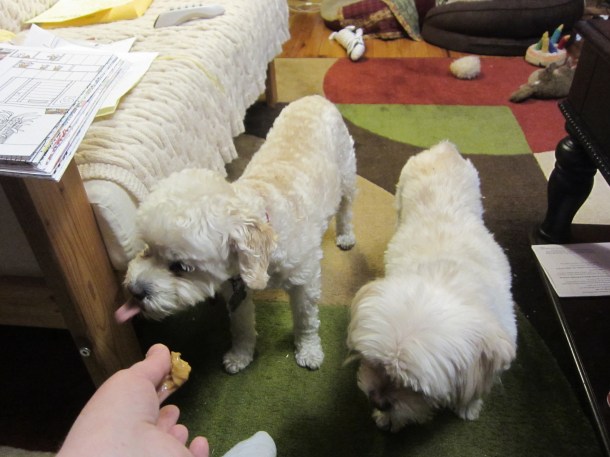
Peanut butter!

020

Peanut butter tongue.

025

“My turn!”

I actually managed to get drops into one of Cricket’s ears, in fifteen attempts, but not in the really bad ear. Cricket bared her teeth at me each time, and swung her head around 360 degrees as if she was possessed by Satan each time I got anywhere near her with the medicine dropper. So we had to go back to the vet, in defeat, the next day, and have him do the second best option. Cricket had to be dragged into the examining room (it’s a good thing the floor is slippery), and then she ran into the corner of the examining room, trying to avoid the reality that she was in the vet’s office, where who knew what horrors could come next. The vet dropped the lotion into her ears in two seconds, before Cricket could build herself up to full hysteria, and then off we went.

The doctor checked Cricket again on Thursday morning, and pulled some more hair out of her bad ear like it was so much fluff. Cricket’s eyes bugged out, and she had to be held still by the vet tech so that she wouldn’t jump off the table, and then the vet told us to come back for one more check-up the following week. I’m not in love with watching Cricket panic as she’s called into the examining room, but I feel like we’re really well taken care of by this doctor, and I wish that we could find a groomer who made us feel the same way. I thought we had, actually. This was the first groomer (after many tries) that Cricket could tolerate long enough to get an actual haircut, and she’s been going there for years.

The thing is, I still don’t understand what went wrong. How come Cricket wasn’t whimpering in pain, or bleeding, right after the grooming? Did they put something on the wound to stop the bleeding and numb the pain, and just not tell us? The other thing is, the scabs were already growing out with new hair in less than a week, and that seems really fast for new growth. The hair inside of the ear is supposed to be plucked at the root, to keep it from growing back so quickly, so, did the groomer shave the inside of Cricket’s ear, and push too hard, shaving off layers of skin?

The vet actually knows Cricket’s groomer and usually trusts her. He said that, from now on, we should come to him every two months to have him remove Cricket’s ear hair, and never let the groomer do it again. I’m sure Cricket will be thrilled when she figures out that she’ll be going to the groomer and the vet on a regular basis for the foreseeable future.

When we got home from the third vet visit of the week, Butterfly had to sniff Cricket all over, to second check his methods and diagnosis, and she seemed satisfied with his work.

I could tell that Cricket was starting to feel better when she scratched her ear against the floor, a sign that her ears were not quite as sensitive anymore. And then she felt so much better that she risked scratching her ear with a paw, though she did sniff the paw afterwards, to check for lingering infection, or just because. She’s like an eight year old boy in a dog costume.


Sitting Shiva


In seventh grade, when I was still new to Orthodox Judaism, the general studies principal at my school lost his mother, and the students were bused, grade by grade, to visit him at his home, where he was sitting Shiva. After the funeral, in Jewish tradition, comes Shiva. Shiva means seven, and the idea is that, for seven days, the mourners remain at home and visitors come to them. Maybe seven days was the limit people could consider taking off from work. Maybe seven days was the limit before people became restless and overwhelmed. If you are very observant, there are countless rules to abide by during Shiva – no shaving, always wear a torn piece of clothing, cover mirrors, sit on lowered seats (boxes are specially made for this purpose), etc. Visitors come at pre-set times, to help make a minyan (ten people) for communal prayer.

It was frightening to imagine that we were supposed to offer comfort to the principal of the school, someone so much more grown up than we would ever be. It was scary just to think of him as someone who might need comfort. And yet, my memory of that day isn’t full of fear and darkness. Somehow, the ritual of the visit, the way we each wished him well as he sat on his low chair and he let us see him be sad, and crying, and smiling too, made the day feel full of light, though it could just be that we happened to be there at the right time of day, so that sunlight was shining in through the windows.

I’ve had to go to a number of funerals and Shiva visits in the past few years, as I’ve become more active in my synagogue and gotten to know the older members. When you make friends with 90-year-olds, funerals become more common occurrences.

A friend of mine lost her father over Passover. His death had been a long process, and in large part she had done her grieving and letting go over the last few years of his life, as she lost pieces of him to illness. The last thing to go was his conviction that he had to stay in order to take care of his wife; that commitment outlasted hunger, even the ability to swallow, by months.

Shiva had to be delayed until after Passover, and then only lasted one day because an unofficial mourning period had already been going on, with friends calling from all over the country for a week. There were so many people at her house that I didn’t know, and I felt out of place and uncool. But then, before the Mourner’s Kaddish, my friend read the eulogy she’d written for the funeral, and as she read it I felt like she was conjuring her father into the room. I could almost see him in the corner, with a bemused expression on his face, wearing his white doctor’s coat and his college tie, and complaining about the driver who cut in front of him on the expressway.

I think that the value of a ritual like Shiva is that it forces you to ask for the things you really need, but maybe don’t think you deserve. When I’m depressed, I lose most of my social skills. But for those seven days, the idea is, your rabbi and friends and family and neighbors are given a schedule for when they can interrupt your isolation. They have a clear mandate to visit you, and bring you food, and pray with you. This is one of the benefits of belonging to a synagogue; there are set practices and communication paths to go by, for everything related to a death in the family, if someone calls and asks what you need, you can tell them. I wish there were more of this for other life events.

There’s a rule that you can’t sit Shiva on Shabbat. If you are three days into Shiva and Friday night comes along, you change out of your mourning clothes and wash and dress and go to the synagogue to say the Mourner’s Kaddish with your community. Maybe the message is that happiness and community will be there waiting for you when you are ready for them, or maybe it’s to remind you that the grief will not last forever, because all around you are people who were in mourning at one time, and now they are singing the prayers and smiling at friends, and one day that will be you too. But I’m not sure if I could bear it, seeing other people’s lives going on all around me, seeing happiness.

Ideally I’d have a sleep over starting from the moment of loss. I’d have people in sleeping bags in every corner of the apartment to help me through every moment. But then I think, if my mom actually died, I wouldn’t be able to host people at all. I’d be curled up in a ball, with Cricket, under the couch. Butterfly would have to take care of both of us.

IMG_0136

Cricket hides under the couch, a lot.


IMG_0707

Butterfly is very good at offering comfort.

008

But paperwork might be too much for her.

Just like there is no sanctioned way to do a Jewish funeral for a dog, or to say the Mourner’s Kaddish for a dog, there is certainly no Shiva for dogs. Right after my last dog, Dina, died, my mother had a long-scheduled trip and had to leave town for two weeks, so I was home alone with the death, in silence. I cleaned obsessively, and having that mindless physical task to do was helpful, but I think I would have liked it if my friends with dogs could have come over and filled the house with their voices, and their dogs’ voices. Maybe I could have offered up the last of Dina’s dog food as a ceremony, or given away the leftover pee pads. But, in the event, I didn’t know how to ask for company, or accept help when it was offered. Maybe if there’d been a set ritual to follow, I could have forced myself to follow it. It would have been such a relief, to tell my Dina stories, and share my grief, and have people all around me who cared that I had lost someone so important to me.


dina smiles

My Dina

DSCF0318

Grandma’s pretty good at offering comfort too.

The Shul Rat


I grew up going to synagogue (Shul is the Yiddish word for synagogue) every week, starting when I was four years old. Mom would drop me and my brother off at junior congregation on Saturday mornings, and then pick us up an hour later to take us to our afternoon activities (gymnastics for me and computers for him). I liked that the service for the kids was only an hour and in a small sanctuary, and that the leader of the services was kind of a kid himself, in his early twenties and doing bible trivia with us and giving out candy for correct answers. There was something special about being there with only my brother and no parents around. It gave us a chance to take ownership of our Judaism, and our synagogue, and not have it be filtered through anyone else, or through a sense of duty.

I also liked that after services we could wander around the synagogue, until Mom got there, and it was like wandering through the White House without supervision. We’d sneak around and make it feel really mysterious and dramatic. The ceilings were high, and the setting was so formal, and everyone was quiet so as not to disturb the goings on in the main sanctuary. There was also something wonderful about having a community outside of my family, and a building to explore. My extended family was not next door, or down the block; we didn’t even have big family dinners more than once or twice a year, so the synagogue was my sense of family.

I liked the older people at shul. They weren’t always warm, but they paid attention and looked me in the eye. I felt like my best self there. At school I was a good student, but got teased constantly. At dance and gymnastics classes, I was barely keeping up and certainly not a star. At home…eh. But at shul, I mattered.

When I was seven, my father started to go to Saturday morning services regularly, and not long after that, my brother and I stopped going to afternoon activities and just stayed for the rest of the adult services with our father. The main sanctuary was a big deal. There was a high ceiling and stained glass windows, and tapestries on the walls, representing the twelve tribes of Israel. I liked the smell of the prayer books, and the hard covers, and the golden type on the cover. I liked that I knew who was a regular and who was new. I liked having a set seat that I went to every time. I loved when the Torah reader, the mother of one of my brother’s good friends, would sing harmonies, and I could sing along with her, and learn from her.


USAKamSyn

My synagogue was not quite this grand, but I can dream.

For special occasions, like an engagement, bags of candy were made up and thrown onto the bima, and the kids ran up to get as much candy as they could reach. I never see this at my current synagogue. Maybe it’s been outlawed because someone could get hit, or someone could miss out on candy. Better to just have a table full of candy to choose from after the service, they think. Phooey.

bags of candy

Bags of candy! (not my picture)

After my father got involved in the synagogue, we started to go to Friday night services, which were a formal affair. Kids came with their parents, and the cantor sang his complex loops of song, and everyone dressed up.  After the service there was a sit down oneg (dessert and talk) in the social hall. Tables were set up in a u-shape, and tea and desserts were set out. There were always non-dairy brownies with chocolate frosting, and I always ate off the frosting and left the brownies behind. Then the rabbi would hit his teacup with his spoon to start the discussion, and the kids would rush out just in the nick of time. The rabbi resented this, and forced his own children to stay put, but the other adults seemed to understand that kids could not sit through a long and boring discussion so late at night, when there was a whole building to explore.

Sometimes we’d end up sitting in the dark, in the far reaches of the building, looking through the toys left out by the preschoolers, or telling ghost stories. Other times, we made up elaborate games that required running through the building, and hiding under benches in the small sanctuary, and even sneaking up onto the bima in the main sanctuary to see what the rabbi kept in his lectern.

033

“Are there toys at shul?”

010

“Or pizza?”

I would have loved to bring Cricket and Butterfly to shul with me, to run through the halls of the building and play tag and have an excuse to laugh and jump and not be so self-conscious. But I never struggled to feel “spiritual” at shul, it was just there, in the building, in the occasion, in me. I wish every kid had a place like that, where God is infused into the walls of the building and doesn’t have to be spelled out; where history is just there all around you, waiting to be discovered.

Cricket would be more interested in searching for the left over bags of candy, but then I’m pretty sure God is in the candy too.

007

“Candy?”

010

“Candy!”