Tag Archives: Hebrew

When Heroes Fly

            I decided to rewatch When Heroes Fly, a fantastic one season Israeli drama (with English subtitles), because I found out that it was about to leave Netflix in January. The first time I’d watched the show was for my online Hebrew class, almost two years ago, with Hebrew subtitles, but it was so vivid and powerful that I understood most of what was going on, despite missing a few words here and there (and everywhere).

            When Heroes Fly follows four guys in a reserves unit who lose their leader in war. Each one deals with the loss, and the trauma of war, in a different way, but the main character, Aviv, truly falls apart. He’s away getting help when his ex-girlfriend, Yaeli, goes on a trip to South America that he was supposed to go on with here, and, it seems, dies in a car accident.

            The mystery that has to be solved, years later, is whether Yaeli actually survived the accident after all, and if so, where is she, and does she want to be found? That’s the frame of the show, but the real drama is in how each of these four men work through their past mistakes and confront themselves and each other.

            What got to me the first time I watched this show was how completely Aviv’s character resonated for me – his inability to heal, despite so much effort and time, and his self-loathing, and how others judged him for being such a mess. His physical expressions of depression and self-loathing, and that sense of truly falling apart – that was me. Even two years ago, after a lifetime of therapy, it all still felt deeply true for me. And yet now, despite grieving both of my dogs, and still having “issues,” and still feeling frightened and incapable at times, I don’t feel that wracking whole body depression anymore. It’s been receding for a long time, but until I watched this show again I didn’t realize how long it’s been since that was my daily, and then weekly, and then monthly experience of life.

            Another thing I relate to, deeply, in this show is how much these friends need each other and yet can’t quite connect or hear each other through the fog of their own trauma responses. We want to believe that if we try hard enough and love hard enough we can fix anything, but sometimes our need to help is the problem, stopping us from seeing the real person in front of us who is in so much pain.

            A new character is introduced late in the series, an Israeli detective with her own deep trauma who has to find the four men and Yaeli as part of a larger case. But she isn’t cut off from her pain, or completely lost in it, she’s strong and broken at the same time. I want to be this woman, this strong, capable woman who is also deeply attached to herself and to reality. I get the feeling that a lot of people think I already am this women. I’m not, yet, but just seeing her on screen makes it seem more possible.

            But the biggest revelation for me in watching this show now is the impact of collective trauma, which goes beyond each individual’s experience of trauma, when they are all experiencing the trauma together. As an American Jew I can try to take an “objective” view on the current war, because my family isn’t running to shelters at any moment as rockets fall, and I’m not grieving a loved one who died in the massacre or was taken hostage, and no one in my family is a soldier in this war, risking their life every day. I am Jewish, but as an American Jew I have the privilege of not feeling the depth of the collective trauma that is tormenting Israelis, and Palestinians, as they try to figure out what happens next.

            When I watch the news and do my deep dives into the history to try and understand what I’m seeing, I still find much of it incomprehensible, because I can’t see it through their eyes; I can’t feel it in my body and know the darkness that prevents clear sight on things that, from here, seem obvious. I keep trying to understand anyway, and I try not to judge the decisions and opinions I can’t understand, because I know that people who are not under the influence of trauma think a lot of things should be possible that people within the trauma can’t fathom and can’t choose.

            Interestingly, while the English title of this show is When Heroes Fly, which suggests that these four men are clearly heroic, as if they are morally unambiguous and selfless and always know what to do, the title in Hebrew is For Her Heroes Fly, suggesting that heroic behavior has to come from somewhere, from some internal motivation, beyond the theoretical goodness and righteousness we keep expecting from our heroes. These are not men with infinite courage and a willingness to die for a cause; these are men who are willing to fight for the people they love.

            People want to believe that Israel only has a right to exist, that Jews only have a right to exist, because we are supposed to be a beacon of light to the nations; and some Jews try very hard to live up to that ideal, but most of us are just people, like everyone else. Requiring Israel to meet standards of behavior that no one else can live up to is unfair and inhumane.     No one gets through wars unscathed, and Israel has had to face war after war, and then terrorist act after terrorist act, throughout her short existence. Israeli soldiers, like all soldiers, are capable of mistakes in judgment and tactics and behavior. When three hostages were accidentally killed by the IDF, Israel had to deal with that reality, because Israel itself has inhuman expectations of its soldiers and its military, just like the world at large seems to have. Israel, this tiny country, with soldiers culled from all walks of life, drafted into service as teenagers, is meant to be a perfect military machine, capable of fighting tunnel warfare without making mistakes and hurting non-fighters, even when the Hamas fighters wear civilian clothes and embed in civilian neighborhoods and buildings. The Israeli soldiers who killed those three hostages, and the soldiers who have killed Palestinian civilians when aiming for Hamas, are all going to have to live the rest of their lives with that burden of guilt and failure, not out of choice but out of necessity, because they have to fight for the survival of their tiny country. The trauma that results will last a lifetime, and will alter everything that comes next.

We, on the outside of all of this, can have whatever hopes and dreams and judgements we want, but it is the people on the ground who will have to make it happen, and that means we have to accept who they are and what feels possible to them, as they carry this war, and every previous war, with them into the future.

If you haven’t had a chance yet, please check out my Young Adult novel, Yeshiva Girl, on Amazon. And if you feel called to write a review of the book, on Amazon, or anywhere else, I’d be honored.

            Yeshiva Girl is about a Jewish teenager on Long Island, named Isabel, though her father calls her Jezebel. Her father has been accused of inappropriate sexual behavior with one of his students, which he denies, but Izzy implicitly believes it’s true. As a result of his problems, her father sends her to a co-ed Orthodox yeshiva for tenth grade, out of the blue, and Izzy and her mother can’t figure out how to prevent it. At Yeshiva, though, Izzy finds that religious people are much more complicated than she had expected. Some, like her father, may use religion as a place to hide, but others search for and find comfort, and community, and even enlightenment. The question is, what will Izzy find?


Another Summer of Hebrew

            I started a new online Hebrew class for the summer, and my new Hebrew teacher is down to earth and clear and friendly, so I am hopeful that the class will be good and productive. But this is going to be my last Hebrew class for a while, because it’s expensive, and with another oral surgery coming up, and the pause on student loan debt repayment ending in August, I need to keep costs down; but also, I feel like I can’t focus on the classes during the school year anymore. I need more rest days, in order to recover from my work days, or else I won’t be able to work much longer.

“You should just stay home with us all the time.”

            I still love learning Hebrew, and I’m hoping that this last class will give me more confidence to continue learning new vocabulary on my own. Maybe I’ll even start writing in Hebrew and see how my voice translates.

            Writing in Hebrew is one of the few things we haven’t worked on in these classes from Tel Aviv, where the focus is on conversation skills and reading newspapers and watching TV. I think I would write poetry in Hebrew, because the language is so conducive to poetry, with all of the rhyming words and onomatopoeia and the leanness of the language overall. I gave up on writing poetry in English after too many discouraging teachers telling me to write like someone else, but maybe with Hebrew I could start again with a blank slate.

            I still want to become fluent in Hebrew, but I think if I take more classes I’d like to move towards Jewish learning in general, rather than Hebrew in particular. The focus in these classes has been on how Hebrew is spoken in Tel Aviv, with very little discussion of things that are recognizably Jewish, rather than Israeli. For me, Hebrew and Judaism are deeply intertwined, but Modern Hebrew has become a secular language, used for every mundane and profound purpose in daily life in Israel, and it feels like, as a result, some of the meaning has been stripped away.

I still want to learn more vocabulary, but I wonder if the words I really want to understand are the ones in the Hebrew Bible, or in the prayers, so that I don’t have to rely on someone else to tell me what they mean. I don’t want to lose sight of Modern Hebrew, and the way it has embraced so many different cultures and absorbed words from Arabic and English and French and Russian and more, I just want to re-invest in the connection to the past, where it all comes from.

I’m still not sure where all of this learning and exploring will take me, or how, or if, I will make use of it in my writing or my teaching, but sometimes learning is worth the effort just for its own sake, for the way it challenges our perceptions and widens our vision of the world and ourselves.

And maybe next summer, or when/if I start feeling better and have more energy, it will lead me to something more.

“Just make sure you take us with you wherever you go.”

If you haven’t had a chance yet, please check out my Young Adult novel, Yeshiva Girl, on Amazon. And if you feel called to write a review of the book, on Amazon, or anywhere else, I’d be honored.

            Yeshiva Girl is about a Jewish teenager on Long Island, named Isabel, though her father calls her Jezebel. Her father has been accused of inappropriate sexual behavior with one of his students, which he denies, but Izzy implicitly believes it’s true. As a result of his problems, her father sends her to a co-ed Orthodox yeshiva for tenth grade, out of the blue, and Izzy and her mother can’t figure out how to prevent it. At Yeshiva, though, Izzy finds that religious people are much more complicated than she had expected. Some, like her father, may use religion as a place to hide, but others search for and find comfort, and community, and even enlightenment. The question is, what will Izzy find?

The Broken Bookcase

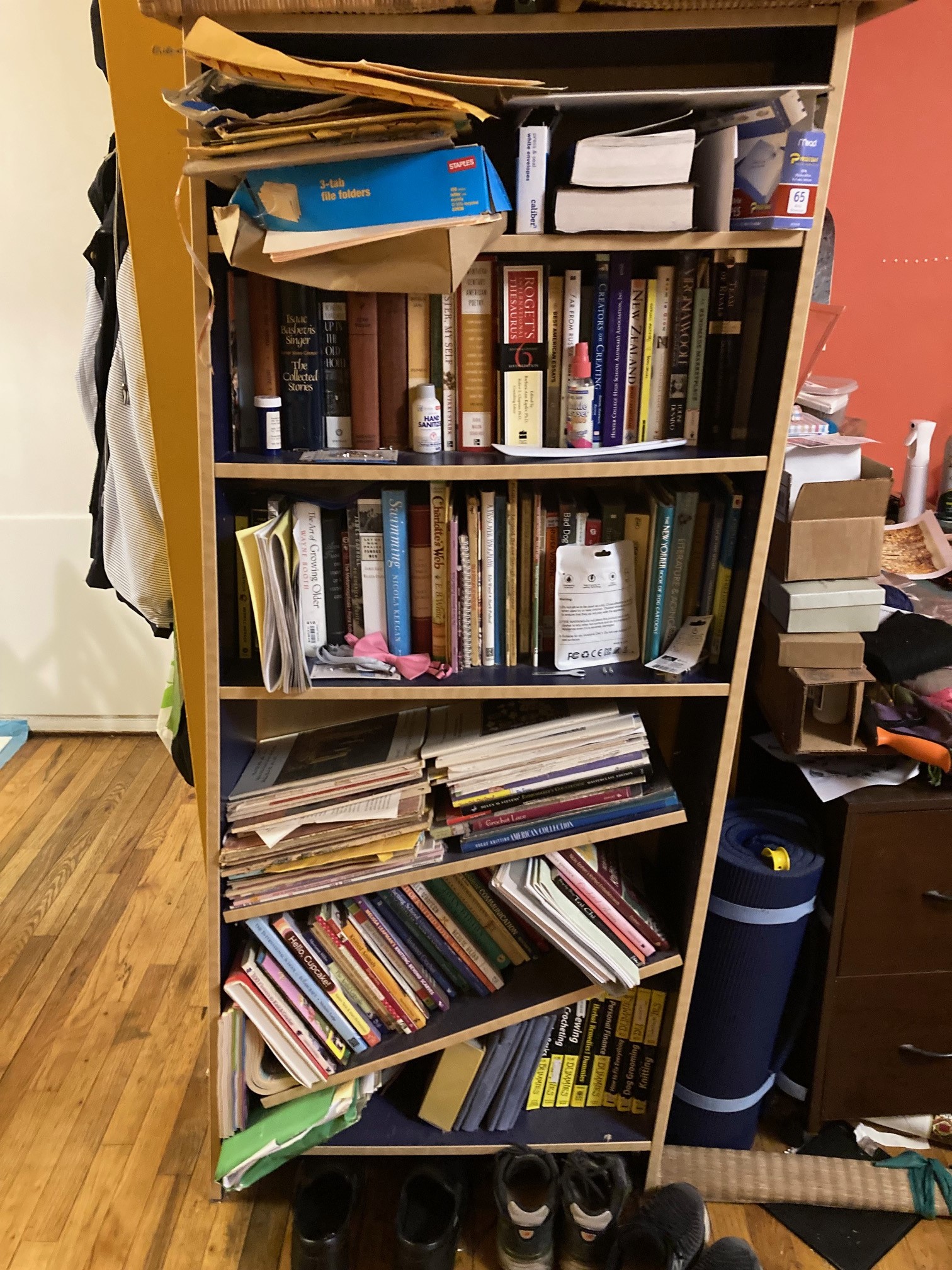
We have a blue Ikea bookcase in the hall that has been tilting for a long time now, but there’s been so much else going on that it never seemed important enough to try to fix it or replace it. We have bookcases everywhere, and I have five in my room alone, so one tilting bookcase didn’t seem like an emergency; until one of the shelves fell, and even then we just put “shelf pins” on the shopping list and eventually bought some, and of course, forgot to put them in. And then another shelf fell. And I still can’t be bothered to deal with the damned thing.

The Broken Bookcase

It’s not that a bookcase is such an expensive thing to replace, especially if we get another one from Ikea, its more that we’d have to actually go to Ikea, carry the heavy box to the car and from the car to the apartment, and then put the thing together, oh, and also empty the broken bookcase and take the broken pieces down to the garbage and refill the new bookcase.

I don’t have the energy for any of that, let alone all of it.

I’ve been trying to clear out the “extra books” from my collection for years now (so that we wouldn’t need so many bookcases), by re-reading the books that I’m on the fence about. I’ve already filled two boxes with books I no longer need, but giving books away is harder than you’d think. The library never wants them, and finding a place that wants the books, on the third Thursday of the month, at twilight, still requires carrying heavy boxes of books out to the car. So at this point I still have a box of discarded books on the floor, next to the bookcases, and I still have three shelves full of books to read through. I also have a bad habit of ordering more books all the time.

“She’s going to throw out our toys to make room for books, isn’t she?”

This feels like a metaphor for the way my brain has been lately: overwhelmed with ideas to follow up on, all resting on iffy shelves and waiting for me to start culling through them; but I can’t even think straight enough to do the culling before another ten or twenty ideas pile on. I feel like every day I’m looking at these tilting shelves in my brain, knowing that it’s all going to overflow at any moment, with no idea how to stop it.

I decided to take a break from going to online Hebrew classes for a few months, because I’ve been struggling to stay focused during the classes this past semester, and because the time I spend in those classes and doing the homework for them has kept me from doing other important things on my to-do list. I’m hoping to get back to the classes over the summer, when I have more free time to focus, but I feel the loss of the socializing and the Hebrew already. I still don’t even know what to do with all of the Hebrew I’ve learned so far, or why it’s been such an obsession for at least two years, if not my whole life.

I feel like there’s a path I should be on, and a long term goal I should be working towards, and that Hebrew language learning is part of it; but I don’t know what that goal is. I don’t want to move to Israel, and I don’t particularly want to go back to school full-time to become a translator or a rabbi or a cantor. I would like to go deeper into Jewish education, if I can, working with teens, maybe, as well as with the younger kids, and maybe even doing curriculum development. But I don’t know of a path to get there, and I don’t want all of that to be instead of writing my novels – the notes for which have filled up a bunch of shelves of their own.

I feel like there’s a whirlwind in my brain, pushing me in different directions all the time, keeping me confused and off kilter, and I’m worried that my internal bookshelves are as wonky as the ones in the broken bookcase in the hall, and it will all tumble down at any moment.

My hope is that once synagogue school is over for the year, I’ll be able to concentrate on all of those ideas whirling around in my brain, and organize them, and maybe even choose some to work on. But I’m afraid I’ll be as busy with doctors and tests this summer as I was last summer, without much improvement in my health to show for it, and those wonky internal shelves will just keep tilting.

But I keep slowly reading through my piles of books, and writing down all of my ideas, and sorting and discarding when I can, because this is how I move forward. It’s not especially practical, or fast, but it’s the way my mind works, so it will have to do for now.

“It’s important to just be yourself, Mommy.”

If you haven’t had a chance yet, please check out my Young Adult novel, Yeshiva Girl, on Amazon. And if you feel called to write a review of the book, on Amazon, or anywhere else, I’d be honored.

            Yeshiva Girl is about a Jewish teenager on Long Island, named Isabel, though her father calls her Jezebel. Her father has been accused of inappropriate sexual behavior with one of his students, which he denies, but Izzy implicitly believes it’s true. As a result of his problems, her father sends her to a co-ed Orthodox yeshiva for tenth grade, out of the blue, and Izzy and her mother can’t figure out how to prevent it. At Yeshiva, though, Izzy finds that religious people are much more complicated than she had expected. Some, like her father, may use religion as a place to hide, but others search for and find comfort, and community, and even enlightenment. The question is, what will Izzy find?

Singing the Psalms

            The part-time musical director/rabbinical student at our synagogue decided to do something different for our monthly musical services this year. Usually we would have a Shabbat band, made up of professionals and congregants, set up next to the Cantor, and making the service feel like a rousing concert. But this year, the sanctuary has been set up in concentric circles, with the congregant singers and musicians in the middle and the rest of the congregation spreading out from there. It’s more intimate without the professional musicians, and there’s more of a focus on meditation and silence between the songs. And, maybe most important, the new songs we learned for these services were from the Book of Psalms, excerpted and used like chants, with lots of repetition and rhythm.

            It’s been an interesting experiment, especially for me as one of the singers, because it’s made me feel more like a participant in making the music, instead of an observer on the sidelines. And it feels really good to sing again, even though I’m still struggling with my breathing. It feels good to be a part of a whole group making music together.

“But we want to sing too!”

            The Psalms have always been a part of the traditional Friday night service, but we haven’t always sung them at my synagogue, and certainly not all six of the Psalms that are included in the prayer book as part of Kabbalat Shabbat (the Welcoming of Shabbat, or the warm up before the official evening service).

We studied the book of Psalms a few years ago in Bible Study, but I don’t think I paid a lot of attention. I was probably still in graduate school for social work at that point, and struggling to pay attention to anything other than school, but I do remember the Rabbi saying that many of the Psalms are “macaroni songs,” or songs that can easily be sung to different tunes, and that opens them up to many different musical interpretations that can give a whole new energy to familiar words.

“I like macaroni!”

            The Psalms, as opposed to most of the rest of the Hebrew Bible, were created to be sung by the Levites in the Temple in Jerusalem. Some of the Psalms even tell you which instruments you should play to accompany them. The Greek word Psalmos means “a song accompanied by a stringed instrument,” and the Hebrew word for the Book of Psalms is Tehillim, which means “songs of praise,” though not all of the Psalms are about praising God. There are one hundred and fifty individual Psalms, and some are communal laments, and others express individual grief and anger at God, and some are thanksgiving and praise songs, but the value of the Psalms is that they give voice to a range of emotions, like joy and fear and rage and gratitude, and they appear in daily and weekly Jewish services, and holidays and funerals, because they can help us to express things when we have no words of our own.

            The Psalms used for Kabbalat Shabbat on Friday night are Psalms 95-99, plus Psalm 29, and there are a few versions that I really like:

            (From Psalm 96) Shiru L’Adonai by Nigunim Ensemble https://youtu.be/yM6_49gQmXw

       (Also from Psalm 96) Ya'aloz Sadai by Nava Tehilla https://youtu.be/QwGksNJixtc
       (From Psalm 98) Zamru L’Adonai by Nava Tehila - https://youtu.be/XQe7vqnCZmU
 

            One of the Psalms we sang all the time, without realizing it was a Psalm, was By the Waters of Babylon. I think we first learned it to sing at a school concert, or maybe at camp, but I knew an English version and a Hebrew version and only in my research for this essay did I realize it came from Psalm 137: By the waters of Babylon, there we sat, sat and wept, as we remembered Zion. It’s a communal lament at the loss of home after the first Temple in Jerusalem was destroyed and the Israelites were exiled to Babylon. We always sang the first lines, but the Psalm goes on to another saying we learned in school: If I forget you, or Jerusalem, let my right hand wither. It always sounded so strange to me, especially on it’s own, because I was clearly an American kid, not longing to go anywhere else, and yet I was supposed to feel so guilty at not longing for Jerusalem that I would lose my right hand. And I’m a righty, so it bothered me a lot. The Psalm also includes a revenge fantasy against the enemies of Israel, and we can read it as literal – that we want to kill those who wronged us or took things from us, or we can read it as a moment of catharsis, to get our yayas out, that is not meant to be acted upon. I guess we get to choose how we read it, like a choose-your-own-adventure story. But the song I learned as a child focused only on the grief, not on the guilt or the desire for revenge, and I wonder if we excerpt these Psalms as a way to avoid the more complicated parts of who we are and how we feel, or the more complicated parts of peoplehood, so that we can just focus on the joy for a little while.

            But the Psalms are everywhere, not just in the Friday night service, and I never really noticed them before. I don’t think we studied the book of Psalms, either in elementary school or high school, probably because we were saying them daily in our prayers and our teachers assumed we knew them and understood them already. But we didn’t. Or, I didn’t.

               Psalm 137- Waters of Babylon by Don McLean - https://youtu.be/uTnspbSjKVc
               Psalm 137 - By the Waters of Babylon by Joey Weisenberg https://youtu.be/24SJuRGPpTI

            The Psalms can also be downright hopeless at times, like Psalm 90 – We spend our years like a sigh; the span of our life is seventy years, or given the strength, eighty years, but the best of them are trouble and sorrow, they pass by speedily and we are in darkness. It’s depressing, sure, but it’s also a chance to acknowledge the dark places in our lives, and in our world, and show them to God, and ask God to care that we are suffering, and, most importantly, to give ourselves permission to care that we are suffering.

“Hey! I suffer too!”

            The most famous Psalm I know of is Psalm 23 – The lord is my shepherd I shall not want. Yea though I walk through the valley of the shadow of death, I will fear no evil, for you are with me. I like to think of it as an aspirational Psalm, a Psalm describing how we want life to be and to feel. It’s phrased in the present tense, as if all of these good things are already here, and I am already comforted, and I already feel safe, and will only experience goodness and love from now on. But I think the idea of a prayer like this is to help us hold onto a vision of a better world, even when that’s not how things are for us right now, which is why it’s often said at funerals. I found a really beautiful version of this one, in Hebrew and English, by one of the Jewish-male-acapella groups who usually sing silly holiday songs to the tunes of popular American music.

            Psalm 23 – Gam Ki Elech – Six13 –  https://youtu.be/bezjJbBkWkg

            But along with the pain, the Psalms can also teach us how to celebrate when things go right, and how to express our gratitude for answered prayers – not because we’re ungrateful creeps who wouldn’t thinking to say thank you on our own, but because celebration and expressing gratitude is just as cathartic as expressing doubt and pain and anger. These Psalms allow us to feel like what we feel and say and do in the world has inherent value, not just to us but to God, who is our clearest personification of the world at large.

            The last of the one hundred and fifty Psalms is Hallelujah and it’s all about praising God, here and there, for his acts and greatness, with horn and lyre and dance and lute and pipe and cymbals. There are a lot of beautiful versions of this one, but I picked two of my favorites.

            Psalm 150 – Halleluya – by Nava Tehilla - https://youtu.be/RV3xV9NJgss
            Psalm 150 – Halleluya – by Nigunim Ensemble - https://youtu.be/ngybRjtv-dk

            Some people learn best through reading, or doing; I learn best through music. So getting the chance to hear the Psalms, and feel them, through music, finally made them seem like more than just words on a page. My hope is that even when we go back to the rowdier version of musical services at my synagogue next year, we can keep the new takes on the Psalms, and add more as they are created, because each new variation seems to capture another feeling that I didn’t notice before, adding more joy and insight and space without ever taking anything away.

Some more songs I love that are taken from the Psalms:

Psalm 92 - Tov L'Hodot by Joey Weisenberg - https://youtu.be/cXwoXKDDGmw

Psalm 118 – Min Hameitzar by Deborah Sacks Mintz – https://youtu.be/EMe4-ggSkdY

Psalm 121 – Esa Einai by Nefesh Mountain – https://youtu.be/aLTt2HytfXQ

“Can you please turn the music down? We’re trying to sleep over here.”

If you haven’t had a chance yet, please check out my Young Adult novel, Yeshiva Girl, on Amazon. And if you feel called to write a review of the book, on Amazon, or anywhere else, I’d be honored.

            Yeshiva Girl is about a Jewish teenager on Long Island, named Isabel, though her father calls her Jezebel. Her father has been accused of inappropriate sexual behavior with one of his students, which he denies, but Izzy implicitly believes it’s true. As a result of his problems, her father sends her to a co-ed Orthodox yeshiva for tenth grade, out of the blue, and Izzy and her mother can’t figure out how to prevent it. At Yeshiva, though, Izzy finds that religious people are much more complicated than she had expected. Some, like her father, may use religion as a place to hide, but others search for and find comfort, and community, and even enlightenment. The question is, what will Izzy find?

All Those Cooking Shows

            I’ve been watching a lot of cooking shows lately (mostly in Hebrew, as language practice) but I haven’t been doing much cooking, to Cricket’s great frustration. I am a messy cook, and as I chop, many pieces of red pepper and carrot and sometimes even chicken land on the floor right in front of her, where she is, conveniently, waiting. Instead, I am microwaving frozen meals, and all she can do is fight with her sister for the leftover sauce in the bowl (Cricket always wins).

“It’s all mine!”

            It’s not that the cooking shows aren’t inspiring. In fact, I feel like I should be making long lists of ingredients to search for, and printing out recipes for Shakshuka with eggplant and Kibbeh, or five kinds of Chummus, and instead I’m eating oatmeal for breakfast, and peanut butter and jelly sandwiches for lunch, and anything I can warm up from the freezer for dinner (unless I’m lucky and Mom does the cooking, but she is not a messy cook, sorry Cricket).

“Harrumph.”

            I should at least be ordering out from Wild Fig (a Turkish restaurant with multiple locations nearby), or buying readymade Falafel or Bourekas from the international supermarket, but I’m not doing either one, and I’m not sure why.

            My first theory for why I was struggling was that most of the recipes, like the shows, are in Hebrew and measure in grams, which makes them largely incomprehensible. So I went online to look for similar recipes in English and found a treasure trove on Jamie Gellar’s site (she’s an orthodox, kosher cook who covers a wide range of styles of cooking, including Israeli).

But now I have a pile of new recipes that I have no energy to make.

            I don’t think it’s depression that’s holding me back, if only because once I take my afternoon (or morning) nap my moods are pretty good, even if my energy level still stinks. But there’s something about knowing how little energy I’m likely to have tomorrow, or next week, that has changed my calculations for what kinds of plans to make, if any.

“Plan to take a nap.”

            I’d like to believe that I’ll be able to do some cooking over the summer, when I won’t need all of my energy for teaching, but there’s also a long list of writing projects and exercise goals and doctor visits and household tasks that I need to catch up on over the summer, and even then, we don’t have air-conditioning in the kitchen to make it bearable, just a fan that tends to read between 80 and 95 degrees all summer long.

But I keep watching these cooking shows and wishing I could just walk down the hall to the kitchen and make an Israeli salad, or bake my own pitas on the top of the stove. I need to believe that something will improve soon so that I’ll be able to use all of this inspiration to actually make plans and follow through on them, or else I’m afraid I’ll get so stuck in my reality that I’ll forget how to hope for more.

Some links:

From Jamie Geller – Machane Yehuda Recipes (in English) (10 min.) https://youtu.be/lgjdy7VQJ0I

From Piece of Hebrew (with English subtitles) A SABICH recipe (14:18) https://youtu.be/nY29TRUh_MY

From Anachnu Al HaMapit with chef Michael Solomonov in Philadelphia (mostly in English with Hebrew subtitles) (53:15)https://youtu.be/EH-WpezAOTg

If you haven’t had a chance yet, please check out my Young Adult novel, Yeshiva Girl, on Amazon. And if you feel called to write a review of the book, on Amazon, or anywhere else, I’d be honored.

            Yeshiva Girl is about a Jewish teenager on Long Island, named Isabel, though her father calls her Jezebel. Her father has been accused of inappropriate sexual behavior with one of his students, which he denies, but Izzy implicitly believes it’s true. As a result of his problems, her father sends her to a co-ed Orthodox yeshiva for tenth grade, out of the blue, and Izzy and her mother can’t figure out how to prevent it. At Yeshiva, though, Izzy finds that religious people are much more complicated than she had expected. Some, like her father, may use religion as a place to hide, but others search for and find comfort, and community, and even enlightenment. The question is, what will Izzy find?

Piece of Hebrew/Piece of French

            I recently found a YouTube channel called Piece of Hebrew and I’m a little bit addicted. I’ve been making YouTube lists for everything lately, for videos about Jewish history and Israel for the teenagers at my synagogue, for guided meditation and exercise videos for me, for Hebrew language shows of all kinds for me (and for any of my students who eventually want to improve their Hebrew). And each time I find one good thing, I find ten more that are sort of on topic, or not really, like videos to add background to my Jews around the World curriculum (there were a ton of virtual tours during Covid), and videos to help people plan trips to Israel (I found a really good Israeli tour guide whose videos are helpful and entertaining), and, of course, as soon as we watch a new show in my online Hebrew class I have to go to YouTube to see if I can find more episodes (there’s a great series about Israeli chefs in cities around the world and a bunch of the episodes are on YouTube, with Hebrew subtitles).

“We’re never going outside again.”

            So, somewhere in there I found the Piece of Hebrew videos, hosted by an Israeli Hebrew teacher named Doron, where he talks about Israeli musicians and TV shows and movies, all in Intermediate level Hebrew with English subtitles. And then I watched some episodes that included Elsa, his live in girlfriend who made Aliyah to Israel four years ago from France and became fluent in Hebrew, and then I found out that she has her own YouTube channel called Piece of French, which is in intermediate and advanced French and all about her life in Israel, and in France, and on vacation, and with her family.

            So now I have five or six pages of links to videos, all of which I want to watch right now. Part of the fun is getting to know the two of them and their dog, Bilhah, and how they met, and how and why they started their channels, and then what their lives are like in Israel on a daily basis: with videos on gardening and shopping and camping and whining about random things, all in French or Hebrew, with English subtitles.

“Does Bilhah bark in Modern or Biblical Hebrew?”

            My current online Hebrew teacher was even mentioned in one of Doron’s videos, listing his five favorite Israeli female singers, which probably encouraged me to watch more videos early on, now that I think about it.

            Of course, now I feel like I’m way too far behind in my French, much farther behind than I thought I was, and I worry that I’m not far enough ahead in Hebrew either, and I should be watching these videos for hours every day to improve. And I’m already overwhelmed with my actual work, and trying to figure out how to get everything done between naps, which is probably why I got so deep into the YouTube videos in the first place, because I could watch them on my phone, lying down.

“We love nap time.”

            It’s so nice that the world has adapted to my chronic exhaustion by providing so much passive entertainment, but I wish I could be well enough to actually go to France and Israel (and Italy and Spain and Japan…) and see everything firsthand. Especially the food. I’d really, really like to taste all of the food for myself.

“Me too!”

If you haven’t had a chance yet, please check out my Young Adult novel, Yeshiva Girl, on Amazon. And if you feel called to write a review of the book, on Amazon, or anywhere else, I’d be honored.

            Yeshiva Girl is about a Jewish teenager on Long Island, named Isabel, though her father calls her Jezebel. Her father has been accused of inappropriate sexual behavior with one of his students, which he denies, but Izzy implicitly believes it’s true. As a result of his problems, her father sends her to a co-ed Orthodox yeshiva for tenth grade, out of the blue, and Izzy and her mother can’t figure out how to prevent it. At Yeshiva, though, Izzy finds that religious people are much more complicated than she had expected. Some, like her father, may use religion as a place to hide, but others search for and find comfort, and community, and even enlightenment. The question is, what will Izzy find?

The New Hebrew Semester

            I’ve been in the same online Hebrew program from Tel Aviv for more than a year now, but each semester feels like a new experience, with new challenges. For the first session of this semester, back in late October, our new teacher spoke quickly and mostly in Hebrew, only clarifying a few words in English here or there, and yet, I was able to follow most of it. A year ago I would have been lost and intimidated and now I’m not. I’m still not fluent, but I’m much closer.

“Mazel Tov.”

            One of the obstacles to overcome each semester is the renewed feeling that I’m the worst student in the class and have the least interesting life and the least impressive resume. My teachers keep telling me that I’m underestimating my fluency, but I’m the one inside my head, grasping around in the dark even for the words I thought I knew well. I do fine with homework and conjugations and vocabulary, but making conversation is hard enough for me in English, with all of my social anxiety, it’s that much harder in Hebrew, with the words endlessly trying to escape from my brain. Generally it takes me a few weeks to remember that everyone in the class is a flawed human being, just like me. I wish I could have mastered this lesson by now, but I guess I should be grateful that it eventually kicks in at all.

I’m still not sure what my goal is in studying Hebrew. Is it about going to Israel for a visit? Or just wanting to learn about Israel in more depth? Is the next step in my journey secular or religious, an activity, or more studying? I just don’t know.

“Don’t go anywhere without me, Mommy.”

This semester we’ve started to read Facebook posts in Hebrew, and other instances of natural Hebrew existing in the wild, to build our reading comprehension, but it has the effect of making me feel like an alien and uncool, now in two different languages.

            One of the new things we’re doing this semester is that instead of watching one TV show from beginning to end, we’re watching single episodes of reality shows (not like “Married at First Sight,” which we watched in a previous class and that I keep trying to wash out of my brain), getting to hear different accents and different vocabularies with each show.

            The first thing we watched was an episode of a show called “Makers,” where a team of creative craftspeople made new hearing aids for a hard of hearing singer, so she wouldn’t have to deal with so much static when she put her headphones on in the studio, and then they created a smart house set up for a pair of born-deaf adult twins who needed help knowing when someone rang the doorbell or when the alarm clock went off. They put light strips in every room, even in the bathroom, and programmed the lights in different colors for each alert: like the phone, or the door, or the sirens telling them to find shelter when rockets came from Gaza. And for one of the sisters who struggled with getting up on time, they attached a light fixture to her alarm clock that gradually grew brighter the longer she ignored it, and then if she was still sleeping, a fan would go on and blow in her face to finally wake her up.

Makers

We also watched an episode of a show called “On the Napkin,” about Israeli chefs, and the episode we watched was about a Japanese cook in Israel, married to an Israeli man for forty years with three adult children, and now she’s serving homestyle Japanese dinners in their dining room/restaurant every night, sourcing tofu and mushrooms and greens from nearby farms.

But the story that really got to me was from a show called “The Recording Studio.” The episode we watched was about a twelve-year-old autistic boy who wanted to record a song for his longtime teacher’s aide. His parents came with him to the studio, but he explained everything himself, telling the host of the show that his aide was so special to him because she’d spent years teaching him how to relate to his non-autistic classmates, teaching him how to speak their language so that he could live in their world and make friends. He said that it would take a degree in psychology to learn the autistic language, so he had to be the one to learn how to understand them. During rehearsals, he not only played piano and sang, he also made sure to communicate as clearly as possible with the host and musicians about what he wanted, and confronted them when they were making assumptions about what he could and couldn’t do, or which truths he could and couldn’t handle.

When his aide finally came into the studio, he hugged her and introduced her to all of the musicians, and then he sang the song with the band, and his teacher and his parents were in tears. It was so clear that she really had set him free from a lonely place, and that she had taught him how to relate to other people and feel connected to them, while still being himself.

Sometimes, out in the real world, I feel like that autistic boy, trying to translate all of my thoughts and feelings into a language other people can understand, and wishing they could speak my language instead, whatever that is. So maybe that’s why I am so drawn to learning languages in the first place, and why I’m working so hard to learn Hebrew in classes full of other people with their own internal languages and stories to share. Hearing about the countries they live in (Israel, Holland, Spain, Belgium, Germany, Italy, Poland, America, Croatia) and the reasons why they want to learn Hebrew (planning to move to Israel, already living in Israel but wanting to speak the language, discovering a Jewish identity, trying to make peace with a Jewish childhood, wanting to talk to Israeli grandchildren, joining an Israeli dance company, or, very often, marrying an Israeli), helps me to feel hopeful that one day I will find the words to say what I mean and, in the meantime, other people will work hard to understand me, just like I work hard to understand them. And the hard work feels worth it, whether I become fluent in Hebrew or not, because the process itself is helping me create connections all over the world, and in my own brain, to help me understand myself.

If you haven’t had a chance yet, please check out my Young Adult novel, Yeshiva Girl, on Amazon. And if you feel called to write a review of the book, on Amazon, or anywhere else, I’d be honored.

            Yeshiva Girl is about a Jewish teenager on Long Island, named Isabel, though her father calls her Jezebel. Her father has been accused of inappropriate sexual behavior with one of his students, which he denies, but Izzy implicitly believes it’s true. As a result of his problems, her father sends her to a co-ed Orthodox yeshiva for tenth grade, out of the blue, and Izzy and her mother can’t figure out how to prevent it. At Yeshiva, though, Izzy finds that religious people are much more complicated than she had expected. Some, like her father, may use religion as a place to hide, but others search for and find comfort, and community, and even enlightenment. The question is, what will Izzy find?

An Israeli Reality Show

            I’m not a huge fan of reality shows. I do watch things like Project Runway and Top Chef, because I like watching what the contestants can create and how they are able to create it, but even the commercials for any of the Real Housewives of Wherever shows or The Bachelor and The Bachelorette make me nauseous. So I wasn’t thrilled when my current Hebrew teacher (in my online language classes from Tel Aviv) said that the Israeli show we’d be watching as a class this semester, to practice our Hebrew listening skills, would be a reality show called Married at First Sight (Chatunah MiMabat Rishon, in Hebrew).

            Oy, God help me.

            The logic behind her choice was that she wanted us to practice listening to how people really speak Hebrew in daily life, with all of the repetitions and slang and run on sentences, as opposed to the scripted Hebrew of the comedy and drama shows I watched (and loved) in previous classes. And I can see her point. But…

            The gimmick of this particular show is that the couples don’t meet until they are under the Chupah (the wedding canopy). There’s a three member team of psychologists who interview the candidates and choose the pairings based on their deep knowledge of humanity, I guess, though they are limited in their choices by who is willing to be on a reality show like this in the first place.

“Are we on a reality show?”

            And then we, as an audience, get to know the future bride and groom and where they work and who their friends and families are, and we watch them trying on wedding dresses and suits and talking to the psychologists, and then the families and friends meet at the wedding venue, and then the bride and groom come out and finally meet each other for the first time under the Chupah.

The wedding ceremony itself is sort of Jewish-wedding-lite, except, they still have the “groom” stomp on a glass (an important symbol meant to remind us of the loss of the first and second temples in Jerusalem, so that even on our happiest days we still remember our saddest days), and even that much feels icky.

            We’re watching the fourth season in class, which means that this show has lasted quite a while, and a lot of people seem to enjoy it. This season was filmed during Covid, so there are face masks here and there, and they probably did a lot of Covid testing behind the scenes, and the only place the couples could go on their honeymoons, outside of Israel, was the Seychelles, for some reason.

“Can we go to the Seychelles? Do they have chicken there?”

            So far, every time one of the brides has been introduced at the wedding, her soon to be groom has been blown away by how beautiful she is, which gets under my skin. The women that are chosen are all thin, of course, and the makeup and hair people are excellent, and the dresses are beautiful too. The guys look a bit more average, though none of them has a beer gut. For me, all of this adds to the ugh-factor, because I am not skinny or perfect, and I don’t have a team of makeup and hair people on call, and I’d still like to believe that someone could fall in love with me, but shows like this keep telling me it’s not possible.

            Following along with the almost-like-a-Jewish-wedding concept, the couple first gets to spend some time “alone” together, with a cameraman, when they go to the Yichud room (the togetherness room) after the ceremony. This is a custom in orthodox, or strictly orthodox, weddings, where the Yichud room is the first time the bride and groom are allowed to be alone together without a chaperone, and therefore finally get a chance to hold hands, or even kiss (there isn’t much time for anything else, but now that they’re married they can do whatever they want). On the show, this really is just a time for the new couple to talk to each other for the first time and exchange small bits of information, like, I have a dog, I have ten tattoos, or I smoke (which, I guess, is still a thing in Israel).

            Then there’s the party, with all of the music and dancing and friends and such, and everyone comments on how wonderful the match is, just to reassure themselves that this whole thing isn’t crazy.

            Then the couple goes to an apartment for the night, to talk and eat and put on their wedding rings and find out where they’re going for their honeymoon (The Seychelles? Oh my God! Who knew!), all filmed by a camera person, or camera people. And then, at some point, the camera people leave and the door is closed for the night. Thankfully.

            So, each week in class, after we’ve watched the week’s episode on our own, we discuss what we liked, didn’t like, didn’t believe, laughed out loud at, wanted to scream about, etc. It’s such a silly show that our conversations about it end up being mostly fun and silly too, though there is quite a lot of backseat diagnosing (because some of the brides and grooms are crazy), and there are always a lot of questions about what the team of psychologists could have been thinking by putting these two people together. Oh, and all of this discussing has to be done in Hebrew.

            Not surprisingly, I can’t relate to most of the people on the show. They are presented to us as the most charming, gorgeous, successful and ambitious people, almost as if they are all the same person, though, clearly, they aren’t. The one thing they do have in common, though, is a willingness to have their intimate relationships recorded and aired in public, which I don’t understand.

I remember how awful it felt when I had to do a sleep study at home, and along with wearing all kinds of monitors I had to keep a video camera aimed at me twenty-four/seven, in case I had some kind of cardiac or neurological event and they needed to see what I was doing when my numbers went wonky. I hated knowing that some stranger might eventually be watching me sleep, eat, or watch TV, though the likelihood that even one person would ever watch a small part of the tape was really low.

“That was a really boring movie.”

            And even if I could tolerate being watched all day and night, I would be deeply suspicious that my “groom” would just be saying that nice/patient/compassionate thing because the cameras were on him and he wanted to look good on TV, and once the cameras stopped the real person would be an asshole and I’d feel like a fool.

            My teacher this semester is a beautiful, young, charming, funny actress/student from just outside of Tel Aviv, so in a way this show fits the energy of the semester overall: lots of silliness and fun, and nothing too deep or serious. She herself, she says, has not been tempted to try out for the show, and prefers making fun of the people who do, which makes her more relatable. She’s always friendly and full of praise for our attempts to speak Hebrew, and never negative or hurtful, but still, part of me worries that this reality show is telling me what real Telavivians are like, and if I go there, which I really want to do, they will rip me apart. Though that could be my old stuff playing up again, from back in elementary school when the beautiful, competitive, well-dressed girls in my class hated my guts.

There’s also the disorienting fact that while this is a reality show taking place in Israel, there is no sense of the politics, or violence, or the social divides between Jews and Arabs and between secular and religious Jews. Even in my lovely, fun, cheery Hebrew class this semester, we still had to talk about the terrorist attack that happened in Tel Aviv recently, where sirens and ambulances and death took over the city for a while. But those things don’t come up on the show, or at least, they haven’t so far.

Hopefully, as the season goes on, there will be a little bit more reality in this reality show, and maybe one or two people I wouldn’t mind meeting in real life. But even if nothing improves on the show, I’m definitely improving my Hebrew listening skills, and learning more about how real Israelis talk when they don’t have a script; which has been reassuring, actually. Clearly I’m not the only one who struggles to find the right words.

“Don’t worry, Mommy. I have trouble with words too.”

If you haven’t had a chance yet, please check out my Young Adult novel, Yeshiva Girl, on Amazon. And if you feel called to write a review of the book, on Amazon, or anywhere else, I’d be honored.

            Yeshiva Girl is about a Jewish teenager on Long Island, named Isabel, though her father calls her Jezebel. Her father has been accused of inappropriate sexual behavior with one of his students, which he denies, but Izzy implicitly believes it’s true. As a result of his problems, her father sends her to a co-ed Orthodox yeshiva for tenth grade, out of the blue, and Izzy and her mother can’t figure out how to prevent it. At Yeshiva, though, Izzy finds that religious people are much more complicated than she had expected. Some, like her father, may use religion as a place to hide, but others search for and find comfort, and community, and even enlightenment. The question is, what will Izzy find?
Speaking Hebrew

            I’m in my third semester of Hebrew classes with the school in Tel Aviv (online), and I’m still loving it. Each semester is ten weeks long, with about a month off in between, and it’s work, but their method lowers the stress level from where it would be in a regular academic class (no tests, short lessons, lots of repetition and variety). And I love that I’m meeting so many different people: from Italy, and Germany, and South Africa, and France, and India, and Australia, and, of course, the United States and Canada. It surprised me, at first, that aside from the fact that we’re speaking Hebrew, and we don’t have class on the Jewish holidays, there’s almost no Jewish content to the class. I don’t even know if all of my classmates are Jewish, because it never comes up. Sometimes I miss the Jewishness I was expecting, but this way I’m getting a real sense of what it must be like to be in a country where Jewishness is so much in the background, and so taken for granted, that it doesn’t need to be discussed.

            My original goal in taking these classes was to overcome my fear of speaking Hebrew, and especially of making mistakes, and I still feel a pinch when I get something wrong in class, or forget something I should have remembered, or lose focus for a second and have to ask for instructions again – but the pinch is so much smaller than it used to be. The accepting, non-judgmental style of the classes seems to be helping to change the wiring in my brain in a way that will, hopefully, translate into the rest of my life as well.

            I keep trying to figure out why I like these classes so much, despite the amount of time and money I’m spending on it that I should be spending on more practical things. I think part of it is that I like getting a chance to meet new people in a controlled environment, where I know what’s expected of me and where the boundaries are. But I’m not sure that that would be enough to push me to take a French or Spanish class, even in the exact same format. There’s a little girl inside of me who fell in love with Hebrew early in life, and she’s reveling in this chance to speak her language.

“Shalom!”

            But maybe my favorite thing about these zoom classes, especially since in-person gatherings have required face masks for so long now, is that my facial expressions are visible. There’s so much of who I am that comes through on my face and it’s been such a relief to be  seen again and to have people say – oh, Rachel doesn’t like that – without my having to say a word!

“Hmm.”

            I’m still – three semesters later – finding stores of vocabulary and grammar that I haven’t accessed in decades. The more I practice, the less time I have to spend rifling through the dusty attic of my brain, with its sticky closets and creaky drawers, for each word I want to say. But I still get anxious when I first log onto the zoom class and the teacher asks each of us how we’re doing and I have to think of a simple, polite answer to the question, in Hebrew. Even in English I would struggle to eke out an everything’s fine, but in Hebrew I feel even more tongue tied.

And yet, given how awkward these opening conversations are for me, it’s ironic, or perfectly reasonable, that I decided to teach my synagogue school students how to have a simple opening conversation in Hebrew. Person one: Hi, how are you. Person two: choose from everything’s fine, very good, and terrible. The kids love saying Al HaPanim (I feel terrible) so that’s been a hit. I love that the kids giggle and smirk when they say it, because that means it will stick with them. And I know from my own experience that there’s such relief in being allowed to say, “I feel terrible,” if only because we are usually expected to say we’re fine when someone asks. And when I explained to them that the literal translation of Al HaPanim is “on the face,” as in “I’m falling on my face,” or “I’m covering my face with my hands because it’s so bad,” they loved it even more. For me, just saying, “it’s on my face,” when my emotions often are right on my face, resonates.

            We’ve also started watching Israeli TV shows for homework between Zoom classes, and it’s exciting to see how much I’ve been able to understand (because even the subtitles are in Hebrew!). The first show we watched was a romantic comedy about the fashion business, and now we’re watching a drama about a group of army buddies with PTSD getting back together to solve a mystery. The TV shows are much more my speed than a lot of the Israeli movies I’ve been able to find, and it’s giving me a better sense of what Israelis themselves might choose to watch.

She has it/The Stylist
When Heroes Fly

            And, as a result, it’s getting more real to me that I may, eventually, be able to visit Israel. Even a few years ago it felt like a dream, or something for my bucket list, but now it feels inevitable. I feel like these classes are giving me the solid ground under my feet that I will need on the trip, in order to really appreciate the experience and not feel unmoored and overwhelmed. I still worry that Israelis won’t like me, because I am too soft, too American, but I’m learning more and more with each class about how Israelis, at least in Tel Aviv, think and speak in real life, and I’m finding that, just like Americans, they are all different, almost like real people.

            In the meantime, I keep practicing my Hebrew, reading slowly through My Hebrew copy of Harry Potter, watching Israeli TV shows and movies, and speaking Hebrew at home, at least with the dogs. They really seem to understand what I’m saying, though they might just be humoring me. It’s hard to tell. They can be especially inscrutable when they’re overdue for a visit to the groomer.

“We don’t need haircuts, and we understand every word you say.

If you haven’t had a chance yet, please check out my Young Adult novel, Yeshiva Girl, on Amazon. And if you feel called to write a review of the book, on Amazon, or anywhere else, I’d be honored.

            Yeshiva Girl is about a Jewish teenager on Long Island, named Isabel, though her father calls her Jezebel. Her father has been accused of inappropriate sexual behavior with one of his students, which he denies, but Izzy implicitly believes it’s true. As a result of his problems, her father sends her to a co-ed Orthodox yeshiva for tenth grade, out of the blue, and Izzy and her mother can’t figure out how to prevent it. At Yeshiva, though, Izzy finds that religious people are much more complicated than she had expected. Some, like her father, may use religion as a place to hide, but others search for and find comfort, and community, and even enlightenment. The question is, what will Izzy find?

Egyptology and Hieroglyphics

            I took two Egyptology classes in college, basically because they fulfilled requirements for my philosophy major and for my honor’s scholarship. One class was on Hieroglyphics and learning how to draw them, and the other was on Egyptian philosophy. I hated my teacher, but it turned out that I actually loved the class where we learned how to draw the Hieroglyphics. There was something magical about seeing the origins of the letters in actual objects, like the ground plan of a simple house is the Hieroglyph for “house,” and an outline of a mouth stands for “mouth,” and a pair of legs in motion means “to come.” But there were also Hieroglyphs of animals, like an Egyptian vulture for the letter A, and a horned viper for the letter F, that hinted at even more meaning to be discovered.

Hieroglyphic translation chart from greatscott.com
“Why so many birds and no pictures of me?”

            The Ancient Egyptian language was written in four scripts, over the course of time. First Hieroglyphics, then Hieratic, (meaning “priestly”) which was a simpler cursive form of Hieroglyphics written mainly by priests, and then Demotic (meaning “popular”) which was a more rapidly written form of the Hieratic script, first appearing in the eighth century BCE and used by the common people, and finally Coptic, which was the final version of Egyptian writing, using the Greek alphabet in addition to seven Egyptian letters representing sounds that didn’t appear in Greek.

            Ancient Hebrew would probably have fit in between Demotic and Coptic, because it was a language that could be written quickly and by the common man, but it wasn’t yet filled out with vowels and spaces to allow for easier reading.

            One of the important differences between ancient Egyptian and ancient Hebrew, though, is that Hebrew continued to develop into what is now Modern Hebrew. Hebrew was eventually given vowels, and spaces, and punctuation to help modernize the language and allow people to read it and speak it more widely. Whereas the ancient Egyptian language stayed in Egypt, ancient Hebrew speakers were exiled from Israel, multiple times, and chose to bring their language, and their religion, with them into the diaspora.

            Despite not liking my Egyptology teacher, I still learned a lot from his class, especially about the influence of ancient Egypt on the development of Judaism. Take for example, the Egyptian belief in magic. In the Hebrew Bible, when Moses goes to Pharaoh to ask him to let the Israelites go, he turned his rod into a snake to show God’s power, but then the Egyptian magicians were able to do the same thing, and Moses had to level up, with the plagues. Was Moses using magic? He was raised by Egyptians after all. The Hebrew Bible is full of magical things, like burning bushes and the splitting of a sea. The magical realism of Egyptian religion and literature definitely influenced the stories in the Hebrew Bible, but then, in the minds of the writers of the Hebrew Bible at least, these acts of God took on a deeper meaning, a poetry, that was beyond magic.

“What’s beyond magic? Is it food?!!”

At the high point of Egyptian civilization there were 2500 gods, with different main gods in charge in different eras, and each god had a place to dwell and a personality and a backstory. And while we think of Judaism as absolutely monotheistic, early on, even though Yahweh was the main God of the Jews, other gods were still acknowledged and worshipped by the Israelites. Prophets eventually came along to yell at the people to stop worshipping other gods and only to worship Yahweh. But even then, Yahweh was considered the god of a particular place. It took exile for the Jews to invent the idea of a god who can travel. When they were exiled to Babylon, after the destruction of the first temple, they realized that they could take their religion, and their concept of God, with them. Eventually, this image of a God who can go wherever you go, became a God who can be whenever and whatever you need God to be. And if your god can be everywhere and anywhere, maybe your god is The God. Period.

            But this transition took a long time, and a lot of wrestling with the gods and ideas of other people and places. Many of the values we think of as particularly Jewish, or Judeo-Christian, were already there in Egyptian writings. One of the most obvious borrowings from Egyptian literature shows up in the book of Proverbs, in the Hebrew Bible. Proverbs is a collection of wisdom literature, addressing morality and good behavior, and is made up of six sections. Each section seems to have been composed at different times, but the third section in particular borrows directly from the Instruction of Amenemope (a piece of Egyptian literature composed between 1300 and 1075 BCE). Some lines are taken almost verbatim and others come very close in their messages, for example: give charity to the poor, avoid the “strange” woman, avoid harmful speech, use fair business practices, and tell the truth. These are all values embraced in Proverbs, and in the Hebrew Bible overall, but in no way unique to the ancient Israelites.

            Somehow, knowing some of the influences on the Israelites, and seeing what they chose to keep and what they chose to change, makes the ancient Jews feel more real to me. They didn’t appear out of nowhere; they were a product of their time, and interacted with the ideas around them. I can relate to that process of sifting, and it gives me more confidence in my own right to reassess their ideas, in order to determine what I believe in, and who I want to be going forward.

“We believe in the power of chicken.”

If you haven’t had a chance yet, please check out my Young Adult novel, Yeshiva Girl, on Amazon. And if you feel called to write a review of the book, on Amazon, or anywhere else, I’d be honored.

            Yeshiva Girl is about a Jewish teenager on Long Island, named Isabel, though her father calls her Jezebel. Her father has been accused of inappropriate sexual behavior with one of his students, which he denies, but Izzy implicitly believes it’s true. As a result of his problems, her father sends her to a co-ed Orthodox yeshiva for tenth grade, out of the blue, and Izzy and her mother can’t figure out how to prevent it. At Yeshiva, though, Izzy finds that religious people are much more complicated than she had expected. Some, like her father, may use religion as a place to hide, but others search for and find comfort, and community, and even enlightenment. The question is, what will Izzy find?